Sir Sandford Fleming: The Visionary Engineer Who Helped Create Modern Time
Introduction
Every day, billions of people around the world organize their lives according to clocks and time zones. Flights depart according to precise schedules, trains cross borders while maintaining coordinated timetables, businesses conduct international meetings, and computers synchronize events across continents. It is easy to forget that the world was not always organized this way.
In the nineteenth century, keeping track of time across different regions was a surprisingly complicated problem. Every town could have its own local time, usually determined by the position of the Sun. When transportation was slow, this caused relatively few problems. But the arrival of railways and telegraphs connected distant cities at unprecedented speed. A difference of only a few minutes between towns could create confusion and, in some circumstances, dangerous railway scheduling problems.
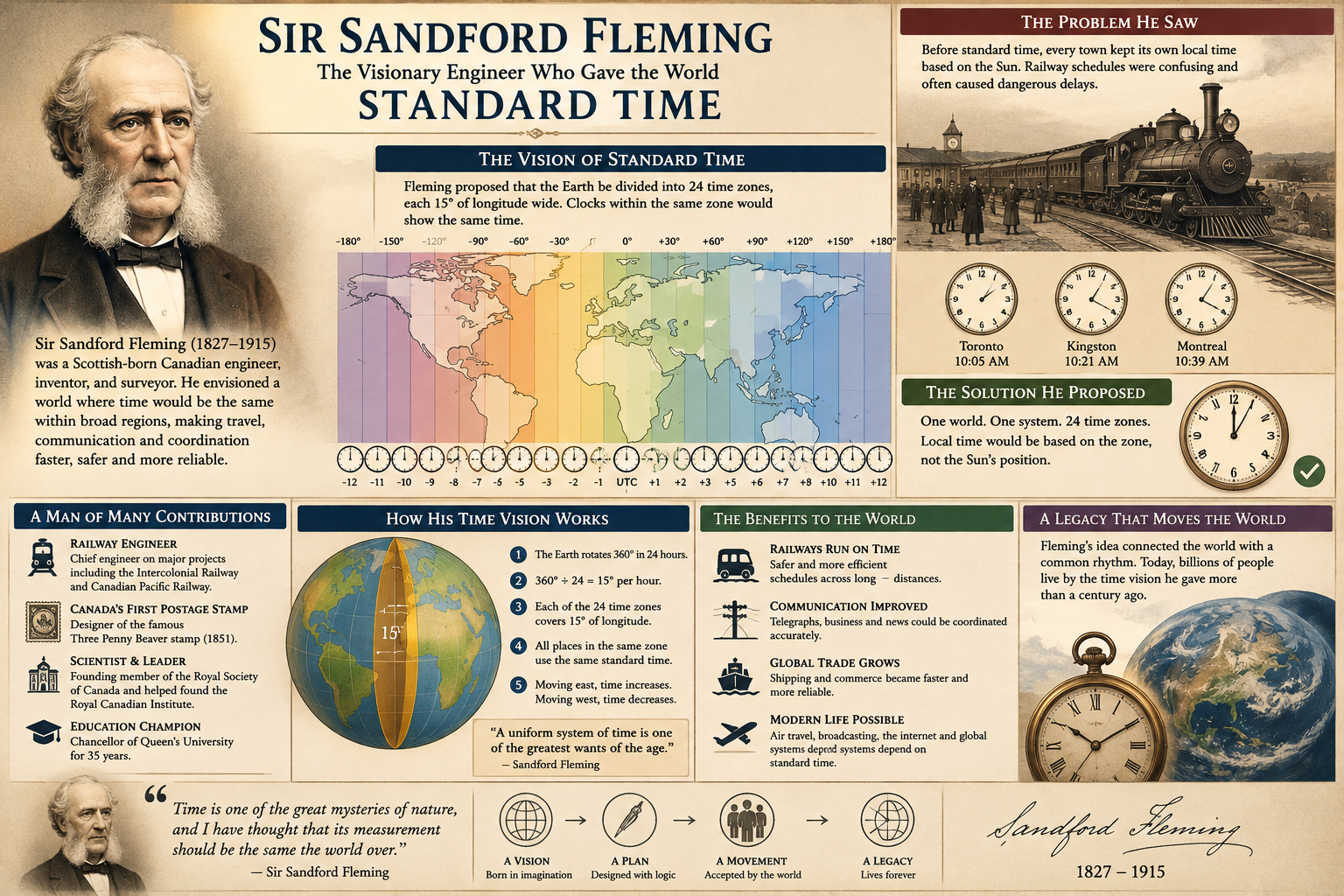
One of the people who recognized the need for a global solution was Sir Sandford Fleming, a Scottish-born Canadian engineer, surveyor, inventor, and visionary. He became internationally famous for promoting a worldwide system of standard time and dividing the Earth into 24 time zones.
But Fleming’s contribution to history went far beyond time zones. He was an important railway engineer, helped develop Canada’s transportation infrastructure, designed Canada’s first postage stamp, supported scientific education, and played a major role in the intellectual development of nineteenth-century Canada.
His story is one of engineering, imagination, persistence, and the ability to recognize a problem before the rest of the world was ready to solve it.
Early Life in Scotland
Sandford Fleming was born on January 7, 1827, in Kirkcaldy, Scotland. He grew up during a period of rapid industrial and technological change. Railways were beginning to transform transportation, steam power was revolutionizing industry, and engineering was becoming increasingly important to modern society.
Fleming developed an interest in mathematics, drawing, surveying, and engineering. These skills would eventually become the foundation of his professional career.
At the age of 18, Fleming emigrated to Canada in 1845. Canada was then developing rapidly, and there was enormous demand for engineers and surveyors who could help build roads, railways, bridges, and other infrastructure.
The young Fleming arrived at an important moment in Canadian history. The country was geographically enormous, and transportation between communities was difficult. Building a modern railway system would become one of Canada’s greatest national projects.
Fleming’s engineering abilities soon attracted attention.
Beginning a Career in Engineering
Fleming worked as a surveyor and engineer during the early years of his Canadian career. Surveying required mathematical precision, careful observation, and knowledge of geography—skills that would serve him throughout his life.
He became involved with railway development at a time when railways represented the future of transportation.
Railways were particularly important in Canada because of the country’s enormous distances. Connecting eastern and western communities required engineering solutions on a massive scale. Mountains, forests, rivers, lakes, and difficult terrain presented major challenges.
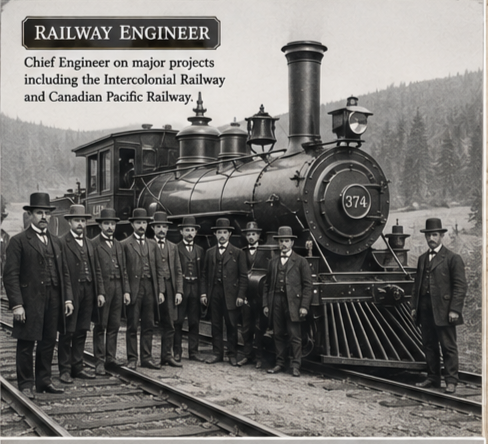
Fleming’s work contributed to the development of Canada’s railway network. He eventually became one of the country’s most respected railway engineers.
His professional career demonstrated an important characteristic that would define his life: he was not interested merely in solving small technical problems. He wanted to think about how engineering could transform society.
The Railway Problem of Time
The railway revolution created a strange problem.
Before railways became widespread, people generally used local solar time. Noon occurred when the Sun was approximately at its highest point in the sky. Because the Earth rotates, however, solar noon occurs at slightly different moments in different locations.
For example, the local time in one town might differ by several minutes from the time in another town hundreds of kilometers away.
This was not particularly important when people traveled by horse or carriage. A traveler might take hours or days to reach another location.
Railways changed everything.
A train could travel rapidly from one town to another, crossing many local meridians during the journey. Railway schedules had to tell passengers exactly when trains would arrive and depart. If every station used its own local time, railway timetables became confusing.
Fleming personally encountered this problem.
According to the famous story associated with his interest in standard time, he once arrived late for a train because of confusion involving the time printed on a railway timetable. Whether every detail of the story is accurate or not, Fleming clearly became convinced that the world needed a simpler system.
He began thinking about time not as a collection of local measurements but as a global system.
Fleming’s Vision of Standard Time
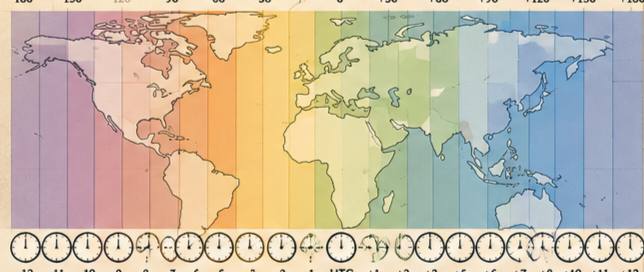
Fleming proposed a worldwide system based on the division of the Earth into 24 time zones.
The basic idea was remarkably simple.
Because the Earth rotates approximately 360 degrees in 24 hours, the globe could be divided into 24 sections, each covering roughly 15 degrees of longitude. Each zone would use a standard time.
This would allow clocks within the same zone to show the same standard time.
Fleming believed that a universal system would make transportation and communication much easier. Instead of every town calculating its own local time, people could use a coordinated international system.
He presented his ideas internationally and became one of the strongest advocates for worldwide standard time.
His proposal was especially relevant to railways, but it also had enormous potential for shipping, international business, communication, science, and everyday life.
The Development of Time Zones
Fleming’s proposal did not instantly become the system used by every country.
Introducing standard time required cooperation among governments, railway companies, scientists, businesses, and communities. People were accustomed to their local solar time, and changing clocks represented a significant cultural and practical adjustment.
Nevertheless, the railway industry increasingly adopted standardized time because it made transportation much more efficient.
In 1884, the International Meridian Conference in Washington, D.C., selected the meridian passing through Greenwich, England, as the prime meridian for international purposes.
The resulting international system developed gradually, and countries adopted time zones at different times.
Although modern timekeeping differs in some details from Fleming’s original proposal, his vision of a world divided into standardized time zones became one of the foundations of the modern global time system.
Today, when someone flies from New York to London, calls someone in Tokyo, or schedules an online meeting with people across several continents, they are using a world organized around the basic concept Fleming promoted.
Railway Engineering and Canada’s Development
Fleming’s achievements were not limited to timekeeping.
He played an important role in Canadian railway development and served as a key engineer on major railway projects.
He became chief engineer of the Intercolonial Railway, a major railway project designed to connect Canada’s Maritime provinces with central Canada.
He also became involved in the development of the Canadian Pacific Railway, one of the most ambitious infrastructure projects in Canadian history.
The Canadian Pacific Railway helped connect the country from east to west and played a major role in Canada’s economic and political development.
For an engineer like Fleming, railway construction involved far more than laying tracks. Engineers had to survey enormous territories, design routes, cross rivers, build bridges, manage difficult terrain, and calculate grades and distances.
Fleming’s engineering expertise made him an important figure during this period of national development.
Canada’s First Postage Stamp
Another fascinating achievement associated with Fleming is his role in designing Canada’s first postage stamp.
In 1851, Canada issued the famous Three Penny Beaver stamp, featuring a beaver.
Fleming designed the stamp’s artwork, helping establish an important symbol of Canadian identity.
The choice of the beaver was significant. Beavers had played a major role in Canada’s early economy through the fur trade and had become an important national symbol.
The stamp demonstrated Fleming’s versatility. He was not only an engineer and surveyor but also had an interest in design and visual communication.
A Scientist and Intellectual
Fleming also contributed to Canada’s scientific and intellectual community.
He helped establish the Royal Canadian Institute, an organization dedicated to science and engineering.
He was also a founding member of the Royal Society of Canada, which promoted scholarship and scientific research.
Fleming understood that a developing nation needed more than railways and physical infrastructure. It also needed education, scientific knowledge, and institutions that encouraged innovation.
His involvement in these organizations reflected his belief that science and engineering should contribute to the progress of society.
Queen’s University and Education
Fleming had a particularly strong relationship with Queen’s University in Kingston, Ontario.
He served as Chancellor of Queen’s University for many years, helping support the university’s development and educational mission.
His commitment to education reflected a broader philosophy: technological progress depended on people being educated to understand and improve the world around them.
Fleming’s legacy therefore belongs not only to engineering but also to education and scientific culture.
The Transatlantic Cable and Global Communication
Fleming also became interested in international communication.
During the nineteenth century, telegraph technology was transforming communication. Messages that had once taken weeks to cross oceans could eventually be transmitted much faster.
Fleming supported the idea of connecting continents through telecommunication systems.
He became involved in discussions surrounding the Pacific cable, which was intended to create a telegraph connection between Canada, Australia, and other parts of the British Empire.
The project reflected Fleming’s belief in a world increasingly connected by technology.
This connects directly with his work on standard time. Railways connected places physically, telegraphs connected them through information, and standardized time helped coordinate these increasingly interconnected systems.
Why Standard Time Was So Important
To understand Fleming’s importance, it helps to imagine the world before standardized time.
Imagine a railway journey passing through several cities. At each location, the clock could show a slightly different local time.
A train schedule might say that a train would leave at 10:00 in one city and arrive at 11:00 in another. But what exactly did 10:00 or 11:00 mean?
The differences might appear small, but railway operations required precision.
A standardized system created a common reference.
The same principle became increasingly valuable for telegraph networks, shipping, international commerce, scientific observations, and eventually aviation and digital communication.
Fleming’s idea was therefore much larger than simply changing clocks. He helped society think of time as a coordinated global resource.
Recognition and Knighthood
Fleming’s achievements eventually received international recognition.
In 1897, he was knighted by Queen Victoria and became Sir Sandford Fleming.
By this time, he was widely respected as one of Canada’s leading engineers and public intellectuals.
His career demonstrated how engineering could influence an entire nation.
He had helped develop transportation infrastructure, promoted scientific education, contributed to Canadian culture, and proposed an idea that would eventually influence the entire world.
Fleming’s Later Years
Fleming continued to remain active in public and intellectual life during his later years.
He lived through an extraordinary period of technological transformation.
When he was born in 1827, railways were still in their infancy. By the time he died, modern railway systems crossed continents, telegraph networks connected distant countries, and international standards for time were becoming increasingly important.
Fleming died on July 22, 1915, in Halifax, Nova Scotia.
He left behind a legacy that reached far beyond his profession.
The Modern Legacy of Sir Sandford Fleming
Today, most people do not think about Sir Sandford Fleming when they look at a clock.
Yet his influence is visible every day.
Time zones are essential to international travel. Airlines depend on standardized time. Global financial markets operate according to carefully coordinated schedules. Television broadcasts, sporting events, international meetings, computer networks, and online services all depend on accurate timekeeping.
Even when people complain about jet lag after crossing several time zones, they are experiencing a system whose development was strongly influenced by the nineteenth-century movement for standard time.
Fleming’s railway work also remains part of Canada’s history. The railway helped transform Canada economically and geographically, and engineers like Fleming played a critical role in making such projects possible.
Conclusion
Sir Sandford Fleming was much more than the man associated with time zones.
He was an engineer who helped build Canada’s railway infrastructure, a designer who contributed to Canada’s first postage stamp, an educator and scientific leader, and a visionary who imagined a world in which time could be coordinated across the entire planet.
His greatest achievement may have been his ability to recognize that technological progress creates new problems that require new ways of thinking.
Railways made the world move faster. Telegraphs made communication faster. Fleming understood that these changes required people to coordinate their activities in a completely new way.
His proposal for a worldwide system of standard time was simple, practical, and remarkably forward-looking.
More than a century after his death, people continue to live according to the basic principle he promoted: a connected world needs a common way to measure and coordinate time.
Sir Sandford Fleming’s story is therefore a powerful example of how one person’s idea can become part of the invisible infrastructure of modern civilization.
The next time you check the time before catching a train, joining an international meeting, boarding a flight, or calling someone on another continent, remember that the modern world of coordinated time has a long history—and Sir Sandford Fleming was one of the visionaries who helped make it possible.



Post Comment