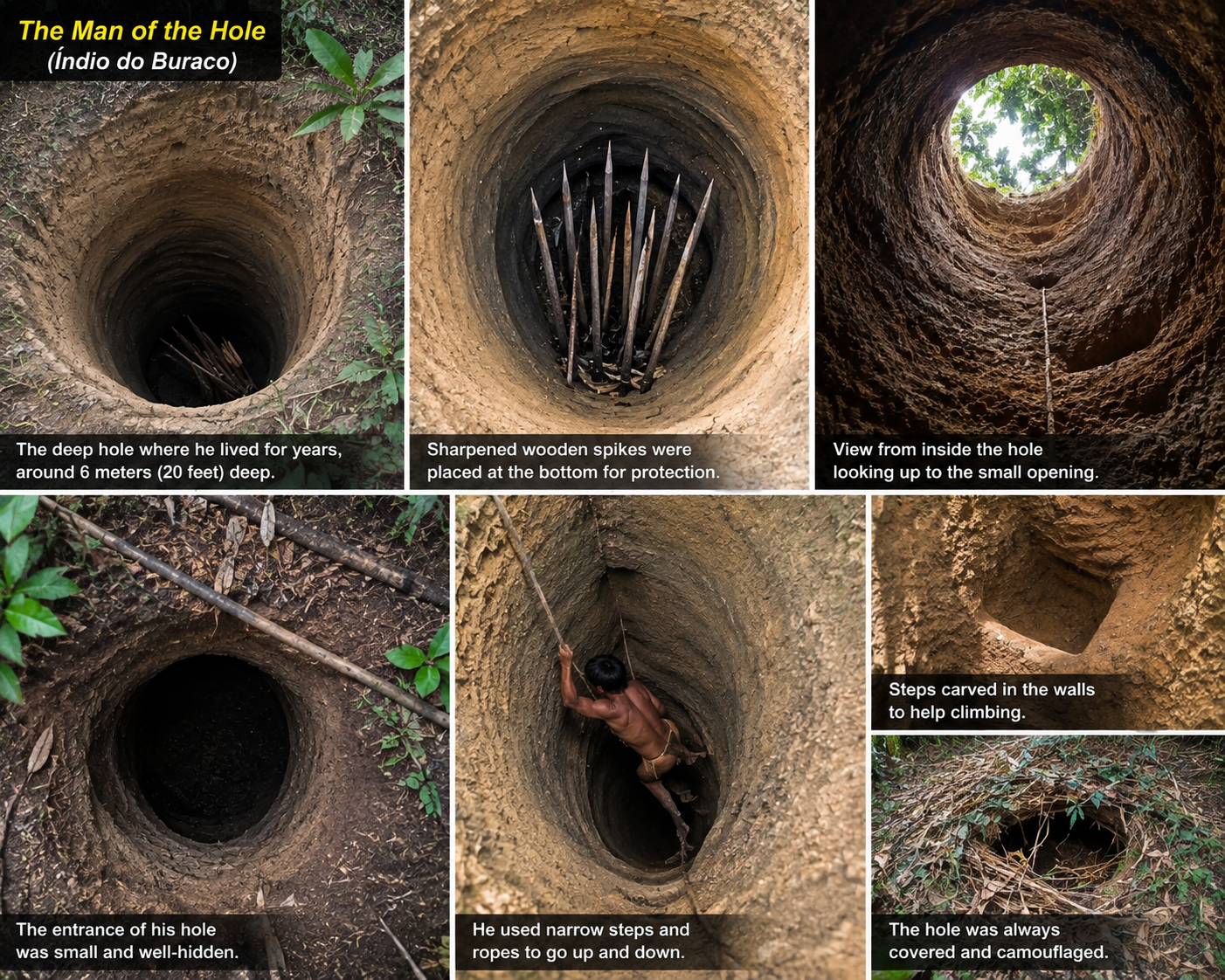
The Man of the Hole: The Extraordinary Story of the Amazon’s Last Survivor
Introduction
Deep within the dense rainforests of Brazil’s Amazon, a man lived alone for more than two decades, avoiding all contact with the outside world. His identity remains unknown, his language was never recorded, and the name of his tribe has been lost forever. The world came to know him simply as “The Man of the Hole.”
His story is one of survival, resilience, tragedy, and the devastating consequences of violence against Indigenous peoples. Far from being a legend, he was a real person who spent the last years of his life protecting the only thing he had left—his freedom.
When he died in August 2022, the world did not just lose one man. It lost an entire culture, a unique language, and centuries of traditions that disappeared with him.
This remarkable story reminds us why protecting Indigenous communities and the Amazon rainforest is one of the most important challenges of our time.
—
A Hidden World in the Amazon
The Amazon Rainforest is the largest tropical rainforest on Earth, stretching across nine South American countries. It contains extraordinary biodiversity and is home to hundreds of Indigenous communities.
Some Indigenous groups have chosen to remain isolated from modern civilization. These are often called uncontacted tribes. They avoid contact because previous encounters with outsiders frequently brought disease, violence, land theft, and exploitation.
The Man of the Hole belonged to one of these isolated peoples.
His homeland was located in the Brazilian state of Rondônia, a region that experienced rapid deforestation and agricultural expansion during the second half of the twentieth century.
As ranches, logging operations, and settlements spread into the forest, Indigenous territories became increasingly threatened.
—
The Destruction of His Tribe
Researchers believe that his tribe was almost completely destroyed during the 1970s and 1980s.
Although many details remain unknown, evidence suggests that armed attacks by land grabbers and ranchers wiped out nearly every member of his community.
These attacks were part of a larger pattern affecting many Indigenous groups throughout the Amazon.
Entire villages disappeared.
Ancient cultures vanished.
Languages that had existed for generations were silenced forever.
The Man of the Hole became the last known survivor of his people.
Imagine carrying the memories of an entire civilization while knowing there was no one left to share them with.
That was the burden he carried every single day.
—
Choosing Isolation
After the destruction of his community, he made a remarkable decision.
He would never trust outsiders again.
Instead of seeking help, he disappeared deeper into the forest and built a life completely independent of modern society.
For more than twenty-six years, he successfully avoided direct contact with everyone.
Government officials occasionally observed signs of his presence, but they respected his wish to remain alone.
His isolation was not caused by fear alone.
It was also an act of resistance.
He refused to surrender his independence or abandon the way of life inherited from his ancestors.
—
Why Was He Called “The Man of the Hole”?
The unusual nickname came from a mysterious feature found in every shelter he built.
Inside or near each hut was a deep, carefully dug hole.
Some measured several feet in depth.
Even today, researchers cannot say with certainty why he dug them.
Several theories have been proposed.
Some experts believe the holes may have served as hunting traps for animals.
Others suggest they were used for hiding, storing food, or ceremonial purposes.
Another possibility is that they held spiritual significance known only to his lost culture.
Since there was no one left to explain their meaning, the mystery remains unsolved.
These strange holes became his defining characteristic, leading journalists to call him “The Man of the Hole.”
Ironically, the nickname became the only name by which the world remembers him.
—
Master of Survival
Living alone in the Amazon is one of the greatest survival challenges imaginable.
The rainforest contains dangerous animals, poisonous insects, powerful rivers, and unpredictable weather.
Yet The Man of the Hole survived year after year.
He hunted wild pigs, birds, and other animals using traditional weapons.
He gathered fruits, nuts, and honey from the forest.
He cultivated small gardens where he grew crops such as cassava, corn, bananas, and papaya.
Every skill he possessed had been passed down through generations of his ancestors.
Without modern tools, electricity, medicine, or communication, he demonstrated an extraordinary understanding of nature.
The rainforest was not merely his home.
It was his teacher, provider, and protector.
—
A Symbol of Indigenous Resistance
As news of his existence spread internationally, The Man of the Hole became a symbol of Indigenous resilience.
His story represented much more than one man’s survival.
It highlighted the continuing struggle faced by Indigenous peoples whose lands are threatened by illegal logging, mining, ranching, and deforestation.
His determination to remain free inspired people around the world to think differently about Indigenous rights and environmental conservation.
For many, he became a powerful reminder that progress should never come at the cost of destroying ancient cultures.
—
Looking Ahead
Although the outside world knew very little about him, every discovery raised new questions.
How did he survive completely alone?
Why did he continue digging mysterious holes?
How did Brazilian authorities protect his territory while respecting his choice to remain isolated?
These questions reveal an extraordinary chapter in modern history.
Living Completely Alone
For most people, living alone for a few weeks would be difficult. For The Man of the Hole, however, solitude became a way of life. After the destruction of his tribe, he spent more than 26 years surviving entirely on his own in the Amazon rainforest.
He had no family, no friends, and no community left. Every decision—from finding food and building shelter to avoiding danger—rested solely on him. Yet he adapted to this harsh reality with remarkable skill.
His life reflected thousands of years of Indigenous knowledge that had been passed down through generations before him. Even though his people were gone, their traditions continued through the way he hunted, farmed, and lived in harmony with the forest.
—
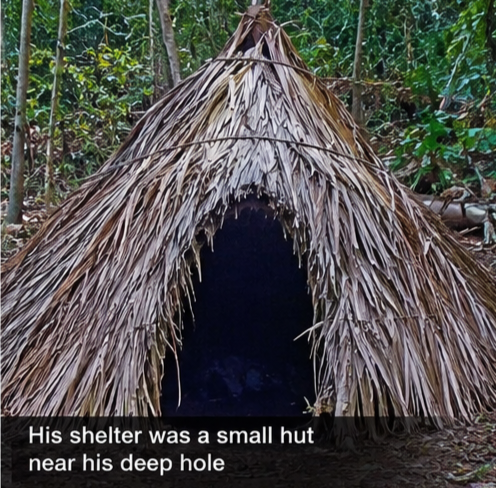
Building Shelters in the Rainforest
Throughout his life in isolation, The Man of the Hole built dozens of simple shelters across his protected territory. These structures were made from tree trunks, branches, palm leaves, and other natural materials found in the rainforest.
The shelters were usually small but carefully constructed to protect him from heavy rain, intense heat, and insects. Researchers discovered that he frequently moved from one shelter to another, likely following seasonal food sources, maintaining gardens, or ensuring his safety.
Each shelter contained evidence of an organized and disciplined lifestyle. There were places for sleeping, storing tools, preparing food, and, most famously, a deep hole dug into the ground.
—
The Mystery of the Holes
The holes remain one of the greatest mysteries surrounding his life.
Every hut contained at least one carefully dug pit, often several feet deep. Despite years of observation, experts have never reached a definitive conclusion about their purpose.
Several theories have been suggested:
– Hunting Traps: Some researchers believe the holes were designed to trap animals such as wild pigs.
– Storage Pits: Others think they may have been used to store food, seeds, or other valuable supplies.
– Defensive Structures: The holes could have provided protection by making it harder for intruders to approach unnoticed.
– Spiritual or Ceremonial Use: Many anthropologists believe the pits may have held religious or cultural significance unique to his lost tribe.
Because there was no surviving member of his community to explain their purpose, the true meaning of the holes may never be known.
—
A Master Hunter and Farmer
The Amazon rainforest is one of the world’s richest ecosystems, but surviving there requires exceptional knowledge.
The Man of the Hole hunted wild animals using traditional weapons, likely including bows and arrows. He also collected fruits, Brazil nuts, honey, and edible plants from the forest.
Evidence found by Brazilian officials showed that he maintained small gardens where he cultivated crops such as cassava, maize (corn), bananas, and papaya. These gardens demonstrated that he was not simply wandering through the forest—he actively managed his environment.
His ability to combine hunting, gathering, and farming allowed him to survive independently for decades.
—
Avoiding Contact
Unlike many survival stories where rescue is the goal, The Man of the Hole consistently avoided contact with outsiders.
Whenever government teams entered his territory, he disappeared before they could reach him. Occasionally, officials found abandoned shelters, fresh footprints, recently harvested crops, or signs that he had been watching them from a distance.
These encounters showed that he was fully aware of the outside world but deliberately chose to remain hidden.
His decision reflected the painful history experienced by many Indigenous communities. For his people, contact with outsiders had brought violence and death rather than safety.
—
FUNAI’s Unique Approach
Brazil’s Indigenous affairs agency, FUNAI (Fundação Nacional dos Povos Indígenas), adopted an unusual policy regarding The Man of the Hole.
Instead of forcing contact, officials respected his wishes.
Their mission became protecting his land rather than interfering with his life.
Government teams periodically monitored the boundaries of his territory, removed illegal intruders when possible, and documented signs of his continued survival without disturbing him.
This approach reflected a growing international understanding that isolated Indigenous peoples have the right to choose whether or not they wish to interact with modern society.
Forcing contact could expose them to diseases against which they have little or no immunity and could permanently destroy their traditional way of life.
—
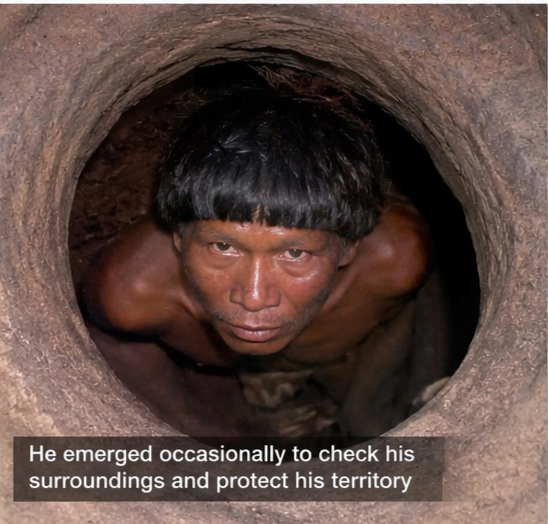
Rare Footage from 2018
For decades, almost no photographs or videos of The Man of the Hole existed.
In 2018, FUNAI released a short video showing him cutting down a tree with an axe.
Although brief, the footage offered the world a rare glimpse into the life of one of Earth’s most isolated individuals.
He appeared healthy, physically strong, and completely comfortable in his surroundings.
The video attracted international attention and renewed discussions about Indigenous rights, rainforest conservation, and the importance of protecting isolated tribes.
—
Lessons from His Life
The Man of the Hole demonstrated that survival is about far more than physical strength.
His life showed the value of traditional ecological knowledge, patience, adaptability, and respect for nature.
He survived not because he conquered the rainforest, but because he understood it.
His story also challenges modern assumptions about civilization and progress. While the outside world often viewed him as isolated, he possessed knowledge of the forest that many modern people could never acquire.
—
Looking Ahead
The final chapter of The Man of the Hole’s story is both heartbreaking and deeply meaningful.
His death in 2022 marked the end of an entire people whose language, traditions, and history disappeared with him. Yet his legacy continues to inspire efforts to protect Indigenous communities and preserve the Amazon rainforest.
The Final Chapter
For more than two decades, The Man of the Hole lived quietly in the Amazon rainforest, surviving entirely on his own while avoiding contact with the outside world. He became a symbol of resilience and determination, representing not only his own survival but also the memory of an entire people who had disappeared.
In August 2022, Brazilian officials conducting a routine monitoring visit found him dead in one of his simple forest shelters. According to reports from Brazil’s Indigenous affairs agency, there were no visible signs of violence or struggle. His body was found lying peacefully in a hammock, and authorities believed he had died of natural causes.
Although his death was expected because of his advanced age, the news echoed around the world. It marked the end of a culture that had survived in the Amazon for countless generations.
—
The End of an Entire People
Most people leave behind family members, friends, or communities that preserve their memories. The Man of the Hole had no one.
With his passing, an entire Indigenous nation disappeared forever.
His language was never documented.
His traditions were never fully understood.
His stories, beliefs, songs, ceremonies, and history vanished with him.
For anthropologists, historians, and linguists, this was an irreplaceable loss. Every Indigenous language contains unique knowledge about nature, medicine, wildlife, and human history. When a language disappears, humanity loses a way of understanding the world.
The Man of the Hole became a powerful reminder that cultural extinction is just as tragic as the extinction of animal species.
—
A Global Symbol of Indigenous Rights
News of his death was reported by major media organizations across the world. Human rights groups, environmental organizations, and Indigenous advocates described him as a symbol of resistance.
His life highlighted the ongoing threats faced by isolated Indigenous communities, including:
– Illegal logging
– Land grabbing
– Mining
– Agricultural expansion
– Violence against Indigenous peoples
– Deforestation of the Amazon Rainforest
His story encouraged governments and international organizations to strengthen protections for Indigenous territories, recognizing that preserving these lands is essential for both cultural survival and environmental conservation.
—
Why the Amazon Matters
The Amazon Rainforest is often called “the lungs of the Earth,” although scientists note that its greatest importance lies in storing vast amounts of carbon, regulating regional and global climate, and supporting extraordinary biodiversity.
For Indigenous peoples, however, the Amazon is much more than a forest.
It is their home.
Their history.
Their identity.
Their place of worship.
Their source of food, medicine, and knowledge.
The Man of the Hole understood this relationship better than anyone. His survival depended on living in harmony with the forest rather than exploiting it.
His life reminds us that protecting Indigenous territories also helps protect one of the world’s most important ecosystems.
—
Respecting the Choice of Isolation
One of the most remarkable aspects of this story is the decision made by Brazil’s Indigenous protection agency.
Instead of forcing contact, officials respected his right to remain isolated.
This approach reflected an important principle recognized in Indigenous rights: uncontacted peoples have the right to determine their own future.
Forced contact has historically exposed isolated communities to infectious diseases and violence. By protecting his territory while avoiding unnecessary interference, authorities gave him the opportunity to live according to his own traditions for as long as possible.
His story demonstrates that respecting human dignity sometimes means respecting a person’s decision to be left alone.
—
Lessons for Future Generations
The life of The Man of the Hole offers several important lessons:
1. Every Culture Matters
Even the smallest Indigenous community carries unique knowledge and traditions that enrich human civilization.
2. Protect Indigenous Lands
When forests disappear, Indigenous cultures often disappear with them. Conservation and Indigenous rights are closely connected.
3. Progress Must Be Responsible
Economic development should never come at the cost of violence, forced displacement, or cultural destruction.
4. Nature Is a Teacher
The Man of the Hole survived for decades because he understood the rhythms of the rainforest. His life reminds us that humans thrive when they respect nature rather than dominate it.
5. History Must Be Remembered
The destruction of his tribe should never be forgotten. Remembering these events helps prevent similar tragedies in the future.
—
Why His Story Continues to Inspire
Although very little is known about his personal life, The Man of the Hole has become one of the most recognizable figures associated with the protection of isolated Indigenous peoples.
He never sought fame.
He never gave interviews.
He never wrote books.
Yet his quiet determination inspired millions of people around the world.
His life has become a symbol of resilience, dignity, and the enduring human desire for freedom.
—
Conclusion
The story of The Man of the Hole is both heartbreaking and inspiring. It tells of a man who lost everything—his family, his community, and his culture—yet never surrendered his independence or his connection to the Amazon rainforest.
His life reminds us that Indigenous peoples are not relics of the past but living communities with unique knowledge, traditions, and rights that deserve protection. It also reminds us that every language, every culture, and every forest lost is a loss for all humanity.
Though the name of his tribe may never be known, The Man of the Hole will be remembered as a symbol of courage, resilience, and the importance of safeguarding both human diversity and the natural world. His silent life continues to speak powerfully to the world, urging us to protect the people and places that remain before more irreplaceable stories are lost forever.


Post Comment