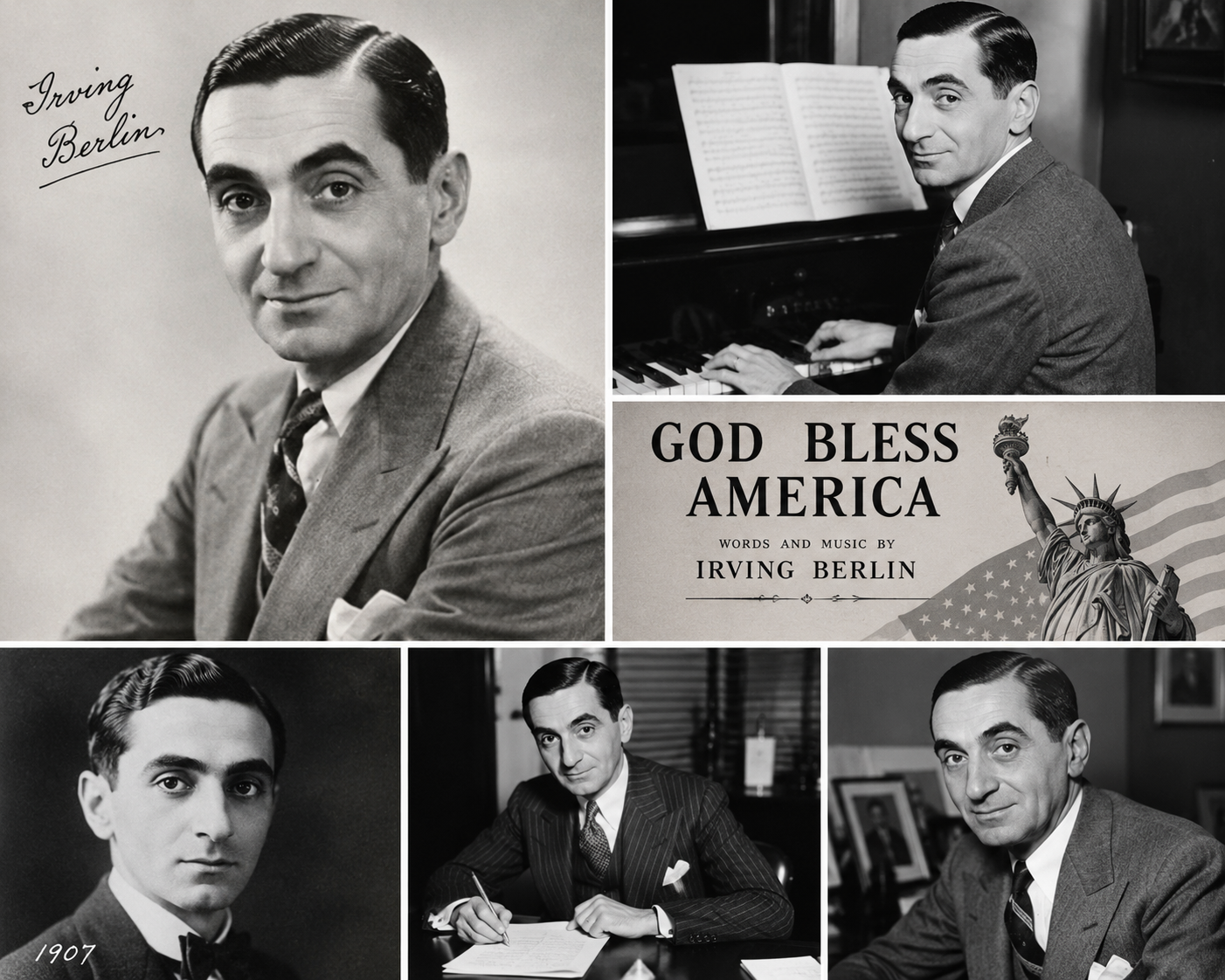
Irving Berlin and the Story Behind “God Bless America”
Introduction
Few songs have become as closely connected with American patriotism as “God Bless America.” Its simple melody, hopeful words, and message of national unity have made it one of the most recognizable patriotic songs in the United States. Behind this famous song was Irving Berlin, one of America’s most successful and influential songwriters.
Berlin wrote hundreds of songs during his extraordinary career, but “God Bless America” became something more than a popular song. It became a musical expression of love for the United States, especially during periods when Americans faced uncertainty, war, and social change.
The story of the song is also the story of Berlin himself—a poor immigrant who arrived in America as a child and eventually became one of the country’s greatest songwriters. His personal journey gave special meaning to his patriotic music.
Irving Berlin: From Immigrant to American Icon
Irving Berlin was born in the Russian Empire in 1888. His family immigrated to the United States when he was a young child. Like many immigrants of the era, his family hoped to find a safer and better life in America.
The family eventually settled in New York City. Berlin grew up in a poor neighborhood and experienced the challenges of immigrant life. He left school at a young age and began working to help support himself and his family.
Music eventually became his path to success.
Berlin did not receive extensive formal musical education. In fact, he had significant limitations as a musician. He could not read and write music in the conventional way that many composers could. Nevertheless, he possessed an extraordinary natural ability to create memorable melodies and lyrics.
His early experiences in New York’s entertainment industry helped him become a professional songwriter. Over time, his songs became popular throughout the country.
Berlin’s career eventually included Broadway shows, films, popular songs, and patriotic compositions. He became one of the most important figures in American popular music.

The Creation of “God Bless America”
Berlin originally wrote “God Bless America” in 1918, during the First World War. At the time, the United States was involved in a major international conflict, and patriotic songs were common.
However, Berlin decided not to publish the song immediately.
Years later, as Europe again moved toward war, Berlin revisited the composition. In 1938, he changed and developed the song for a new generation.
This was an important moment in American history.
The United States was watching the growing tensions in Europe. Adolf Hitler and Nazi Germany were becoming increasingly powerful, and another major war appeared possible. Americans were debating their country’s role in world affairs.
Against this background, Berlin’s song carried a powerful message of gratitude, peace, and protection.
Kate Smith and the Song’s Rise to Fame
One of the most important people in the history of “God Bless America” was singer Kate Smith.
Berlin believed Smith was the right performer for the song. On November 10, 1938, she introduced “God Bless America” on her radio program.
The timing was significant.
Only two days earlier, Nazi Germany had experienced the violent attacks against Jewish people and property that became known as Kristallnacht. Berlin, who was Jewish and had immigrated to America, was deeply aware of the dangers facing Europe.
When Kate Smith performed the song, it quickly attracted attention.
The song’s message was straightforward: America should be thankful for its freedom and ask for divine protection.
The opening lines expressed this idea with a prayer-like quality:
“God bless America, land that I love.”
The song continued by describing the country as a place deserving gratitude and protection.
Why the Song Became So Powerful
“God Bless America” did not become famous because of complicated musical arrangements. Its strength came from its simplicity.
The melody was easy to remember, and the lyrics were easy for ordinary people to understand.
The song also expressed emotions that were particularly powerful during uncertain times.
People wanted peace.
People wanted security.
People wanted to believe that their country could remain safe.
Berlin’s song provided a musical way to express those feelings.
Unlike some patriotic songs that focus on military victories, “God Bless America” is primarily a prayer for the nation. It asks for God’s blessing and protection rather than celebrating war itself.
That distinction helped make the song appealing to a wide audience.
Irving Berlin’s Immigrant Perspective
One of the most interesting aspects of “God Bless America” is Berlin’s own background.
He was not born in the United States. He arrived as an immigrant and grew up in difficult circumstances.
America had given him opportunities that might have been impossible elsewhere.
Through talent, hard work, and determination, Berlin transformed himself from a poor immigrant child into a successful American songwriter.
This personal experience influenced the emotional power of his patriotic work.
For Berlin, America was not simply a geographic location. It represented opportunity and freedom.
His story reflected an important part of the American experience: an immigrant arriving with very little and building a successful life.
America Before World War II
When “God Bless America” became popular in 1938, the world was becoming increasingly dangerous.
Europe was moving toward another devastating war. Germany was expanding its power, while tensions between nations were increasing.
Americans were closely following events overseas.
Many people remembered the terrible losses of World War I and hoped that the United States could avoid another global conflict.
Berlin’s song appeared during this atmosphere of uncertainty.
Its message was not aggressive. Instead, it asked for peace and protection.
That made it particularly suitable for radio, public gatherings, schools, and patriotic events.
The Song During World War II
After the United States entered World War II in 1941, “God Bless America” became even more prominent.
American soldiers went overseas, families waited anxiously at home, and the country mobilized for war.
Patriotic music became an important part of American life.
“God Bless America” was performed at public events, military gatherings, political events, and sporting occasions.
For many Americans, the song became associated with the hope that soldiers would return safely and that the country would remain strong.
The song’s popularity also demonstrated the power of radio.
During the early twentieth century, radio connected millions of Americans. A song could move rapidly from one city to another and become part of the national culture.
“God Bless America” benefited enormously from this new communication technology.
Berlin’s Contribution During World War II
Irving Berlin did more than write patriotic songs.
During World War II, he became deeply involved in supporting American troops. He wrote and participated in “This Is the Army,” a wartime musical revue created to entertain soldiers.
The production became a major success.
Berlin donated much of the income from the show to the U.S. Army Emergency Relief fund. He also traveled to military bases and participated in performances for service members.
His patriotism was therefore not limited to songwriting.
He used his fame, music, and financial success to support American troops.
“God Bless America” and American Identity
Over time, the song became part of America’s cultural identity.
It was performed at presidential events, national celebrations, memorial services, sporting events, and other public occasions.
The phrase “God Bless America” itself became a familiar expression.
For many Americans, hearing the song creates an emotional connection with national history.
It can remind people of veterans, military families, national celebrations, and important moments in American history.
The song has also been performed by generations of singers, allowing it to remain familiar even as musical styles changed.

The Song and American Sports
“God Bless America” has also become associated with American sporting events.
For many years, the song has been performed at baseball games and other major sporting occasions.
Its use in sports demonstrates how patriotic music can move beyond its original historical setting.
A song written during the approach of World War II can still be heard decades later at a baseball stadium filled with modern fans.
That continued presence shows how deeply the song entered American popular culture.
A Song That Crossed Generations
One reason “God Bless America” has survived for so long is that its message is easy to understand.
The song does not depend on a particular political event.
Its central ideas—love of country, gratitude, hope, and protection—can be understood by different generations.
A person hearing it in the 1940s could connect with it.
Someone hearing it decades later could also find meaning in it.
That ability to survive changing political and cultural circumstances is one of the characteristics of a lasting patriotic song.
Irving Berlin’s Musical Legacy
Irving Berlin’s contribution to American music goes far beyond “God Bless America.”
He wrote many songs that became standards of American popular music. His work influenced Broadway, Hollywood, jazz, and popular entertainment.
Among his famous compositions were “White Christmas,” “There’s No Business Like Show Business,” “Cheek to Cheek,” and many others.
His career lasted for decades.
Berlin’s remarkable achievement was his ability to create songs that ordinary people remembered and loved.
He understood that a successful song did not necessarily need complicated musical structures. A strong melody combined with meaningful lyrics could reach millions of people.
The Meaning of “God Bless America” Today
More than eight decades after its famous 1938 performance, “God Bless America” remains recognizable.
Its meaning can vary depending on the listener.
For some people, it is a religious prayer.
For others, it is a patriotic expression.
For others, it represents America’s immigrant story and the idea that people can build better lives through opportunity.
The song’s history also reminds us that patriotism can take many forms.
Patriotism is not only about military power or national victories. It can also involve gratitude, hope, unity, and concern for the future of a country.
Berlin’s song expresses these ideas in a very simple musical form.
The Immigrant Who Wrote an American Anthem
Perhaps the most remarkable part of the “God Bless America” story is the identity of its creator.
Irving Berlin was an immigrant who arrived in America as a child.
He experienced poverty and hardship.
He had little formal musical education.
Yet he eventually became one of America’s greatest songwriters.
His life reflected the opportunities that he believed America provided.
That makes his patriotic music particularly interesting.
He was writing about a country that had become his home.
The song therefore carried both a national message and a deeply personal one.
Conclusion
“God Bless America” is much more than an old patriotic song.
It is part of the history of twentieth-century America and the remarkable life of Irving Berlin.
Originally conceived during World War I and later revised during the growing tensions before World War II, the song became famous through Kate Smith’s 1938 radio performance.
Its popularity grew during World War II and continued for generations.
The song’s simple message of love, gratitude, hope, and protection helped it become one of America’s best-known patriotic songs.
Irving Berlin’s own journey makes the story even more powerful. He arrived in America as an immigrant child, grew up in poverty, and eventually became a legendary songwriter whose music reached millions of people.
His life and his music demonstrate how deeply the idea of America was connected with his own experience.
Today, when people hear “God Bless America,” they may think of national celebrations, veterans, sports stadiums, military ceremonies, or important moments in American history.
But behind those familiar words is the story of an immigrant songwriter who transformed his gratitude for his adopted country into a song that became part of America’s national culture.
Irving Berlin’s “God Bless America” remains a lasting symbol of American patriotism, hope, and the belief in a country worth loving and protecting.

Post Comment