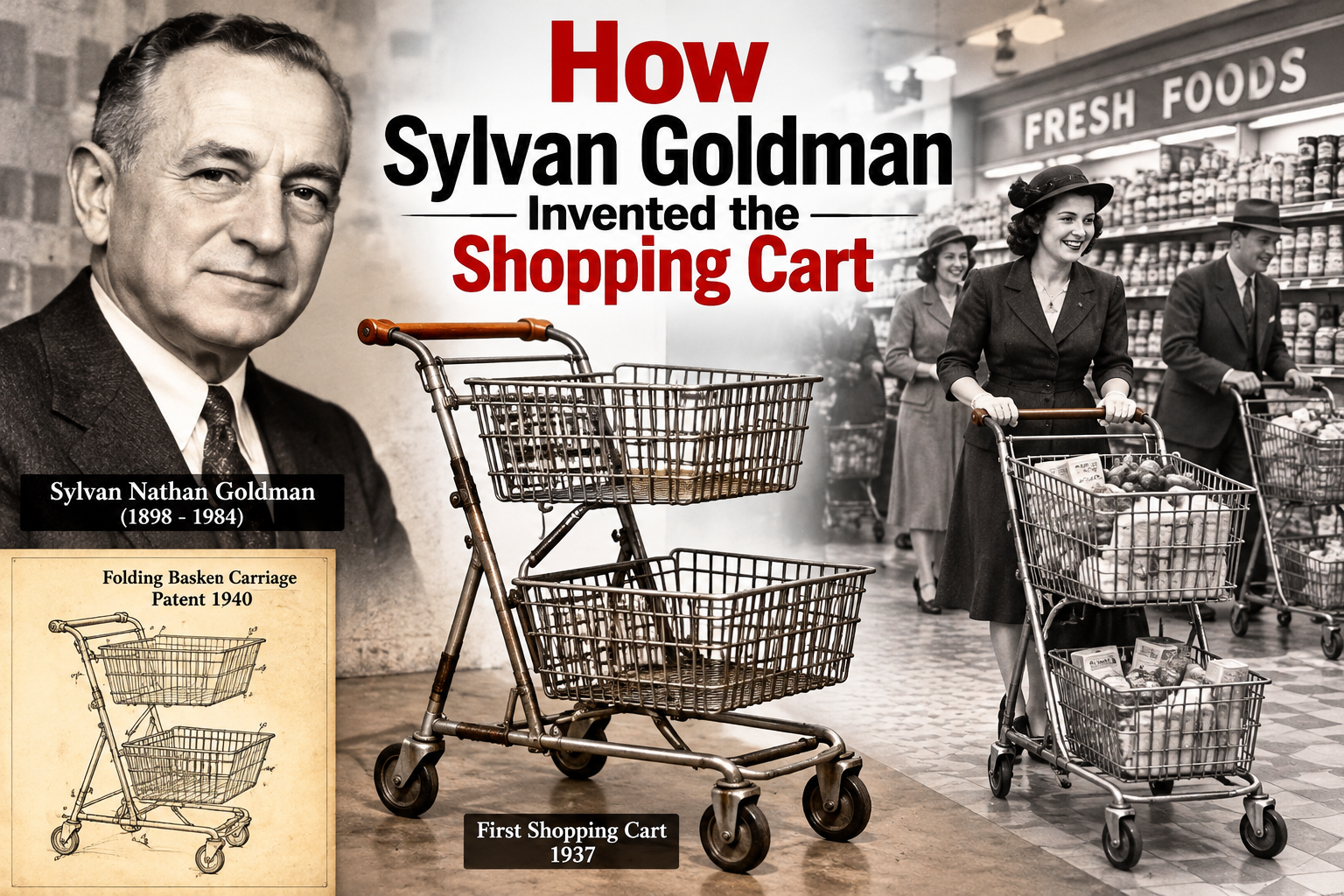
How Sylvan Goldman Invented the Shopping Cart
Introduction
Today, shopping at a supermarket seems simple. Customers walk through the aisles, select their favorite products, place them inside a shopping cart, and move comfortably from one section to another. But have you ever wondered how the shopping cart was invented?
Behind this everyday invention was an American businessman named Sylvan Nathan Goldman. His idea transformed the grocery-shopping experience and helped supermarkets become more convenient for millions of people.
Goldman introduced his early shopping cart in 1937 in Oklahoma City, Oklahoma. His invention allowed customers to carry more groceries without holding heavy baskets in their hands. Although shoppers did not immediately accept his idea, his determination and creative marketing eventually helped make the shopping cart a familiar part of everyday life.
His story demonstrates how observing a simple problem and finding a practical solution can change an entire industry.
Who Was Sylvan Goldman?
Sylvan Nathan Goldman was born on November 15, 1898, in Ardmore, in what was then the Chickasaw Nation, Indian Territory, now part of Oklahoma, United States.
As a young man, Goldman became familiar with the retail business. He learned about selling products, managing customers, and understanding what shoppers needed. These experiences helped him develop the business skills that later supported his innovations.
After serving in the First World War, Goldman worked in the grocery and wholesale produce businesses with his brother, Alfred. The brothers eventually became involved in the expanding American supermarket industry.
In 1920, they opened a Sun Grocery store in Tulsa, Oklahoma. Their business grew, and they later sold the Sun Grocery chain. In 1934, Goldman acquired the struggling Humpty Dumpty supermarket chain.
As he worked to improve his stores, he looked for ways to make shopping easier and more attractive to customers.
This interest in practical improvements eventually led to his most famous invention: the shopping cart.

How Did Sylvan Goldman Get the Idea for the Shopping Cart?
During the 1930s, self-service grocery stores were becoming increasingly important in American retail. Instead of asking a shopkeeper to collect every item, customers could walk through the store and select products themselves.
This system offered greater freedom, but it also created a problem.
Customers usually carried their groceries in handheld shopping baskets. When the baskets became heavy or full, shoppers had to stop shopping, visit the checkout counter, or make repeated trips.
Goldman recognized that customers might purchase more products if they had an easier way to carry them around the store.
He began thinking about a device that could support a shopping basket while allowing customers to move it without lifting its weight.
The concept was straightforward: combine a basket, a wheeled frame, and a design that could be stored compactly when not in use.
Goldman worked with Fred Young, an employee who helped turn the idea into a practical design. Their early shopping cart drew inspiration from the folding chair.
This was an important example of creative thinking. Goldman did not need to invent wheels or baskets. Instead, he combined familiar objects to solve a problem in a new way.
How Was the First Shopping Cart Designed?
Goldman’s early shopping cart was quite different from the large metal carts found in supermarkets today.
The original design consisted of a folding frame resembling a chair, wheels, and two wire shopping baskets. One basket sat above the other, allowing shoppers to carry more groceries than a single handheld basket could accommodate.
The frame could be folded for storage, while the baskets could be removed and stacked separately.
This design offered several advantages:
– Greater carrying capacity: Customers could collect more groceries during a single trip through the store.
– Less physical effort: Shoppers no longer needed to carry every item in their hands.
– Improved convenience: Customers could move around the aisles while keeping their groceries together.
– Compact storage: The folding frame and removable baskets helped stores manage limited space.
Goldman filed for patents covering his shopping-carriage designs, and the folding basket carriage patent was granted in April 1940.
The invention represented an important step in the development of modern supermarket equipment.
How Did Sylvan Goldman Introduce the Shopping Cart in 1937?
Inventing the shopping cart was only the first challenge. Goldman also had to convince customers to use it.
When the carts were first introduced, many shoppers were hesitant. Some men preferred carrying their own baskets because they did not want to appear physically weak. Some women considered the carts awkward or associated them with pushing a baby carriage.
The problem was not necessarily the usefulness of the invention. Many customers simply needed to understand how it could improve their shopping experience.
Goldman realized that customers would be more willing to try the carts if they could see other people using them comfortably.
Instead of abandoning the idea, he developed a marketing strategy to encourage adoption.
How Did Marketing Make the Shopping Cart Popular?
Goldman used demonstrations to help shoppers become familiar with his invention. He hired people to push shopping carts around the store and demonstrate how easily they could carry groceries.
These demonstrations helped make the carts appear normal and useful rather than unusual or embarrassing.
As customers watched other shoppers using the carts, they began to understand their advantages.
Goldman’s approach demonstrated an important business principle: a good invention may still need effective marketing before people recognize its value.
He did not simply create a product and wait for customers to accept it. He identified the reasons people were reluctant to use it and developed a way to address their concerns.
Gradually, the shopping cart became more popular, and his grocery stores benefited from the additional convenience.
The invention helped customers carry more products and made the self-service supermarket experience easier to manage.
How Did the Shopping Cart Change American Supermarkets?
The shopping cart helped support the development of the modern supermarket.
Before its introduction, the amount of shopping customers could comfortably complete was limited by the capacity of their handheld baskets. A wheeled cart made it easier to collect a larger variety of products in one visit.
This created advantages for both shoppers and retailers.
Customers could move through larger stores without carrying heavy baskets. Retailers could display more products and offer a shopping experience designed around browsing, selecting, and collecting items.
Shopping carts also became useful for families purchasing groceries for several days, customers buying bulky packages, and shoppers purchasing products in larger quantities.
As supermarkets expanded, carts became an essential part of the shopping environment.
Goldman’s contribution was not simply a new piece of equipment. His invention helped make self-service shopping more practical on a larger scale.
How Did the Shopping Cart Evolve After Goldman’s Invention?
Although Goldman helped establish the early shopping cart, the design continued to evolve.
One important improvement came from Orla E. Watson, who developed the telescoping shopping cart in 1946.
Watson’s design allowed carts to fit inside one another when they were not being used. This made it easier for supermarkets to store many carts in a relatively small area.
Goldman’s original folding design required components to be removed and assembled, whereas the telescoping design was ready to use and could be nested with other carts.
The two innovations served related but different purposes.
Goldman helped popularize the wheeled shopping carrier, while Watson introduced a significant improvement in storage and convenience. Their contributions helped shape the shopping carts used in supermarkets today.
Modern carts have since gained larger baskets, stronger frames, child seats, specialized wheels, and designs for warehouse stores.
Some supermarkets have also introduced handheld scanners and smart-cart technologies that help customers track purchases as they shop.
The basic idea, however, remains recognizable: provide a convenient way to transport products through a store.

How Did Sylvan Goldman Influence the Retail Industry?
Goldman’s influence extended beyond the physical design of the cart.
His work reflected a broader understanding of customer behavior. He recognized that the shopping experience could affect how customers interacted with a store and how easily they could purchase products.
The shopping cart helped make it possible for customers to browse more freely, collect more items, and move comfortably through self-service stores.
For retailers, this was an important development in the organization of grocery shopping.
Goldman also contributed to other innovations in the grocery business, including equipment related to bagging groceries and handling milk bottles.
His career illustrated the connection between practical invention and business management. He understood that successful retailing involved more than stocking products; it also required designing a convenient experience for customers.
What Can Modern Entrepreneurs Learn From Sylvan Goldman?
Goldman’s story offers several useful lessons for inventors, business owners, and aspiring entrepreneurs.
1. Observe everyday problems.
The idea for the shopping cart came from a common difficulty: customers could not comfortably carry large quantities of groceries. Entrepreneurs can often find opportunities by observing ordinary frustrations.
2. Improve what already exists.
Goldman combined familiar elements into a new solution. Innovation does not always require creating something entirely unfamiliar.
3. Understand customer behavior.
His initial customers were reluctant to use the carts. Recognizing their concerns was essential to making the invention successful.
4. Promote ideas effectively.
Demonstrations helped customers see the practical value of the shopping cart. A useful product needs clear communication as well as good design.
5. Keep improving.
The shopping cart continued to develop after Goldman’s initial invention. Successful products often become more useful through later improvements by other innovators.
These lessons remain relevant to businesses working in retail, technology, manufacturing, and consumer products.
Conclusion
Sylvan Nathan Goldman changed grocery shopping by turning a simple observation into a practical invention. His early shopping cart, introduced in Oklahoma City in 1937, helped customers carry more groceries with less effort and contributed to the growth of self-service supermarkets.
His invention was not immediately welcomed by everyone. Through demonstrations, marketing, and persistence, Goldman helped customers recognize its usefulness.
Later improvements, including Orla Watson’s telescoping design, made shopping carts easier to store and use, further establishing them as essential supermarket equipment.
Today, millions of shoppers use carts without thinking about the problem they were originally designed to solve.
Goldman’s story reminds us that innovation often begins with a simple question: How can an ordinary task be made easier?



Post Comment