Robert Ballard: The Oceanographer Who Discovered the Titanic
Introduction
The ocean covers approximately 71 percent of Earth’s surface, yet its deepest regions remain among the most challenging places for humans to explore. Beneath the waves lie underwater mountains, unusual marine creatures, ancient shipwrecks, and geological formations that can change our understanding of life on Earth.
One man who helped reveal these hidden worlds is Dr. Robert Duane Ballard, an American oceanographer, marine geologist, and deep-sea explorer. He became internationally famous for discovering the wreck of the RMS Titanic in 1985. However, his scientific achievements extend far beyond that historic discovery.
Through innovative underwater technology, scientific research, and educational programs, Ballard helped transform how researchers investigate the ocean floor. His career demonstrates how curiosity, determination, and engineering can turn seemingly impossible discoveries into reality.
Early Life of Robert Ballard
Robert Duane Ballard was born on June 30, 1942, in Wichita, Kansas, United States. During his childhood, he developed a strong interest in the ocean and underwater exploration.
Growing up in Southern California exposed him to a region where marine science and ocean research were important scientific pursuits. The Pacific Ocean offered opportunities to learn about marine life, underwater geography, and the mysteries hidden beneath the waves.
As a young man, Ballard became interested in scuba diving and oceanographic research. These experiences encouraged him to pursue a career that combined scientific investigation with adventure.
Rather than limiting himself to studying the ocean from the surface, he wanted to understand what existed far below it. This ambition eventually led him into marine geology, oceanography, and deep-sea technology.
Education and Scientific Career
Ballard studied geology and chemistry at the University of California, Santa Barbara, before continuing his education in graduate programs. He later earned a doctorate in marine geology and geophysics from the University of Rhode Island in 1975.
His scientific training gave him the knowledge needed to study the physical structure of the ocean floor, underwater geological formations, and the processes that shape the seabed.
Ballard also served in the United States Navy and became involved with deep-submergence research at the Woods Hole Oceanographic Institution in Massachusetts.
At Woods Hole, scientists and engineers were developing technologies that could investigate the ocean at depths beyond the reach of ordinary diving equipment.
Ballard became particularly interested in underwater vehicles, sonar systems, and remote-controlled cameras. These technologies would later play a crucial role in some of his most important discoveries.
The Discovery of Hydrothermal Vents
One of Ballard’s most significant scientific contributions occurred in 1977, when researchers exploring the Galápagos Rift discovered active hydrothermal vents on the ocean floor.
Hydrothermal vents are openings in the seabed through which heated, mineral-rich water escapes. They often form in regions where geological activity heats seawater circulating through rocks beneath the ocean floor.
These environments revealed something remarkable: complex communities of organisms could survive without relying directly on sunlight.
For a long time, scientists had understood that most ecosystems ultimately depended on energy from the Sun. Plants use sunlight for photosynthesis, and animals depend directly or indirectly on the food chains this process supports.
Hydrothermal vent ecosystems demonstrated another possibility. Microorganisms can use chemical energy to produce organic matter through a process called chemosynthesis. These microbes support unusual communities of animals living in the deep ocean.
Ballard participated in the research that helped bring this discovery to light.
The finding changed scientific thinking about the limits of life. It also encouraged researchers to consider whether similar environments might exist on other worlds, including ocean-bearing moons in our solar system.
This achievement is an important reminder that Ballard’s scientific legacy is not limited to shipwrecks.
The Historic Search for the Titanic
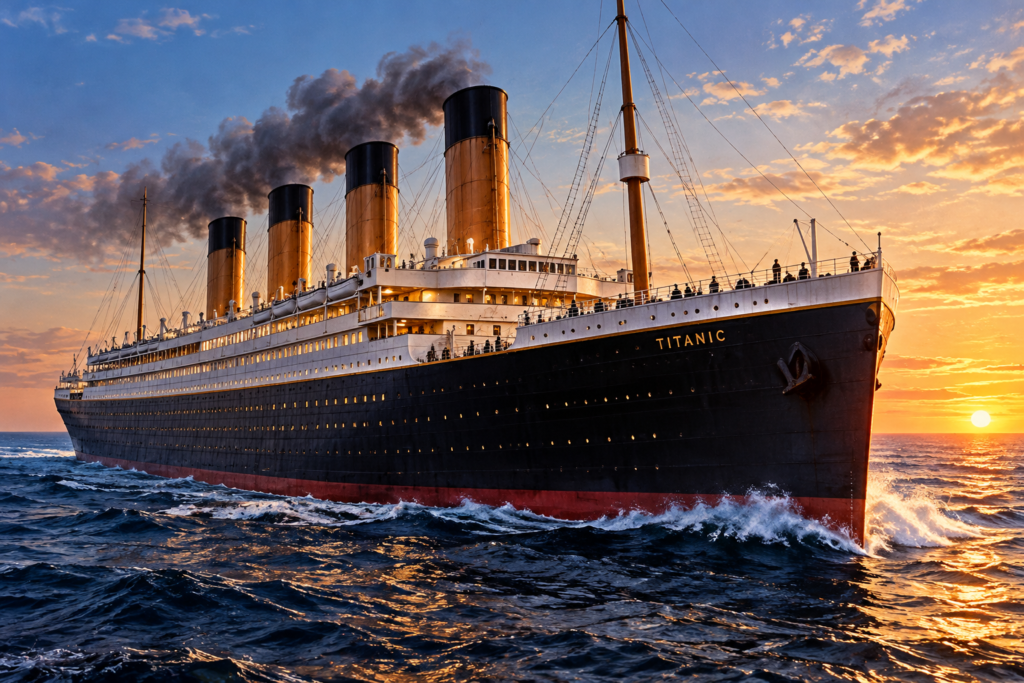
The RMS Titanic was one of the most famous passenger ships of the early twentieth century. It struck an iceberg during its maiden voyage across the North Atlantic and sank on April 15, 1912.
More than 1,500 people lost their lives in the disaster. The ship became a lasting symbol of human ambition, technological confidence, and the dangers of the sea.
Although the Titanic’s sinking received worldwide attention, locating the wreck proved extremely difficult.
The North Atlantic is vast, the ocean floor is dark, and water pressure increases enormously with depth. Traditional diving methods could not reach the wreck, which lay thousands of metres beneath the surface.
Robert Ballard wanted to locate the ship, but he understood that success would require specialized equipment, careful planning, and a systematic search.
He had also spent years developing experience in deep-sea exploration. This background helped him understand how underwater imaging systems could be used to investigate large areas of the ocean floor.
How Robert Ballard Discovered the Titanic in 1985
In 1985, a joint American-French expedition searched for the Titanic using the research vessels Knorr and Le Suroit.
The American team was associated with the Woods Hole Oceanographic Institution, while the French team came from IFREMER, the French oceanographic research institution.
The expedition used sophisticated underwater imaging equipment, including the towed camera system Argo. Rather than depending entirely on a conventional search for the ship’s main hull, the researchers examined the seabed for debris that might lead them to the wreck.
This strategy proved successful.
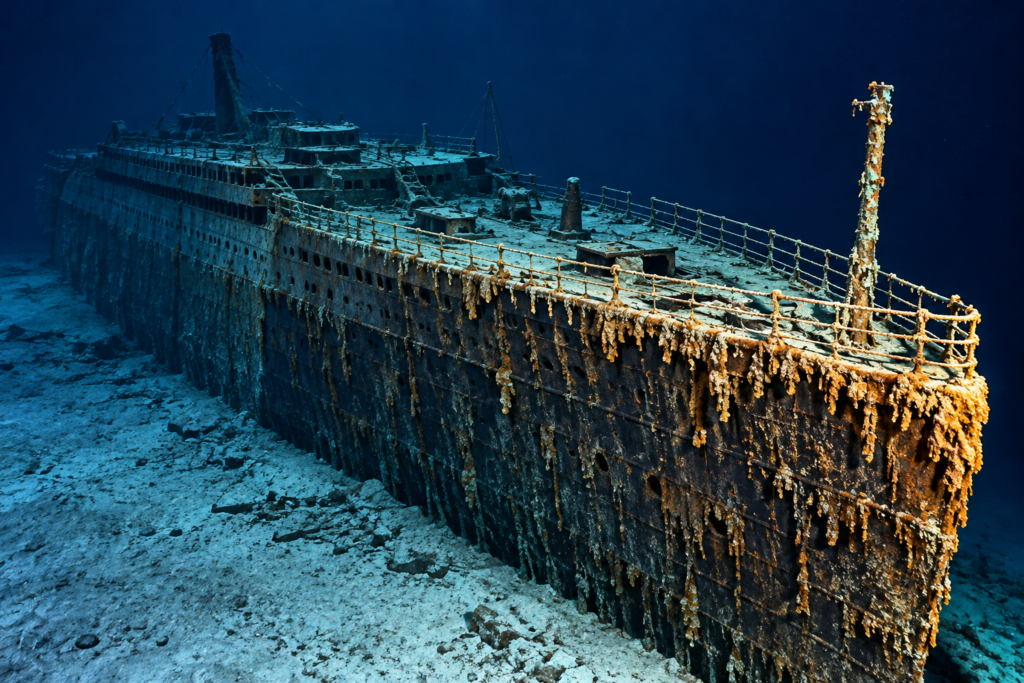
Just after 1 a.m. on September 1, 1985, the team identified a Titanic boiler in underwater images. The wreck had been located approximately 3,800 metres, or 12,500 feet, below the ocean surface.
The discovery was a major milestone in marine exploration.
It also demonstrated that scientists could use underwater imaging technology to investigate places that were previously extremely difficult to examine.
The wreck was not found by Ballard acting alone. The achievement depended on international cooperation, engineers, researchers, ship crews, and the combined work of the American and French teams.
Their success changed the future of deep-sea archaeology and oceanographic research.
Returning to the Titanic in 1986
Ballard returned to the Titanic site in 1986 for a closer examination.
This expedition used the crewed submersible Alvin and a remotely operated vehicle called Jason Junior.
Alvin carried researchers deep underwater, while Jason Junior could be directed through confined spaces using cameras and remote controls.
These technologies allowed the team to examine parts of the wreck that could not be studied adequately from a surface vessel.
The researchers documented the ship’s remains and gathered important visual evidence about its condition.
The expedition also demonstrated the potential of combining human observation with robotic exploration. Researchers could remain inside a submersible while remotely operated machines entered areas that presented additional challenges.
For Ballard, the Titanic was both a historical site and a scientific opportunity. Its remains offered clues about the disaster, the effects of deep-sea conditions on materials, and the challenges of preserving submerged cultural heritage.
Other Famous Shipwreck Discoveries
Ballard’s career includes several important shipwreck investigations beyond the Titanic.
The German Battleship Bismarck
In 1989, Ballard led an expedition that located the wreck of the German battleship Bismarck, which sank during World War II in 1941.
The investigation combined underwater technology with historical research to examine the remains of the famous warship.
USS Yorktown
Ballard also participated in the discovery of the sunken American aircraft carrier USS Yorktown, lost during the Battle of Midway in 1942.
The wreck provided researchers with an opportunity to investigate an important part of naval history.
PT-109
Another notable discovery associated with Ballard’s work was PT-109, the patrol boat commanded by future American president John F. Kennedy during World War II.
These investigations illustrate how deep-sea exploration can contribute to historical research as well as marine science.
Each wreck represents a different story involving technology, warfare, human decisions, and the powerful forces of the ocean.
Robert Ballard’s Underwater Technology
One of Ballard’s lasting contributions is his work with remotely operated vehicles and advanced underwater imaging systems.
Exploring the deep ocean presents serious challenges. At great depths, sunlight disappears, water pressure becomes immense, and communication with the surface is difficult.
Traditional divers cannot safely reach most of these environments. Crewed submersibles can descend to great depths, but their operations require specialized equipment and careful planning.
Remotely operated vehicles offer another approach. These machines can carry cameras, lights, and scientific instruments into the ocean while operators control them from a ship or another suitable platform.
Towed camera systems can also survey large areas of the seabed, helping researchers locate geological features and possible shipwrecks.
Ballard helped advance the use of these technologies in ocean research. His work demonstrated that exploration could be made more effective by combining engineering, photography, sonar, robotics, and scientific analysis.
Modern oceanographers continue to build on these methods to study underwater ecosystems, geological processes, and historic sites.
Founding the Ocean Exploration Trust
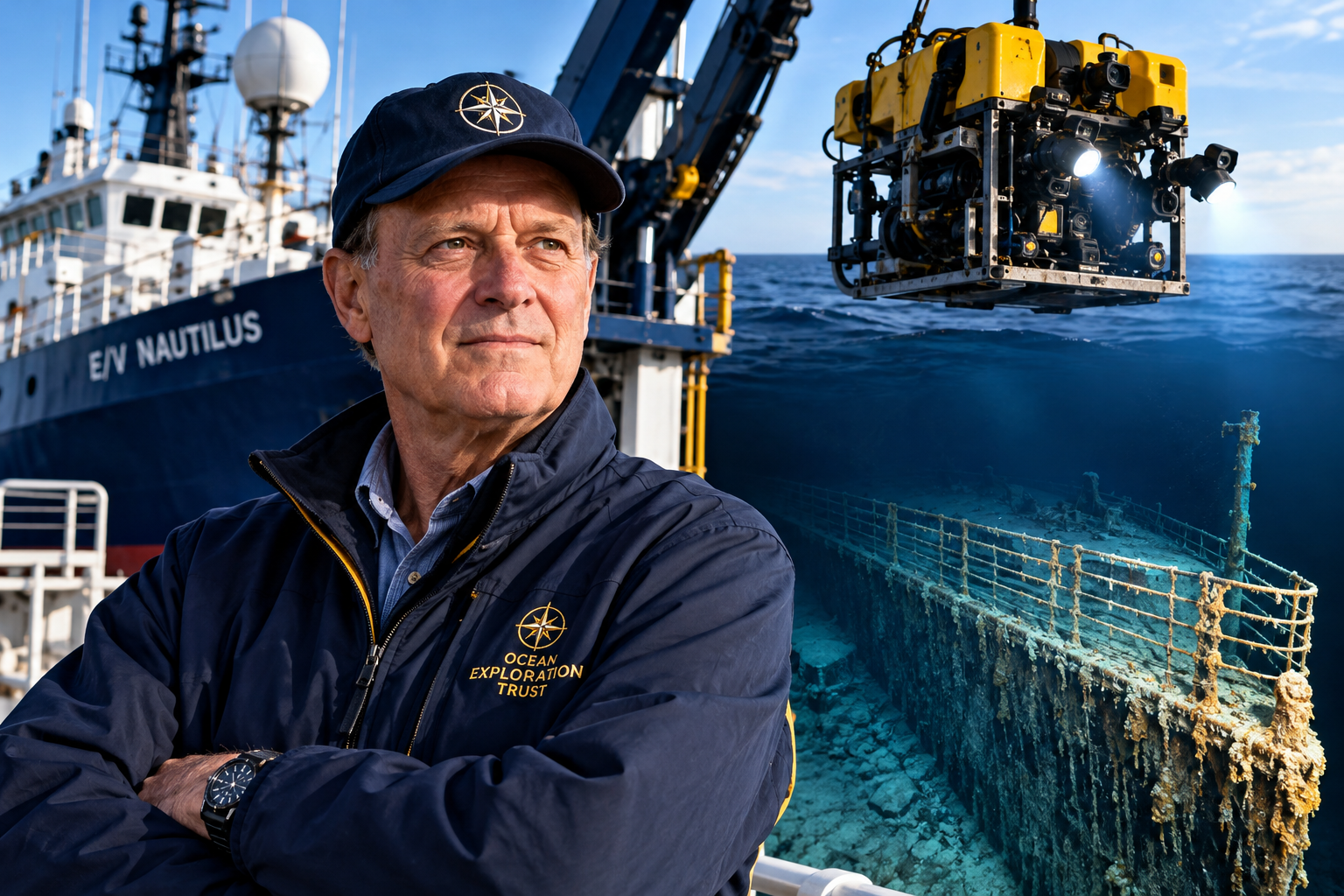
In 2008, Ballard founded the Ocean Exploration Trust, an organization dedicated to exploring the ocean and sharing discoveries with the public.
Its exploration vessel, E/V Nautilus, supports scientific expeditions using modern equipment and underwater robots.
One important feature of these expeditions is the use of technology to connect researchers and audiences on land with activities taking place at sea.
Live video, data transmission, and educational programs can help students and interested members of the public follow scientific investigations as they happen.
This approach brings ocean exploration beyond the research vessel. People who may never visit the open ocean can still observe discoveries and learn how scientists investigate the underwater world.
Ballard has also supported educational initiatives, including the JASON Project, which encouraged students to engage with science and technology through exploration-based learning.
His work shows that scientific discovery becomes even more valuable when knowledge is shared with future generations.
Awards and Recognition
Robert Ballard has received significant recognition for his contributions to exploration, science, and education.
His achievements have been acknowledged by scientific and educational institutions, including the National Geographic Society and the National Endowment for the Humanities.
He received the National Geographic Society’s Hubbard Medal in 1996 and the National Humanities Medal in 2003.
These honours reflect the broader impact of his work. Ballard did more than help locate famous shipwrecks. He advanced deep-sea research, contributed to discoveries about life in extreme environments, and encouraged people to become interested in ocean science.
His career also illustrates the importance of collaboration between scientists, engineers, historians, educators, and research organizations.
Why Robert Ballard’s Work Matters Today
The ocean plays a major role in Earth’s climate, ecosystems, geological processes, and human history. Understanding it is essential for protecting marine environments and improving scientific knowledge.
Yet much of the deep ocean remains difficult to explore.
Ballard’s work helped establish methods for investigating the seabed with remotely operated vehicles, underwater imaging systems, and coordinated research expeditions.
These tools can help scientists study deep-sea habitats, map underwater landscapes, examine shipwrecks, and investigate geological activity.
His discoveries also demonstrate why scientific exploration matters. A search for a famous shipwreck can lead to advances in engineering, while the study of an unexpected ecosystem can transform our understanding of where life can exist.
The Titanic made Ballard internationally famous, but the scientific principles behind his work have applications far beyond one ship.
His legacy lies in expanding the tools, knowledge, and public interest needed to explore Earth’s final frontiers.



Post Comment