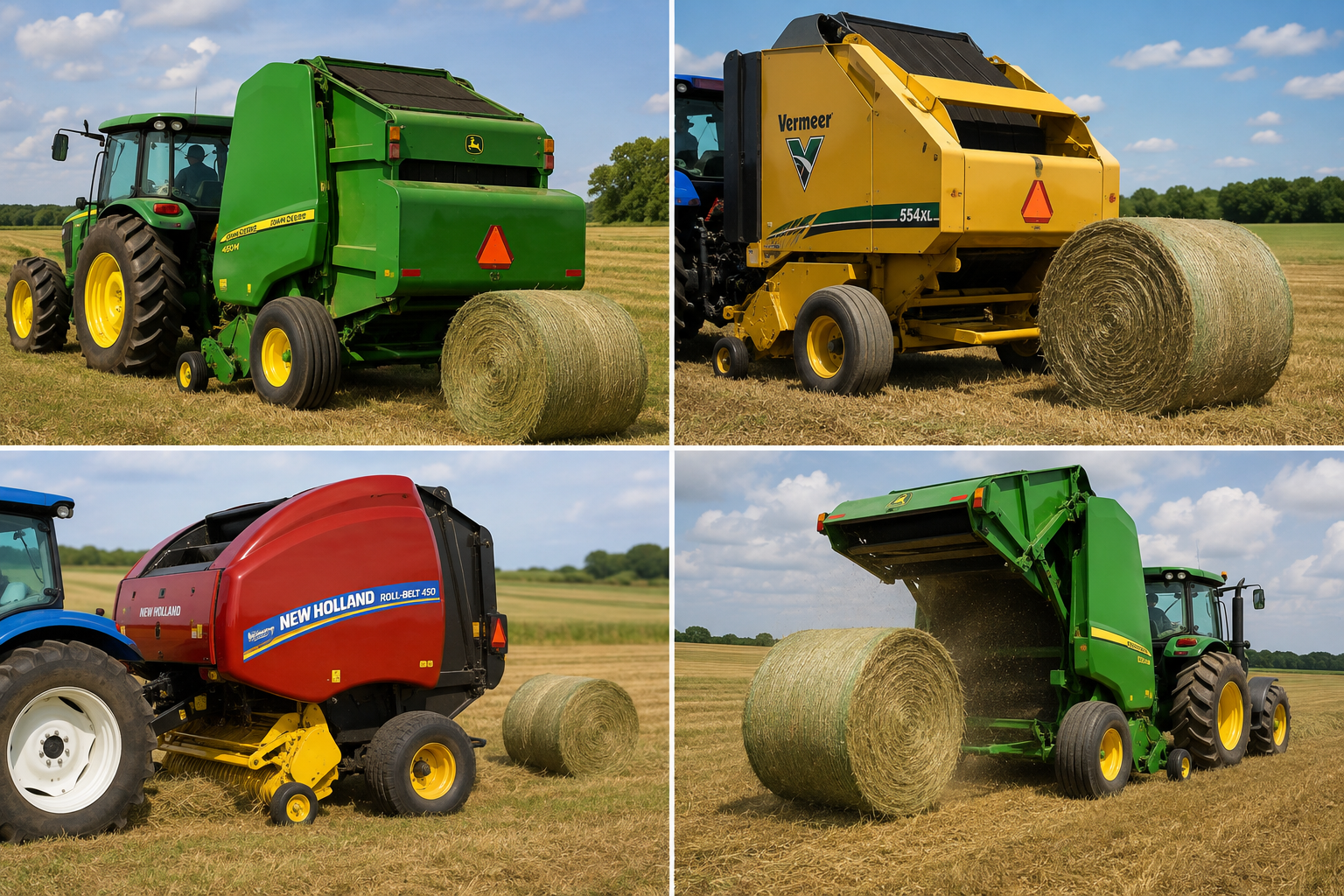
The Invention of the Round Hay Baler: The Machine That Changed Haymaking
Introduction
Agriculture has always depended on innovation. From simple hand tools to modern tractors and automated harvesting equipment, farmers have continuously developed better ways to produce food and manage livestock. Among the machines that transformed agricultural work, the round hay baler holds a special place.
Before modern balers became common, harvesting hay required enormous amounts of manual labor. Farmers had to cut grass, allow it to dry, rake it into windrows, gather it, and then form it into manageable bundles or small rectangular bales. Workers often had to lift and stack hundreds or even thousands of bales by hand.
The development of the round hay baler changed this system. Instead of producing many small packages, farmers could create large, compact cylindrical bales that could be moved with tractors and loaders. This reduced labor, increased productivity, and made it possible for farmers to harvest much larger quantities of hay.
The invention of the round hay baler was not the work of one person alone. It was the result of decades of experimentation and engineering. Early innovators developed the concept of rolling hay into cylindrical packages, while later engineers created machines capable of producing large, dense bales efficiently.
Today, round hay balers are widely used for hay, straw, grass, and other forage crops. Their development is an excellent example of how agricultural engineering can completely change the way farmers work.
—
What Is a Round Hay Baler?
A round hay baler is an agricultural machine that collects dried grass or other forage from a field and compresses it into a cylindrical bale.
The machine is normally pulled behind a tractor. As the tractor moves across the field, the baler’s pickup mechanism collects hay from a windrow. The hay is then transported into a chamber where belts, rollers, chains, or other mechanisms rotate it.
As more hay enters the chamber, the material begins forming a large cylinder. Continued rotation and compression create a dense round bale.
When the bale reaches the required size, the machine wraps it with twine or netting. The rear gate then opens, and the completed bale is released onto the field.
This process allows one operator and one tractor to perform work that previously required many workers.
—
Early History of Round Baling
The idea of making hay into round packages is more than a century old.
In the early days of mechanized agriculture, inventors were searching for ways to reduce the amount of manual labor involved in haymaking. Traditional hay harvesting required farmers to handle loose hay repeatedly.
The Luebben family of Nebraska played an important role in the early development of round baling technology. The family experimented with machines that used belts to roll hay into cylindrical packages.
Ummo Luebben became an important name in the early history of round baling. His work demonstrated that hay could be mechanically collected and formed into round bales.
These early machines were very different from today’s sophisticated balers. They were relatively simple, and their capacity was limited. Nevertheless, they established an important principle that would influence future agricultural machinery.
The basic idea was simple:
Collect the hay, roll it, compress it, and create a manageable cylindrical package.
That concept became the foundation for future round-baling technology.
—
John M. Wolf and Large Round Bales
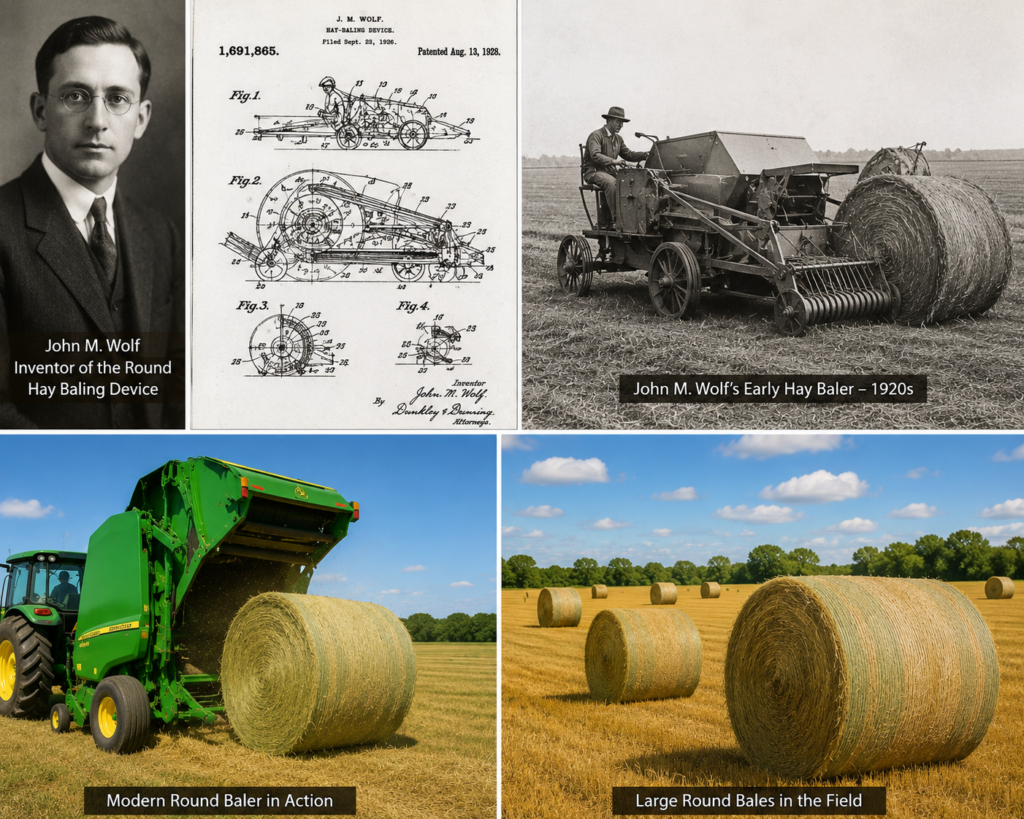
Another important development came from John M. Wolf, an inventor from North Dakota.
During the 1920s, Wolf developed a machine designed to produce large cylindrical hay bales. His work was important because it demonstrated that round bales could be made much larger than the small cylindrical packages produced by some earlier machines.
Large bales offered an important advantage: farmers could reduce the number of individual packages they had to handle.
However, large bales also created a new challenge. A bale weighing hundreds of pounds could not easily be lifted by hand. Farmers therefore needed tractors, mechanical loaders, and specialized handling equipment.
This relationship between baling and bale handling became extremely important in the later development of modern haymaking systems.
—
The Allis-Chalmers Roto-Baler
One of the most important milestones in the history of the round baler came from Allis-Chalmers.
During the late 1930s and 1940s, the company developed and commercialized the Roto-Baler.
The Roto-Baler was based on earlier round-baling concepts and helped bring cylindrical hay bales into commercial agricultural use.
Instead of leaving hay loose in the field or requiring workers to form small bundles manually, the machine could collect hay and produce a compact cylindrical bale.
The Roto-Baler became an important agricultural machine and helped prove that round baling could be practical on farms.
Although these early round bales were much smaller than many modern large round bales, the technology represented a major step forward.
Farmers began to see the advantages of mechanized round baling.
—
The Problem of Farm Labor
To understand the importance of the round hay baler, we need to understand the traditional haymaking process.
Historically, haymaking was extremely labor-intensive.
After grass was cut, it had to dry in the field. Farmers then raked it into rows. Loose hay had to be collected and transported. If the hay was made into small square bales, workers often had to manually pick up each bale.
Imagine a farmer producing hundreds of bales during a single harvest.
Every bale had to be:
Lifted
Loaded
Transported
Unloaded
Stacked
Moved again when needed
This required considerable physical effort.
As farms became larger and rural labor became more expensive or difficult to find, farmers needed machinery capable of reducing manual work.
The large round baler provided an answer.
—
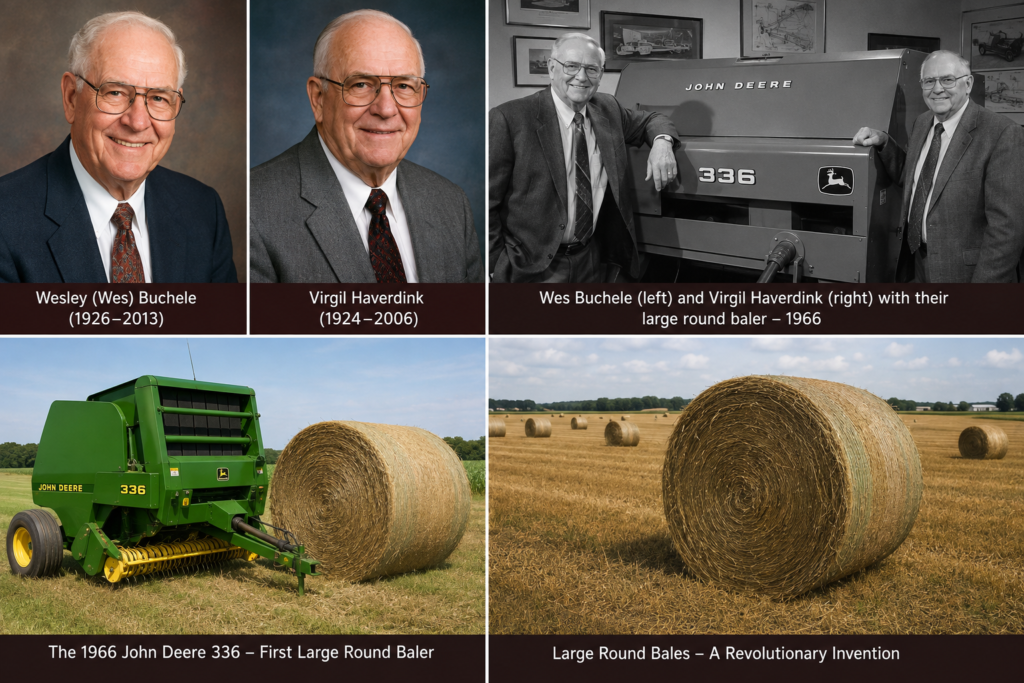
Wesley Buchele and Virgil Haverdink
During the 1960s, agricultural engineers continued working on the idea of large round bales.
At Iowa State University, Wesley Buchele and graduate student Virgil Haverdink worked on a large round baler concept.
Their work demonstrated the potential of producing much larger cylindrical bales.
The development of large round bales was significant because it changed the entire approach to hay handling.
Instead of producing hundreds of relatively small bales, a farmer could produce a smaller number of large bales.
Mechanical equipment could then be used to move those bales.
This was an important step toward the modern system of tractor-based hay production.
—
Gary Vermeer and the Modern Large Round Baler
When discussing the modern large round baler, Gary Vermeer is one of the most important names.
In the late 1960s, Gary Vermeer became interested in solving the labor problems associated with haymaking.
The goal was ambitious: create a system that would allow a farmer to perform most of the haymaking operation with minimal labor.
Vermeer and his engineering team began developing a machine capable of producing large cylindrical bales.
Early prototypes were tested in the field. Like many inventions, the first attempts were not perfect. Engineers had to solve problems related to starting the bale, feeding hay into the chamber, controlling bale shape, and ejecting the finished bale.
Through continued experimentation, the design was improved.
The result was a practical large round baler that helped establish a completely new approach to hay production.
—
The Large Round Baler Revolution
The introduction of the large round baler in the early 1970s was a major turning point.
Large round bales could contain enormous quantities of hay compared with traditional small bales.
This meant farmers could dramatically reduce the number of individual bales they needed to handle.
The machine could travel through the field, collect windrowed hay, form a large cylindrical bale, tie or wrap it, and release it.
A tractor and baler could therefore replace a large amount of manual labor.
The large round baler became particularly useful for cattle farms and other livestock operations that needed large quantities of hay throughout the year.
—
How Does a Round Hay Baler Work?
Although modern machines can be technologically advanced, their basic operation follows several steps.
1. Pickup
The baler begins by collecting hay from the windrow.
A rotating pickup mechanism uses specially designed tines to lift the hay from the ground.
2. Feeding
The collected hay moves into the bale chamber.
The machine must feed the material evenly to create a properly shaped bale.
3. Rolling
Inside the chamber, belts or rollers rotate the hay.
As more material enters, the cylinder becomes larger.
4. Compression
The machine compresses the hay to produce a dense bale.
Bale density is important because a dense bale is easier to transport and can contain more hay in a smaller volume.
5. Wrapping
When the bale reaches the required size, the machine wraps it with twine or netting.
Wrapping keeps the bale together and makes handling easier.
6. Ejection
Finally, the rear gate opens and the completed bale is released.
The tractor can then continue moving through the field to produce another bale.
—
Fixed-Chamber and Variable-Chamber Balers
Modern round balers generally use different types of bale-forming systems.
A fixed-chamber baler forms the bale inside a chamber with a largely fixed size. The bale develops within the chamber until it reaches the required diameter.
A variable-chamber baler allows the chamber to expand as the bale grows. This design can provide greater flexibility in bale size and density.
Both systems have advantages, and farmers choose machines according to their crops, field conditions, livestock requirements, and operating preferences.
—
The Development of Net Wrapping
Wrapping technology has also changed dramatically.
Early baling systems relied heavily on twine. Modern round balers can use net wrap, which can quickly cover the outside of a completed bale.
Net wrapping provides several advantages.
It helps maintain bale shape and can reduce the amount of time required to secure a bale.
Faster wrapping means the baler can return to collecting hay sooner, improving field productivity.
Modern machines may also provide automated wrapping systems that require very little operator intervention.
—
Benefits of the Round Hay Baler
The round hay baler provides many advantages to modern farmers.
Reduced Labor
One of the biggest benefits is the reduction in manual labor.
Large round bales can be moved using tractors and loaders rather than requiring workers to carry them by hand.
Higher Productivity
A modern baler can process large quantities of hay in a relatively short period.
Easier Transportation
Large cylindrical bales can be moved using specialized tractor attachments and trailers.
Efficient Storage
Round bales can be arranged in storage areas and, under suitable conditions, may be stored outdoors.
Better Farm Management
Farmers can produce large quantities of forage during the harvesting season and store it for periods when fresh grass is unavailable.
—
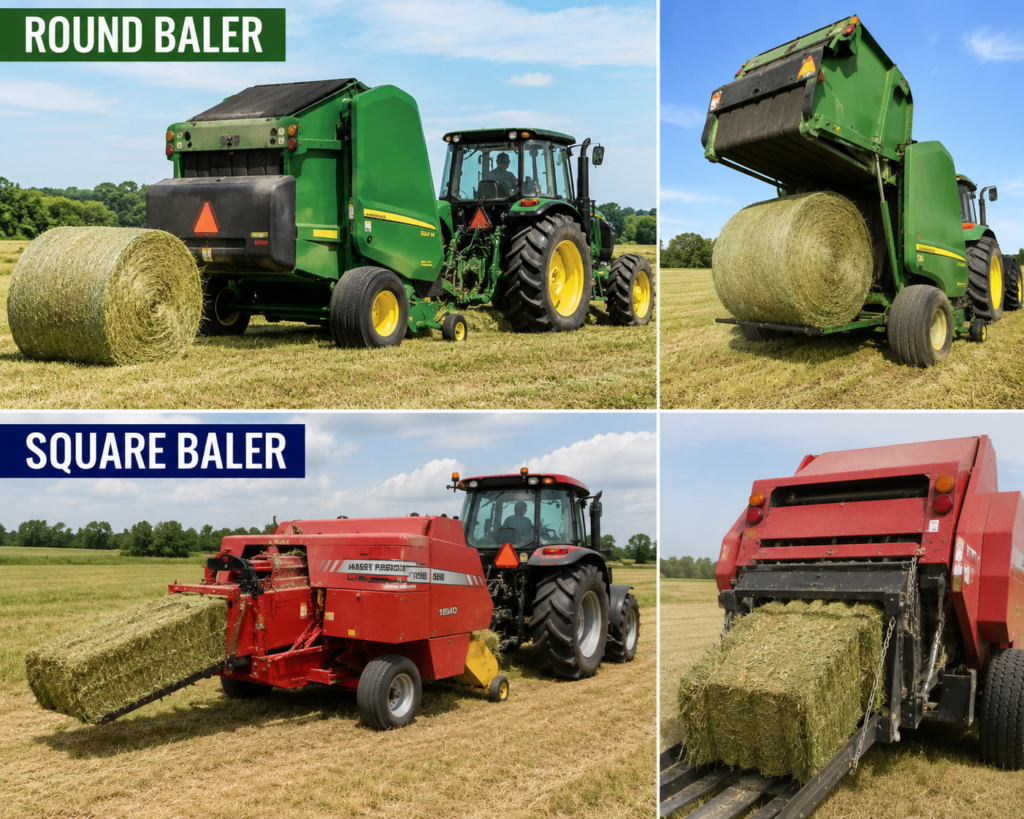
Round Baler vs. Square Baler
Round and square balers are both important agricultural machines.
Small square bales are often easier for people to manually handle and can be convenient for smaller livestock operations, horse farms, and markets where hay is sold individually.
Round bales are generally better suited to large-scale operations where mechanical handling equipment is available.
The choice depends on the farmer’s needs.
Farm size, available labor, livestock numbers, storage facilities, transportation equipment, and local market conditions all influence the decision.
—
The Impact on Livestock Farming
The round hay baler has had a particularly strong impact on livestock farming.
Cattle, horses, sheep, and other livestock often depend on stored forage during periods when pasture growth is limited.
Farmers can harvest hay when weather and crop conditions are favorable and store it for later use.
Large round bales make it practical to store and distribute substantial quantities of forage.
A single large bale can provide feed for many animals, depending on bale size, hay quality, animal numbers, and feeding requirements.
This has made round balers especially valuable to cattle producers.
—
Modern Round Balers
Today’s round balers are far more advanced than the machines developed decades ago.
Modern equipment may include:
Hydraulic systems
Electronic controls
Automatic bale tying
Automatic net wrapping
Bale-density adjustment
Moisture monitoring
Digital displays
Sensors
Automatic bale ejection
Improved pickup systems
These technologies allow farmers to monitor the baling process more closely and improve consistency.
Some modern machines can also communicate important information to the tractor operator, helping identify problems and improve productivity.
—
The Future of Round Baling
The development of the round baler is not finished.
Agricultural machinery manufacturers continue to improve efficiency, reliability, automation, and precision.
Future balers may become increasingly connected and intelligent.
Sensors could provide more detailed information about crop moisture, bale density, machine performance, and field conditions.
Automation may also reduce the amount of work required from the operator.
The goal remains similar to the goal of the early inventors: make hay harvesting faster, easier, and more efficient.
—
Conclusion
The invention of the round hay baler represents one of the most important developments in agricultural mechanization.
Its history began with early experiments in cylindrical hay baling and continued through the work of inventors and agricultural engineers such as Ummo Luebben, John M. Wolf, Wesley Buchele, Virgil Haverdink, and Gary Vermeer.
Each stage of development contributed something important.
Early inventors demonstrated that hay could be rolled into cylindrical packages. Later engineers developed machines capable of producing larger and denser bales. The introduction of the modern large round baler transformed the process by dramatically reducing manual labor.
Today, the round hay baler is an essential machine for many hay and livestock farms around the world.
What began as a simple idea—rolling hay into a round bale—eventually became a sophisticated agricultural technology capable of harvesting and packaging huge quantities of forage efficiently.
The round hay baler is more than just a machine. It represents the evolution of farming from highly manual labor toward modern mechanized agriculture, helping farmers save time, reduce physical effort, increase productivity, and manage livestock feed more efficiently.
Its continuing development shows that agricultural innovation never truly stops. As technology advances, the humble round bale will likely remain an important part of farming for many years to come.


Post Comment