Walter O. Snelling: The American Chemist Who Helped Put Propane in a Bottle
Every time an American family turns on an LPG or propane stove, they are using the result of more than a century of chemistry, engineering and industrial innovation.
But in the early 1900s, propane was not a familiar household fuel.
Gasoline was the fuel of a rapidly changing America, automobiles were beginning to transform transportation, and petroleum companies were learning how to make better use of every part of the refining process.
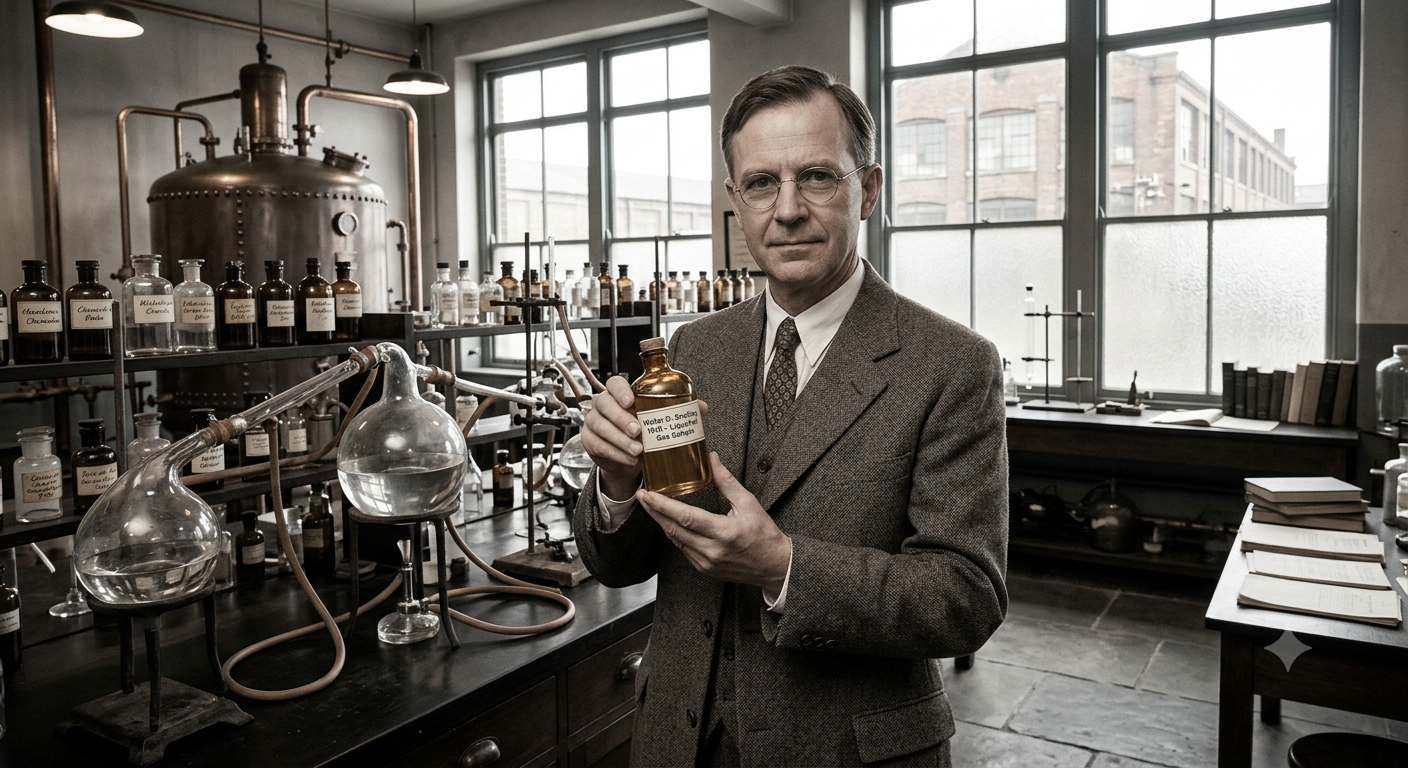
Then an American chemist began investigating something that many people might have considered nothing more than a dangerous waste product: the volatile vapors escaping from gasoline.
His name was Dr. Walter Otheman Snelling.
Snelling did not invent the modern LPG cylinder single-handedly. The cylinder itself evolved through the work of many engineers and manufacturers over subsequent decades. But Snelling played an important role in the early development of commercial propane and liquefied petroleum gas (LPG).
His experiments helped show that propane and related gases could be separated, liquefied and stored under pressure—and that these gases could become useful fuels.
That idea helped lay part of the foundation for the portable propane industry Americans know today.
An American Chemist With a Curious Mind
Walter Otheman Snelling was born on December 13, 1880, in Washington, D.C.
He studied chemistry and developed a career that combined scientific research with practical industrial problems. Before his propane work, he had experience with the U.S. Geological Survey and later joined the U.S. Bureau of Mines.
The Bureau of Mines was dealing with some of the most difficult and dangerous problems associated with America’s rapidly expanding mining and energy industries.
Snelling’s work included investigations involving explosives, fuels and industrial chemistry.
It was this scientific background that eventually led him to investigate gasoline vapors.
And what he found would have consequences far beyond the laboratory.
The Gasoline Vapor Problem
At the beginning of the automobile age, gasoline was not the highly refined and carefully controlled product consumers know today.
It contained volatile components that could evaporate easily.
Those vapors could be hazardous, but Snelling realized they might also contain valuable hydrocarbons.
Instead of simply asking how to control the vapors, he investigated what they actually contained.
His experiments led him to focus on several light hydrocarbons, including propane.
Propane was not discovered by Snelling—it had been identified by earlier chemists—but his work helped demonstrate its practical potential as a fuel.
This distinction matters.
Snelling’s importance was not that he suddenly discovered an unknown gas. His contribution was helping transform a chemical substance into a practical, recoverable and commercially useful fuel.
The Propane Breakthrough
One of the remarkable properties of propane is that it can be stored as a liquid under pressure.
That makes it possible to transport and store a substantial quantity of fuel in a relatively compact container.
When the pressure is reduced, the liquid propane vaporizes into a gas.
That gas can then be burned to produce heat.
This simple physical principle is at the heart of propane and LPG systems.
Snelling’s experiments helped demonstrate the commercial possibilities of recovering these light hydrocarbons from petroleum-related sources.
A substance that could have been regarded as an unwanted vapor could instead become a valuable product.
That was an important shift in thinking.
From Laboratory Experiment to American Business
Snelling’s work soon moved beyond scientific research.
He became associated with Frank P. Peterson, Chester Kerr and Arthur Kerr in developing processes for recovering liquefied petroleum gases.
Their efforts helped lead to the formation of the American Gasol Company, an early company involved in marketing propane.
This was a critical stage in the story.
Science had identified a useful fuel.
Now industry had to figure out how to produce it, store it, transport it and sell it.
That transition—from laboratory discovery to commercial product—is often where the biggest technological challenges begin.
An Early American Home Uses Propane
One of the most interesting parts of the early propane story is its connection to an ordinary American home.
Historical accounts identify John Gahring as an early consumer of propane.
In 1912, propane was reportedly used at his home for lighting and cooking.
Imagine what that meant at the time.
Electricity was still spreading across America. Natural-gas pipelines did not reach every community. Rural households often depended on fuels that required significant storage and transportation.
A fuel that could be stored in a container and used when needed offered a completely different possibility.
Propane could be delivered to places that did not have access to a conventional gas pipeline.
The idea was simple, but its potential was enormous.
Snelling’s 1913 Patent
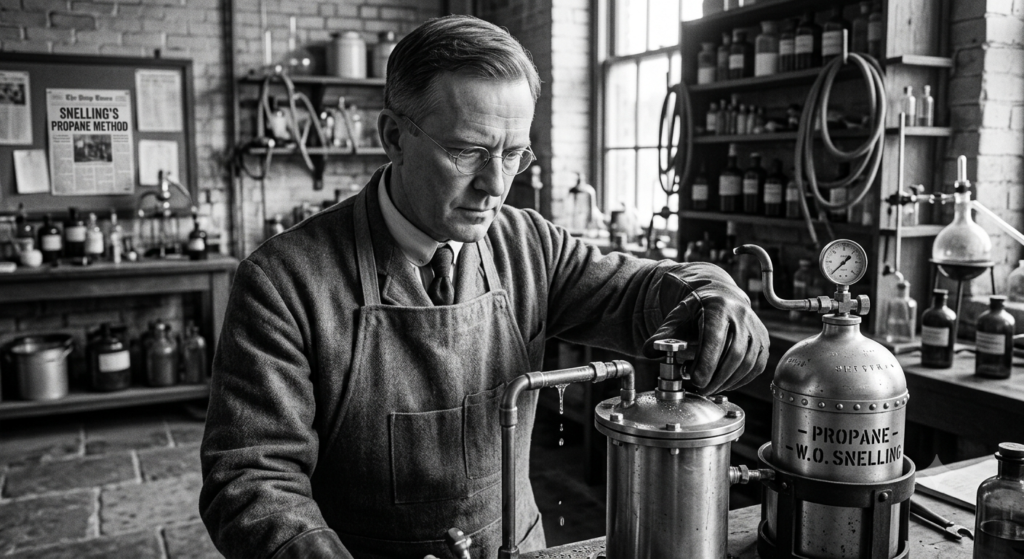
Snelling’s research also resulted in an important U.S. patent.
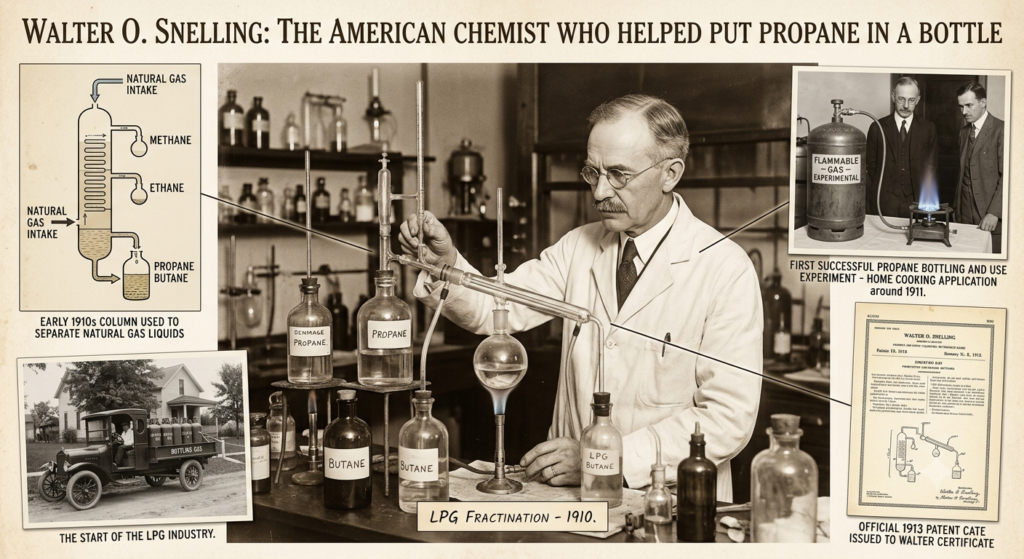
On March 25, 1913, he received U.S. Patent No. 1,056,845, titled “Process of Refining Natural-Gas Gasolene.”
The patent dealt with processing natural-gas gasoline and recovering valuable components.
It is an important document in the history of Snelling’s work because it shows that his contribution was closely connected to the practical recovery and processing of petroleum-related gases.
This is also why describing Snelling simply as “the inventor of the LPG cylinder” is misleading.
The modern cylinder was not created by one person in one moment.
Instead, propane storage developed through a long process involving chemistry, pressure vessels, valves, transportation systems, filling equipment and safety engineering.
Snelling was an important early figure in the fuel and propane side of that story.
The $50,000 Deal
Snelling’s work attracted commercial attention.
Historical accounts state that in 1913, he sold his propane-related patent interest to Frank Phillips, the founder of Phillips Petroleum Company, for approximately $50,000.
For the early twentieth century, that was a substantial amount of money.
The transaction demonstrated that the petroleum industry was beginning to recognize the commercial value of liquefied petroleum gases.
The idea was no longer just a scientific curiosity.
Propane had become a potential business.
A New Kind of Portable Energy
The significance of propane went beyond the fuel itself.
It created the possibility of portable gas energy.
A household did not necessarily need a permanent pipeline connection.
A farmer did not necessarily need to live near a natural-gas network.
A business could store fuel on-site.
A cylinder or tank could be filled, transported and connected to an appliance.
That flexibility eventually made propane valuable across rural America and in industries ranging from agriculture to manufacturing.
Propane could be used for:
– Cooking
– Home heating
– Water heating
– Farm operations
– Industrial heating
– Metal cutting
– Drying
– Commercial kitchens
– Backup energy
The technology continued to evolve, but the underlying concept remained remarkably consistent.
Store the fuel as a liquid. Release it as a gas. Burn it for energy.
The Industry Grows
The propane industry did not become a national phenomenon overnight.
During the 1920s and 1930s, companies continued developing better methods for producing, transporting and distributing liquefied petroleum gases.
Railroad transportation became important.
Storage facilities expanded.
Bottle-filling operations developed.
Odorization became an important safety measure because propane itself is naturally odorless.
As the infrastructure improved, propane became increasingly practical for consumers and businesses.
The industry was building a system around the scientific principle that Snelling and other early researchers had helped establish.
What About the LPG Cylinder?
This is where the history often becomes oversimplified.
You may see Walter O. Snelling described online as the “inventor of the LPG cylinder.”
A more historically careful description is that he was an early pioneer of commercial propane and liquefied petroleum gas technology.
The modern LPG cylinder was developed over time.
It required advances in:
– Pressure-vessel design
– Steel manufacturing
– Valves
– Regulators
– Transportation
– Filling systems
– Safety standards
– Leak prevention
– Gas distribution
Many engineers and companies contributed to those developments.
Snelling’s contribution came much earlier, when scientists and industrialists were still figuring out how to make liquefied petroleum gases commercially useful.
So the better question is not:
“Did Snelling invent the LPG cylinder?”
It is:
“Did Snelling help make the portable propane industry possible?”
The historical evidence supports that description much more clearly.
More Than a Propane Pioneer
Propane was only one part of Walter Snelling’s remarkable career.
He continued working in science and industry long after his early petroleum experiments.
His career included research involving explosives, industrial chemistry and military technology.
The Science History Institute’s archival collection records a large body of his work, including patents, correspondence and technical documents.
By 1960, 179 patents had been issued in his name, according to the institute’s archival description.
That is an extraordinary record.
It shows that Snelling was not simply a one-discovery inventor.
He was a prolific American scientist who spent decades applying chemistry to practical problems.
Why His Story Matters Today
The story of Walter O. Snelling is especially interesting because it demonstrates how major innovations often begin with something ordinary.
He was not trying to create the modern kitchen LPG cylinder.
He was investigating gasoline vapors.
He wanted to understand what was in them and whether they could be controlled and used.
That curiosity led to a chain of developments.
Scientific research led to a better understanding of propane.
That understanding led to methods for recovering and liquefying it.
Commercial companies began marketing the fuel.
Engineers developed better containers and distribution systems.
Consumers began using propane.
Eventually, propane became a familiar part of everyday American life.
Today, millions of people can use propane without knowing anything about the chemistry behind it.
They simply turn a valve and light a burner.
But that ordinary action is connected to a long history of American science and engineering.
The American Behind the Idea
Walter O. Snelling died on September 10, 1965, in Allentown, Pennsylvania.
He was 84.
By the time of his death, the fuel industry had changed dramatically from the world he knew in 1910.
Automobiles had transformed transportation.
Petroleum refining had become a massive industry.
Propane had become an established fuel.
And the basic concept he helped develop—recovering useful gases, liquefying them and storing them under pressure—had become part of everyday energy infrastructure.
His story is therefore not simply about a gas.
It is about seeing opportunity in something others might overlook.
From Gasoline Vapors to the Modern Propane Cylinder
More than a century ago, Walter O. Snelling looked at volatile gasoline vapors and recognized that they might have value.
That insight helped open a new chapter in American fuel history.
He did not design the modern LPG cylinder by himself.
He did not single-handedly create the propane industry.
But his research helped demonstrate that propane could be recovered, liquefied, stored and used as a practical fuel.
That contribution mattered.
Today, propane cylinders can be found beside homes, restaurants, farms, workshops and businesses across America.
The technology may look simple.
But behind that cylinder is a century of chemistry, engineering and industrial development.
And near the beginning of that story stands an American chemist whose curiosity helped turn an unwanted vapor into a valuable source of energy.
Dr. Walter O. Snelling helped put propane on the path from laboratory chemistry to everyday life.
That is why his name deserves a place in the history of American innovation.

Post Comment