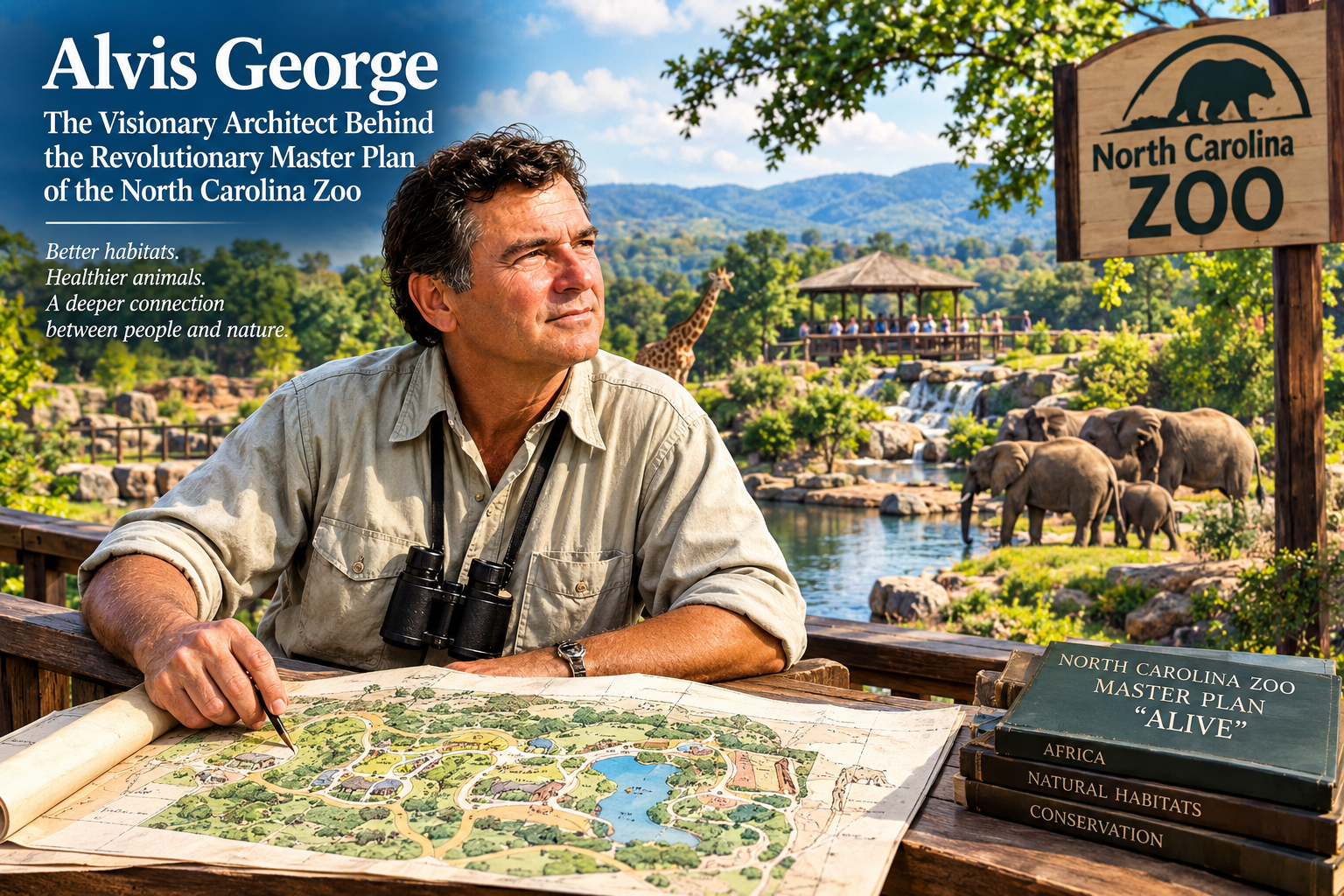
Alvis George: The Visionary Behind the Revolutionary Master Plan of the North Carolina Zoo
When people think about great American zoos, they often imagine impressive animals, enormous habitats, and beautiful landscapes. But behind some of America’s most ambitious zoological projects are architects and planners whose names are less familiar to the public.
One of those men was Alvis Owen George Jr., an architect from North Carolina whose vision helped shape one of the most ambitious zoological projects in the United States: the North Carolina Zoo in Asheboro.
George played a major role in developing the zoo’s original master plan. His contribution was not simply about designing buildings. He was part of a team that imagined an entirely different kind of zoo—one in which animals would have large, naturalistic environments rather than being confined to small traditional cages.
The idea was revolutionary for its time.
Instead of creating a conventional city zoo packed with small exhibits, the planners wanted a huge zoological park where animals could live in environments that more closely resembled their natural surroundings.
That vision eventually helped make the North Carolina Zoo famous for its expansive habitats and open landscapes.
A Different Idea of What a Zoo Could Be
During the 1960s and early 1970s, many traditional zoos were organized around relatively compact animal exhibits. Visitors could move from one cage or enclosure to another, seeing large numbers of species in a relatively small area.
The people planning North Carolina’s new zoo wanted something different.
They envisioned a large zoological park with room to grow, rather than a traditional urban zoo constrained by limited land. The philosophy emphasized animal welfare, conservation, education, research, recreation, and natural surroundings.
This philosophy became central to the original master plan known as “ALIVE.”
The plan went far beyond simply deciding where to put animal exhibits. It considered the site’s geology, hydrology, soils, vegetation and future development. It also envisioned major continental regions and a large-scale zoological complex.
Alvis George became one of the key architects involved in turning that ambitious idea into a physical plan.
The Journey That Changed the Project
One of the most fascinating parts of George’s story was a research trip undertaken before the zoo’s permanent design was developed.
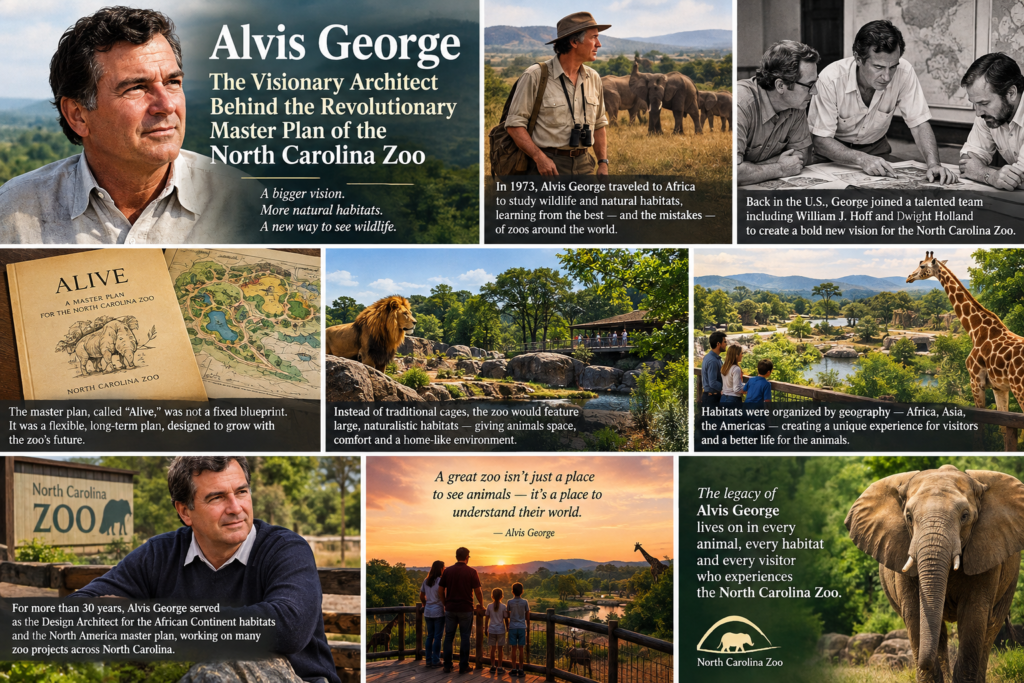
In 1973, Alvis George traveled with zoo director William Hoff and other professionals to Africa and Europe to study zoos and wildlife environments. The trip lasted approximately four weeks and included visits to well-known zoological institutions.
The purpose was not simply to copy successful exhibits.
According to accounts of the project, the team wanted to examine what other zoos did well—and what they did poorly—so that North Carolina could create something better.
That approach was important.
The planners were effectively asking a new question:
What if a zoo could be designed around the needs of the animals rather than around the limitations of traditional zoo architecture?
That question became one of the foundations of the North Carolina Zoo.
Africa Became a Source of Inspiration
The African landscape had a particularly strong influence on the team’s thinking.
George and his colleagues traveled through Africa to observe animals and their surroundings. The experience helped inform the natural-habitat concept that became part of the original master plan.
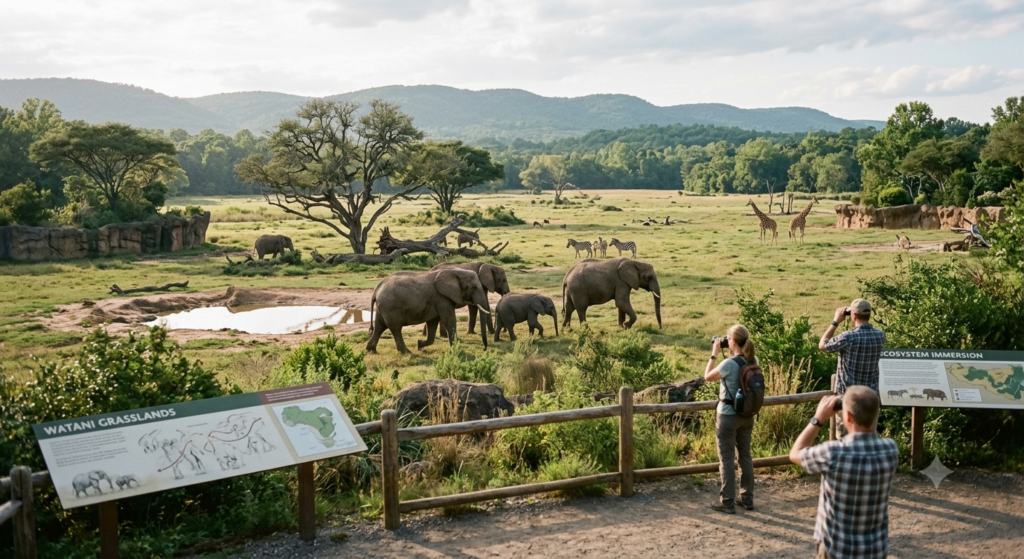
Rather than putting an elephant, lion or giraffe into a small enclosure surrounded by concrete walls, the goal was to create a landscape in which the visitor felt separated from the animal by distance, terrain and natural barriers.
This changed the visitor experience as well.
Instead of simply looking at an animal behind a fence, visitors could encounter an environment.
The landscape itself became part of the exhibit.
From Traditional Zoo to Zoological Park
The distinction was significant.
The planners were not thinking of the project as merely a collection of animal displays. The original vision described a much broader institution combining wildlife habitats, conservation, research, education and recreation.
That philosophy explains why the zoo was given such an enormous site.
The original project had roughly 1,300 acres available, giving the planners an extraordinary amount of room to work with.
Such a large site allowed them to think decades into the future.
Instead of asking, “Where can we put the next exhibit?” they could ask, “What could this entire landscape become?”
That long-term thinking became one of the project’s greatest strengths.
The “ALIVE” Master Plan
The master plan developed in the 1970s became a blueprint for the zoo’s future.
According to the North Carolina Zoo’s historical publication, the plan was essentially the design philosophy that would guide future development. It included detailed studies of the site’s physical characteristics and proposed future exhibit clusters representing continental regions.
The vision was extraordinary for its time.
The original concept ultimately envisioned a zoo representing the world’s continents rather than simply assembling unrelated animals.
Africa was among the first major regions developed. North America followed later, and the zoo has continued working toward the broader continental vision established decades earlier.
In other words, the zoo that visitors see today is partly the result of decisions made during the 1970s.
Designing for the Animals
Perhaps George’s most important contribution was the emphasis on natural habitats.
The objective was to provide animals with significantly more space and environments that encouraged more natural behavior.
This could mean trees, rocks, water, hills, vegetation and large areas in which animals could move away from visitors.
For the public, that sometimes meant the animals were farther away than they might be in a traditional zoo.
But that was intentional.
The visitor was being invited to enter the animal’s world rather than forcing the animal into the visitor’s world.
This was a fundamental philosophical change.
A Zoo Built to Grow
Another remarkable aspect of the project was its commitment to future expansion.
The planners did not want the zoo to reach its limits after a few decades. They wanted land and infrastructure that could accommodate future generations.
That philosophy proved remarkably successful.
Over the following decades, the North Carolina Zoo expanded its habitats and eventually became recognized as one of the world’s largest natural-habitat zoos by developed acreage. One account describes the developed area reaching about 500 acres with roughly 1,800 animals.
The enormous scale made the zoo fundamentally different from many urban zoological parks.
Visitors were not simply walking between rows of exhibits.
They were traveling through a landscape.
Alvis George’s Broader Architectural Career
The North Carolina Zoo was only one part of Alvis George’s architectural career.
He worked on numerous projects throughout North Carolina, including schools, libraries, community-college buildings and other public facilities. NCModernist records that he designed more than 20 buildings for community colleges and played a major role in the development of the North Carolina Zoological Park.
But the zoo remained one of his most distinctive accomplishments.
His work demonstrated how architecture could extend beyond conventional buildings.
A zoo required architecture, landscape planning, engineering, animal management, ecology and visitor circulation to work together.
The result was essentially an enormous living architectural project.
A Vision That Lasted for Decades
George’s relationship with the zoo did not end when the original master plan was completed.
According to historical accounts, he continued working with zoo leaders for approximately three decades, until his death in 2001.
His involvement therefore spanned much of the zoo’s formative history.
That longevity is important because large public projects rarely appear exactly as they were originally imagined.
Budgets change.
Technology changes.
Animal-care standards change.
Visitor expectations change.
Landscapes mature.
New conservation priorities emerge.
Yet the fundamental idea behind the North Carolina Zoo remained remarkably durable: give wildlife space, create naturalistic habitats and make conservation and education central to the visitor experience.
The North Carolina Zoo’s Continuing Evolution
The original vision did not end with the first habitats.
The zoo has continued to evolve and expand.
Recent plans have included new continental regions and major improvements to habitats and visitor infrastructure. The zoo’s long-term development has continued to draw upon the idea of creating large naturalistic environments while supporting conservation, education and recreation.
The modern zoo therefore represents a mixture of old vision and new technology.
The original planners provided the enormous canvas.
Later generations have continued painting on it.
Why Alvis George Matters
Alvis George’s story is interesting because his most important achievement was not a single famous building.
It was an idea.
He helped demonstrate that architecture could be used to change the relationship between humans and wildlife.
Instead of asking how many animals could be displayed in the smallest possible space, the North Carolina Zoo’s planners asked how much space could be given to animals and how visitors could experience them within a natural landscape.
That was a profound shift.
It reflected changing attitudes toward animal welfare, conservation and environmental education during the twentieth century.
And it helped establish a model that would influence how people thought about modern zoological parks.
A Legacy Written Across the Landscape
Today, millions of visitors can experience the results of decisions made by George and his colleagues decades ago.
They may not know his name.
They may come to see elephants, lions, giraffes, bears, gorillas or other wildlife.
They may remember the enormous habitats, the walking trails and the feeling of being surrounded by nature.
But behind that experience lies a remarkable planning story.
Alvis George helped imagine a zoo that was not simply a collection of cages.
He helped envision a zoological park.
The difference is more than a change of words.
It represents a change in philosophy.
The North Carolina Zoo was designed to give animals room, give landscapes importance and give visitors an opportunity to understand wildlife in a more natural setting.
The original master plan, developed in the 1970s, was ambitious enough to look decades into the future. Its continental vision continues to influence the zoo’s development today.
For Alvis George, architecture became something larger than buildings.
It became a way to shape an environment.
And in Asheboro, North Carolina, that environment became one of America’s most remarkable zoological landscapes.
Post Comment