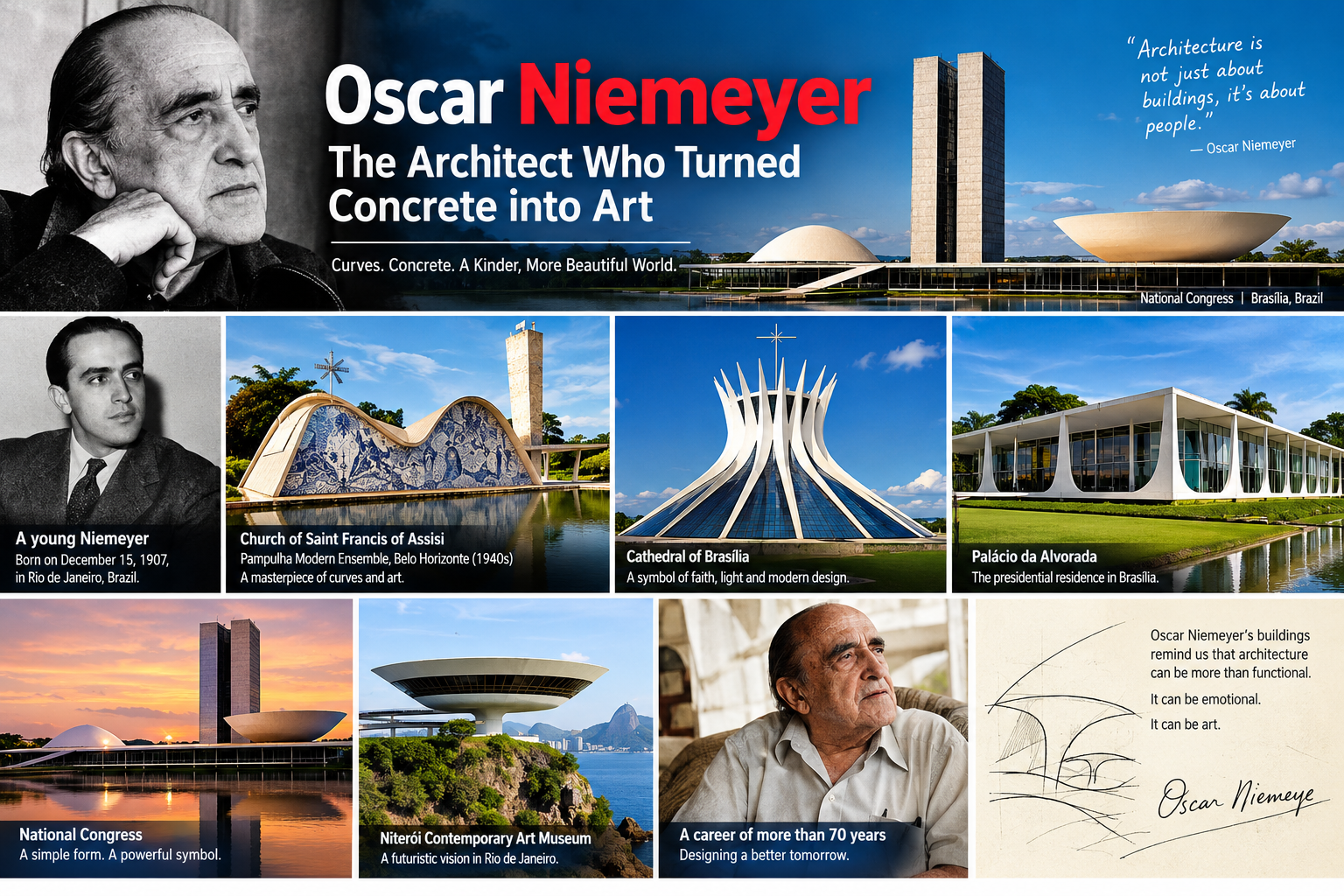
Oscar Niemeyer: The Architect Who Turned Concrete into Art
Oscar Niemeyer was one of the most influential architects of the 20th century. Born in Rio de Janeiro, Brazil, in 1907, he became famous for transforming reinforced concrete into expressive, sculptural architecture. His buildings were not simply designed to serve a purpose; they were created to make people feel something.
Niemeyer’s architecture was recognized for its sweeping curves, dramatic structures, open spaces, and bold use of concrete and glass. His work helped shape the appearance of modern Brazil, particularly the extraordinary buildings of Brasília, the capital city inaugurated in 1960.
Over a career lasting more than seven decades, Niemeyer worked on major projects in Brazil and around the world. His buildings became symbols of modernism and demonstrated that architecture could be both functional and artistic.
Early Life in Rio de Janeiro
Oscar Ribeiro de Almeida Niemeyer Soares Filho was born on December 15, 1907, in Rio de Janeiro, Brazil.
He grew up in a period when Brazilian cities were changing rapidly. Rio de Janeiro was already an important cultural center, and architecture was beginning to move away from traditional European styles toward modern ideas.
Niemeyer studied at the National School of Fine Arts in Rio de Janeiro. He graduated in architecture in 1934.
Instead of immediately establishing a large independent practice, he joined the studio of architect Lúcio Costa. This decision became an important step in his career.
Costa was one of Brazil’s leading modernist architects, and his office was involved in important architectural projects. Niemeyer had the opportunity to work with some of the most influential figures in modern architecture.
One of them was the famous architect Le Corbusier.
The experience would influence Niemeyer, but he would eventually develop an architectural style that was distinctly his own.
The Beginning of a Unique Style
Modern architecture was often associated with straight lines, geometric shapes, simplicity, and functional design.
Niemeyer approached modernism differently.
He became fascinated by the possibilities of curves.
For him, architecture did not always have to follow rigid geometric patterns. Reinforced concrete could be shaped into flowing forms that interacted with the surrounding landscape.
This idea became one of the defining characteristics of his work.
His buildings could appear to rise from the ground, float above a landscape, or curve around an open space.
Instead of hiding concrete as a purely structural material, Niemeyer made it an important part of the artistic expression of his buildings.
The Pampulha Modern Ensemble
One of Niemeyer’s major early breakthroughs came in Belo Horizonte, Brazil.
In the early 1940s, he was commissioned to design several buildings around Pampulha Lake.
The project included a casino, restaurant, yacht club, and the Church of Saint Francis of Assisi.
Niemeyer worked with several important Brazilian artists and designers, including painter Cândido Portinari and landscape architect Roberto Burle Marx.
The result was unlike conventional architecture of the period.
The Church of Saint Francis of Assisi became particularly famous for its curved concrete forms and distinctive blue-and-white tile artwork.
The Pampulha project demonstrated that modern architecture could combine structure, art, landscape, and culture.
The Pampulha Modern Ensemble was later recognized by UNESCO as a World Heritage site.
It became an important milestone in the development of modern architecture in Brazil.
Designing a New Capital
Niemeyer’s most famous chapter began in the 1950s.
Brazilian President Juscelino Kubitschek wanted to establish a new capital in the country’s interior.
The project was ambitious: Brazil would build an entirely new capital city.
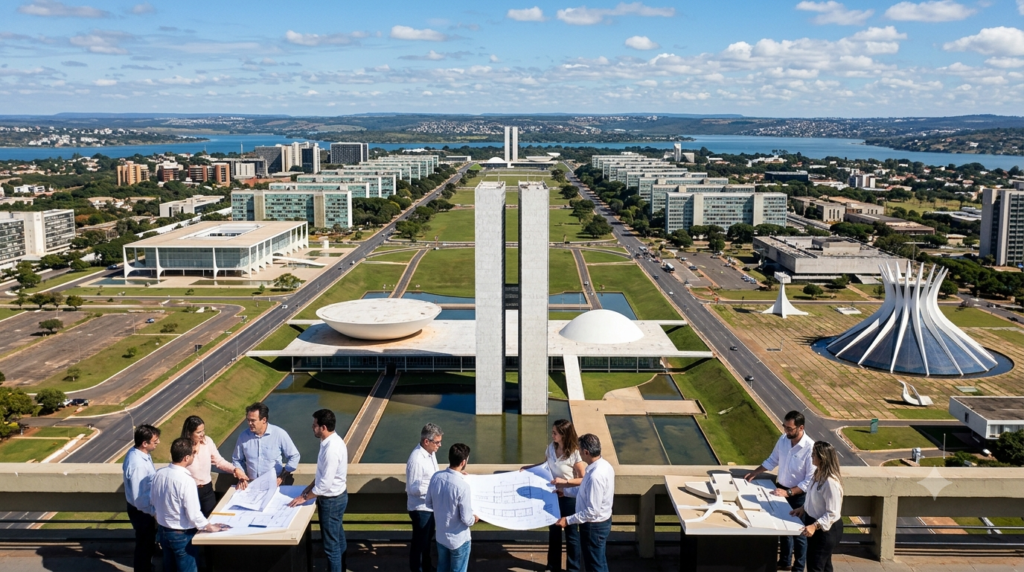
Lúcio Costa was selected to create the city’s urban plan, while Oscar Niemeyer was responsible for designing many of its most important public buildings.
Construction of Brasília began in 1956.
Niemeyer was given an extraordinary opportunity.
Instead of designing one building within an existing city, he was helping create the architectural identity of an entirely new capital.
His designs included the National Congress, the Presidential Palace, the Supreme Federal Court, the Cathedral of Brasília, and other important structures.
Brasília was officially inaugurated as Brazil’s capital on April 21, 1960.
The National Congress
The National Congress became one of the most recognizable symbols of Brasília.
The building consists of two tall towers accompanied by two large bowl-shaped structures.
One bowl faces upward while the other faces downward.
The simple but dramatic composition created a powerful visual symbol for the new capital.
The building demonstrated one of Niemeyer’s greatest strengths: creating monumental architecture with relatively simple geometric elements.
The National Congress became an instantly recognizable image of Brasília and modern Brazilian architecture.
The Cathedral of Brasília
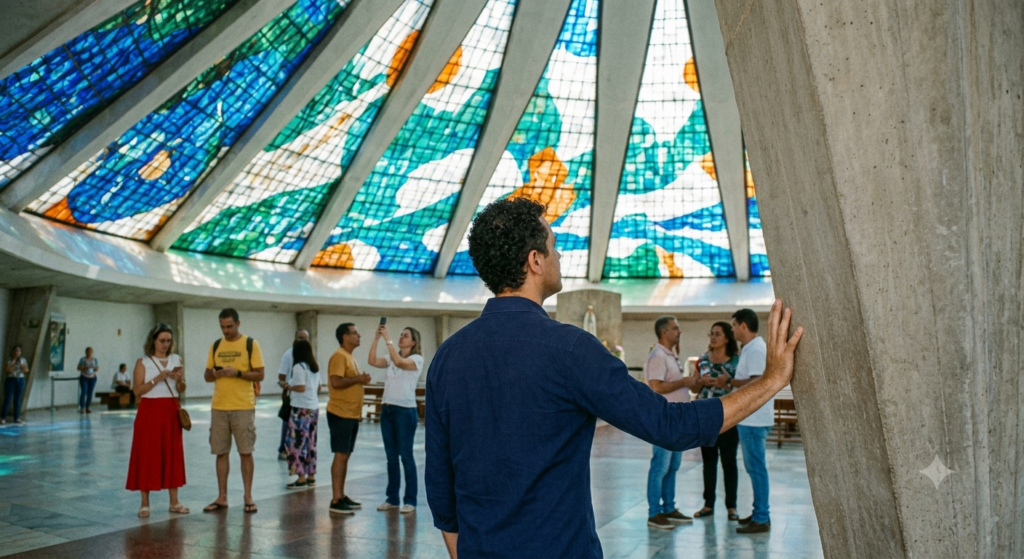
Another masterpiece of Niemeyer’s Brasília work is the Cathedral of Brasília.
The cathedral looks dramatically different from traditional churches.
Instead of conventional walls and a rectangular structure, Niemeyer created a circular building surrounded by enormous curved concrete elements that rise toward the sky.
The structure allows natural light to enter the interior through large areas of colored glass.
Inside, visitors experience a combination of light, height, color, and curved architectural forms.
The cathedral demonstrates Niemeyer’s belief that architecture could create an emotional experience rather than simply provide a functional space.
Architecture as Art
Niemeyer often treated architecture as an artistic discipline.
He believed that beauty mattered.
His work challenged the idea that modern architecture needed to be completely rigid or purely functional.
His famous use of curves became a visual signature.
Concrete could bend.
Walls could flow.
Buildings could become sculptures.
This approach gave his architecture a distinctive identity.
His sketches were also important. Niemeyer frequently began with drawings that explored the shape and movement of a building before the final technical design was developed.
His architectural archive later became an important record of his creative process.
International Recognition
Niemeyer’s reputation soon extended beyond Brazil.
In 1947, he participated in the international team involved in designing the United Nations Headquarters in New York City.
His international career continued to grow over the following decades.
He designed buildings in Europe, North Africa, and other parts of the world.
Among his notable international works were the headquarters of the French Communist Party in Paris and major projects in Algeria.
His architecture demonstrated that his design language could work in different cultural and geographical settings.
Political Challenges and Exile
Niemeyer’s professional life was also affected by political events in Brazil.
He was a member of the Brazilian Communist Party, and following Brazil’s military coup in 1964, his political position contributed to difficulties in continuing his architectural work in the country.
He spent periods working abroad and continued designing buildings internationally.
During this period, architecture became an important way for him to continue his creative work even while Brazil was experiencing political change.
Eventually, he returned to Brazil and resumed major architectural projects.
The Niterói Contemporary Art Museum
One of Niemeyer’s later masterpieces appeared in Rio de Janeiro’s neighboring city of Niterói.
The Niterói Contemporary Art Museum was completed in the 1990s.
The building resembles a futuristic flying saucer resting above the landscape.
Its circular form overlooks Guanabara Bay and creates a dramatic relationship between architecture, ocean, sky, and surrounding mountains.
The museum became one of the most recognizable landmarks in the region.
It also demonstrated that Niemeyer’s architectural imagination remained powerful even decades after his earliest successes.
A Career That Lasted More Than 70 Years
Niemeyer’s career was extraordinary in its length.
He worked through generations of architectural change and continued designing projects when many architects had already retired.
His work appeared in different countries and across different types of buildings.
But the fundamental elements of his architecture remained recognizable.
Curves.
Concrete.
Light.
Space.
And monumental simplicity.
His buildings were often instantly identifiable as Niemeyer designs.
Oscar Niemeyer’s Legacy
Oscar Niemeyer died in Rio de Janeiro on December 5, 2012, at the age of 104, just ten days before his 105th birthday.
By the time of his death, he had become one of the most internationally recognized Brazilian architects in history.
His greatest architectural legacy can be seen in Brasília.
The city transformed the idea of what a modern capital could look like. Its monumental buildings, open spaces, and carefully planned urban design created a unique architectural environment.
UNESCO recognized Brasília as a World Heritage site in 1987, describing it as an important landmark in 20th-century urban planning.
Niemeyer’s influence extends far beyond Brazil.
Architects, designers, and students continue to study his buildings because they demonstrate how structure and artistic expression can work together.
His career also showed that modern architecture did not have to be cold or unimaginative.
Modern buildings could be dramatic.
They could be emotional.
They could have movement.
And they could become symbols of an entire nation.
The Man Who Made Concrete Move
Oscar Niemeyer changed the way many people imagined concrete.
To some architects, concrete was primarily a structural material.
To Niemeyer, it could become a sculptural medium.
His sweeping curves and monumental forms gave his buildings a sense of movement and lightness.
From the Pampulha complex to the monumental buildings of Brasília and the futuristic Niterói Contemporary Art Museum, Niemeyer repeatedly demonstrated that architecture could be both practical and poetic.
His work remains visible across Brazil and around the world.
More than a century after his birth, the curves of his buildings continue to attract visitors, photographers, architects, and artists.
Oscar Niemeyer did not simply design buildings.
He transformed architecture into a form of visual poetry—and showed the world that even concrete could move.

Post Comment