Emiliano Zapata: The Revolutionary Who Fought for Land and Liberty
In the history of the Mexican Revolution, few figures became as closely associated with the struggle for land as Emiliano Zapata. A farmer, village leader, military commander, and revolutionary, Zapata emerged from the southern Mexican state of Morelos and built a movement around a simple but powerful demand: land taken from villages should be returned to the people who worked it.
Born in 1879, Zapata lived through a period when Mexico was undergoing major economic and political changes. Large haciendas expanded in many parts of the country, while rural communities saw traditional lands come under increasing pressure. For Zapata and the villagers of Morelos, the issue was not simply political power. It was the question of who would control the land on which families depended.
His name would eventually become inseparable from the slogan “Tierra y Libertad” — “Land and Liberty.” His movement, known as Zapatismo, became one of the most important agrarian movements of the Mexican Revolution.
A Childhood in Morelos
Emiliano Zapata was born on August 8, 1879, in the village of Anenecuilco in the state of Morelos, south of Mexico City.
He grew up in a rural environment where agriculture was central to community life. Zapata received some education and learned to read and write, but his formal schooling was limited. His experiences in Morelos exposed him to the growing conflict between village communities and large haciendas.
During the years of President Porfirio Díaz, Mexico experienced economic modernization, including the expansion of commercial agriculture. But the benefits of modernization were not distributed equally. In Morelos, large estates increasingly acquired land that villages had traditionally controlled.
The Library of Congress records that Zapata had already begun working to recover village land by 1906. In 1909, local residents elected him president of the village council of Anenecuilco.
This local struggle would eventually become the foundation of his revolutionary career.
The Beginning of the Mexican Revolution
Mexico entered a period of political upheaval in 1910 when Francisco I. Madero challenged the long rule of Porfirio Díaz.
Madero called for political change and opposed Díaz’s continued control of the country. His rebellion helped ignite what became the Mexican Revolution.
Zapata joined the revolutionary movement, but his primary concern remained the land question.
In the spring of 1911, Zapata and his followers captured the important city of Cuautla in Morelos. His forces demonstrated that the revolutionary movement in the south could challenge government troops.
After Díaz’s government collapsed, however, Zapata’s relationship with Madero deteriorated.
Madero wanted to establish a new political order and restore constitutional government. Zapata and his followers wanted concrete action on land.
For the villagers of Morelos, political change alone did not solve the problem they had been fighting for years.
Why Zapata Refused to Give Up His Weapons
One of the major disagreements between Zapata and Madero concerned disarmament.
Madero expected revolutionary forces to lay down their weapons as the new political system was established. Zapata was unwilling to do so without meaningful progress on land reform.
The disagreement became increasingly serious.
Zapata believed that promises were not enough. His movement wanted the restoration of lands that had been taken from village communities.
Instead of ending his struggle, Zapata continued the rebellion.
This placed him in opposition not only to the old Díaz government but also to the new government that had emerged from the revolution.
The Plan of Ayala
In November 1911, Zapata and schoolteacher Otilio E. Montaño helped produce one of the most important documents associated with the Mexican Revolution: the Plan of Ayala.
The document was signed on November 25 and proclaimed at Ayala, Morelos, on November 28, 1911. It became the political and agrarian blueprint of the Zapatista movement.
The Plan of Ayala accused Madero of failing to fulfill the promises associated with the revolution.
More importantly, it laid out specific demands concerning land.
The plan called for the return of lands taken from villages during the Porfiriato. It also proposed the redistribution of large haciendas under specified conditions.
The Library of Congress describes the document as the foundation of the Zapatista agrarian rebellion.
For Zapata’s followers, the revolution was therefore not simply about replacing one political leader with another. It was about changing the relationship between rural communities and landowners.
The Zapatista Army
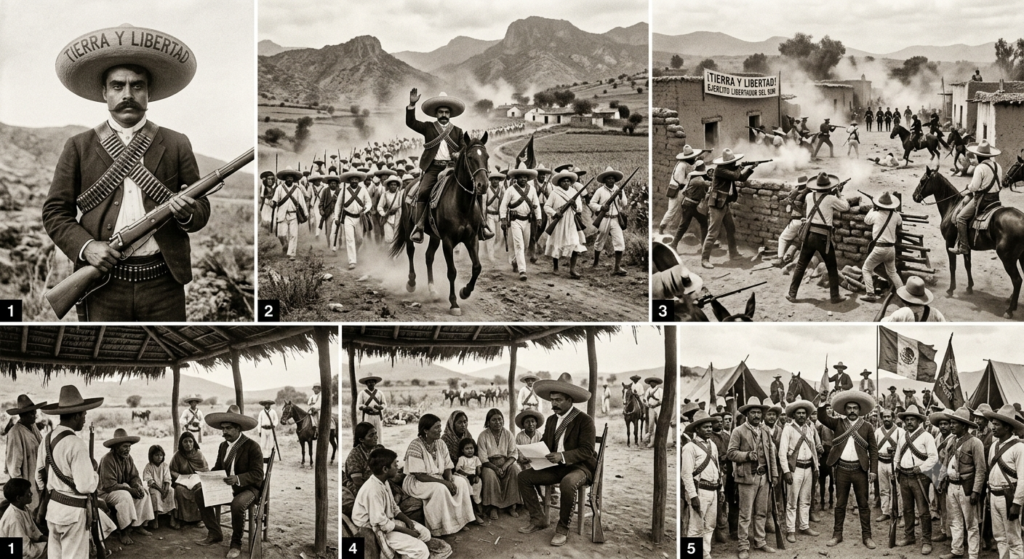
Zapata’s forces were not a conventional national army in the modern sense.
The movement was based heavily in rural communities, particularly in Morelos and surrounding regions. According to the Library of Congress, Zapatista forces were decentralized and often organized into relatively small units.
This structure reflected the nature of the movement itself.
Many of the people fighting under Zapata came from farming communities. They knew the local countryside and had personal connections to the villages whose interests they claimed to defend.
The movement therefore combined military resistance with a social and agrarian program.
Zapata’s forces gained support beyond Morelos. The Plan of Ayala attracted support in areas including Guerrero, Tlaxcala, Puebla and parts of the state of Mexico and Mexico City.
After Madero
The Mexican Revolution became increasingly complicated after Madero’s government collapsed.
In February 1913, Madero was overthrown and assassinated during a coup led by General Victoriano Huerta.
Zapata continued his armed struggle.
The political landscape now contained multiple revolutionary factions, each with different objectives and leaders.
Zapata remained focused on his agrarian program.
As the struggle against Huerta developed, revolutionary forces from different regions fought against the government.
When Huerta was eventually defeated in 1914, the revolution did not end. Instead, disagreements among the revolutionary leaders intensified.
Zapata and Pancho Villa
Two of the best-known revolutionary figures were Emiliano Zapata in the south and Francisco “Pancho” Villa in the north.
Their movements developed in different regions and had different local circumstances, but both opposed the political forces associated with Venustiano Carranza.
In late 1914, Zapata and Villa formed an alliance.
The two revolutionary leaders met in Mexico City in December 1914. Their alliance represented one of the most dramatic moments of the Mexican Revolution.
Their forces occupied Mexico City, but neither Zapata nor Villa permanently established control over the national government.
For Zapata, military occupation of the capital was not the ultimate objective.
He returned to Morelos, where he concentrated on the land reforms that his movement had promised.
Building an Agrarian Program in Morelos
The Zapatista movement attempted to put its ideas into practice in Morelos.
Land was redistributed and communities were encouraged to regain control of agricultural resources.
This period demonstrated an important characteristic of Zapata’s movement: it was not simply a military rebellion.
Zapatistas attempted to create a different rural order based on village land and agricultural communities.
The experiment faced enormous pressure.
Villa’s forces suffered major military defeats, while Carranza’s forces gradually strengthened their position. By 1916, Carranza’s troops were invading Morelos and putting increasing pressure on Zapata’s movement.
The revolutionary coalition that had briefly united different factions had effectively broken apart.
The Final Years
By the late 1910s, Zapata’s position had become increasingly difficult.
Some Zapatista commanders abandoned the movement, while government forces continued military operations against Morelos.
Nevertheless, Zapata continued to resist.
His movement remained connected to the communities and land issues that had brought it into existence.
In 1919, government forces devised a plan to eliminate him.
Zapata was invited to meet a supposed Carrancista officer who claimed to be ready to defect.
On April 10, 1919, Zapata entered the Hacienda de Chinameca in Morelos.
The meeting was a trap.
When Zapata arrived, soldiers opened fire.
Emiliano Zapata was killed at the age of 39.
The assassination removed the movement’s most recognizable leader, but it did not erase the ideas for which he had fought.
Why Emiliano Zapata Became a Symbol
Zapata’s historical importance extends beyond the battlefield.
His name became associated with the struggle of rural communities to control their own land.
The Plan of Ayala remains one of the clearest expressions of the Zapatista political program. Its demands focused on restoring village lands and changing the distribution of agricultural property.
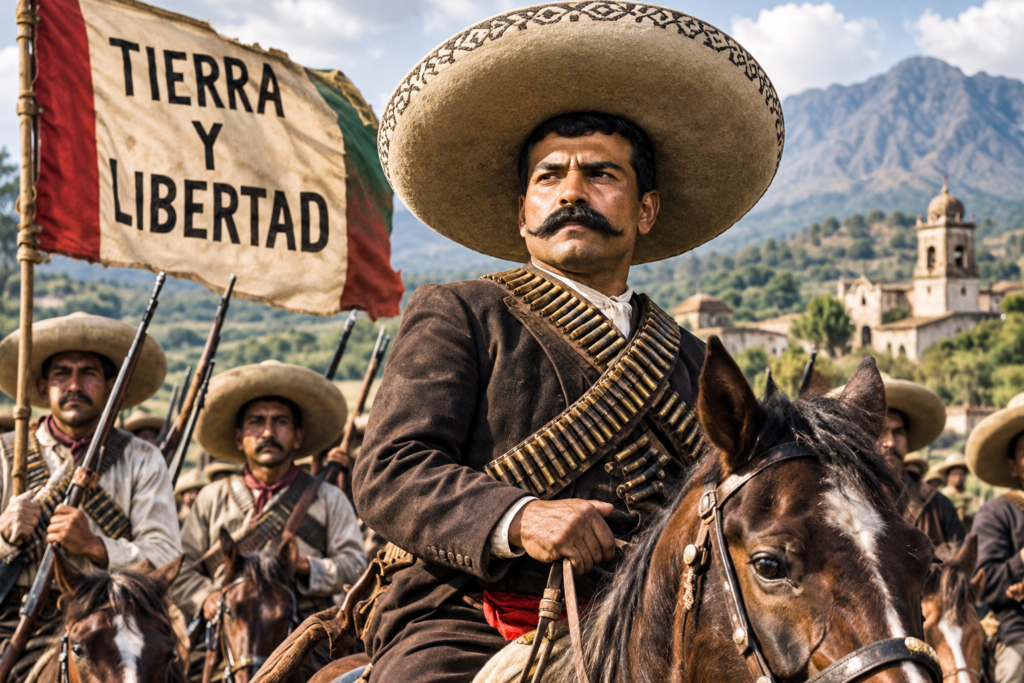
His image also became part of Mexico’s political and cultural memory.
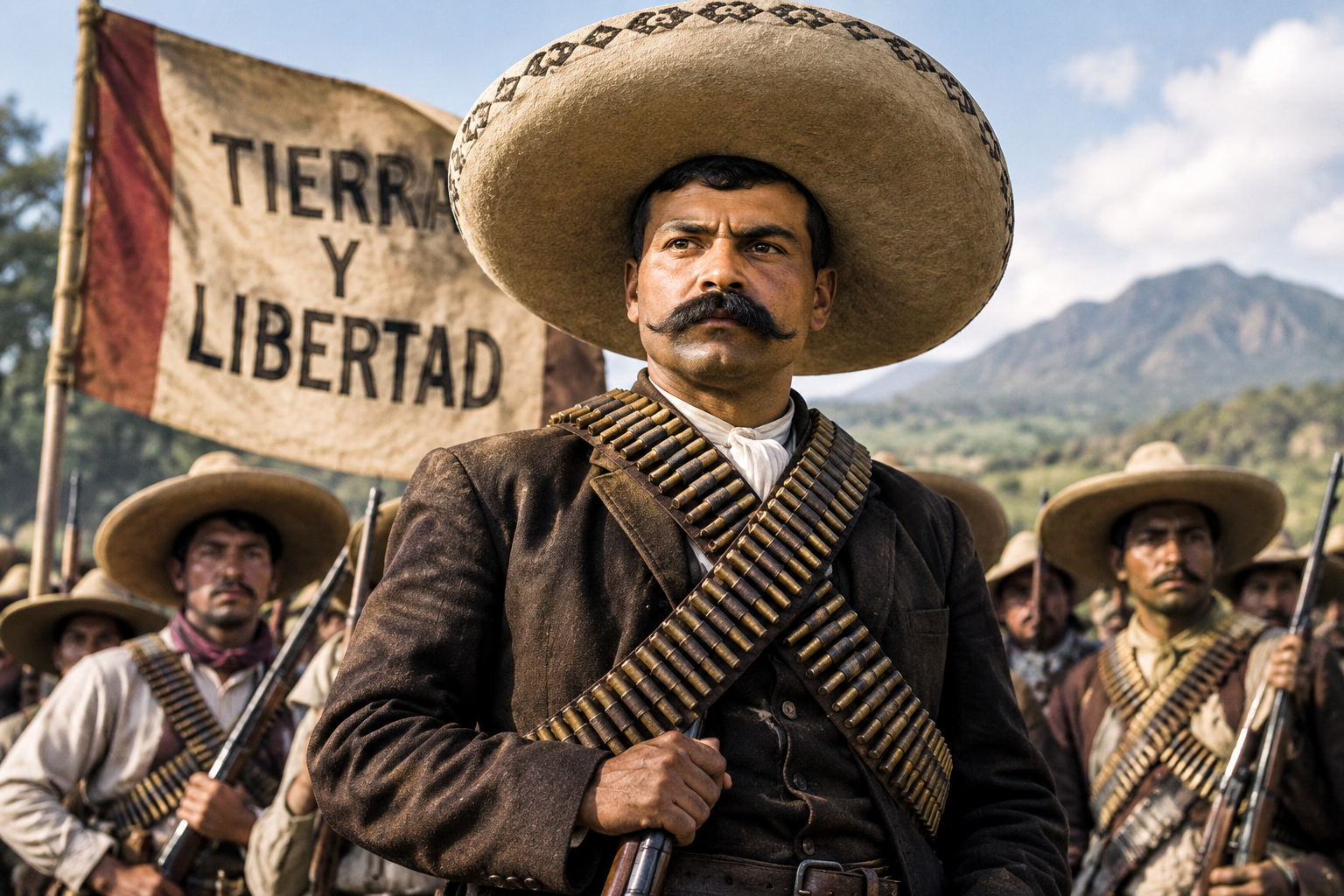
The famous photograph of Zapata and his followers helped create the enduring visual image of the revolutionary leader: a mustached man in a broad sombrero, carrying weapons and surrounded by armed supporters.
But behind that famous image was a more specific historical struggle.
Zapata came from a village community in Morelos where land was central to everyday life. His revolutionary program grew from that local experience and developed into a much broader movement.
“Land and Liberty”
The phrase associated with Zapata — “Tierra y Libertad,” or “Land and Liberty” — captured the central connection between economic independence and political freedom in his movement.
For Zapata’s followers, liberty was not simply the ability to participate in elections.
It was also connected to the ability of rural families and communities to control the land they depended upon.
This helps explain why Zapata remained influential after his death.
His movement had emerged from a specific historical problem, but its central question was much broader:
Who should control the land, and who should benefit from it?
Zapata’s Place in History
Emiliano Zapata did not become president of Mexico, nor did he establish a permanent national government.
His importance came from something different.
He transformed a regional struggle over village land into one of the defining agrarian movements of the Mexican Revolution.
The Plan of Ayala gave that movement a written political program. Zapatista forces demonstrated the military strength of rural communities. The reforms attempted in Morelos showed how revolutionary ideas could be applied locally.
The Library of Congress describes the land struggle surrounding Zapata as an important part of the social revolution that developed in Mexico during this period.
More than a century after his death, Zapata remains one of the most recognizable figures of the Mexican Revolution.
His story is not simply the story of a soldier.
It is the story of a village leader who entered a national revolution because of a local problem — the loss of community land — and transformed that struggle into a movement whose ideas continued long after his death.
Emiliano Zapata’s life ended in an ambush in 1919, but the question at the heart of his movement did not disappear with him.
For his followers, the revolution had always been about more than changing presidents. It was about land, community, and the right of ordinary people to determine the future of the places where they lived and worked.
Post Comment