The Great Banana Strike: The Tragic Story Behind Colombia’s Banana Massacre
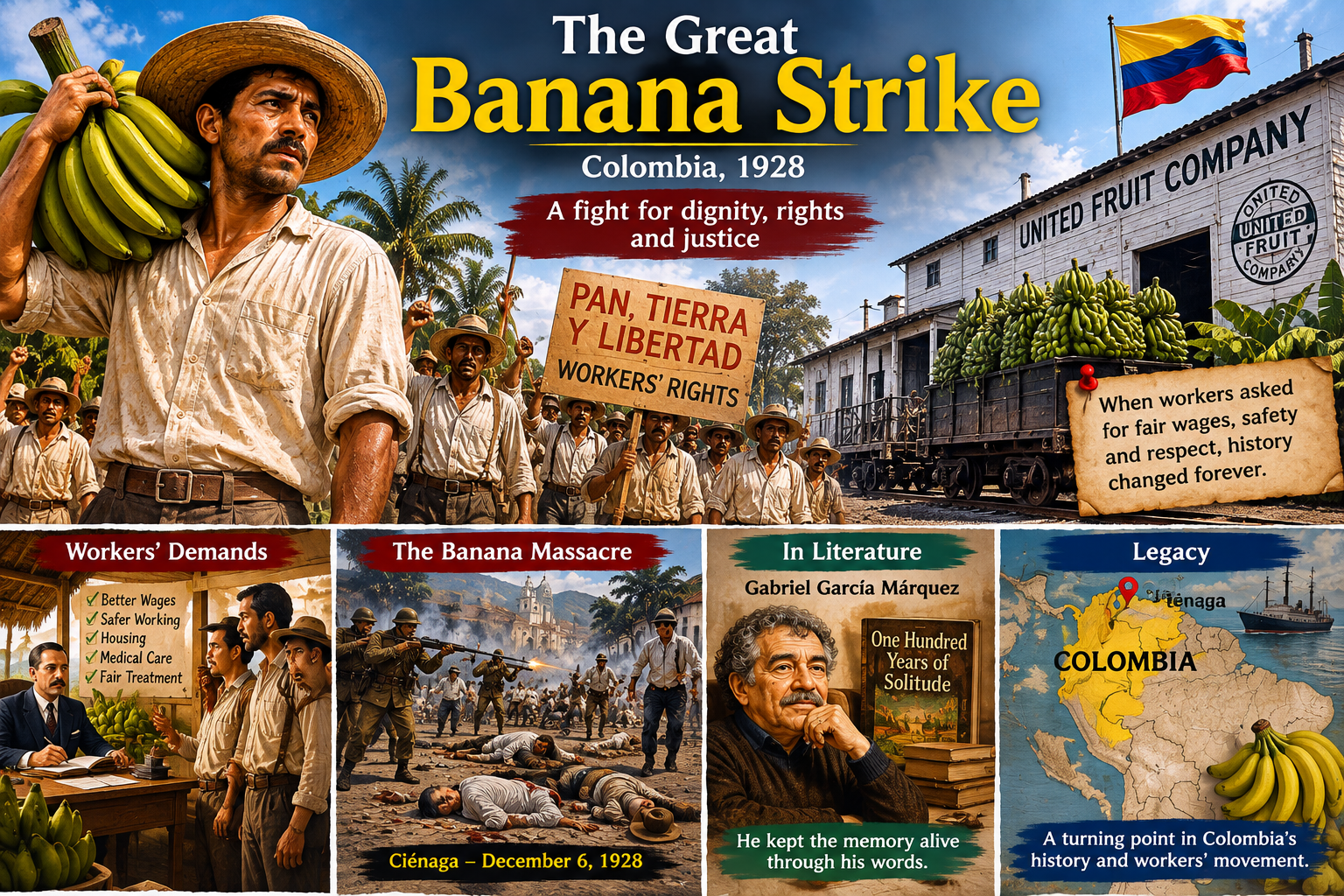
In the history of modern Latin America, few labor conflicts became as controversial and influential as the Great Banana Strike of 1928 in Colombia. What began as a struggle by plantation workers for better working conditions ended in a violent confrontation between striking workers and the Colombian Army in the town of Ciénaga, Magdalena.
The event became known as the Banana Massacre or Masacre de las Bananeras. It involved thousands of workers connected to the powerful United Fruit Company, an American corporation that had become a dominant force in Colombia’s banana-growing region.
The exact number of people killed remains disputed. Contemporary and later accounts give dramatically different figures, ranging from a relatively small official figure to estimates of hundreds or more than a thousand. A U.S. diplomatic report from January 1929 said the number of strikers killed exceeded 1,000, while other historical estimates are much lower.
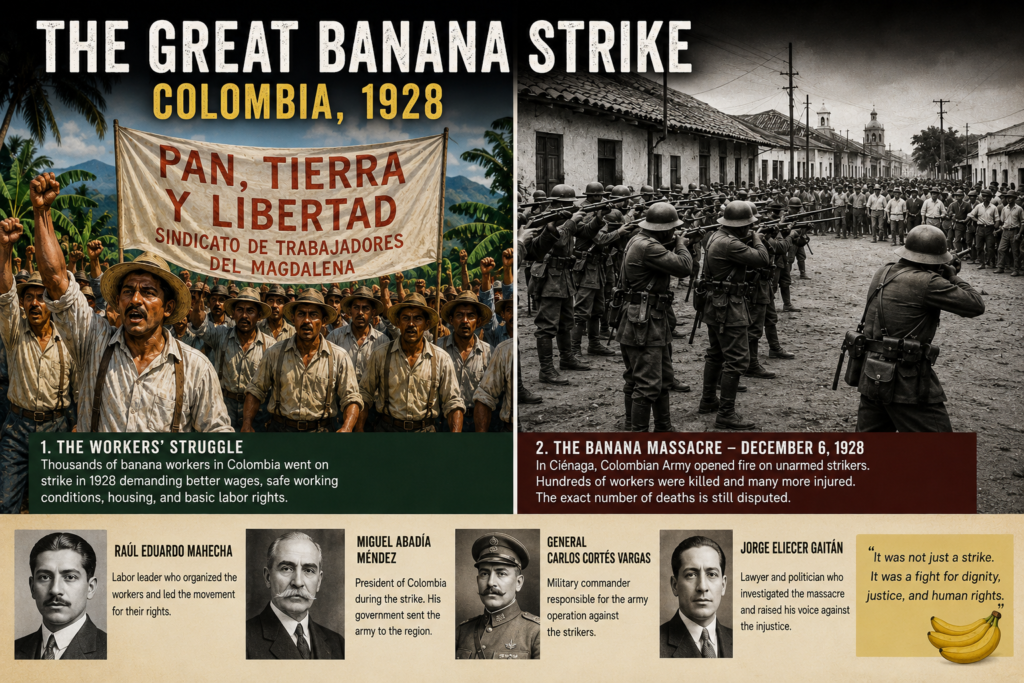
At the center of this story were men such as Raúl Eduardo Mahecha, General Carlos Cortés Vargas, President Miguel Abadía Méndez, and Jorge Eliécer Gaitán. Their different roles would help shape how Colombia remembered the tragedy.
—
The Rise of the Banana Industry
During the early twentieth century, bananas became an important export from Colombia’s Caribbean region. The area around Santa Marta and Ciénaga was particularly important because its climate was suitable for growing bananas and its location provided access to Caribbean shipping routes.
The United Fruit Company became enormously influential in the region. It controlled important parts of banana production, transportation and commercialization, creating what historians describe as an enclave economy. By the 1920s, thousands of workers and peasants depended on the banana industry for their livelihoods.
For the company, Colombia was an important source of bananas for international markets.
For workers, however, life on the plantations could be difficult.
Many workers were not directly employed by the United Fruit Company. Instead, labor was often arranged through contractors. Workers demanded that the company recognize them as direct employees and provide conditions consistent with Colombian labor law.
This disagreement eventually became the foundation of the great strike.
—
Raúl Eduardo Mahecha: A Voice for the Workers
One of the most important men in the story was Raúl Eduardo Mahecha, a Colombian labor organizer.
Mahecha had experience organizing workers before arriving in the Magdalena banana region. He became an influential figure among plantation workers and helped organize the Unión Sindical de Trabajadores del Magdalena (USTM).
Under the organization of labor leaders such as Mahecha, workers became increasingly determined to demand better treatment.
Their struggle was not initially about destroying the banana industry.
Instead, workers wanted improvements in their everyday lives and recognition of basic labor rights.
This distinction is important because later accounts sometimes portray the strike simply as a revolutionary uprising. Historical research shows that many of the workers’ demands were practical labor demands, including direct employment, insurance, payment practices and improved living conditions.
—
What Did the Workers Want?
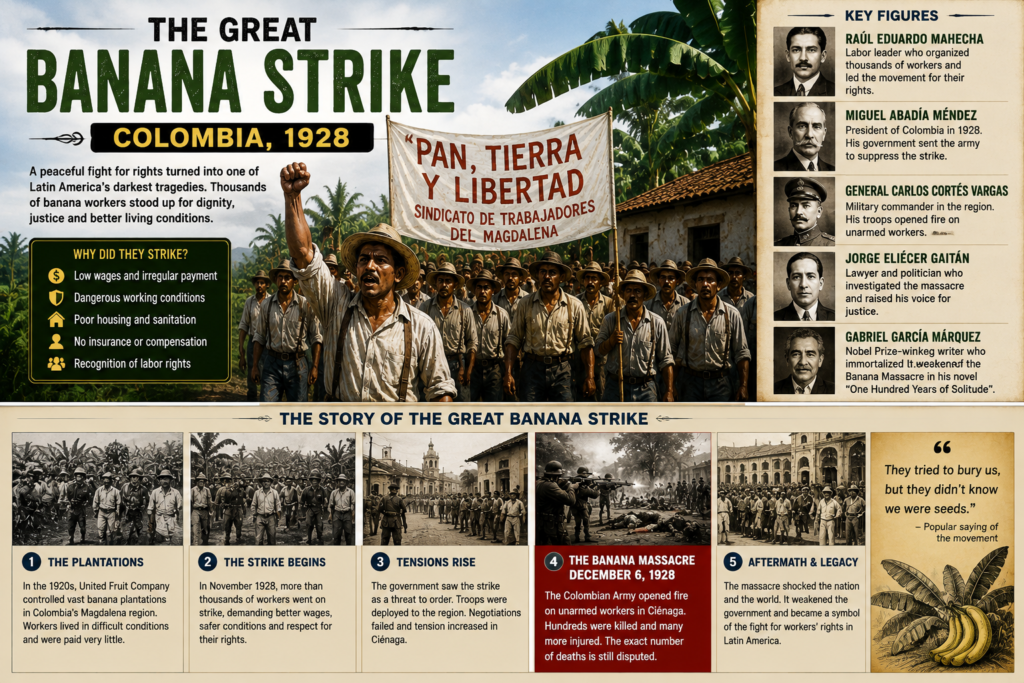
The workers presented a list of demands to the company.
Among their demands were:
Direct employment rather than employment through subcontractors
Collective insurance
Compensation for workplace accidents
Better housing and sanitation
A six-day working week
Improvements in wages
Regular payment
An end to certain company-store and voucher practices
Better medical services
Many of these demands were connected to labor protections that workers believed should already apply under Colombian law.
To the workers, this was not simply a fight over bananas.
It was a fight over dignity, wages, safety and recognition.
—
The Great Banana Strike Begins
In November 1928, the conflict reached a new stage.
Workers stopped working and began a massive strike against the banana companies operating in the region.
The number of participants is difficult to determine precisely, but historical sources describe the movement as involving tens of thousands of workers and peasants. One scholarly reference describes almost 30,000 workers and peasants participating in the broader rebellion.
The strike quickly became one of the largest labor confrontations Colombia had seen.
The banana plantations stopped functioning normally.
Bananas could not be harvested and transported at the usual rate.
The economic pressure increased.
But negotiations did not produce the solution workers wanted.
—
President Miguel Abadía Méndez
Another important man in the story was Miguel Abadía Méndez, who was President of Colombia at the time.
Abadía Méndez belonged to the Conservative Party and governed Colombia during the final years of the long Conservative political era.
His government viewed the growing strike through the lens of public order and political instability.
The government became increasingly concerned that the strike could become connected to revolutionary or communist activity.
Military forces were sent to the banana region.
This decision transformed the labor dispute into a much more dangerous confrontation.
—
General Carlos Cortés Vargas
The military response was associated with General Carlos Cortés Vargas.
Cortés Vargas was placed in command of Colombian troops in the region.
The government’s position was that it needed to restore order.
The workers and their supporters, however, viewed the military presence as a threat.
The situation became increasingly tense around the town of Ciénaga.
Thousands of people were gathered in the area while negotiations and political pressure continued.
Then came the night of December 5–6, 1928.
—
The Night of the Banana Massacre
On December 6, 1928, Colombian troops opened fire on a gathering of striking workers in Ciénaga.
The soldiers were positioned around the area where the crowd had gathered.
What happened next became one of the darkest episodes in Colombia’s labor history.
People were killed and wounded.
The precise circumstances and number of victims have been debated ever since.
The official military account gave a very low number of deaths, while other accounts and later investigations produced much higher estimates. A U.S. diplomatic communication in January 1929 reported that the number killed exceeded 1,000.
Because reliable records were incomplete and political interests influenced contemporary reporting, historians still debate the exact death toll.
But one fact is not seriously disputed:
The Colombian Army used deadly force against striking banana workers in Ciénaga in December 1928.
—
Why Is the Death Toll Still Controversial?
The number of victims became part of the political and cultural memory of the massacre.
Different figures have been reported over the decades.
The military’s official version was dramatically lower than estimates circulated by workers, political opponents and foreign observers.
The United Fruit Company itself later became part of the controversy surrounding the event.
A U.S. diplomatic report stated that the number of strikers killed exceeded 1,000, demonstrating that even contemporary American officials were aware that the death toll was much greater than the official Colombian figure.
Modern historians continue to debate the evidence.
Therefore, a responsible historical article should not present one exact death toll as unquestionably proven.
The safest conclusion is that the massacre killed an uncertain number of workers, with estimates varying enormously.
—
Jorge Eliécer Gaitán Enters the Story
Another famous Colombian man connected with the aftermath was Jorge Eliécer Gaitán.
Gaitán was a young politician and lawyer who became one of the most important political figures in twentieth-century Colombia.
After the massacre, Gaitán investigated and publicly criticized the government’s handling of the banana strike.
His political work helped turn the tragedy into a national political issue.
The banana massacre became a powerful symbol for Colombians who believed that workers and ordinary citizens had been sacrificed in defense of powerful economic interests.
Gaitán’s criticism helped bring the events in Ciénaga to national attention. Sources describe his role in challenging the government’s version of the events.
—
A Political Crisis for the Conservative Government
The massacre damaged the reputation of President Abadía Méndez’s government.
The government had attempted to portray the strike as a threat to public order.
But news of workers being killed created outrage.
The incident became an example of the tension between:
Foreign business interests + government power + workers’ rights.
The political consequences were significant.
The Conservative Party eventually lost power in 1930, ending approximately 44 years of Conservative political dominance in Colombia.
The banana massacre therefore became more than a labor dispute.
It became part of a much larger political transformation in Colombia.
—
The United Fruit Company
The United Fruit Company was one of the most powerful American corporations operating in Latin America during this period.
Its influence extended beyond simply growing bananas.
The company was involved in transportation, railways, shipping and commercial networks connected to the banana trade.
Its economic power created enormous benefits for international commerce, but it also generated criticism over labor practices and political influence.
The 1928 strike exposed the difficult relationship between multinational corporations and local workers.
The controversy surrounding United Fruit later became part of the broader historical discussion about the so-called “banana republics” of Central and South America.
—
The Human Cost
Behind the political names and corporate history were ordinary workers.
They were men who worked in difficult plantation conditions.
They had families.
They depended on wages to buy food and support their households.
For them, the strike was not an abstract political battle.
It was about everyday life.
A worker asking for safer housing, proper payment or compensation after an accident was asking for something that seems basic today.
But in the banana economy of the 1920s, workers faced a powerful corporation, subcontracting systems and a government increasingly concerned about political unrest.
The massacre demonstrated how quickly a labor dispute could become a national tragedy.
—
The Banana Massacre in Literature
The events of 1928 later entered Colombian literature.
The most famous literary connection is Gabriel García Márquez, one of Colombia’s greatest writers.
His novel One Hundred Years of Solitude contains a fictionalized version of a banana-company massacre.
In the novel, the event becomes part of the mysterious and tragic history of Macondo.
García Márquez used the episode to explore memory, political violence and the way governments and societies can forget traumatic events.
However, readers should remember that literature and history are different.
García Márquez transformed historical events into fiction. Historians therefore should not treat every detail in the novel as a literal historical record.
The banana massacre nevertheless had a profound influence on Colombia’s cultural memory.
—
Why the Great Banana Strike Still Matters
Almost a century later, the Great Banana Strike remains relevant.
The story raises questions that still exist in modern societies:
How much power should a corporation have?
What rights should workers have?
What happens when workers and employers cannot reach an agreement?
How should governments respond to strikes?
What happens when economic interests conflict with human rights?
These questions make the 1928 banana strike much more than an old story about bananas.
It is a story about power, workers, corporations, politics and memory.
—
The Men Who Shaped the Story
Several men became central to the historical story:
Raúl Eduardo Mahecha
A labor organizer who helped mobilize banana workers and became one of the important leaders of the strike movement.
Miguel Abadía Méndez
The Conservative president of Colombia during the strike and massacre.
General Carlos Cortés Vargas
The military commander associated with the government’s suppression of the strike.
Jorge Eliécer Gaitán
A lawyer and politician who investigated and publicly attacked the government’s handling of the massacre.
Gabriel García Márquez
The Colombian writer who later transformed the memory of the banana massacre into one of the most famous fictional episodes in One Hundred Years of Solitude.
Together, these men represent very different sides of the story: workers, government, military, political opposition and literature.
—
Conclusion: The Bananas That Became a Symbol
The Great Banana Strike of 1928 began with workers demanding better conditions in Colombia’s banana plantations.
It ended in bloodshed.
The events of December 1928 became known as the Banana Massacre, and the exact number of victims remains disputed. What is certain is that the Colombian Army opened fire on striking workers in Ciénaga, turning a labor conflict into one of the most controversial tragedies in Colombia’s twentieth-century history.
The names of Raúl Eduardo Mahecha, Miguel Abadía Méndez, Carlos Cortés Vargas and Jorge Eliécer Gaitán remain connected to the story.
And decades later, Gabriel García Márquez ensured that the memory of the banana massacre would reach readers around the world.
The story ultimately reminds us that behind every major economic industry are human beings.
Bananas may have been the product.
But workers, power and politics were at the heart of the conflict.
Post Comment