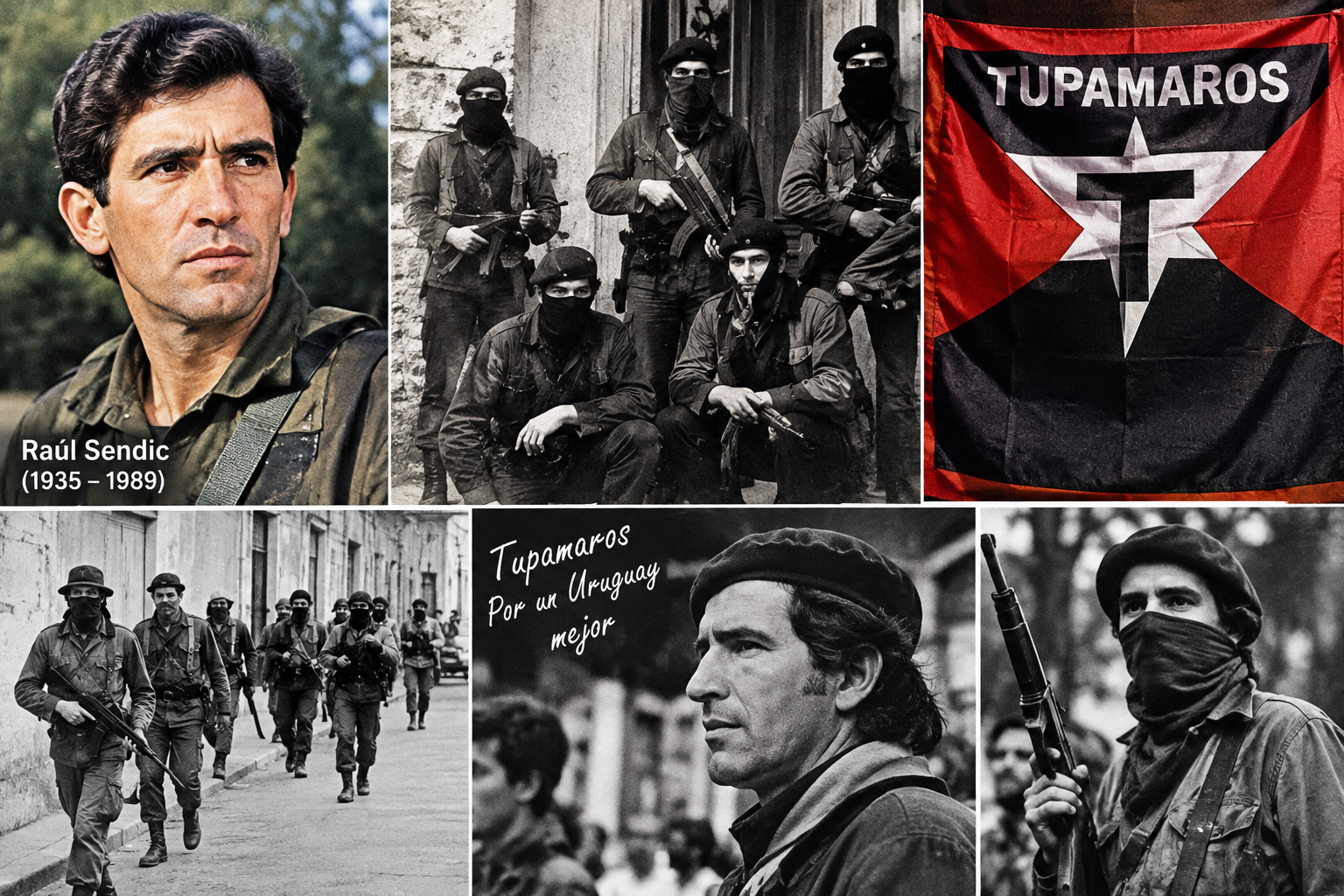
Raúl Sendic and the Tupamaros: The Revolutionary Movement That Changed Uruguay
In the turbulent political landscape of 20th-century Latin America, few movements were as unusual and controversial as Uruguay’s National Liberation Movement—Tupamaros (MLN-T). Unlike many revolutionary organizations that operated primarily from remote rural areas, the Tupamaros developed a sophisticated urban guerrilla movement in the heart of Montevideo.
At the center of this story was Raúl Sendic Antonaccio, a lawyer, socialist activist and organizer who became one of the most influential figures on Uruguay’s revolutionary left.
Sendic’s life was closely connected with the struggles of poor rural workers. His political experiences eventually convinced him and other activists that Uruguay’s existing political system was incapable of addressing the country’s deepest social and economic problems. Out of this environment emerged the Tupamaros.
Their history included clandestine operations, bank robberies, kidnappings, propaganda campaigns, prison escapes and armed confrontations with the state. The movement was eventually defeated by Uruguay’s security forces, but its story did not end there.
After years of imprisonment and Uruguay’s return to democracy, former Tupamaros entered electoral politics. Their transformation from an armed revolutionary organization into a legal political movement became one of the most remarkable political developments in modern Uruguay.
Raúl Sendic’s Early Life
Raúl Sendic Antonaccio was born in 1925 in Uruguay. He studied law and became increasingly interested in social inequality, workers’ rights and socialist politics.
Rather than concentrating exclusively on urban politics, Sendic became particularly interested in the difficult conditions experienced by agricultural workers.
In northern Uruguay, sugarcane workers often faced extremely difficult economic circumstances. Wages were low, employment was insecure and workers had limited political influence.
Sendic began working with these communities and became involved in organizing agricultural laborers.
One of the organizations associated with his work was the Unión de Trabajadores Azucareros de Artigas (UTAA), a union representing sugarcane workers.
The experiences he gained among these workers had a major influence on his political thinking.
For Sendic, economic inequality was not simply an abstract political question. He had seen poverty and exploitation directly and believed that traditional political institutions were failing to solve these problems.
The Political Environment of Uruguay
Uruguay had long been regarded as one of Latin America’s more stable democracies.
The country had developed strong political institutions, a relatively large middle class and important social-welfare programs.
However, by the late 1950s and early 1960s, Uruguay was experiencing serious economic difficulties.
Economic growth slowed, unemployment increased and inflation became a major problem. Social tensions grew as workers and students demanded political and economic reforms.
At the same time, the Cuban Revolution of 1959 transformed political debates throughout Latin America.
For many young left-wing activists, Cuba appeared to demonstrate that revolutionary movements could overthrow established governments.
For others, however, the Cuban example raised concerns about violence and political authoritarianism.
Uruguay’s left became increasingly divided over the question of how radical political change should be pursued.
It was in this environment that Sendic and other activists began developing a clandestine revolutionary organization.
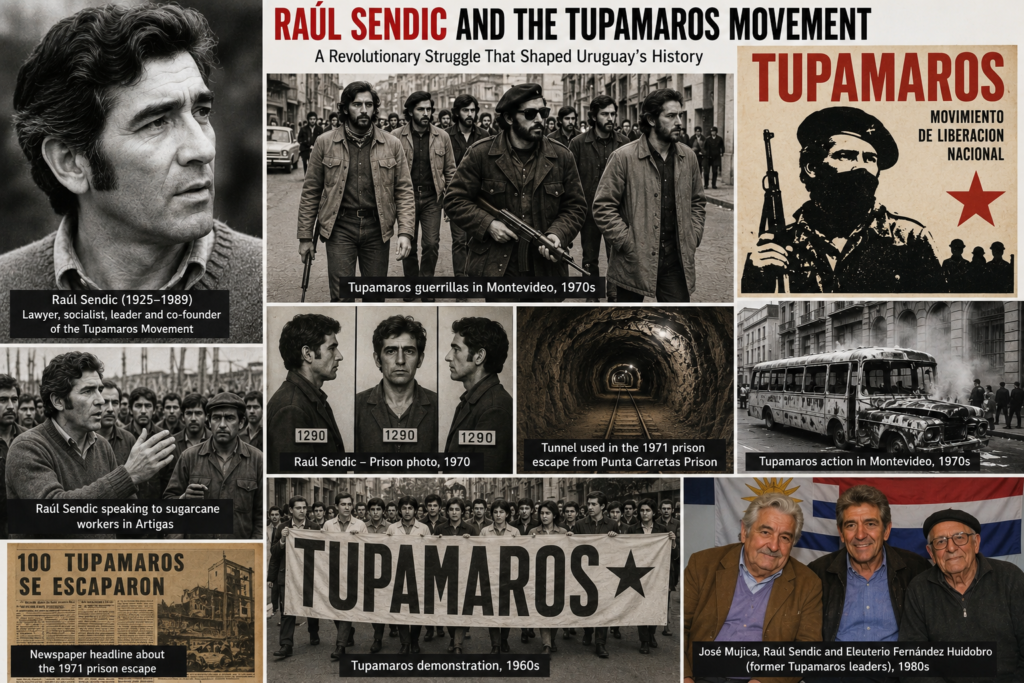
The Birth of the Tupamaros
During the early 1960s, various left-wing activists and groups gradually came together.
The organization eventually became known as the Movimiento de Liberación Nacional–Tupamaros, commonly shortened to MLN-T or simply Tupamaros.
The name was inspired by Túpac Amaru II, the famous Indigenous leader who led a major uprising against Spanish colonial rule in South America during the 18th century.
The Tupamaros were different from many contemporary guerrilla organizations.
Instead of immediately attempting to establish a rural revolutionary army, they developed an urban guerrilla strategy.
Montevideo became their principal operational environment.
This approach allowed the organization to use the city’s streets, buildings and underground networks to conduct clandestine activities.
The Urban Guerrilla Strategy
The Tupamaros became famous for what they described as revolutionary action combined with political propaganda.
Their activities included robberies, sabotage, weapons seizures, kidnappings and attacks on state institutions.
Money obtained through robberies was sometimes presented by the organization as being used for revolutionary activities or social purposes.
The group also carried out highly publicized propaganda operations designed to embarrass the government.
One of the reasons the Tupamaros attracted international attention was their ability to combine clandestine political organization with carefully planned urban operations.
Their activities were intended not only to weaken the state but also to demonstrate what they regarded as corruption and inequality within Uruguayan society.
However, the movement’s activities also involved violence and coercion.
Kidnappings and armed attacks created fear and contributed to the increasingly violent political atmosphere in Uruguay.
Propaganda and the Image of the Tupamaros
The Tupamaros understood the importance of public perception.
They attempted to present themselves as revolutionary activists fighting corruption and economic injustice rather than simply as criminals.
Their communications frequently focused on government corruption, poverty and social inequality.
This helped them gain sympathy among some sections of Uruguay’s population, particularly among politically radicalized students and workers.
But their opponents viewed them as an armed organization that threatened democratic institutions and public security.
This disagreement over the meaning of their actions remains an important part of the historical debate surrounding the Tupamaros.
The Escalation of Violence
By the late 1960s, Uruguay’s political situation was deteriorating.
The government responded to growing unrest with increasingly strong security measures.
Police and intelligence agencies expanded their efforts against revolutionary organizations.
The Tupamaros responded with increasingly ambitious operations.
The confrontation gradually became a cycle of attacks, arrests and retaliation.
As political violence increased, the distinction between political activism and armed insurgency became increasingly blurred.
The crisis also contributed to a broader weakening of Uruguay’s democratic institutions.
Raúl Sendic’s Arrest
Sendic became one of the government’s most important targets.
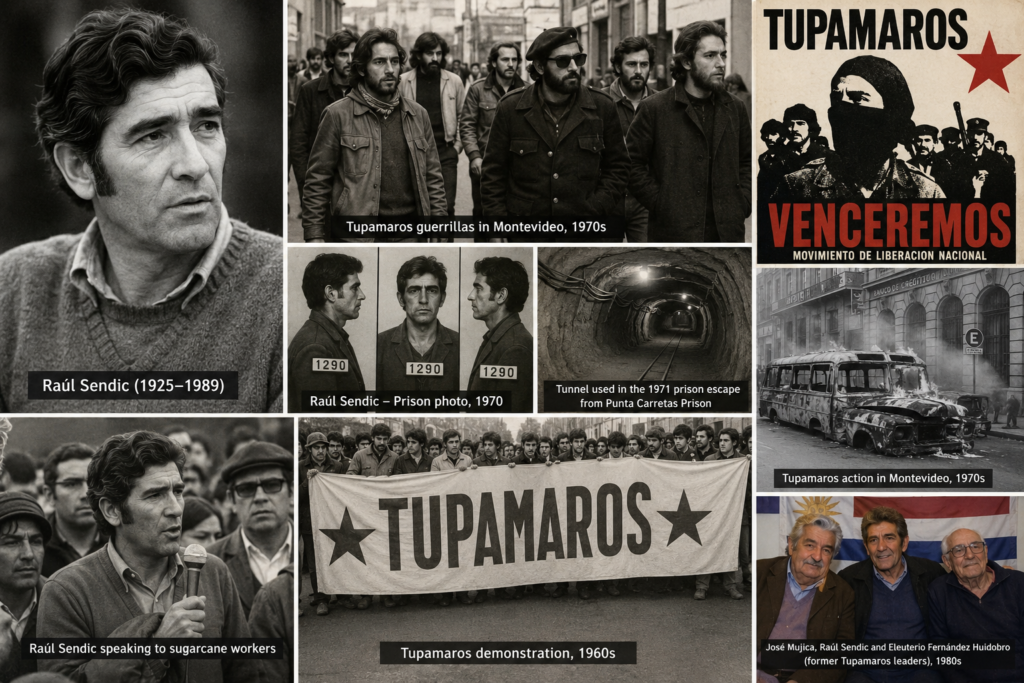
He was arrested in 1970, but the Tupamaros demonstrated their organizational strength by carrying out a spectacular prison escape in 1971.
The escape from Punta Carretas prison became one of the most famous episodes in the history of the movement.
More than 100 Tupamaro prisoners escaped through a tunnel connecting the prison with a nearby building.
The operation became an international symbol of the organization’s ability to plan complex clandestine actions.
For the government, however, the escape represented a serious challenge to state authority.
The 1972 Defeat of the Tupamaros
The decisive turning point came in 1972.
Uruguayan security forces launched a major campaign against the Tupamaros.
Through arrests, intelligence operations and military actions, the government dismantled much of the organization’s underground structure.
Sendic was captured again in September 1972 after being wounded during an armed confrontation.
By the end of that year, the Tupamaros had largely lost their ability to operate as an effective guerrilla organization.
Many members were arrested, while others went into exile.
The revolutionary experiment that had dominated Uruguay’s political headlines for much of the previous decade had effectively been defeated militarily.
Uruguay’s Military Dictatorship
The defeat of the Tupamaros did not restore political stability.
Instead, Uruguay entered a period of increasing military influence.
In 1973, President Juan María Bordaberry dissolved Congress, marking the beginning of the country’s civic-military dictatorship.
Political parties were restricted, opponents were imprisoned and democratic freedoms were severely limited.
Former Tupamaros and other political opponents experienced years of imprisonment and harsh treatment.
Sendic spent many years in prison.
The military dictatorship lasted until the restoration of democratic government in 1985.
Years in Prison
For Sendic and many other Tupamaros, the years of dictatorship were defined by imprisonment.
The former guerrilla leaders became political prisoners whose experiences would later influence Uruguay’s democratic political culture.
Their imprisonment also contributed to a transformation in how some former revolutionaries viewed armed struggle.
By the time democracy returned, many former Tupamaros had concluded that revolutionary violence was no longer the path they wanted to pursue.
The movement began a remarkable political transformation.
From Guerrillas to Politicians
The return of democracy in 1985 opened the door for former Tupamaros to participate in legal politics.
The movement increasingly abandoned armed struggle and became involved with Uruguay’s democratic left.
Former Tupamaros eventually became associated with the Frente Amplio, Uruguay’s broad left-wing political coalition.
The Movimiento de Participación Popular (MPP) became an important political vehicle for former Tupamaro activists.
This transformation was historically significant.
An organization that had once attempted to challenge the state through armed struggle was now attempting to change Uruguay through elections, political organization and democratic institutions.
José Mujica and the Tupamaro Legacy
The most internationally famous former Tupamaro was José “Pepe” Mujica.
Mujica had been imprisoned during Uruguay’s dictatorship and spent years in captivity.
After democracy returned, he entered electoral politics.
He eventually became a prominent member of the MPP and later served as President of Uruguay from 2010 to 2015.
Mujica’s rise from guerrilla fighter and political prisoner to elected president became a remarkable symbol of Uruguay’s political transformation.
His simple lifestyle and outspoken political views also attracted considerable international attention.
His career demonstrated how former revolutionary activists could become participants in democratic institutions rather than opponents of them.
Raúl Sendic’s Later Years
After his release, Sendic remained involved in political activity.
However, his health deteriorated during the 1980s.
He continued to advocate for social and economic reforms and remained an important symbolic figure for Uruguay’s radical left.
Sendic died in Paris in 1989, at the age of 64.
By then, Uruguay had already returned to democratic government, and the former Tupamaros were increasingly operating within the country’s legal political system.
Why the Tupamaros Matter in History
The history of the Tupamaros is important because it demonstrates how political movements can change dramatically over time.
The organization began as a revolutionary movement that believed armed struggle could transform Uruguay.
It became one of Latin America’s best-known urban guerrilla organizations.
It was then militarily defeated, and many of its leaders spent years in prison.
Yet the movement eventually re-emerged as part of a democratic political coalition.
This transformation makes the Tupamaros different from many revolutionary organizations of the Cold War period.
A Complicated Legacy
The legacy of Raúl Sendic and the Tupamaros remains controversial.
Supporters have remembered Sendic as a champion of poor workers and social justice.
Critics have emphasized the violence, kidnappings, robberies and attacks carried out by the movement.
Both aspects are important when examining the history.
The Tupamaros cannot be understood simply as either heroic freedom fighters or ordinary criminals.
They were a political movement born from genuine social and economic conflicts, but they chose armed struggle as a means of pursuing their goals.
That decision had profound consequences for Uruguay.
The Larger Latin American Context
The Tupamaros were part of a much larger wave of political radicalization that swept Latin America during the 1960s and 1970s.
The Cuban Revolution inspired revolutionary movements across the continent.
At the same time, governments and militaries increasingly viewed left-wing organizations as security threats.
The Cold War intensified these conflicts.
Uruguay’s experience therefore reflected a broader regional struggle involving socialism, capitalism, nationalism, military power and democracy.
But Uruguay’s story remained distinctive because of the country’s strong political traditions and the later democratic integration of former guerrillas.
From Revolution to Democracy
Perhaps the most important lesson from the Tupamaros story is the movement’s eventual transition from armed rebellion to democratic politics.
The former guerrillas did not simply disappear after their military defeat.
Many returned to political life.
They organized legally, participated in elections and eventually gained significant political influence.
The career of José Mujica demonstrated how dramatic this transformation could become.
A former guerrilla could eventually become the democratically elected leader of the same country whose government had once imprisoned him.
Conclusion
Raúl Sendic and the Tupamaros occupy a complicated place in the history of Uruguay and Latin America.
Sendic emerged from the struggles of rural workers and became convinced that fundamental political and economic change was necessary.
The Tupamaros transformed his ideas into an urban revolutionary movement that challenged the Uruguayan state during one of the most turbulent periods of the country’s history.
Their armed campaign ultimately failed. By 1972, the organization had been largely dismantled, and many of its leaders were imprisoned.
But the story did not end with defeat.
After the restoration of democracy in 1985, former Tupamaros entered legal politics. Their participation in the Frente Amplio and the rise of former Tupamaro José Mujica demonstrated a remarkable transformation from guerrilla warfare to democratic government.
The history of Sendic and the Tupamaros therefore offers more than a story about an armed revolutionary movement. It is also a story about poverty, political idealism, violence, repression, imprisonment, political transformation and the difficult transition from revolution to democracy.
Their legacy remains debated, but their impact on Uruguay’s modern political history is undeniable.


Post Comment