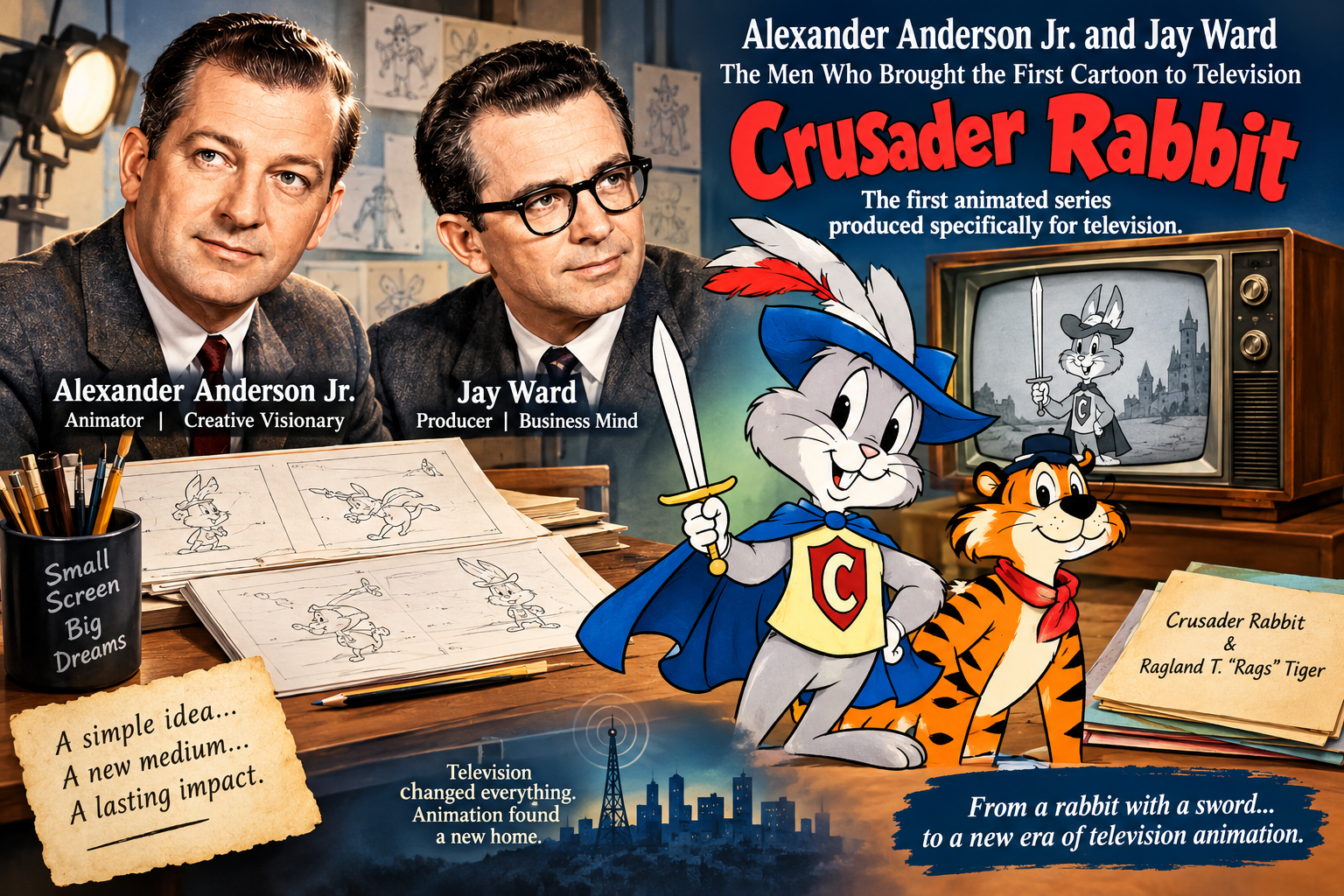
Alexander Anderson and Jay Ward: The Men Who Brought the First Cartoon to Television
Before television became filled with animated superheroes, talking animals, colorful adventures, and Saturday-morning cartoons, there was a much simpler beginning.
Television was still a young medium in the late 1940s and early 1950s. Networks were experimenting with new kinds of entertainment, and producers were trying to discover what could be created for a small screen without the enormous budgets associated with theatrical animation.
Two American men, Alexander Anderson Jr. and Jay Ward, saw an opportunity.
They believed that cartoons did not have to be made only for movie theaters. Animation could be created specifically for television.
Their most important creation was Crusader Rabbit, a small rabbit with a big personality who became a landmark in television history.
The series is widely recognized as the first animated series produced specifically for television. Although historical sources differ over exactly how its early production and broadcasts should be dated, Crusader Rabbit is firmly associated with the birth of American television animation.
The story of Anderson and Ward is therefore not simply the story of a cartoon rabbit. It is the story of two men who helped demonstrate that television could become a home for animation.
Television Was a New Frontier
In the years after World War II, television was rapidly entering American homes.
Movies already had a successful animation industry. Studios such as Disney, Warner Bros., and MGM had demonstrated the enormous entertainment potential of animated characters. But theatrical animation was expensive.
Every movement could require numerous drawings. Backgrounds had to be created, music recorded, voices performed, and films carefully assembled.
Television presented a completely different economic challenge.
A television station needed programming regularly. It could not necessarily afford to produce theatrical-quality animation for every episode.
This created a question:
Could cartoons be made specifically for television at a much lower cost?
Alexander Anderson Jr. believed the answer was yes.
Alexander Anderson Jr.: An Animator With a Different Idea
Alexander Anderson Jr. was an animator and artist who understood how traditional animation worked.
He also understood that television required a different approach.
Instead of attempting to reproduce the elaborate animation audiences saw in movie theaters, Anderson envisioned a simpler style that could work within television’s limitations.
The idea was revolutionary in its practicality.
Characters could move less. Backgrounds could be reused. Scenes could be designed economically. Stories could carry the entertainment rather than relying entirely on complicated animation.
This approach would eventually become known as limited animation, a technique that became extremely influential in television cartoons.
But Anderson needed a partner who could help transform the creative idea into a business and production operation.
That partner was Jay Ward.
Jay Ward Enters the Story
Jay Ward was not primarily known as an animator in the same way Anderson was. His strengths included business, production, organization, and developing entertainment properties.
Together, Anderson and Ward began working on the concept that would become Crusader Rabbit.
Their partnership was unusual but effective.
Anderson brought animation experience and creative ideas.
Ward brought entrepreneurial energy and an understanding of how the project could be presented to television.
Their work demonstrated an important lesson in entertainment history: major changes often happen when creative and business skills come together.
Meet Crusader Rabbit
The central character was Crusader Rabbit, an adventurous rabbit who became one of television’s earliest animated stars.
His companion was Ragland T. “Rags” Tiger.
The characters were not created for a theatrical movie. They were designed specifically for television.
That distinction is extremely important.
Animation had existed for decades before Crusader Rabbit. Cartoons were already popular in movie theaters. What made the project historically significant was its connection to television as a new distribution medium.
The creators were not simply moving an existing theatrical cartoon onto television.
They were asking how animation itself could be redesigned for television.
The Birth of a New Animation Style
One of the most important contributions of Crusader Rabbit was its economical production style.
Traditional animation could require a tremendous number of individual drawings.
Television could not always support that level of expense.
Anderson’s approach relied on techniques that reduced the amount of movement required.
Characters might remain relatively still while only their mouths, arms, or other small parts moved.
Backgrounds could remain unchanged for extended periods.
Camera movements, dialogue, sound effects, and storytelling could provide much of the energy.
To modern audiences, this may seem simple.
At the time, however, it represented an important production solution.
The objective was not necessarily to make the most elaborate cartoon possible.
It was to make animation that television could afford.
That distinction helped open the door for an entirely new television-animation industry.
The First Television Cartoon Series
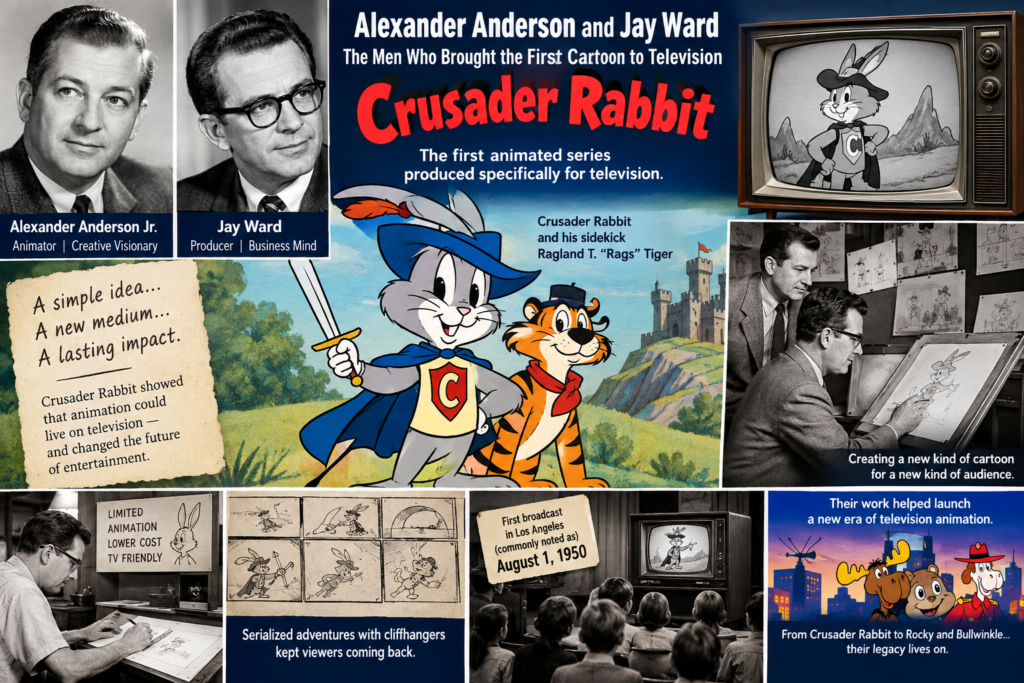
Crusader Rabbit is commonly described as the first animated television series.
Historical accounts differ regarding its earliest production and broadcast dates. Some records place important production activity in the late 1940s, while other historical references identify August 1, 1950, as the first Los Angeles television broadcast.
The important point is that the series emerged during the earliest years of commercial American television and became a pioneering example of animation created specifically for the medium.
The program was broadcast in short installments rather than functioning exactly like the theatrical cartoons audiences already knew.
This format suited television.
A story could continue from one installment to another, encouraging viewers to return to see what happened next.
Cliffhangers on Television
One of the clever features of Crusader Rabbit was its use of serialized storytelling.
Episodes could end with the characters facing a dangerous or exciting situation.
Then viewers had to wait for the next installment.
This was a familiar storytelling technique in older movie serials, but applying it to television animation created a distinctive format.
The approach also helped compensate for the limited animation.
Instead of depending on constant visual movement, the program could create excitement through the story.
The viewer wanted to know what would happen next.
That was an important insight for television producers.
A successful cartoon did not necessarily require spectacular animation in every second.
A strong character and an engaging story could keep an audience watching.
Why Limited Animation Mattered
The importance of Crusader Rabbit becomes even clearer when we look at what happened later.
Television expanded rapidly during the 1950s and 1960s.
Broadcasters needed enormous quantities of programming.
Animation studios recognized that television could become a major market, but producing animation at theatrical standards remained expensive.
Limited animation offered a solution.
Studios could reuse backgrounds, simplify character movements, reduce the number of drawings, and concentrate on dialogue and storytelling.
This approach eventually became associated with many television cartoons.
Anderson and Ward were therefore participating in something much larger than the success of one rabbit.
They were helping establish the economic and artistic language of television animation.
From Crusader Rabbit to a Larger Career
Jay Ward’s career did not end with Crusader Rabbit.
He went on to establish Jay Ward Productions, which became responsible for some of the most memorable animated characters in American television history.
Among them were Rocky and Bullwinkle, Dudley Do-Right, and other characters associated with the distinctive humor of the studio.
These later productions demonstrated how far the basic television-animation concept could develop.
The animation could remain economical while the writing became sophisticated.
The humor could appeal to children while containing jokes and satire that adults could also appreciate.
This became one of the defining characteristics of Jay Ward’s productions.
Alexander Anderson’s Continuing Influence
Alexander Anderson also remained an important figure in animation.
His work extended beyond Crusader Rabbit and contributed to the development of characters and concepts that became part of American popular culture.
His career is particularly interesting because he was involved in animation during a period when the industry itself was changing.
The transition from theatrical animation to television was not merely a technological development.
It required artists to rethink how stories were constructed, how characters moved, and how productions could be financed.
Anderson was part of that transformation from its early stages.
Why Their Partnership Was Important
Anderson and Ward brought different strengths to their collaboration.
Anderson understood animation.
Ward understood the business and production possibilities of television.
Together they demonstrated that an animated property could be designed around the economics of the new medium.
This may sound obvious today, but it was not obvious when television was still developing.
The entertainment industry had spent decades learning how to make cartoons for theaters.
Television required a new model.
Anderson and Ward helped prove that such a model was possible.
A Small Screen With a Big Future
The television screen of the early 1950s was dramatically different from today’s screens.
Televisions were smaller.
Broadcast technology was limited.
Programming schedules were still developing.
There were far fewer channels.
Yet television had one enormous advantage:
It could bring entertainment directly into people’s homes.
That made it an extraordinary opportunity for animation.
Once producers discovered that cartoons could be produced economically, animated characters could appear on television regularly.
Over time, this would lead to an enormous television-animation industry.
Children would grow up with cartoon programs as a normal part of television culture.
Characters would become household names.
Saturday mornings would eventually become closely associated with animated programming.
And the foundations of that television-cartoon era can be traced back to pioneers such as Anderson and Ward.
The American Spirit of Experimentation
The story of Crusader Rabbit also reflects a broader American tradition of experimentation.
Television was new.
Nobody knew exactly what it would become.
Some people saw it as an extension of radio.
Others viewed it primarily as a way to broadcast theater, news, sports, or live entertainment.
Anderson saw another possibility.
He looked at animation and asked a practical question:
How can this art form work on television?
Instead of waiting for technology and budgets to become perfect, he looked for a way to work within existing limitations.
That willingness to experiment was crucial.
The result was not the most visually elaborate animation of its era.
It did not need to be.
Its historical importance came from demonstrating what could be done.
More Than a Rabbit
It is easy to look back at early television programs and judge them entirely by modern standards.
Today’s animated productions can feature extraordinarily detailed backgrounds, sophisticated computer animation, complex lighting, and fluid movement.
Crusader Rabbit came from a completely different technological and economic world.
Its significance is therefore not based on whether its animation looks modern.
Its significance is based on what it helped make possible.
The series showed that animation could become a regular television format.
That was a major step.
Once the idea had been demonstrated, other creators and studios could build upon it.
The Road to Rocky and Bullwinkle
Jay Ward’s later work illustrates the possibilities that opened after the early experiment.
With productions such as The Adventures of Rocky and Bullwinkle and Friends, television animation could combine economical production with clever writing and memorable characters.
The tone could be playful and intelligent at the same time.
That style became part of the identity of Jay Ward Productions.
The journey from a simple rabbit cartoon to the sophisticated humor of Rocky and Bullwinkle shows how quickly television animation could evolve.
The medium had found its audience.
It had also found its business model.
Their Place in Animation History
Alexander Anderson Jr. and Jay Ward deserve attention because they were working at a moment when the future of television was still uncertain.
They did not invent animation.
They did not create the first cartoon character.
But they helped demonstrate something new:
animation could be created for television itself.
That distinction changed the industry.
Their work helped establish a foundation upon which generations of television animators would build.
From simple black-and-white broadcasts to colorful animated series and eventually computer-generated productions, television animation continued to evolve.
Yet every new generation depended on the pioneers who first proved that the medium could work.
The Legacy of Crusader Rabbit
Today, Crusader Rabbit may not have the same public recognition as Mickey Mouse, Bugs Bunny, or later television characters.
But historical importance is not always measured by modern popularity.
The series occupies an important place in the development of television.
It was an early experiment in producing animation specifically for a medium that was still finding its identity.
Its economical production methods anticipated the needs of the television-animation business.
Its serialized storytelling demonstrated how cartoons could be adapted to television schedules.
And its creators showed that television did not have to wait for animation to become cheaper or more technologically advanced.
Animation could change itself to fit television.
Two Men Who Helped Change Television
Alexander Anderson Jr. and Jay Ward were working in an industry undergoing enormous change.
Movies had already established animation as a powerful form of entertainment.
Television was now creating a new opportunity.
Their answer was Crusader Rabbit.
The character’s adventures were modest compared with the enormous animated productions that would come decades later. But the idea behind them was ambitious.
Anderson and Ward were helping answer a question that would shape the entertainment industry for generations:
What can animation become when the television screen becomes its home?
Their answer helped launch an entirely new era.
The rabbit may have been small.
The production may have been simple.
But the idea was enormous.
Alexander Anderson Jr. and Jay Ward helped bring animation into the television age—and in doing so, became two of the early men who helped shape the future of American television.

Post Comment