William Anders and Earthrise: The Photograph That Changed How Humanity Saw Earth
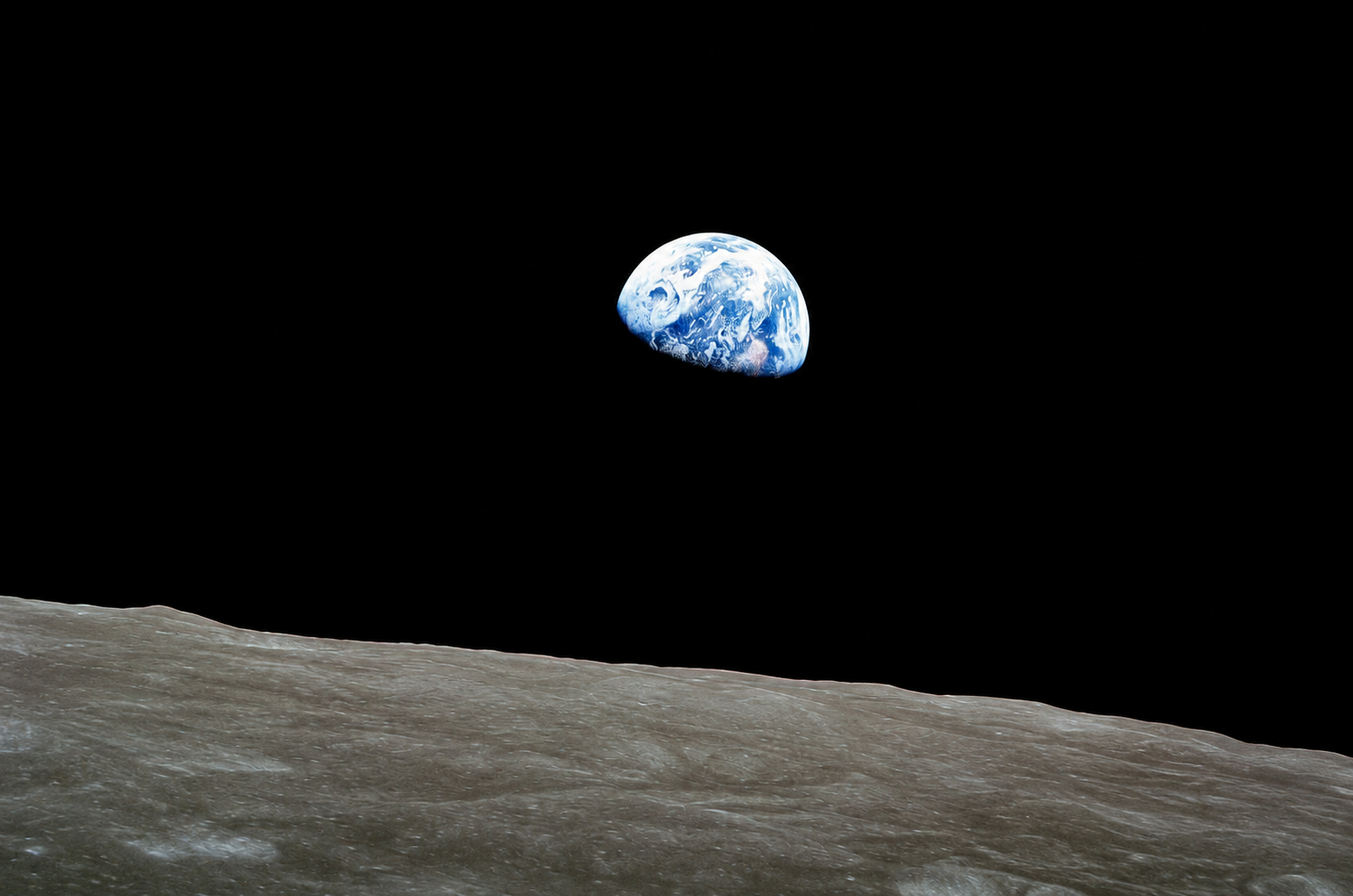
On December 24, 1968, humanity received one of the most extraordinary Christmas gifts in history: a photograph of Earth rising above the barren surface of the Moon. The image became known as “Earthrise.” It showed our planet as a small, beautiful blue-and-white world surrounded by the darkness of space.
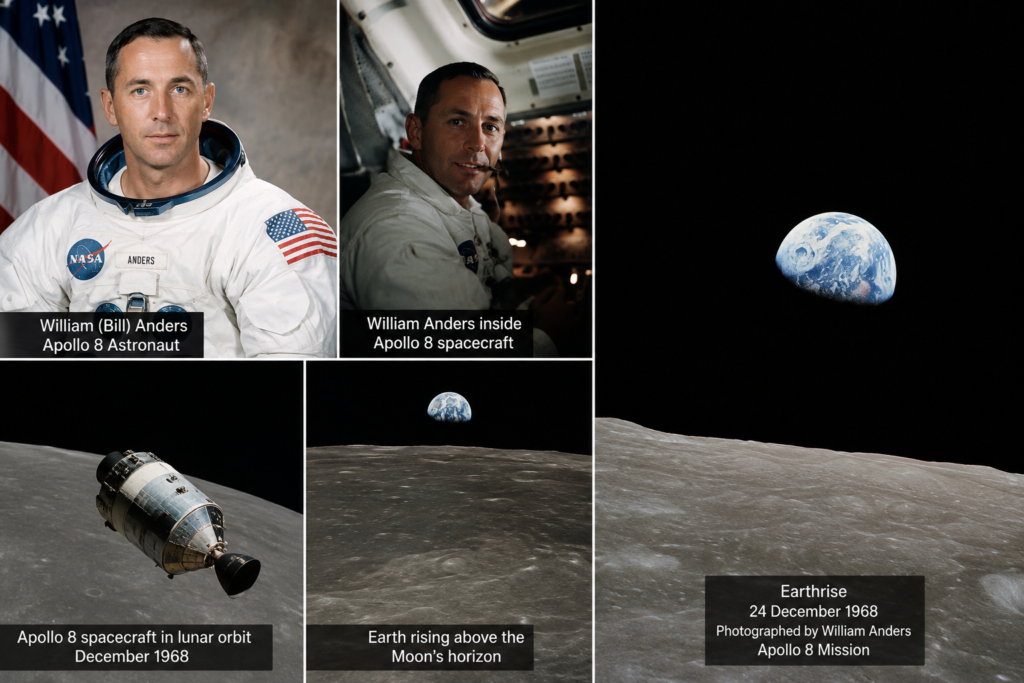
The photograph was taken by NASA astronaut William Anders, a member of the historic Apollo 8 mission. Along with astronauts Frank Borman and James Lovell, Anders became one of the first three humans to travel to the Moon and orbit another world.
Earthrise was more than a remarkable space photograph. It became a symbol of Earth’s beauty, fragility, and unity. At a time when the world was experiencing political conflict, social change, and environmental concerns, the image gave millions of people a completely new perspective on their home planet.
Who Was William Anders?
William Alison Anders was born on October 17, 1933, in Hong Kong. He later became an American Air Force officer, nuclear engineer, and NASA astronaut.
Anders developed an interest in science and engineering and eventually graduated from the United States Naval Academy in 1955. He later earned a master’s degree in nuclear engineering from the Air Force Institute of Technology.
Before joining NASA, Anders served as a military pilot. His technical background and experience made him an excellent candidate for the early American space program.
In 1963, Anders was selected by NASA as part of Astronaut Group 3. The group included several astronauts who would later play important roles in America’s effort to reach the Moon.
Anders initially trained for future space missions, but his historic opportunity came when he was assigned to Apollo 8.
The Apollo 8 Mission
Apollo 8 was one of the most important missions in the history of space exploration.
The mission launched from Kennedy Space Center in Florida on December 21, 1968. Frank Borman served as commander, James Lovell was the command module pilot, and William Anders was the lunar module pilot.
There was one important detail: Apollo 8 did not actually carry a lunar module. The mission had originally been planned differently, but NASA changed the mission profile as preparations progressed.
Instead, Apollo 8 would travel all the way to the Moon, enter lunar orbit, circle the Moon, and then return safely to Earth.
This was an enormous achievement.
No human beings had ever traveled so far from Earth. No astronauts had previously entered lunar orbit. The mission was also conducted only a few years after President John F. Kennedy had challenged the United States to land a person on the Moon before the end of the 1960s.
Apollo 8 demonstrated that humans could travel to the Moon and successfully operate a spacecraft in lunar orbit.
Traveling Beyond Earth
After launch, Apollo 8 traveled through space toward the Moon.
The spacecraft consisted of the command module, service module, and other mission equipment. Inside the command module, Borman, Lovell, and Anders lived and worked while traveling hundreds of thousands of kilometers from Earth.
As the spacecraft approached the Moon, the astronauts prepared for one of the most important maneuvers of the mission: lunar orbit insertion.
Apollo 8 successfully entered orbit around the Moon.
The astronauts now had an incredible view that no human had ever experienced before.
They could see the Moon’s surface from above while also seeing the distant Earth.
The Moon appeared enormous and mysterious. Its surface was covered with craters, mountains, plains, and shadows. But Earth looked completely different.
From the distance of the Moon, Earth appeared small.
It was a blue-and-white sphere floating against an enormous black background.
That contrast would soon produce one of the most famous photographs ever taken.
The Moment of Earthrise
On December 24, 1968, during Apollo 8’s lunar orbit, the astronauts were preparing to photograph the Moon’s surface.
As the spacecraft moved around the Moon, the astronauts suddenly saw something extraordinary.
Earth appeared above the lunar horizon.
It looked as if the planet was rising over the Moon.
William Anders quickly recognized the importance of the moment and photographed it.
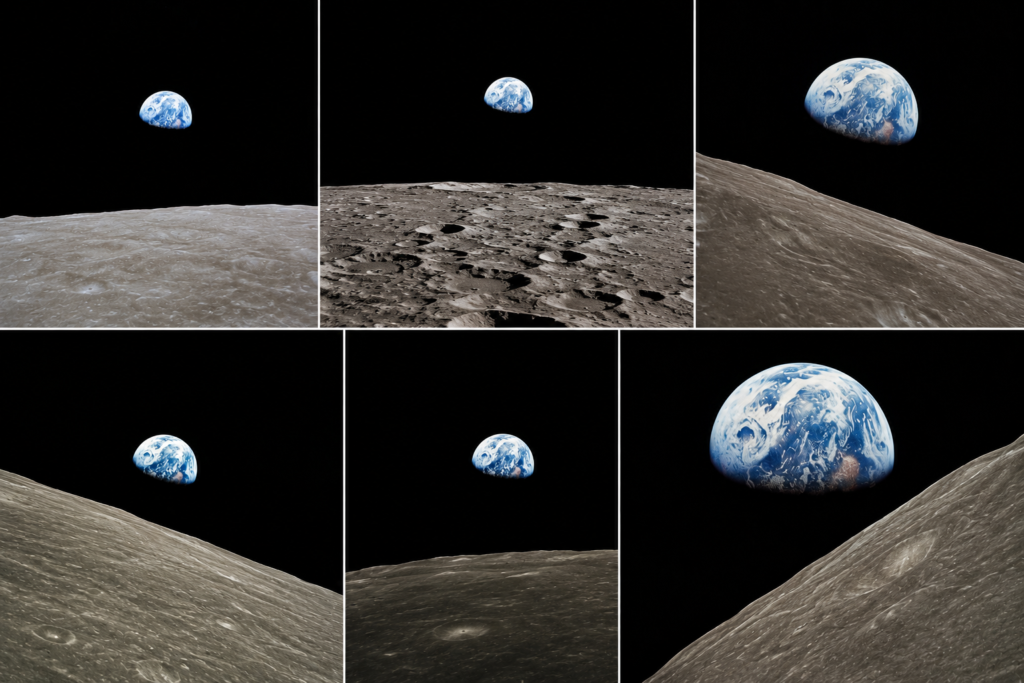
The famous image became known as Earthrise.
The photograph shows Earth appearing above the gray and lifeless lunar landscape. In the background is the deep blackness of space.
The colors of Earth are striking. Blue oceans, white clouds, and brown and green areas of land contrast dramatically with the gray Moon.
The photograph was powerful partly because of its simplicity.
It showed Earth not as a collection of countries or political borders, but as one small planet.
Why Earthrise Was So Important
Before Apollo 8, people had seen photographs of Earth from space, but Earthrise offered something different.
For the first time, millions of people could see their planet from the perspective of someone traveling around another world.
The photograph created a powerful emotional response.
On Earth, people were accustomed to seeing the world from the ground. Nations appeared separate. Cities, borders, oceans, and continents seemed enormous.
From lunar distance, those divisions disappeared.
Earth looked like one small home floating in an immense universe.
The photograph therefore became associated with ideas of global unity and environmental awareness.
It encouraged people to think about Earth as a shared home.
Earth and the Moon
One of the most fascinating aspects of Earthrise is the contrast between Earth and the Moon.
The Moon’s surface in the photograph appears dry, ancient, and lifeless.
Earth, by comparison, looks bright and alive.
Its blue color comes primarily from the presence of vast oceans. White clouds cover portions of the atmosphere. The planet appears active and dynamic.
This contrast made the image especially memorable.
The Moon had been the destination of the Apollo 8 astronauts, but Earth became the unexpected star of the mission’s photography.
Instead of simply looking outward toward another world, humanity was given a chance to look back at itself.
The Photograph and the Environmental Movement
Earthrise appeared during a period of growing environmental awareness.
During the late 1960s, scientists, writers, activists, and members of the public were increasingly concerned about pollution, population growth, natural resources, and the condition of the planet.
Earthrise became closely associated with this growing environmental consciousness.
The photograph helped people understand the idea that Earth is limited and isolated.
There is no second Earth nearby.
There is no visible border separating one nation from another when viewed from space.
The atmosphere that supports life appears as a thin layer around the planet.
The photograph therefore became a visual reminder of Earth’s vulnerability.
Although William Anders did not take the photograph specifically as an environmental campaign image, its meaning expanded far beyond the Apollo 8 mission.
The Famous Christmas Eve Broadcast
Apollo 8 was orbiting the Moon on Christmas Eve.
The astronauts made a television broadcast from lunar orbit that was watched by people around the world.
During the broadcast, Borman, Lovell, and Anders shared views of the Moon and Earth and read from the Book of Genesis.
The event became one of the most memorable moments of the Apollo program.
The timing was especially significant. While the astronauts were far away from Earth, millions of people were celebrating Christmas at home.
The message from lunar orbit connected people across the world with three astronauts who were looking back at their shared planet.
William Anders as a Photographer
William Anders is often remembered primarily as an astronaut, but his role as a photographer was equally important.
The Apollo missions carried cameras because photography was an essential part of documenting the Moon and space.
Astronauts photographed geological features, spacecraft operations, and the Earth.
However, the Earthrise photograph demonstrated how a carefully captured image could become much more than scientific documentation.
It could become a cultural symbol.
Anders later explained that the astronauts were interested in photographing the Moon but were also surprised by the appearance of Earth.
The photograph was made quickly during the spacecraft’s movement around the Moon.
The astronauts understood that they were witnessing something extraordinary.
A Photograph That Became a Symbol
Earthrise eventually became one of the most recognizable photographs in human history.
It appeared in books, magazines, posters, documentaries, museums, educational materials, and environmental campaigns.
Its influence extended far beyond the space program.
Artists, scientists, environmentalists, educators, and writers all used the photograph to communicate different ideas about humanity’s relationship with Earth.
For some people, it represented scientific achievement.
For others, it represented environmental responsibility.
For others, it symbolized peace and human unity.
Its meaning continues to evolve.
The Legacy of Apollo 8
Apollo 8 was not a Moon-landing mission. The astronauts did not walk on the lunar surface.
Nevertheless, the mission was a major step toward the Apollo 11 Moon landing in 1969.
Apollo 8 demonstrated that a crewed spacecraft could travel to the Moon, enter lunar orbit, operate there, and return safely to Earth.
The mission also provided valuable information about lunar navigation and operations.
Most importantly, it demonstrated what was possible.
Only a few months later, Apollo 11 successfully landed humans on the Moon.
William Anders therefore became part of the critical sequence of missions that made the first lunar landing possible.
William Anders After NASA
Anders left NASA in 1969 after completing his astronaut career.
He later served in important government and aerospace positions. He became involved with the Nuclear Regulatory Commission and later worked with General Electric and other organizations.
He also served as chairman and chief executive of General Dynamics.
Although his professional career continued for decades, his name remained permanently connected with the Apollo 8 mission and Earthrise.
The photograph he captured became one of the defining visual records of the twentieth century.
The Death of William Anders
William Anders died on June 7, 2024, in a plane accident near Jones Island in Washington State. He was 90 years old.
His death was widely mourned by the space community.
NASA and fellow astronauts remembered him for his contribution to Apollo 8 and for capturing Earthrise.
Although Anders was one of three astronauts on Apollo 8, his photograph gave the mission a unique cultural legacy.
His camera captured a moment that changed how millions of people viewed their planet.
Why Earthrise Still Matters Today
More than half a century after Apollo 8, Earthrise remains relevant.
Modern spacecraft regularly photograph Earth from space. Satellites provide detailed images of our planet every day.
Yet Earthrise retains a special emotional power.
The reason is that it was not simply a satellite photograph.
It was an image created by human beings who were physically traveling around another world.
The photograph communicates distance.
It reminds viewers that Earth is surrounded by an enormous universe.
At the same time, it shows how extraordinary our planet looks from far away.
Earth is not shown as an abstract scientific object.
It appears as a home.
A New Perspective on Humanity
The greatest legacy of Earthrise may be the perspective it gives us.
Human history is filled with conflicts, political disagreements, competition, and borders.
But from the Moon, none of those divisions are visible.
The planet appears whole.
This does not mean that differences between people disappear. Instead, the photograph encourages us to recognize that all human life ultimately depends on the same planet.
The air, oceans, land, and ecosystems connect humanity.
Earthrise made that idea visible in a single photograph.
Conclusion
William Anders and the Apollo 8 mission occupy an important place in the history of space exploration.
Apollo 8 proved that humans could travel to the Moon and orbit another world. But the mission also produced something that could not be measured only in scientific data or engineering achievements.
It produced Earthrise.
The photograph of Earth appearing above the Moon became a symbol of exploration, discovery, beauty, and human unity.
William Anders did not simply photograph a planet.
He captured a new perspective on humanity’s home.
From hundreds of thousands of kilometers away, Earth looked small, bright, and incredibly precious.
That image continues to remind us that although humanity is divided by geography, politics, and culture, everyone shares the same fragile world.
The astronauts of Apollo 8 traveled to the Moon to explore another world. In the process, they helped humanity see its own world in a completely new way.
Earthrise remains one of the greatest photographs ever taken—not because it shows how far humanity had traveled, but because it showed us what we had left behind: one beautiful planet, floating alone in the darkness of space.


Post Comment