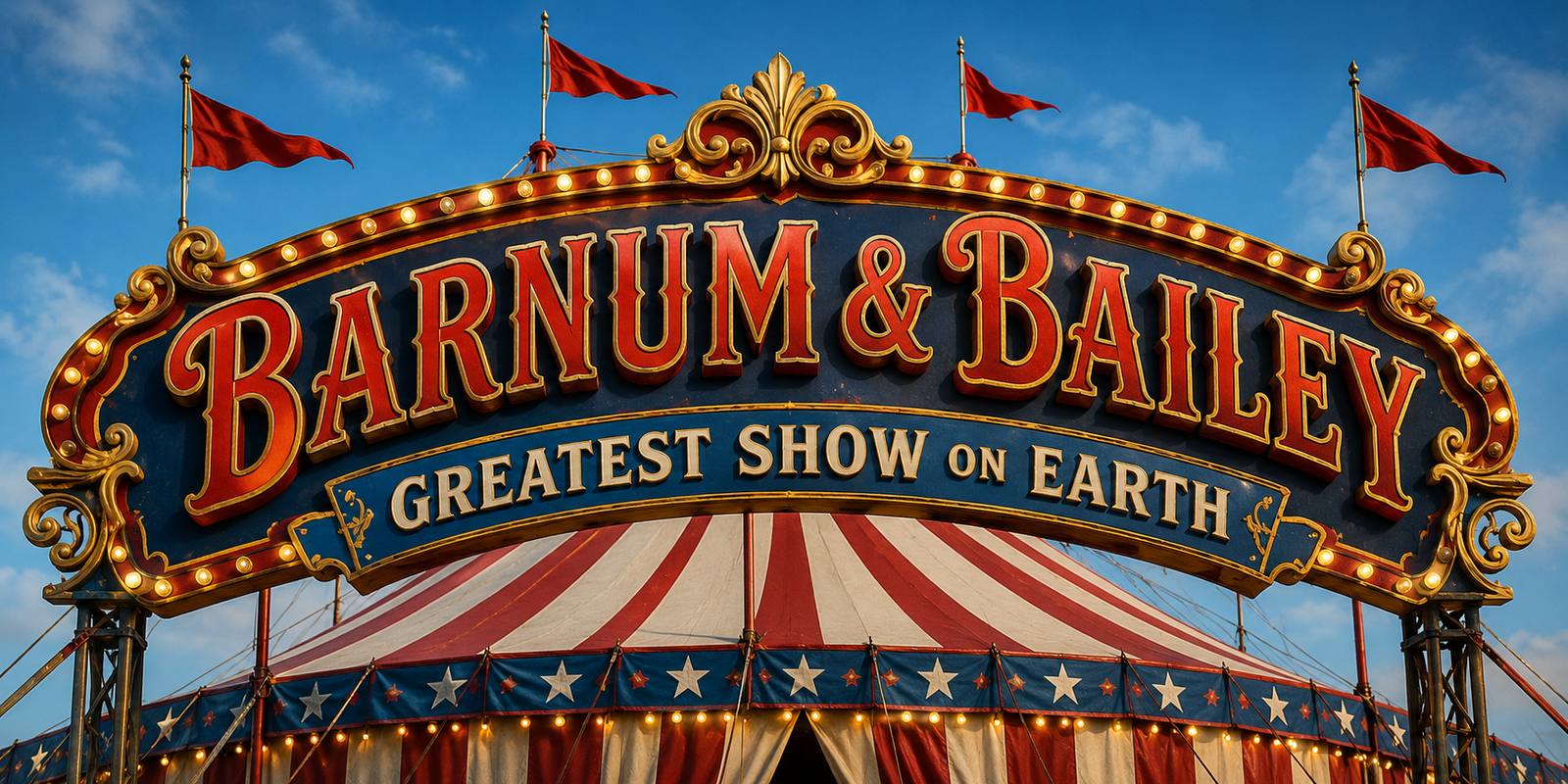
Barnum & Bailey Circus: The Story of America’s Greatest Show
For more than a century, the name Barnum & Bailey represented spectacle, adventure, entertainment, and the extraordinary world of the American circus. At a time when television, cinema, and the internet did not exist, the circus was one of the most exciting forms of mass entertainment in America.
Behind this famous name were two remarkable showmen: P. T. Barnum and James Anthony Bailey. Their careers were different, but together they helped create one of the most famous traveling entertainment organizations in American history.
The story of Barnum & Bailey is not simply a story about tents, elephants, acrobats, clowns, and performers. It is also a story about business, advertising, transportation, ambition, and the extraordinary ability to capture the public imagination.
The Rise of P. T. Barnum
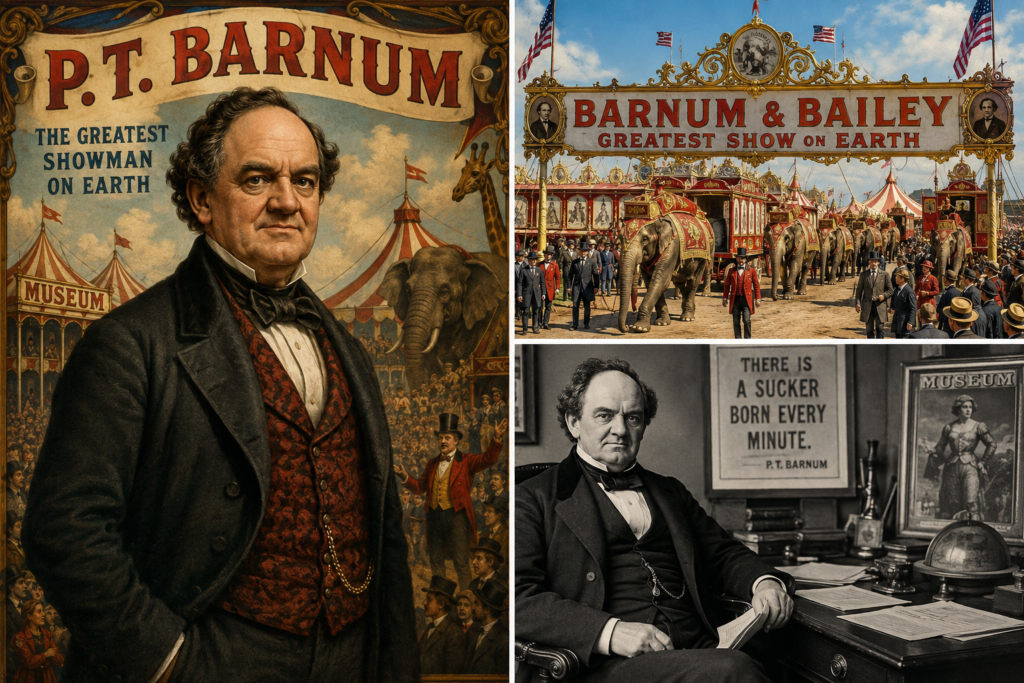
Phineas Taylor Barnum was born on July 5, 1810, in Bethel, Connecticut.
Barnum became famous long before his name was connected with the circus. He was an entrepreneur and showman who understood the power of publicity. He became involved in exhibitions, museums, entertainment, and promotional ventures.
One of his most important achievements was the development of Barnum’s American Museum in New York City.
The museum became famous for its unusual exhibitions, animals, performers, curiosities, and educational displays. Barnum understood that people were naturally attracted to things they considered unusual or mysterious.
His approach was simple but powerful: create curiosity, advertise the attraction, and give the public a reason to visit.
Barnum became one of the most successful showmen of the 19th century.
The American Circus Before Barnum & Bailey
Circuses had already existed in America before Barnum became involved with them.
Traveling circus companies moved from town to town, presenting equestrian acts, acrobats, clowns, musicians, animal performances, and other attractions.
However, transportation was difficult and expensive.
A large circus required horses, wagons, equipment, performers, animals, food, tents, and workers. Moving everything from one city to another was a major logistical challenge.
The expansion of America’s railroad network changed the possibilities for traveling entertainment.
Railroads allowed large circus organizations to move enormous amounts of equipment and performers across the country much faster than before.
This helped create the era of the railroad circus.
James Anthony Bailey
James Anthony Bailey was another important figure in the development of the American circus.
Born James Anthony McGinnis in 1847, he became known professionally as James Anthony Bailey.
Unlike Barnum, Bailey was not primarily famous for creating a museum empire. His great strength was organization and circus management.
Bailey became associated with successful circus operations and developed a reputation as a highly capable businessman.
He understood how to manage performers, transportation, equipment, advertising, and finances.
His practical business skills would eventually complement Barnum’s extraordinary promotional talent.
The Barnum and Bailey Partnership
In 1880, P. T. Barnum and James Anthony Bailey combined their circus interests.
The resulting organization became known as P. T. Barnum’s Greatest Show on Earth and the Great London Circus, and the partnership eventually developed into the famous Barnum & Bailey Circus.
The partnership brought together two very different strengths.
Barnum was an extraordinary promoter.
Bailey was an efficient organizer and manager.
Together, they created a circus capable of traveling on a massive scale.
Their show was designed to be larger, more spectacular, and more memorable than ordinary traveling entertainment.
The Meaning of “The Greatest Show on Earth”
The phrase “The Greatest Show on Earth” became one of the most recognizable slogans in circus history.
It represented the ambition of the Barnum & Bailey organization.
The circus did not want to be just another traveling show.
It wanted to create an enormous spectacle that audiences would remember for the rest of their lives.
The advertising promised excitement, wonder, animals, performers, music, elaborate costumes, and spectacular acts.
At a time when entertainment choices were limited, such promises could attract enormous crowds.
A Circus on Wheels
One of the most remarkable aspects of the great American circus was its ability to move.
A modern audience can easily underestimate how difficult this was in the 19th century.
Imagine moving hundreds of performers, workers, animals, wagons, tents, costumes, musical instruments, cooking equipment, and other supplies from one city to another.
The railroad made this possible on an unprecedented scale.
Circus trains became an important part of American entertainment history.
The arrival of a circus train could itself become an event.
Local residents knew that something spectacular was coming when they saw the circus equipment and performers arriving in their town.
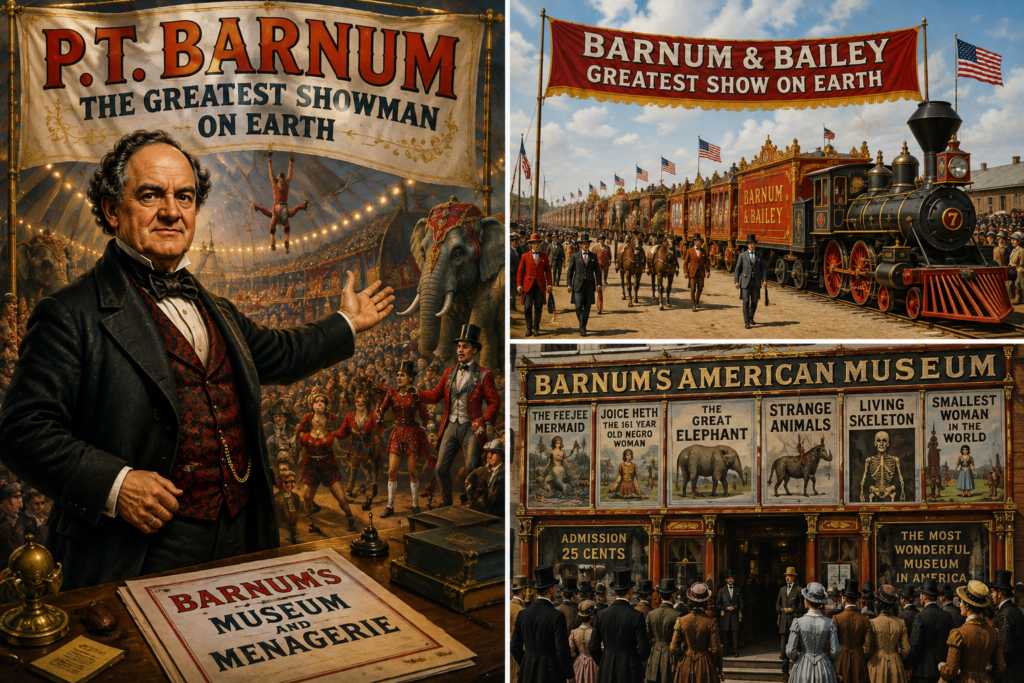
The Circus Parade
Before a performance, circus organizations often used parades to attract attention.
A circus parade could feature performers, horses, musicians, decorated wagons, animals, banners, and colorful costumes.
The parade was more than entertainment.
It was advertising.
People who watched the parade were reminded that the circus was in town.
Children became excited.
Adults became curious.
The circus had already begun selling tickets before the main performance even started.
This combination of entertainment and marketing was one of the reasons the great circus organizations became so successful.
Animals and the American Circus
Animals became one of the most recognizable elements of the traditional American circus.
Elephants, horses, camels, lions, tigers, and other animals appeared in many circus performances.
Elephants in particular became strongly associated with the American circus.
Large animals created a sense of scale and wonder that was difficult for audiences to experience elsewhere.
However, the use of animals in circuses is also an important part of the industry’s complicated history.
Modern audiences have very different views about animal welfare, and many practices associated with historical circuses are now widely criticized.
Understanding the history of the circus therefore requires looking at both its entertainment achievements and the controversies surrounding it.
Acrobats and Aerial Performers
Animals were only one part of the show.
Circuses also featured extraordinary human performances.
Acrobats performed dangerous-looking feats of balance and strength.
Aerial performers worked high above the ground.
Equestrians demonstrated remarkable control while riding horses.
Clowns entertained audiences between major acts.
Musicians provided the sound that helped create the atmosphere.
Every performance was carefully designed to create excitement.
The combination of many different types of performers made the circus different from almost every other form of entertainment of the period.
Barnum’s Talent for Advertising
One of P. T. Barnum’s greatest talents was advertising.
He understood that a successful show needed attention before the audience ever entered the tent.
Colorful posters appeared throughout cities and towns.
Newspapers carried advertisements.
Banners and signs announced extraordinary attractions.
The circus created a sense of anticipation.
Barnum understood a principle that remains important in modern marketing:
People become interested when they believe they are going to see something extraordinary.
His promotional methods influenced American advertising and entertainment for generations.
The Circus as a Family Experience
The American circus became an important form of family entertainment.
Parents could take their children to see performances that seemed impossible in everyday life.
For many children, seeing a large circus for the first time was unforgettable.
The enormous tent, bright costumes, music, animals, performers, and crowds created an atmosphere of wonder.
In small towns especially, the arrival of a major circus could become one of the biggest events of the year.
Barnum’s Death
P. T. Barnum died on April 7, 1891, in Bridgeport, Connecticut.
However, the circus tradition associated with his name continued.
The organization he had helped build remained an important force in American entertainment.
James Bailey continued to play a major role in the circus world until his death in 1906.
The Barnum & Bailey name survived both men.
The Ringling Brothers
Another important family entered the story of the American circus: the Ringling brothers.
The Ringling brothers had created their own successful circus organization.
Their business eventually became one of the strongest competitors to Barnum & Bailey.
In 1907, the Ringling Brothers purchased the Barnum & Bailey Circus.
The two circus traditions were eventually brought together.
This was one of the most important developments in American circus history.
The Birth of Ringling Bros. and Barnum & Bailey
The combined organization eventually became known as Ringling Bros. and Barnum & Bailey Circus.
It brought together two of the most famous names in American circus history.
The organization became enormous.
Its performances featured large numbers of performers, animals, musicians, technicians, and support workers.
The circus continued traveling across the United States and became an important part of American popular culture.
For decades, the name Ringling Bros. and Barnum & Bailey was almost synonymous with the American circus.
The Golden Age of the Big Top
The early and middle decades of the 20th century are often remembered as a golden age of the American big-top circus.
Circuses could attract huge audiences.
Large tents could accommodate thousands of spectators.
Circus trains traveled across the country.
The performers became famous within the world of entertainment.
The circus was no longer simply a small traveling show.
It had become a massive entertainment industry.
Competition from Modern Entertainment
But entertainment was changing.
Movies became increasingly popular.
Then came radio.
Later, television entered American homes.
People no longer had to travel to a circus to see exciting performances.
They could enjoy entertainment from their own living rooms.
This created new challenges for the traditional circus.
The circus still had one major advantage, however.
It offered something television could not completely reproduce:
a live experience.
The enormous tent, the crowd, the music, and the physical presence of performers created an atmosphere that could not easily be duplicated on a screen.
Changing Attitudes Toward Animals
Another major challenge was the changing public attitude toward animals in entertainment.
Animal-rights organizations and members of the public increasingly questioned the use of elephants and other animals in circuses.
Concerns about animal treatment became an important issue for major circus companies.
The debate became especially significant for Ringling Bros. and Barnum & Bailey.
Eventually, the circus stopped using elephants in its performances, and animal-related controversies continued to influence public discussion about the future of traditional circuses.
The End of the Famous Circus
In 2017, Ringling Bros. and Barnum & Bailey Circus performed its final shows and closed.
The decision marked the end of an extraordinary chapter in American entertainment history.
For more than a century, the Barnum name had been connected with some of the biggest circus spectacles in America.
The closure reflected many changes in society, including changing entertainment habits, operating costs, attendance patterns, and concerns about animal performances.
Although the circus closed, its historical influence did not disappear.
Why Barnum & Bailey Still Matters
The story of Barnum & Bailey is important because it demonstrates how entertainment can evolve.
P. T. Barnum understood publicity.
James Bailey understood organization.
The combination of promotion and management created a powerful entertainment business.
The circus also demonstrated the importance of transportation and logistics.
Without railroads, it would have been extremely difficult to move such a large organization across the country.
The circus therefore represents an interesting combination of entertainment, business, transportation, advertising, and American popular culture.
The Legacy of P. T. Barnum
P. T. Barnum remains one of the most recognizable American showmen.
His methods were sometimes controversial, and some of his promotional practices would be viewed very differently today.
Nevertheless, his ability to create public curiosity was extraordinary.
He understood that entertainment was not simply about what happened on stage.
It was also about the story surrounding the event.
The posters, the headlines, the parade, the anticipation, and the spectacle were all part of the experience.
Modern entertainment companies continue to use similar principles.
The Legacy of James Bailey
James Anthony Bailey deserves equal attention.
While Barnum became famous for publicity, Bailey’s contribution was strongly connected to management and organization.
A giant traveling circus could not operate successfully without careful planning.
Thousands of details had to be coordinated.
People, animals, equipment, transportation, performances, food, advertising, and finances all had to work together.
Bailey’s ability to manage a large entertainment organization helped make the Barnum & Bailey Circus successful.
More Than a Circus
Barnum & Bailey was more than a tent and a collection of performers.
It became a symbol.
It represented the American fascination with adventure, spectacle, and the extraordinary.
For generations of Americans, the circus represented a temporary escape from ordinary life.
A circus could arrive in town for only a short time, but it could create memories that lasted for decades.
That emotional connection explains why the history of Barnum & Bailey continues to attract attention today.
Conclusion
The story of Barnum & Bailey Circus is one of the greatest chapters in the history of American entertainment.
P. T. Barnum brought extraordinary promotional talent and an instinct for spectacle.
James Anthony Bailey brought organization, management, and business expertise.
Together, their names became connected with one of the most famous circus organizations in history.
The later combination with the Ringling Brothers created an even larger institution that carried the Barnum name for generations.
The traditional American circus eventually disappeared from the national stage, but its influence remains visible.
Modern live entertainment, advertising, celebrity promotion, spectacular events, and traveling shows all owe something to the pioneering showmen of the 19th and early 20th centuries.
Barnum & Bailey showed America that entertainment could be enormous.
They transformed the circus into a national spectacle and created memories for millions of people.
Their story reminds us that sometimes the most powerful form of entertainment is not simply what people see—it is the sense of wonder and anticipation created before the show even begins.
The big top may have changed, but the fascination with the greatest show on earth remains part of American history.


Post Comment