Marc Garneau: The First Canadian in Space and a Pioneer of Canadian Exploration
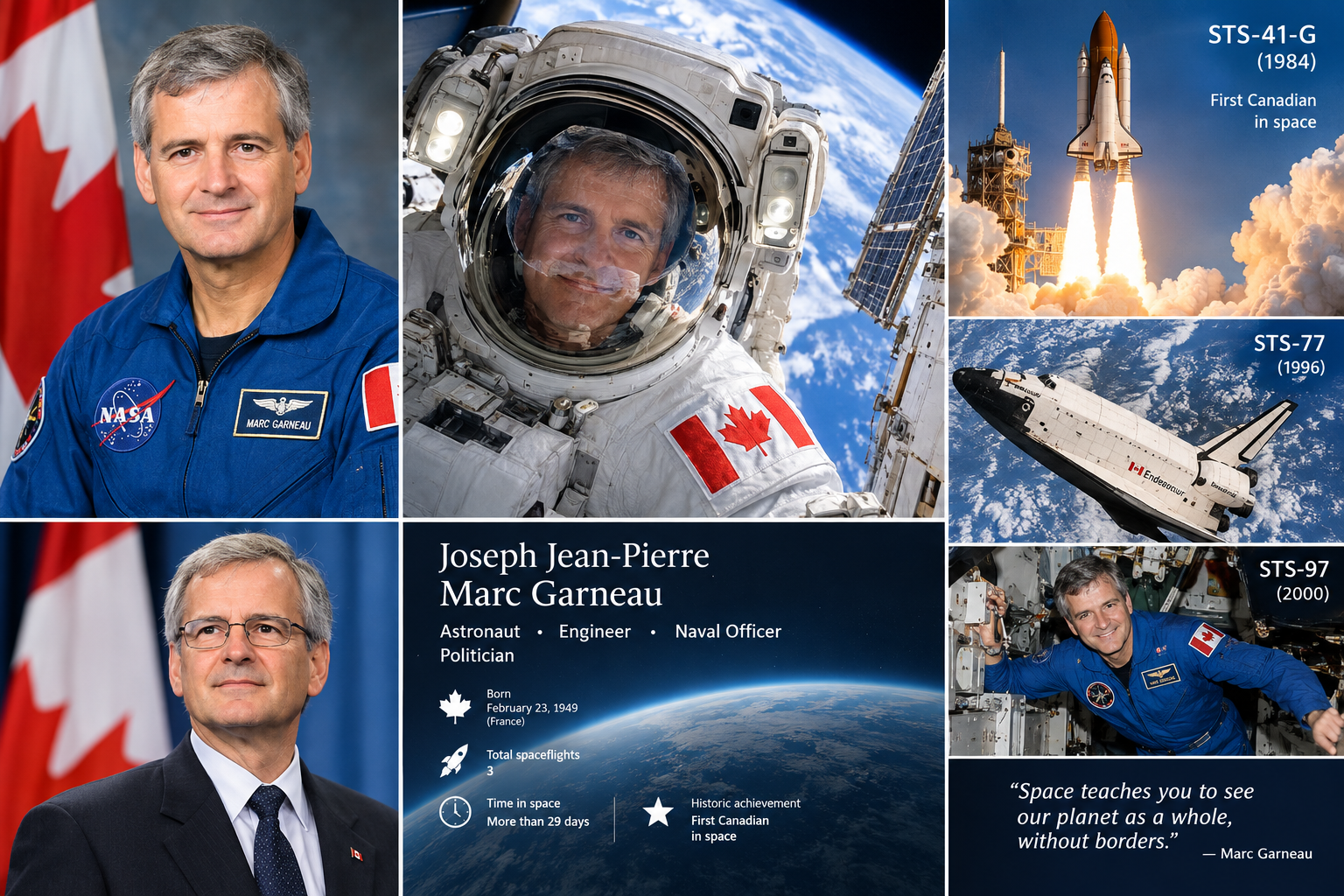
When people think about the history of Canadian space exploration, one name stands out as a true pioneer: Joseph Jean-Pierre Marc Garneau. A naval officer, engineer, astronaut, scientist, and politician, Garneau became a symbol of Canada’s growing role in human spaceflight.
On October 5, 1984, Garneau made history when he launched aboard NASA’s Space Shuttle Challenger on mission STS-41G. With that flight, he became the first Canadian to travel into space. His achievement represented an important milestone not only for Garneau personally, but also for Canada’s developing space program.
Over the course of his astronaut career, Garneau flew into space three times. His missions included STS-41G in 1984, STS-77 in 1996, and STS-97 in 2000. Altogether, he spent more than 677 hours in space.
His journey, however, began long before he ever entered a spacecraft.
Early Life and Education
Marc Garneau was born on February 23, 1949, in Quebec City, Quebec. From an early stage in his life, he developed an interest in science, engineering, and technology.
His academic career prepared him for work that would eventually take him far beyond Earth. In 1970, he earned a Bachelor of Science degree in Engineering Physics from the Royal Military College of Kingston. Three years later, he completed a doctorate in Electrical Engineering at the Imperial College of Science and Technology in London, England.
His combination of engineering knowledge and military experience would later become extremely valuable when Canada began selecting its first group of astronauts.
Career in the Canadian Navy
Before becoming an astronaut, Garneau built an impressive career in the Canadian military.
In the 1970s, he worked as a combat systems engineer aboard the Canadian naval vessel HMCS Algonquin. He later became an instructor in naval weapons systems at the Canadian Forces Fleet School in Halifax.
His work involved sophisticated technology, including naval weapons, communications, electronic warfare systems, and engineering projects. He also contributed to the development of equipment and systems used by Canada’s armed forces.
This technical background helped establish Garneau as an ideal candidate for Canada’s emerging astronaut program.
Canada Selects Its First Astronauts
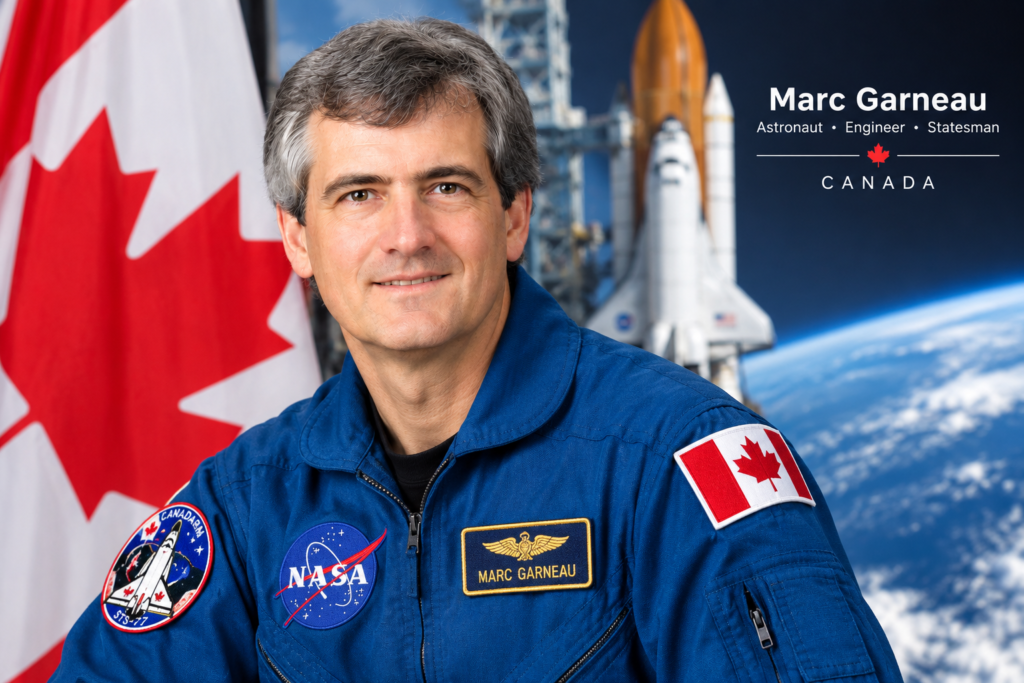
In 1983, Canada selected its first six astronauts. Garneau was among them, alongside Roberta Bondar, Steve MacLean, Ken Money, Robert Thirsk, and Bjarni Tryggvason.
The selection was part of a growing relationship between Canada and the United States in space exploration.
Canada had already made an important contribution to the Space Shuttle program through the development of the Canadarm, the robotic arm that became one of the country’s most famous space technologies. NASA’s use of Canadian technology helped strengthen cooperation between the two nations and contributed to Canada’s first opportunity to send an astronaut into space.
For Garneau, this was the beginning of a remarkable new chapter.
The Historic STS-41G Mission
On October 5, 1984, Space Shuttle Challenger lifted off from Kennedy Space Center in Florida carrying the crew of STS-41G.
Among the astronauts was Marc Garneau.
The mission lasted approximately 8 days, 5 hours, 23 minutes, and 33 seconds, ending with the shuttle’s return to Kennedy Space Center on October 13.
Garneau served as a payload specialist and conducted Canadian experiments during the mission. His work covered three broad areas:
– Space technology
– Space science
– Life sciences
The Canadian experiments examined subjects ranging from the effects of the space environment to human adaptation to spaceflight. Remarkably, the equipment needed for his ten Canadian experiments fit into a relatively small storage area aboard the shuttle.
The significance of the mission went far beyond scientific research.
When Garneau entered orbit, he became the first Canadian to fly in space.
For Canada, it was a historic moment.
A New Era for Canadian Space Exploration
Garneau’s first mission helped demonstrate that Canadian astronauts could contribute meaningful scientific and technological expertise to international space missions.
His achievement also helped inspire a new generation of Canadians interested in science, engineering, aviation, and space exploration.
Canada’s space program continued to grow. In 1989, the Canadian Space Agency was established, providing a dedicated national organization for Canada’s activities in space.
Garneau remained involved in the astronaut program and later became Deputy Director of the Canadian Astronaut Program. His responsibilities included providing technical and program support for experiments planned for future missions.
But his journey into space was not finished.
STS-77: Garneau Returns to Space
In 1992, Garneau was selected for NASA mission specialist training. He subsequently trained at NASA’s Johnson Space Center and gained experience supporting shuttle missions from Mission Control as a capsule communicator, commonly known as CAPCOM.
In May 1996, he returned to space aboard Space Shuttle Endeavour on mission STS-77.
This time, Garneau served as a mission specialist.
STS-77 lasted approximately ten days and included a variety of scientific and technological experiments. The mission carried experiments involving Spacehab, the Spartan satellite, an inflatable antenna experiment, and other research projects.
Garneau’s second flight made him the first Canadian astronaut to travel into space twice.
His transformation from Canada’s first astronaut to an experienced mission specialist demonstrated how quickly Canadian participation in human spaceflight was developing.
STS-97 and the International Space Station
Garneau’s third and final spaceflight came in 2000.
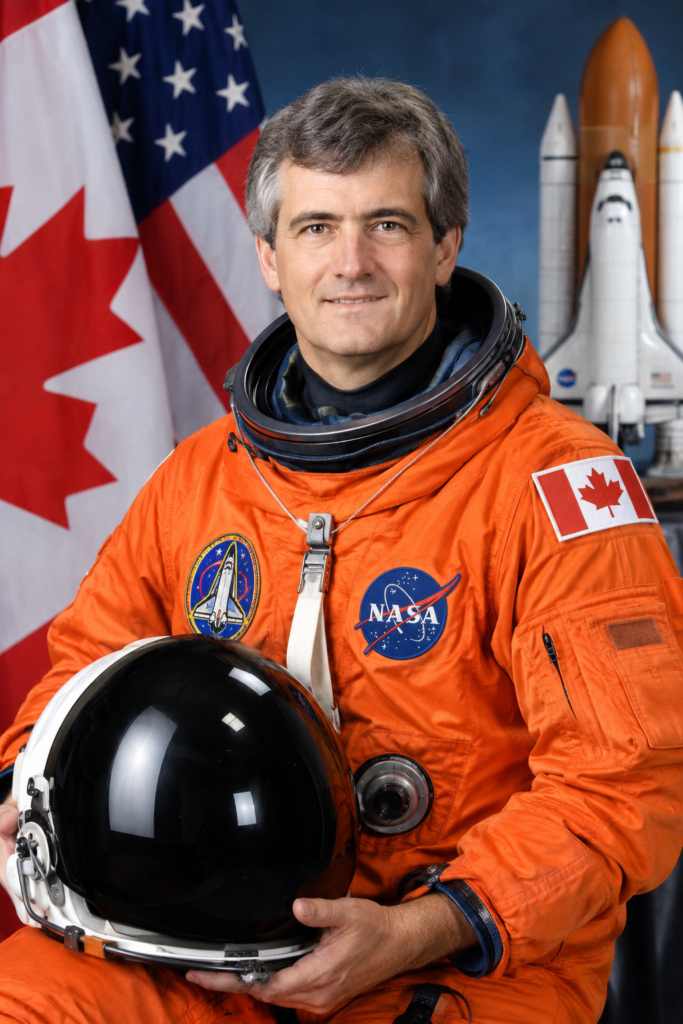
On November 30, 2000, he launched aboard Space Shuttle Endeavour as part of STS-97. The mission was particularly significant because it contributed to the construction and expansion of the International Space Station (ISS).
STS-97 delivered and installed the first pair of large solar arrays for the International Space Station. These solar panels provided an important increase in the station’s ability to generate electrical power.
During the mission, Garneau worked alongside an international group of astronauts involved in the growing space station project.
When he returned to Earth, his three missions had given him more than 677 hours of spaceflight experience.
His three missions also demonstrated the evolution of human spaceflight—from scientific experiments aboard the early Space Shuttle missions to the international construction of a permanent research laboratory in orbit.
Life After Spaceflight
Garneau’s career did not end when his astronaut flights were complete.
In 2001, he became the first vice-president of the Canadian Space Agency and later served as its president from 2001 to 2005.
His experience as an engineer, military officer, astronaut, and space-program leader gave him a unique perspective on Canada’s role in science and technology.
Garneau later entered Canadian politics. In 2008, he was elected as a Member of Parliament representing the Montreal-area riding of Notre-Dame-de-Grâce—Westmount.
His political career gave him another platform from which to advocate for science, innovation, technology, and Canada’s international role.
Awards and Recognition
Marc Garneau received numerous honours during his career.
Among them were the NASA Space Flight Medal, awarded for his space missions, and the NASA Exceptional Service Medal. He was also appointed an Officer of the Order of Canada in 1984 and later became a Companion of the Order of Canada in 2003.
He also received numerous honorary degrees from Canadian universities and institutions.
These honours reflected the importance of his achievements not only as an astronaut but also as an engineer, public servant, and national figure.
Marc Garneau’s Legacy
The importance of Marc Garneau’s career cannot be measured only by the number of hours he spent in orbit.
His greatest contribution was perhaps what his achievement represented.
Before 1984, Canada had never sent one of its citizens into space. Garneau changed that. His first mission demonstrated that Canadian scientists and engineers could participate directly in human spaceflight.
His career also helped establish a path for later Canadian astronauts, including Roberta Bondar, Chris Hadfield, Julie Payette, Robert Thirsk, Steve MacLean, Dave Williams, and others.
Canada’s involvement in space has since expanded dramatically, including major contributions to robotics, Earth observation, science, and the International Space Station. The Canadian Space Agency notes that since the first astronaut group was formed in 1983, 14 Canadians have been selected as astronauts.
Garneau was the person who opened that historic door.
Remembering a Canadian Space Pioneer
Marc Garneau died on June 4, 2025, at the age of 76.
His death marked the passing of one of the most important figures in Canadian space history.
From naval engineering to the Space Shuttle, from the first Canadian mission in 1984 to the construction of the International Space Station, Garneau’s career followed the remarkable development of Canada’s involvement in space exploration.
His story is also a reminder that historic achievements often begin with education, technical knowledge, determination, and the willingness to accept a challenge.
Marc Garneau did more than become the first Canadian in space. He helped prove that Canada could take its place among the nations exploring beyond Earth.



Post Comment