The 33 Miners: The Incredible Survival and Rescue at San José Mine
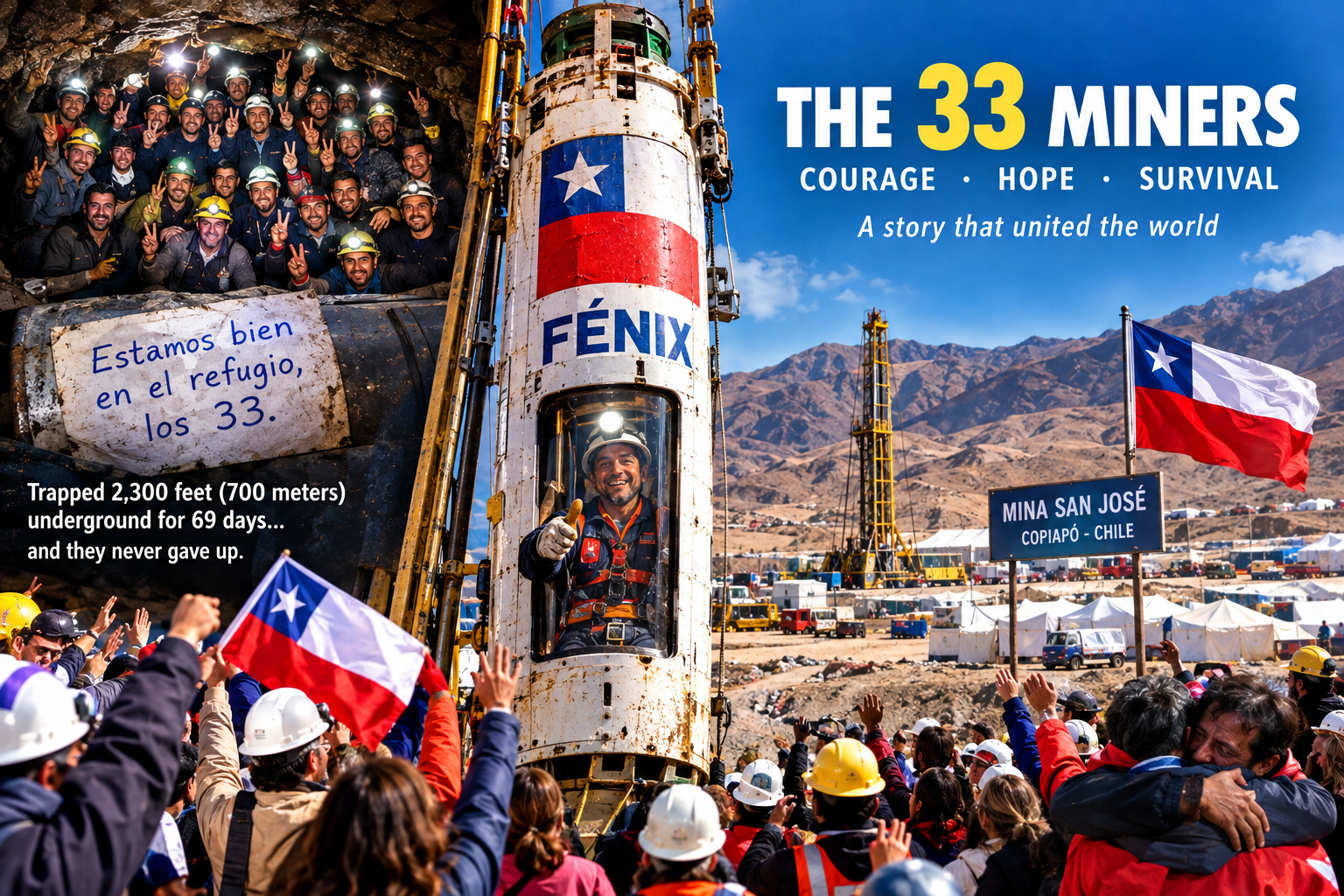
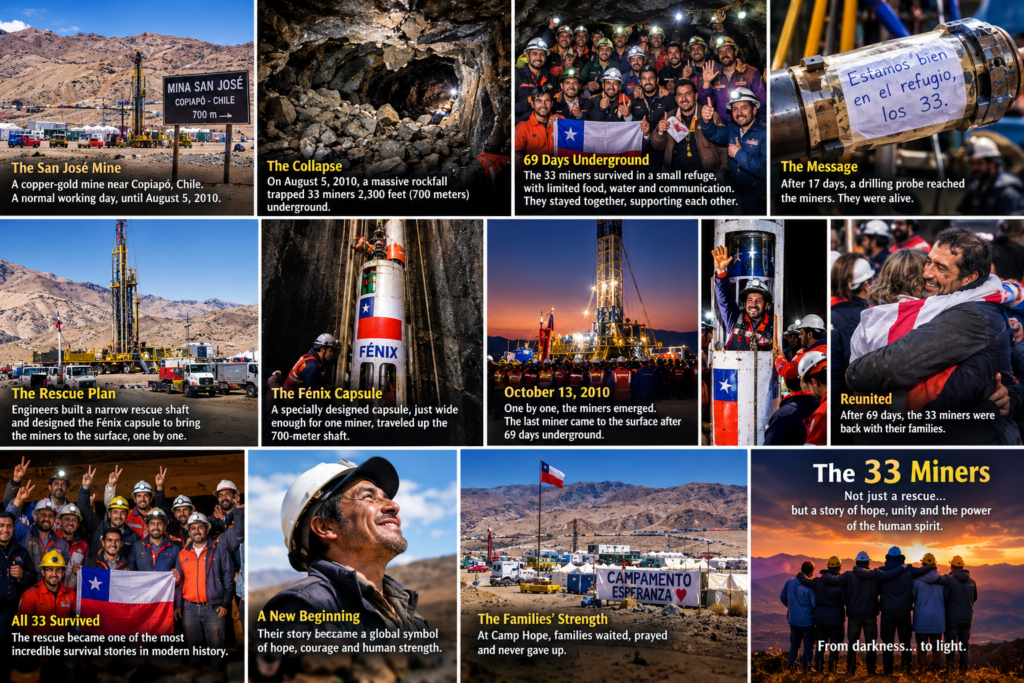
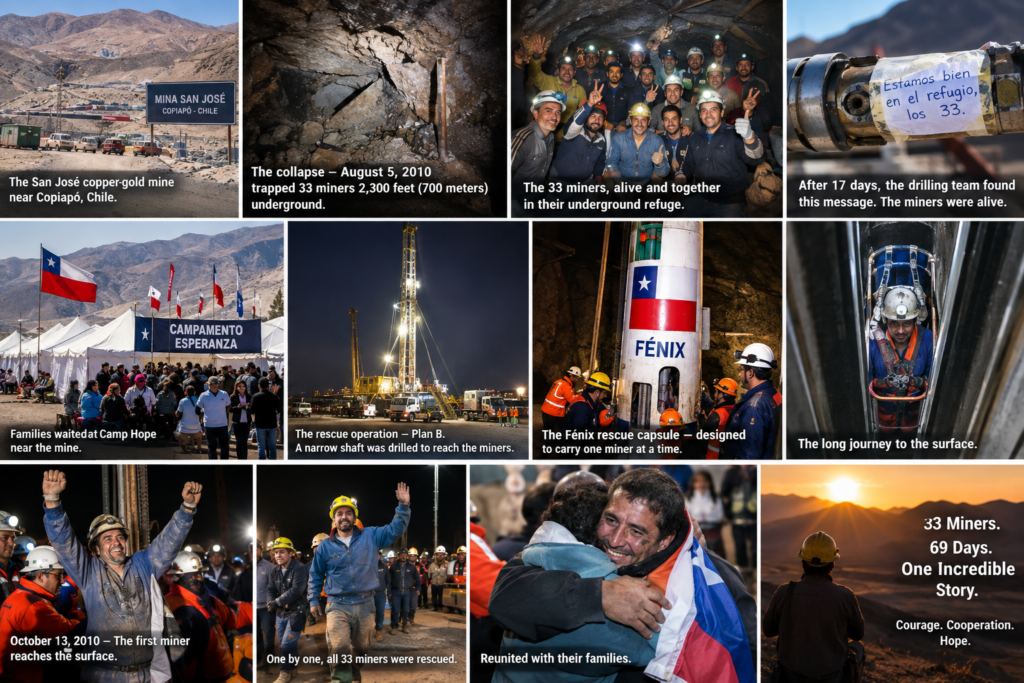
On August 5, 2010, an ordinary working day at the San José copper-gold mine in northern Chile suddenly became a fight for survival. A massive rockfall deep inside the mine trapped 33 miners approximately 2,300 feet (700 meters) underground.
What followed was an extraordinary 69-day ordeal that captured the attention of the entire world.
The miners were separated from the surface by hundreds of meters of rock. Their families had no idea whether they were alive. Rescue teams faced enormous technical challenges, unstable underground conditions, extreme temperatures, and the possibility that the men might never be found.
Yet the miners survived.
Their story became one of the most remarkable examples of human endurance in modern history.
The San José Mine
The San José mine was located near Copiapó in Chile’s Atacama Desert, one of the driest places on Earth. The region has a long history of mining, particularly copper and gold.
Mining in the area was economically important, but the San José mine had a difficult history. Safety concerns had previously been raised about the operation, and the underground workings were complicated by their depth and geological conditions.
On August 5, 2010, 33 miners were working underground when a huge section of rock collapsed.
The force of the collapse blocked the main access routes to the surface.
The men were suddenly trapped.
Trapped 700 Meters Below Ground
The miners were not trapped in a small room immediately after the collapse. Instead, they found themselves inside a vast underground network containing tunnels and work areas.
But being underground did not make their situation safe.
They had limited food and water, no reliable communication with the surface, and no certainty that rescuers would locate them.
The deeper they were underground, the more difficult rescue became.
For the first several days, rescuers drilled exploratory holes into the mountain in an attempt to determine where the missing miners were located.
The operation was complicated by the mine’s geological structure. A rescue drill could easily miss the area where the men were trapped.
Every meter mattered.
The Search for the Missing Men
Above ground, the families of the miners gathered near the mine.
At first, there was hope that the men might have escaped through another part of the underground workings.
But as the hours became days, uncertainty grew.
Rescue crews began drilling boreholes into the mine.
Several attempts failed.
A drill could pass through the rock without reaching the miners.
For the families, every unsuccessful attempt was devastating.
Then, after 17 days, the world received extraordinary news.
A drilling probe reached the underground refuge.
When rescuers pulled the drill back to the surface, they discovered a handwritten message attached to it.
It read:
“Estamos bien en el refugio, los 33.”
“We are well in the shelter, the 33.”
The discovery changed everything.
The miners were alive.
The World Learns Their Story
The message immediately became an international symbol of hope.
For the first time, rescuers knew exactly where the men were.
But finding them was only the beginning.
The miners remained hundreds of meters underground.
A rescue tunnel large enough for a person could not simply be drilled quickly through such a huge distance of rock.
Engineers had to develop a completely new strategy.
The first priority was keeping the miners alive while a rescue shaft was constructed.
Small boreholes were used to send supplies underground.
Food, water, medicine and communication equipment could gradually be delivered to the refuge.
The miners now had a connection with the outside world.
Life Underground
The 33 men faced extraordinary psychological and physical pressure.
They were living in darkness far below the surface, with temperatures and humidity making the environment uncomfortable.
There was also limited space and uncertainty about how long they would remain underground.
The miners had to establish a system of organization.
They rationed their food and water.
Eventually, psychologists and medical specialists became involved in supporting both the miners and their families.
The men also received messages and supplies from the surface.
One of the greatest challenges was maintaining their physical health.
Doctors understood that the rescue might take weeks or even months. The men therefore needed carefully controlled nutrition rather than simply receiving large quantities of food.
Their mental health was equally important.
They needed something that gave their days structure and purpose.
Three Rescue Plans
Several rescue plans were developed during the operation.
The main approach eventually became known as Plan B.
Engineers used a powerful drilling system to create a narrow rescue shaft from the surface to the underground refuge.
The hole needed to be large enough for a specially designed rescue capsule.
Other drilling efforts were also underway, providing backup options.
The rescue operation therefore became a race against time involving engineers, miners, medical experts, military personnel and specialists from different countries.
The entire world was watching.
The Rescue Capsule
One of the most important pieces of equipment developed for the rescue was the Fénix rescue capsule.
The capsule was designed to carry one miner at a time through the narrow rescue shaft.
It was only slightly wider than the miner inside it.
The capsule had wheels and safety systems designed to help it travel through the long vertical tunnel.
For the trapped miners, the capsule represented freedom.
But the journey was dangerous.
The rescue shaft stretched hundreds of meters upward.
A failure during the operation could have been catastrophic.
The Long Wait
As the drilling continued, the miners waited underground.
They knew that rescuers were working for them, but they also knew that the operation was extremely complicated.
The psychological pressure was enormous.
Above ground, the families waited beside the mine.
The site became known internationally as Campamento Esperanza, or “Camp Hope.”
News organizations from around the world arrived in Chile.
Television cameras transmitted images of the rescue operation globally.
The miners had become famous before they had even reached the surface.
August Became September, and September Became October
The miners were trapped for far longer than anyone initially expected.
Days became weeks.
Weeks became months.
Yet the rescue effort continued.
Engineers worked around the clock.
Drilling machines slowly advanced through the rock.
Every breakthrough brought renewed hope.
But every technical problem threatened to delay the operation.
The rescue required extraordinary coordination.
The miners underground had to remain healthy.
The drilling teams had to maintain accuracy.
The rescue shaft had to be stable.
And the capsule had to work.
There was no room for complacency.
Reaching the Refuge
Eventually, the drilling operation succeeded in reaching the area where the miners were located.
The rescue shaft was prepared for the final operation.
Medical teams studied how each miner should be brought to the surface.
The men were assessed for their physical condition, and preparations were made for their first moments above ground.
After spending more than two months underground, returning suddenly to sunlight and open air could itself be physically challenging.
The rescue would therefore be carefully controlled.
October 13, 2010
Then came the day the world had been waiting for.
On October 13, 2010, the rescue operation began.
One by one, the miners entered the Fénix capsule.
The capsule slowly traveled upward through the rescue shaft.
After approximately 69 days underground, the first miner emerged onto the surface.
The crowd erupted.
Family members cried.
People embraced.
Flags were raised.
The impossible suddenly seemed possible.
Then another miner emerged.
And another.
One by one, all 33 men were brought safely to the surface.
The final miner emerged after the extraordinary rescue operation had continued for many hours.
Chile had accomplished something that had once seemed almost impossible.
All 33 miners survived.
A Global Moment of Hope
The rescue became one of the most watched events in television history.
Millions of people around the world followed the operation.
The story transcended Chile.
It became a global story about survival and hope.
The miners came from different backgrounds and had different personalities, but underground they had been forced to depend on one another.
Their survival demonstrated the importance of cooperation under extreme circumstances.
The rescue also showcased modern engineering.
No single person could have accomplished it.
Scientists, engineers, drilling specialists, medical professionals, miners and rescue workers all contributed to the effort.
The Strength of the Miners
The physical challenge was only one part of the story.
The psychological challenge was enormous.
Imagine spending more than two months hundreds of meters below the Earth’s surface without knowing exactly when—or whether—you would return home.
The miners had to maintain discipline.
They had to manage limited resources.
They had to support one another.
They had to deal with fear, uncertainty and isolation.
Their ability to maintain organization and hope played an important role in their survival.
The Families Who Waited
The story of the 33 miners is also the story of their families.
For weeks, relatives lived near the mine.
They endured uncertainty and watched the rescue operation develop.
The creation of Camp Hope became an important symbol of their determination.
Families prayed, waited and encouraged one another.
When the miners finally emerged, many of the most emotional scenes involved reunions between the men and their loved ones.
For the families, the rescue was not simply a technical achievement.
It was the return of fathers, brothers, sons and friends.
The Men Become International Figures
After their rescue, the 33 miners became internationally known.
They received invitations from around the world and were celebrated as symbols of survival.
Their story appeared in books, documentaries and films.
They met political leaders and public figures.
For some, however, life after the rescue was not simple.
Returning to normal life after such a traumatic experience presented its own challenges.
The world saw the dramatic rescue, but the psychological effects of spending 69 days underground could not disappear immediately.
Lessons From San José
The San José disaster raised serious questions about mining safety.
The rescue demonstrated what can be achieved through technology and international cooperation, but the accident also highlighted the dangers faced by miners.
Mining remains one of the world’s most demanding occupations.
Workers can face rockfalls, explosions, flooding, fires, toxic gases and equipment failures.
The story of the 33 miners therefore became more than a story of survival.
It also became a reminder that prevention and safety must come before rescue.
A successful rescue is extraordinary.
But preventing workers from becoming trapped in the first place is even more important.
An Extraordinary Engineering Achievement
The rescue at San José was an engineering challenge on an enormous scale.
Drilling hundreds of meters through rock with enough precision to reach a specific underground location is extremely difficult.
Engineers had to consider the geological structure of the mountain, drilling accuracy, tunnel stability and the design of the rescue capsule.
They also had to work under intense international attention.
The operation showed how different areas of expertise could be combined to solve an apparently impossible problem.
Why the Story Still Matters
More than a decade later, the story of the 33 miners remains one of the most extraordinary survival stories ever recorded.
It combines tragedy and hope.
It began with a catastrophic collapse.
It continued with uncertainty and fear.
It became a global rescue effort.
And it ended with 33 men returning to the surface alive.
The image of the Fénix capsule slowly emerging from the underground shaft became a powerful symbol.
It represented the moment when darkness gave way to light.
The miners had spent 69 days beneath the Earth.
Then, one by one, they came home.
The 33 Men Who Refused to Give Up
The San José miners did not know how their story would end when the mine collapsed on August 5, 2010.
They only knew that they were trapped.
For 17 days, the outside world did not know whether they had survived.
Then came the message that changed everything:
The 33 were alive.
From that moment forward, an international rescue operation began.
For 52 more days, the miners waited.
They ate carefully managed food.
They communicated with their families.
They received medical care.
They endured darkness and uncertainty.
And they waited for the capsule that would take them home.
On October 13, 2010, that wait finally ended.
The rescue of the 33 Chilean miners became a defining example of courage, cooperation and human perseverance.
Their story reminds us that even when people are buried beneath hundreds of meters of rock, hope can still reach them.
And sometimes, against extraordinary odds, everyone comes home.
Post Comment