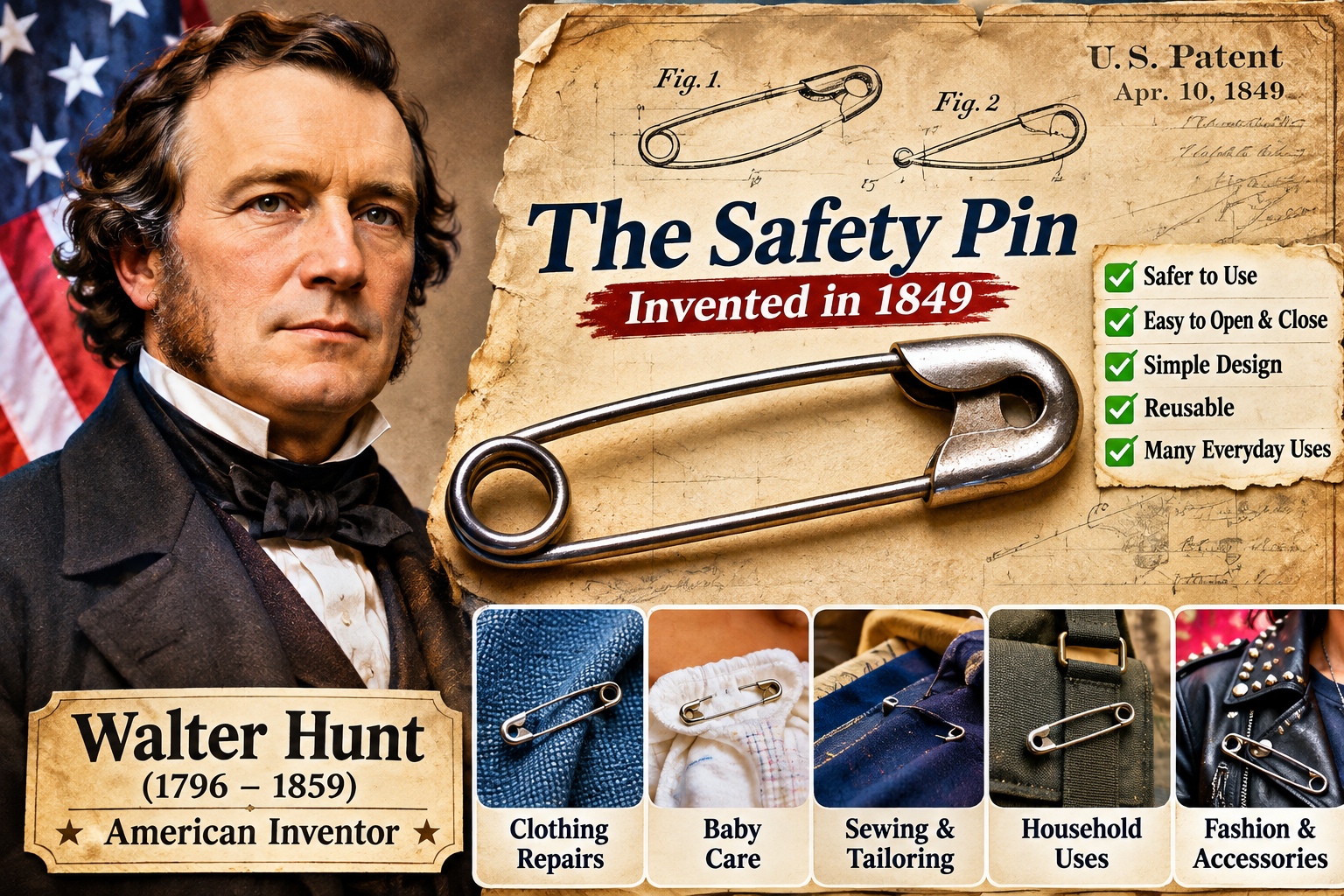
How Walter Hunt Invented the Safety Pin
Introduction
Some of the world’s most useful inventions are also the simplest. A small object made from a single piece of metal wire can solve an everyday problem that people might otherwise struggle with. One such invention is the safety pin.
Behind this familiar household item was Walter Hunt, an American inventor who had a remarkable ability to turn ordinary materials into practical solutions. In 1849, Hunt developed a design for the modern safety pin, creating a device that could hold fabric together while protecting the person using it from the sharp end of the wire.
Although he never became as famous as some other inventors of his time, his creation became an important part of everyday life. His story demonstrates how a simple idea can have a lasting influence on the world.
Who Was Walter Hunt?
Walter Hunt was born on July 29, 1796, in Martinsburg, New York, United States. He grew up during a period when American society was changing rapidly through industrial development and technological progress.
Hunt was naturally interested in machinery, tools, and practical inventions. Rather than concentrating on only one area, he explored different problems and attempted to develop useful solutions.
He became known for his inventive mind and ability to experiment with mechanical designs. Throughout his life, he worked on several inventions involving everyday objects, machines, and equipment.
However, the safety pin would eventually become his most widely recognized creation.
The Problem That Inspired the Safety Pin
During the nineteenth century, people used various methods to fasten clothing and hold pieces of fabric together. Ordinary straight pins were common, but they had an obvious disadvantage: their exposed sharp points could injure the person using them.
A pin could easily come loose from clothing, prick someone’s skin, or fall out of the material.
People needed a fastening device that was simple, inexpensive, and safer to use.
Walter Hunt recognized the usefulness of a design that could solve this problem. He began experimenting with a piece of flexible metal wire, looking for a way to create a fastener that would remain closed and cover its sharp point.
His experiments led to an ingenious solution.
How Walter Hunt Invented the Safety Pin
In 1849, Walter Hunt developed the design of the modern safety pin.
His invention used a single piece of wire that could be bent into a spring-like shape. One end formed a circular coil, which provided flexibility and tension. The other end was shaped into a sharp point that could be pushed into a protective clasp.
This design made the device practical and easy to operate.
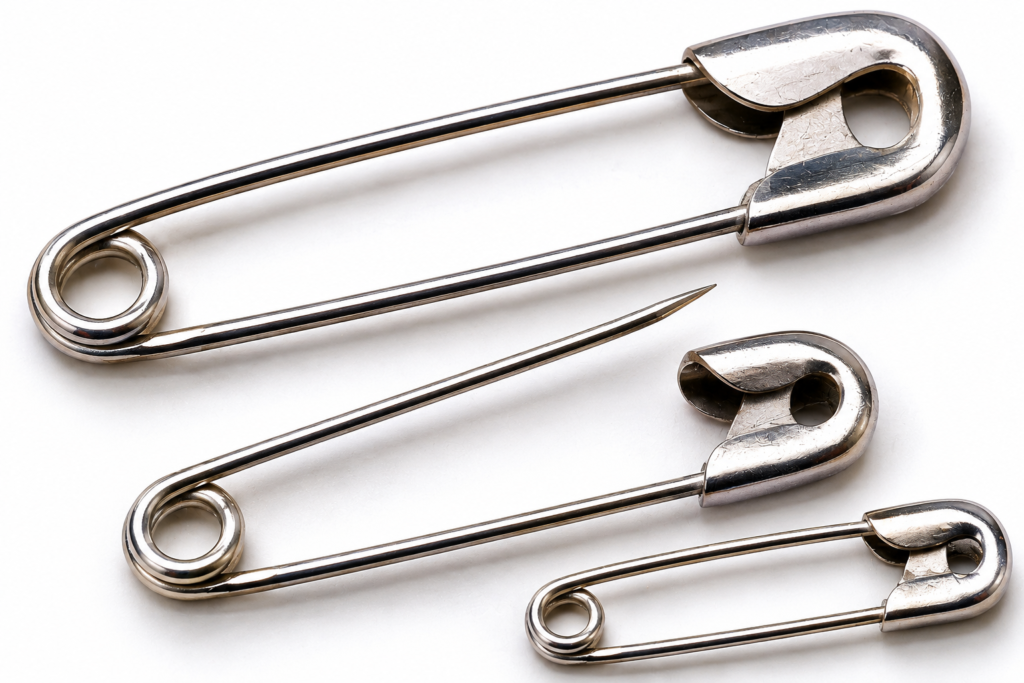
The safety pin had several important features:
– Protective clasp: Covered the sharp point and reduced the risk of accidental injury.
-Spring mechanism: Helped the pin remain closed after fastening.
-Flexible wire: Allowed the user to open and close the device.
– Simple construction: Made it suitable for inexpensive manufacturing.
– Reusable design: Allowed people to use it repeatedly.
The combination of these features made Hunt’s invention different from an ordinary straight pin.
The $15 Debt and the Invention’s Story
One of the most frequently repeated stories about Walter Hunt concerns a $15 debt.
According to the popular account, Hunt was trying to repay money he owed when he began experimenting with a piece of wire. During this process, he developed the safety pin design.
The story illustrates how financial pressure and creative thinking can sometimes come together to produce an unexpected invention.
However, the exact circumstances surrounding the invention are not completely established by the popular story. What is historically documented is that Hunt patented his safety pin design in 1849.
Walter Hunt’s Safety Pin Patent
Walter Hunt received a United States patent for his safety pin on April 10, 1849.
The patent was officially recorded under the title of a dress pin. It described the arrangement of the wire, spring, and protective catch that made the invention useful.
Hunt’s design demonstrated that a small mechanical improvement could make an everyday object safer and more convenient.
He later sold the patent rights for $400, according to commonly reported historical accounts.
Although this was money at the time, the commercial success of the safety pin eventually extended far beyond the original transaction.
How the Safety Pin Changed Everyday Life
The safety pin gradually became a useful product in homes, clothing businesses, tailoring shops, and textile manufacturing.
Its usefulness came from its simplicity. People did not need special training or complicated equipment to operate it.
The invention offered several practical benefits:
1. Clothing Repairs
Safety pins provided a quick way to hold torn fabric, loose buttons, and damaged clothing together until proper repairs could be made.
2. Baby Clothing
They became useful for fastening different types of fabric and clothing accessories, including traditional cloth diapers.
3. Sewing and Tailoring
Tailors and home sewing enthusiasts used safety pins to hold fabric in position during different stages of sewing.
4. Household Applications
People found many additional uses for safety pins, from organizing small items to temporarily fastening materials.
5. Fashion and Accessories
Over time, safety pins also appeared in fashion designs and accessories, becoming more than just a practical fastening tool.
Other Inventions by Walter Hunt
Walter Hunt was not a one-invention inventor. He explored several areas of mechanical design and developed other devices during his career.

His work included:
– Sewing machine: Hunt developed an early sewing machine design, although he did not turn it into a major commercial success.
– Repeating firearm: He worked on an early repeating rifle mechanism.
– Street-sweeping machine: He developed mechanical equipment intended to improve street cleaning.
– Other mechanical devices: His inventive work also covered practical tools and machines.
His career reveals an inventor who was constantly interested in improving the way people worked and lived.
Why Did Walter Hunt Sell His Patent?
Hunt sold the rights to his safety pin patent for a relatively small amount compared with the enormous long-term popularity of the product.
He was an inventor who frequently developed new ideas, but he did not always focus on building large manufacturing businesses around them.
The safety pin became commercially successful through later manufacturing and distribution.
His experience also highlights an important lesson in business: creating an invention and building a successful business around it are two different challenges.
The Lasting Legacy of Walter Hunt
Walter Hunt died on June 8, 1859, in New York City.
Although he did not live to witness the full worldwide popularity of the safety pin, his invention continued to influence everyday life.
Today, safety pins are manufactured in different sizes, materials, and designs. They remain useful in clothing, sewing, fashion, crafts, and household repairs.
The basic principle behind Hunt’s invention is still recognizable in the safety pins people use today.
His contribution is a reminder that innovation does not always require complicated technology. Sometimes, a small improvement to an ordinary object can make a significant difference.



Post Comment