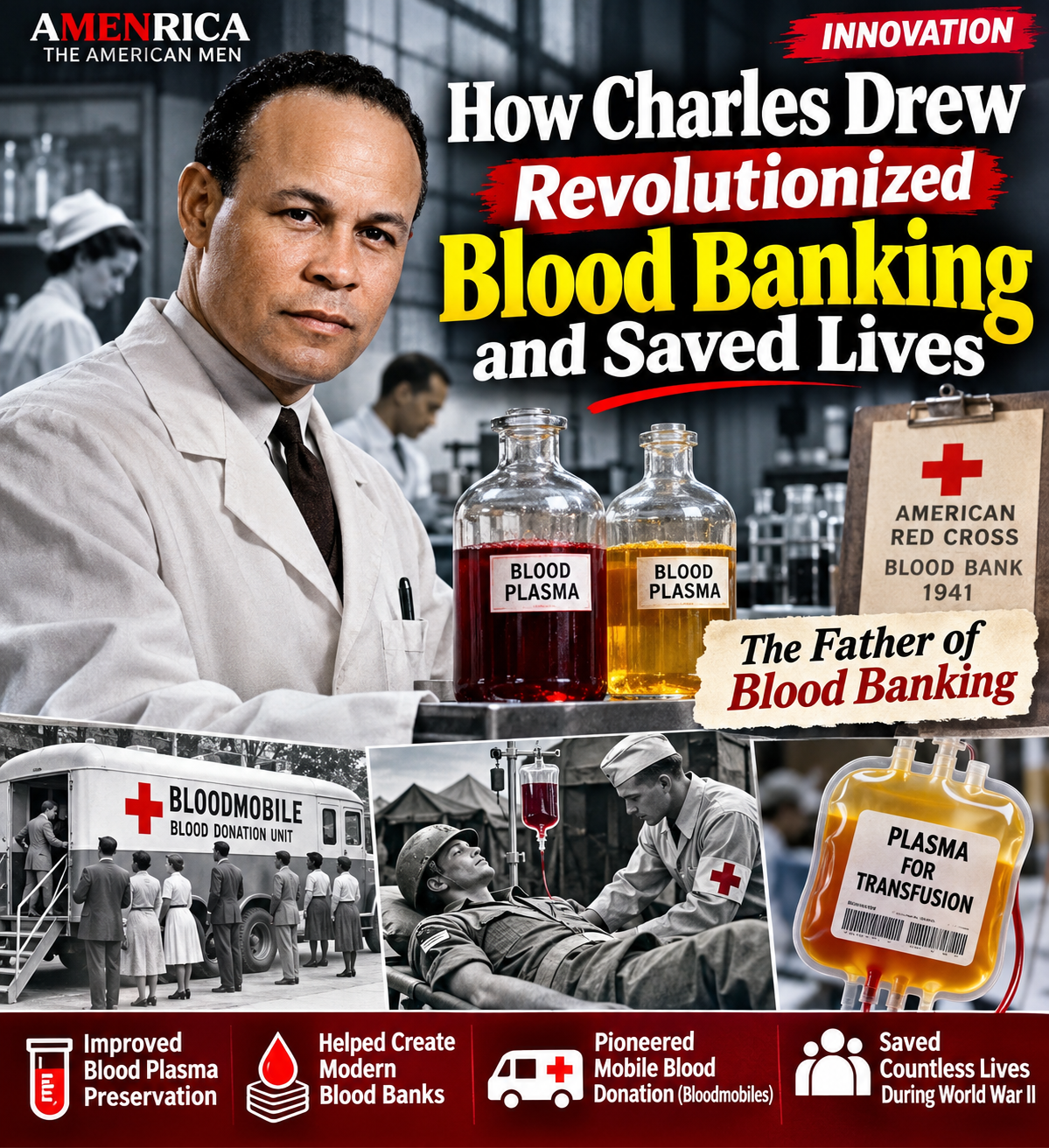
How Charles Drew Revolutionized Blood Banking and Saved Lives
Introduction
What if doctors could collect blood, preserve it, transport it over long distances, and use it when patients urgently needed it?
Today, blood banks are an essential part of healthcare. Hospitals depend on stored blood and blood components to treat accident victims, surgical patients, and people suffering from serious illnesses.
However, this system did not develop overnight. It required years of medical research, scientific innovation, and the dedication of pioneering doctors.
One of the most important figures in this history was Dr. Charles Richard Drew, an African American physician and medical researcher who revolutionized blood banking.
Through his groundbreaking research, Drew improved methods of separating and preserving blood plasma. His work helped make large-scale blood collection and distribution possible, particularly during World War II.
Known as the Father of Blood Banking, Charles Drew became an important figure in American medical history.
His story is not only about scientific achievement but also about determination, education, equality, and service to humanity.
Who Was Charles Richard Drew?
Charles Richard Drew was born on June 3, 1904, in Washington, D.C., United States.
He grew up in an African American family during a period when racial discrimination created significant barriers for Black Americans.
From an early age, Drew showed exceptional ability in academics and sports. He was particularly interested in football and track and field.
He attended Dunbar High School in Washington, D.C., an institution known for educating talented African American students.
After graduating, he received an athletic scholarship to Amherst College in Massachusetts.
He completed his undergraduate education in 1926.
Drew initially worked as a biology instructor and athletic coach at Morgan College in Baltimore. However, his ambition was to become a doctor.
His interest in medicine was influenced partly by personal experiences, including the illness and death of his sister.
Determined to pursue medical science, he continued his education despite the financial and racial challenges of that period.
His Journey into Medical Science
Charles Drew entered McGill University Faculty of Medicine in Montreal, Canada.
At McGill, he studied medicine and surgery and graduated in 1933.
During his medical education, he developed a particular interest in blood transfusions.
He worked with researchers investigating blood storage and transfusion techniques.
Drew recognized that blood preservation was one of the major challenges facing modern medicine.
Doctors often needed blood urgently, but collecting and storing sufficient quantities was difficult.
He became increasingly interested in understanding the different components of blood and discovering better methods of preserving them.
His medical education provided the foundation for the research that would eventually transform blood banking.
The Medical Problem: Why Was Blood Difficult to Store?
Before modern blood banking systems developed, hospitals faced serious difficulties maintaining reliable blood supplies.

Whole blood contains several important components:
– Red blood cells transport oxygen throughout the body.
– White blood cells help protect the body against infections.
– Platelets help blood clot.
– Plasma is the liquid component that carries proteins, nutrients, hormones, and other substances.
Each component has different medical uses and storage requirements.
At that time, doctors needed better methods to preserve blood products and make them available when emergencies occurred.
This challenge became especially important during World War II.
Large numbers of soldiers and civilians were being injured, and hospitals needed dependable supplies of blood products.
Charles Drew understood that separating blood plasma from whole blood could help address this problem.
The Breakthrough: Preserving Blood Plasma
In 1938, Charles Drew received a Rockefeller Foundation fellowship to conduct advanced research at Columbia University in New York.
He worked at Columbia-Presbyterian Medical Center, where he studied blood preservation.
His research focused on separating plasma from whole blood and improving methods of storing blood components.
Plasma offered an important advantage because it could be processed and preserved separately from red blood cells.
Drew helped develop improved techniques for collecting, processing, storing, and transporting plasma.
His work also contributed to the preparation of dried plasma, which could be reconstituted with sterile water before medical use.
In 1940, he completed his doctoral research, titled *Banked Blood: A Study in Blood Preservation*, and earned a Doctor of Medical Science degree.
This research established an important scientific foundation for large-scale blood banking.
It demonstrated that blood collection and preservation could become more organized and practical.
Blood for Britain: A Mission During World War II
One of the most important chapters in Charles Drew’s career began in 1940.
World War II was spreading across Europe, and Britain was experiencing devastating German air attacks.
Hospitals were treating large numbers of injured civilians and soldiers.
Medical authorities urgently needed blood plasma to support emergency treatment.
The United States organized a program known as Blood for Britain.
Charles Drew was selected to help lead the medical and scientific work behind this initiative.
His responsibilities included organizing blood collection, establishing processing procedures, supervising quality standards, and coordinating the preparation of plasma shipments.
The program collected approximately 14,500 blood donations for Britain.
The plasma was processed and transported across the Atlantic to support British hospitals.
This project demonstrated the importance of organized blood collection and large-scale plasma preservation.
Drew’s leadership helped establish a practical model for supplying blood products during major emergencies.
The American Red Cross Blood Bank
Following the success of Blood for Britain, Charles Drew became an important leader in America’s developing blood banking system.
In 1941, he was appointed the first medical director of the American Red Cross Blood Bank in New York.
His responsibilities included organizing blood donation programs, supervising medical procedures, and improving the collection and distribution of blood products.
The American Red Cross was developing a national blood collection program to support military and civilian medical needs.
Drew helped introduce organized procedures for collecting and processing blood.
He emphasized the importance of medical testing, proper handling, refrigeration, and safe transportation.
His experience during Blood for Britain helped him understand how large-scale blood banking could operate efficiently.
The work became particularly important as the United States entered World War II.
The Development of Mobile Blood Donation Services
Another important development in blood banking was the introduction of mobile blood collection facilities.
These services eventually became widely known as bloodmobiles.
Instead of requiring every donor to travel to a hospital or permanent collection center, mobile units made it possible to collect blood in different communities.
They could visit workplaces, factories, neighborhoods, and other locations.
Mobile collection services helped make blood donation more accessible.
Refrigeration and improved transportation methods also supported the safe handling of collected blood.
The development of organized mobile donation programs became an important part of modern blood collection systems.
Today, bloodmobiles operate in many countries and help hospitals maintain adequate blood supplies.
Charles Drew’s Fight Against Racial Discrimination
Charles Drew’s achievements extended beyond medical research.
He also became an important voice against racial discrimination in American healthcare.
During World War II, American blood collection organizations and military authorities introduced policies that initially excluded Black blood donors and later segregated donated blood according to race.
Drew strongly opposed these practices.
He understood that blood compatibility depended on scientific and medical factors, including blood groups, rather than the racial identity of the donor.
He believed that separating blood supplies based on race had no scientific justification.
In 1942, he left his position with the American Red Cross blood program.
His decision reflected his opposition to discriminatory policies.
His stand demonstrated that medical science should be guided by evidence, fairness, and human dignity.
This part of his life remains an important example of the relationship between scientific knowledge and social equality.
Returning to Howard University
After leaving the American Red Cross program, Drew returned to Howard University in Washington, D.C.
He became a professor and chairman of the Department of Surgery.
He also served as chief surgeon at Freedmen’s Hospital.
At Howard University, he dedicated himself to medical education and surgical training.
He encouraged talented students to pursue careers in medicine and helped train a new generation of doctors.
He believed that African American students deserved equal opportunities to become successful medical professionals.
Drew also maintained high standards in surgical education and medical research.
His contribution to medicine was therefore not limited to blood preservation.
He also influenced future generations through teaching, leadership, and mentorship.
Awards and Recognition
Charles Drew received recognition for his important contributions to medical science and education.
Some notable achievements include:
– 1940: Earned a Doctor of Medical Science degree from Columbia University.
– 1941: Became the first African American surgeon selected as an examiner for the American Board of Surgery.
– 1944: Received the Spingarn Medal from the NAACP.
– 1946: Became a Fellow of the International College of Surgeons.
– 1949: Served as a consultant to the U.S. Surgeon General.
– 1981: Was honored on a United States postage stamp.
– 2015: Was inducted into the National Inventors Hall of Fame.
These recognitions reflected his lasting influence on medicine and American society.
The Tragic Death of Charles Drew
Despite his remarkable achievements, Charles Drew’s life ended unexpectedly.
On April 1, 1950, he died following injuries sustained in an automobile accident near Burlington, North Carolina.
He was only 45 years old.
At the time of his death, he was continuing his work as a surgeon, professor, and medical educator at Howard University.
His death shocked the medical community.
An incorrect story later circulated claiming that he died because a hospital refused to treat him due to racial discrimination.
However, historical investigations have found no reliable evidence supporting that story.
His death resulted from injuries sustained in the automobile accident.
Although his life was relatively short, his scientific contributions continued to influence healthcare for generations.
How Charles Drew Changed Modern Medicine
Charles Drew’s research helped transform blood preservation and transfusion medicine.
His work contributed to the development of organized systems for collecting, processing, storing, and distributing blood plasma.
His contributions influenced several important areas of healthcare.
Blood preservation: He helped improve techniques for separating and preserving plasma.
Modern blood banking: His research and leadership helped establish large-scale blood collection and processing programs.
Emergency medicine: Plasma preservation made it easier to transport medical supplies to locations where they were urgently needed.
Blood donation programs: He helped demonstrate the importance of organized blood collection.
Medical education: He trained future doctors and encouraged greater opportunities for African American medical professionals.
Modern blood banking has developed significantly since Drew’s time, with improved testing, storage technologies, and safety procedures.
Nevertheless, his pioneering work remains an important part of its history.
The Legacy of a Medical Pioneer
Charles Richard Drew’s legacy continues through the hospitals, medical institutions, educational programs, and blood donation organizations that recognize his contribution.
His name has been given to several schools, medical institutions, and educational facilities.
The Charles R. Drew University of Medicine and Science in Los Angeles was established in his honor.
His story is also taught as an important example of African American achievement in science and medicine.
He demonstrated that scientific innovation could overcome major medical challenges and improve human life.
His opposition to racial discrimination also established an important lesson about equality in healthcare.
Today, millions of people depend on blood transfusions and blood products.
The modern system exists because generations of researchers, doctors, nurses, donors, and medical organizations worked together to improve blood collection and preservation.
Charles Drew was one of the pioneers who helped make that progress possible.



Post Comment