How Glenn Curtiss Shaped Early American Aviation
Introduction
Before airplanes became a common form of transportation, flying was one of humanity’s greatest dreams. At the beginning of the twentieth century, inventors and engineers were experimenting with machines that could carry people through the sky. Among the pioneers who helped turn this dream into reality was Glenn Hammond Curtiss, an American inventor, engineer, motorcycle racer, and aircraft manufacturer.
Born in 1878, Curtiss played an important role in the development of early American aviation. His achievements included designing powerful aircraft engines, developing early airplanes, experimenting with seaplanes, and helping establish naval aviation in the United States.
While the Wright brothers are widely remembered for achieving the first successful powered airplane flight, Curtiss made equally important contributions to the development and commercial growth of aviation.
His journey from a young bicycle mechanic to one of America’s most influential aviation pioneers demonstrates how determination, engineering skills, and continuous experimentation can change the world.
Early Life and Interest in Engineering
Glenn Hammond Curtiss was born on May 21, 1878, in Hammondsport, New York, United States. His childhood was not particularly easy. His father died when he was young, and his family faced financial difficulties.
Curtiss received limited formal education and eventually left school to begin working. He initially worked for the Eastman Kodak Company, where he gained experience in practical and technical work.
Later, he became a bicycle messenger for Western Union.
Although these jobs were different, they helped him develop an interest in mechanical equipment and transportation.
Curtiss was fascinated by bicycles and their construction. He studied their mechanical systems and eventually started repairing and manufacturing bicycles.
His bicycle business provided an opportunity to experiment with mechanical designs. These early experiences helped him develop the engineering abilities that would later become essential to his aviation career.
He did not know that his interest in machinery would eventually lead him into one of the most exciting industries of the twentieth century.
From Bicycle Mechanic to Motorcycle Pioneer
Before entering aviation, Curtiss established himself as a successful motorcycle manufacturer and racer.
He became interested in developing lightweight engines that could produce considerable power. At that time, motorcycles were still developing, and engineers were experimenting with different engine designs.
Curtiss designed and manufactured powerful motorcycle engines that attracted considerable attention.
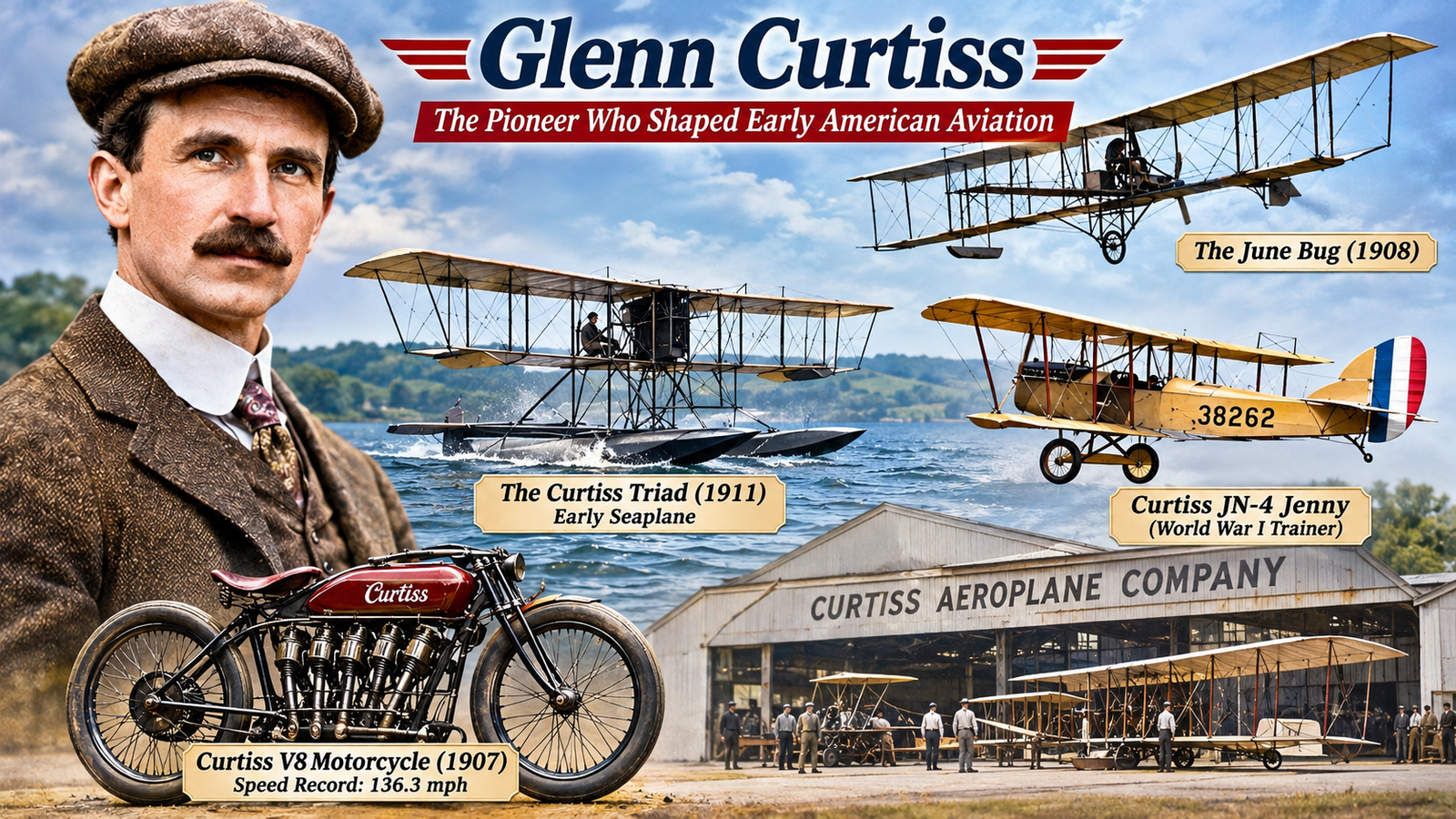
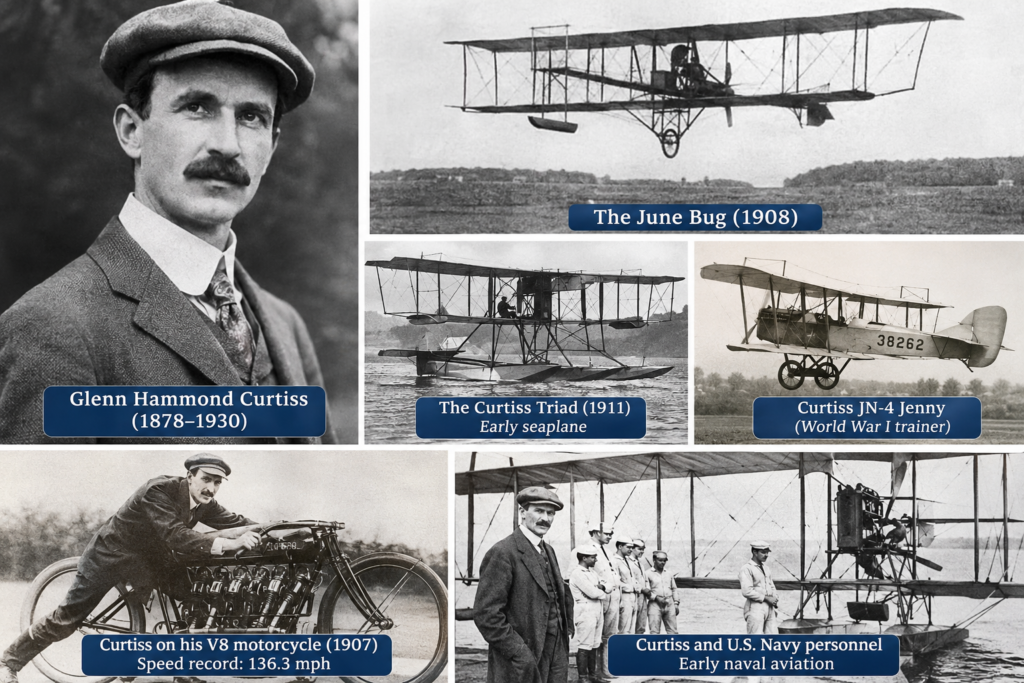
In 1907, he achieved international recognition when he rode a specially built V8-powered motorcycle at Daytona Beach, Florida.
He reached approximately 136.3 miles per hour, setting a remarkable motorcycle land-speed record.
This achievement demonstrated his understanding of engine performance, mechanical engineering, and lightweight construction.
These skills later became extremely valuable in aviation.
Early airplanes required engines that were powerful enough to lift an aircraft while remaining sufficiently lightweight. Curtiss already had practical experience with this engineering challenge.
His motorcycle success opened the door to an entirely new opportunity: building flying machines.
Joining Alexander Graham Bell’s Aviation Experiments
One of the most important turning points in Curtiss’s life occurred in 1907.
Alexander Graham Bell, the famous inventor of the telephone, was also interested in aviation. He established the Aerial Experiment Association (AEA), an organization dedicated to developing practical flying machines.
Bell invited Curtiss to join the group because of his knowledge of engines and mechanical engineering.
The association included several talented individuals, including Casey Baldwin, J. A. D. McCurdy, and Thomas Selfridge.
Curtiss became an important member of the team and contributed his engineering knowledge to aircraft development.
The group experimented with different wing designs, engines, aircraft structures, and flight-control systems.
These experiments were not always successful. Early aircraft were difficult to control, and even small engineering mistakes could lead to accidents.
However, Curtiss believed that practical experimentation was essential to improving aviation technology.
His participation in the association helped him move from motorcycle engineering into the world of aircraft design.
The June Bug: A Major Achievement in Early Aviation
One of Glenn Curtiss’s most important achievements was the June Bug, also known as Aerodrome No. 3.
The aircraft was developed through the Aerial Experiment Association in 1908, with Curtiss playing a major role in its construction and flight testing.
On July 4, 1908, Curtiss flew the June Bug approximately 5,090 feet at Hammondsport, New York.
This flight was significant because it demonstrated that an American-built airplane could perform a sustained public flight.
The achievement won the first leg of the Scientific American Trophy competition.
The trophy recognized important accomplishments in powered aviation, and Curtiss’s success attracted national attention.
At a time when many people still doubted whether airplanes could become practical machines, the June Bug provided encouraging evidence of aviation’s potential.
It also established Curtiss as one of America’s leading aviation pioneers.
Improving Aircraft Control and Aileron Technology
Building an airplane was only one part of the challenge. Pilots also needed reliable methods to control aircraft while flying.
Early aircraft designers experimented with different systems to maintain balance and change direction.
Curtiss became associated with the development and use of ailerons, movable surfaces attached to an airplane’s wings.
Ailerons help an aircraft roll from side to side, allowing pilots to control its movement and perform turns.
This technology became an important part of modern aircraft design.
Curtiss’s work in this area also contributed to a major disagreement with the Wright brothers, who had developed their own aircraft-control technology using wing warping.
The disagreement eventually became part of a lengthy aviation patent dispute.
Despite these legal challenges, the development of practical flight-control systems helped make airplanes increasingly reliable and useful.
Winning International Recognition in France
Curtiss wanted to demonstrate that American aviation technology could compete internationally.
In 1909, he travelled to Reims, France, to participate in an important international aviation competition.
He entered the Gordon Bennett Aviation Trophy race with his aircraft.
The event attracted aircraft designers and pilots from several countries.
Curtiss performed successfully and won the competition, becoming an international aviation celebrity.
His victory was an important achievement for the United States.
It demonstrated that American aircraft could compete with European designs and helped increase international interest in American aviation engineering.
The success also attracted attention from investors, customers, and military organizations.
Curtiss was no longer simply an American motorcycle engineer experimenting with airplanes. He had become an internationally recognized aviation pioneer.
The Historic Albany-to-New York Flight
In 1910, Curtiss completed another remarkable aviation achievement.
On May 29, 1910, he flew from Albany to New York City, following the Hudson River.
The journey covered approximately 150 miles, with a scheduled stop along the route.
At that time, long-distance aviation was still extremely challenging.
Aircraft had limited power, navigation systems were basic, and pilots had little protection from changing weather conditions.
Curtiss successfully completed the journey and received a $10,000 prize.
This achievement demonstrated that airplanes could travel much farther than the short distances associated with early flying demonstrations.
It helped strengthen public confidence in aviation as a possible means of transportation.
The flight also showed that aircraft technology was progressing rapidly.
Developing Seaplanes and the Curtiss Triad
Curtiss did not limit his experiments to airplanes that operated from land.
He recognized that aircraft capable of taking off from and landing on water could have important practical applications.
Waterways were particularly useful for aviation because they provided natural landing areas in locations where airports did not exist.
Curtiss began experimenting with floats and other structures that could allow aircraft to operate on water.
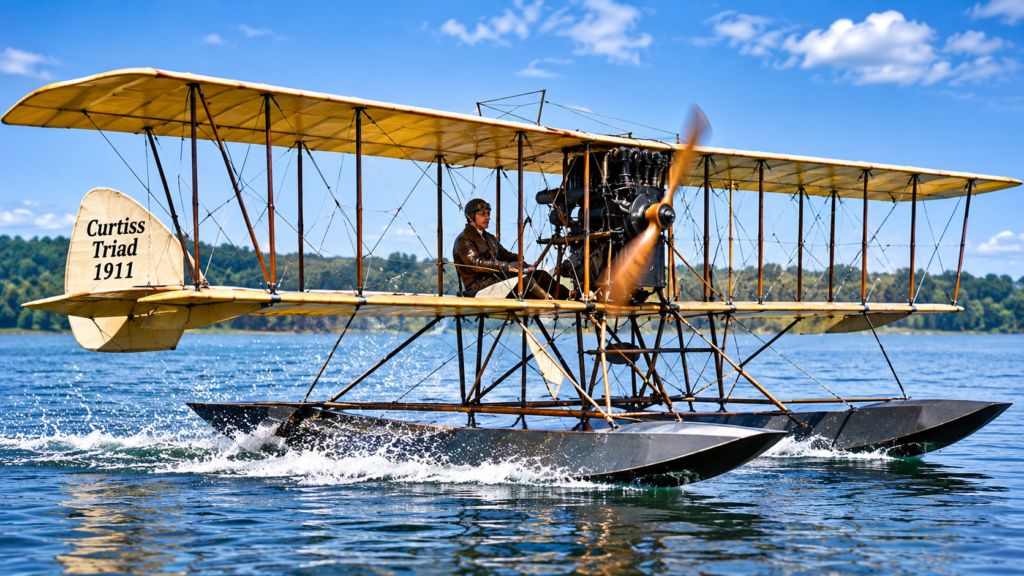
His experiments eventually led to the development of the Curtiss Triad, an amphibious aircraft capable of operating from both land and water.
In 1911, the United States Navy acquired the Curtiss A-1 Triad.
This was an important milestone in American naval aviation.
The aircraft demonstrated that airplanes could become useful tools for naval observation and military operations.
Curtiss’s work helped establish the foundation for future naval aircraft development.
For this reason, he became widely known as the Father of Naval Aviation.
Building an Aircraft Manufacturing Business
Curtiss understood that aviation needed more than talented inventors. It also required businesses capable of manufacturing aircraft on a larger scale.
In 1910, he established the Curtiss Aeroplane Company.
The business later developed into the Curtiss Aeroplane and Motor Company.
The company produced aircraft, engines, and aviation equipment for civilian and military customers.
It also supported pilot training and the expansion of aviation technology.
As aviation developed, demand for aircraft increased.
During World War I, the need for military airplanes created new opportunities for aircraft manufacturers.
Curtiss’s company became one of the major American aircraft manufacturers of the period.
His business achievements helped transform aviation from an experimental activity into an important industrial sector.
The Curtiss JN-4 Jenny and World War I
One of the most recognizable aircraft associated with the Curtiss company was the JN-4 Jenny.
The Jenny was a biplane developed primarily as a training aircraft.
It featured two sets of wings and a design suitable for teaching new pilots the fundamentals of flying.
During World War I, the aircraft became widely used in American pilot-training programs.
Thousands of military pilots learned essential flying skills using aircraft from the JN series.
After the war, many surplus Jenny aircraft entered civilian service.
They became popular among travelling pilots who performed demonstrations and air shows across the United States.
These pilots were often called barnstormers.
They introduced aviation to communities that had never seen an airplane before.
The JN-4 Jenny therefore helped popularize flying among ordinary Americans and became an important symbol of early aviation.
Challenges and Competition with the Wright Brothers
Curtiss’s aviation career was not without challenges.
One of his most significant difficulties involved the Wright brothers.
Wilbur and Orville Wright had achieved the first successful powered airplane flight in 1903 and held important patents related to aircraft-control systems.
Curtiss developed different aircraft technologies, including his use of ailerons.
The Wright brothers believed that certain Curtiss designs infringed on their patents.
The disagreement developed into a lengthy legal battle that affected the American aviation industry.
Aircraft manufacturers and inventors faced uncertainty about which technologies could be used without violating existing patents.
The conflict continued for many years.
Eventually, in 1929, the Curtiss Aeroplane and Motor Company and Wright Aeronautical combined to form the Curtiss-Wright Corporation.
The dispute illustrates how competition and disagreements over intellectual property were part of the early development of aviation.
Despite these difficulties, Curtiss continued contributing to aircraft engineering and manufacturing.
Personal Life, Retirement, and Death
After years of working in aviation, Curtiss gradually stepped away from active aircraft development.
In 1920, he retired from active aviation pursuits.
He became involved in business and property development, particularly in Florida.
His contributions had already established him as one of the most influential figures in early American aviation.
On July 23, 1930, Glenn Hammond Curtiss died in Buffalo, New York, at the age of 52.
Although his life was relatively short, his engineering achievements continued to influence aviation long after his death.
His name remains associated with aircraft innovation, seaplane development, and the early growth of American aviation.
The Lasting Legacy of Glenn Curtiss
Glenn Curtiss helped transform aviation during one of the most important periods in transportation history.
His achievements went beyond designing individual aircraft. He contributed to the development of aircraft engines, flight-control systems, seaplanes, pilot training, and aircraft manufacturing.
His most important contributions included:
– Advancing lightweight and powerful aircraft engines.
– Helping develop and demonstrate practical aircraft designs.
– Promoting aileron-based aircraft control.
– Developing early seaplanes and amphibious aircraft.
– Supporting the establishment of American naval aviation.
– Building an important aircraft manufacturing company.
– Producing training aircraft used during World War I.
– Helping make aviation more familiar to the American public.
His contributions were recognized when he was inducted into the National Aviation Hall of Fame in 1964.
Today, Curtiss is remembered as one of the pioneers who helped transform the dream of human flight into a growing industry.


Post Comment