Elisha Otis: The Elevator Pioneer
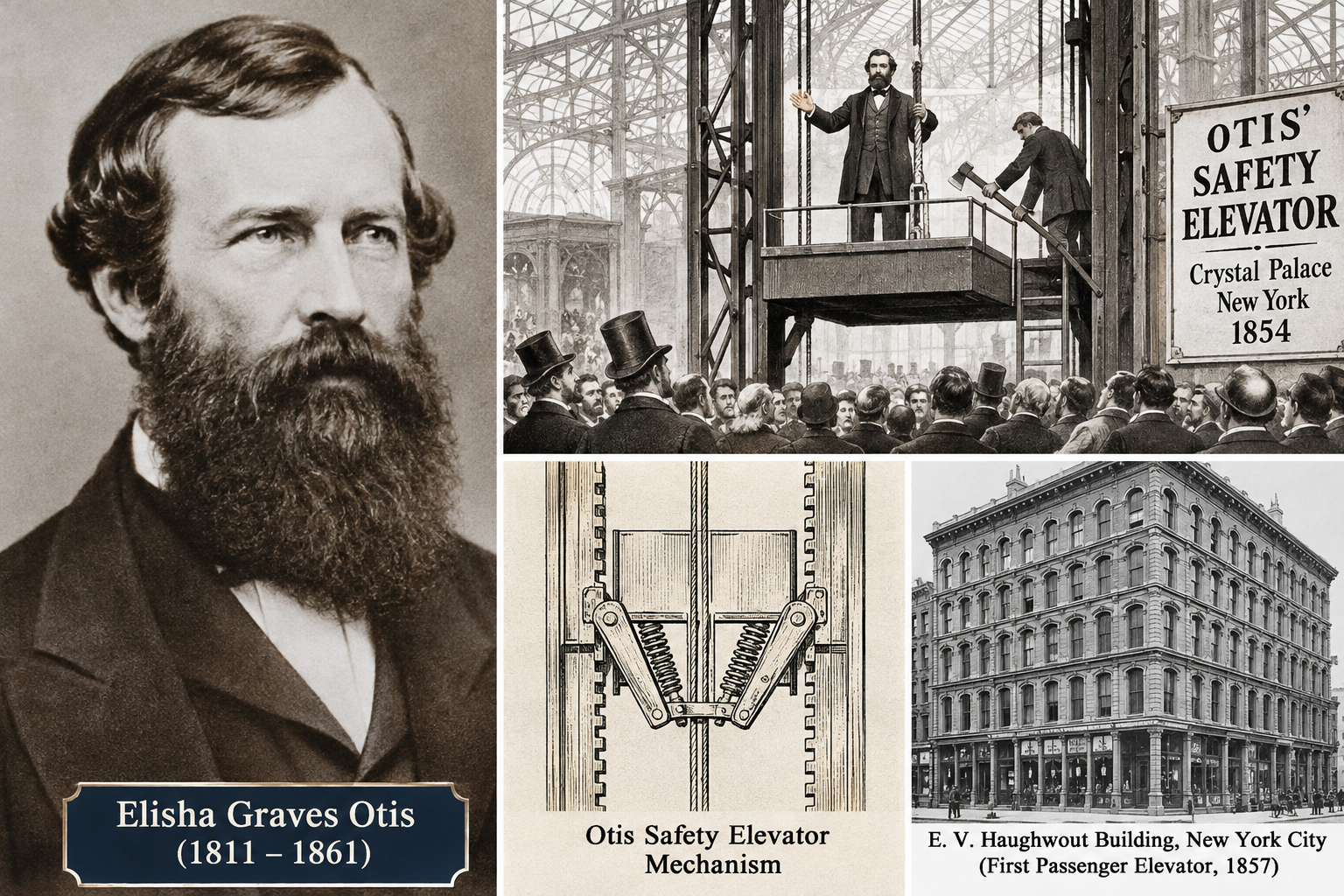
Elisha Graves Otis was an American inventor whose innovation changed the way people travel inside buildings. He is best known for developing the safety elevator, a revolutionary invention that helped make passenger elevators safer and more reliable. Before his invention, people were afraid of using elevators because a broken lifting rope could cause a serious accident. Otis developed a safety mechanism that could prevent an elevator platform from falling if its main supporting rope broke.
His invention became an important foundation for modern skyscrapers, tall commercial buildings, hotels, and residential towers. Although he did not live to witness the full impact of his work, his contribution transformed architecture and urban transportation forever.
Early Life and Childhood
Elisha Graves Otis was born on August 3, 1811, in Halifax, Vermont, United States. He grew up during a period when America was experiencing industrial development and technological change.
Otis did not come from a wealthy background. His early life involved hard work, financial challenges, and several attempts to establish himself professionally. He developed an interest in machinery and practical engineering through his working experiences.
As a young man, he explored different occupations and learned how mechanical equipment operated. These experiences helped him understand the importance of improving machines and making them more dependable.
His practical knowledge eventually became the foundation of his greatest invention.
Early Career and Mechanical Experience
Before becoming a famous inventor, Otis worked in several industries. He operated a gristmill and later became involved in manufacturing.
He gained experience working with mechanical equipment and developing practical solutions to industrial problems.
During the 1850s, Otis moved into work involving machinery and lifting equipment. He eventually worked in a factory in Yonkers, New York, where he was responsible for improving equipment used to move heavy materials between floors.
This work introduced him to an important engineering problem: lifting platforms could become extremely dangerous if their supporting ropes broke.
Otis began thinking about how to prevent such accidents.
The Problem with Early Elevators
During the nineteenth century, factories and warehouses frequently used mechanical hoists to transport heavy materials between different floors.
However, these machines had a major weakness. If the main supporting rope broke, the platform could fall and cause serious damage or injury.
Although lifting equipment already existed, people were reluctant to trust it for passenger transportation.
As American cities expanded, businesses increasingly needed buildings with multiple floors. A reliable method of transporting people vertically was becoming essential.
Otis understood that improving the lifting mechanism was not enough. The machine also needed a reliable safety system.
This challenge inspired him to develop a new invention.
The Invention of the Safety Elevator
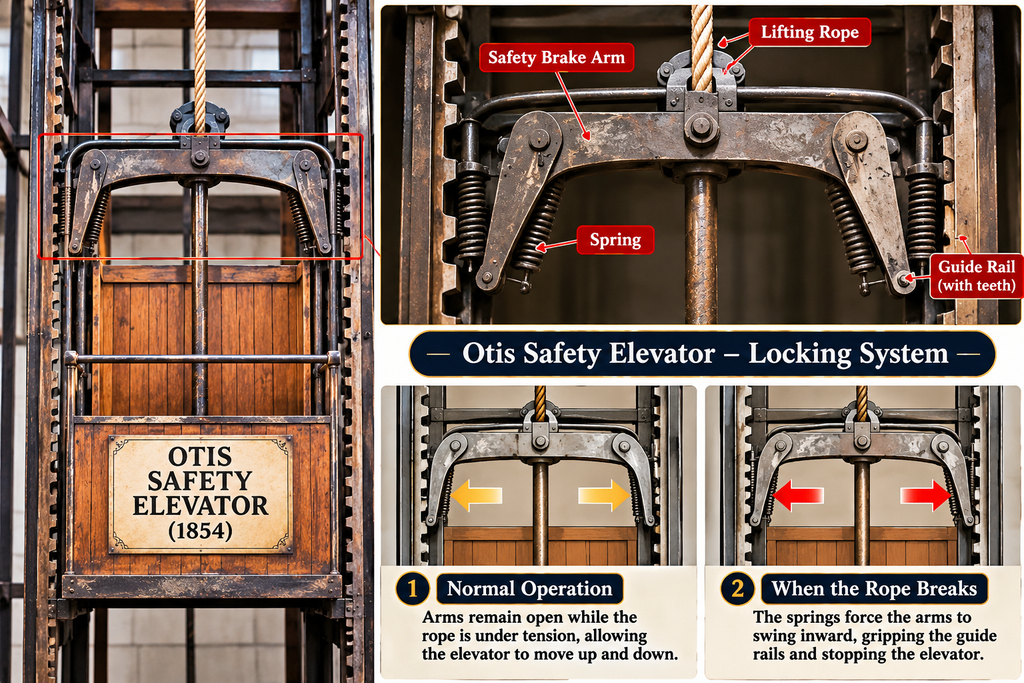
Elisha Otis developed a special safety mechanism designed to prevent an elevator platform from falling if its supporting rope broke.
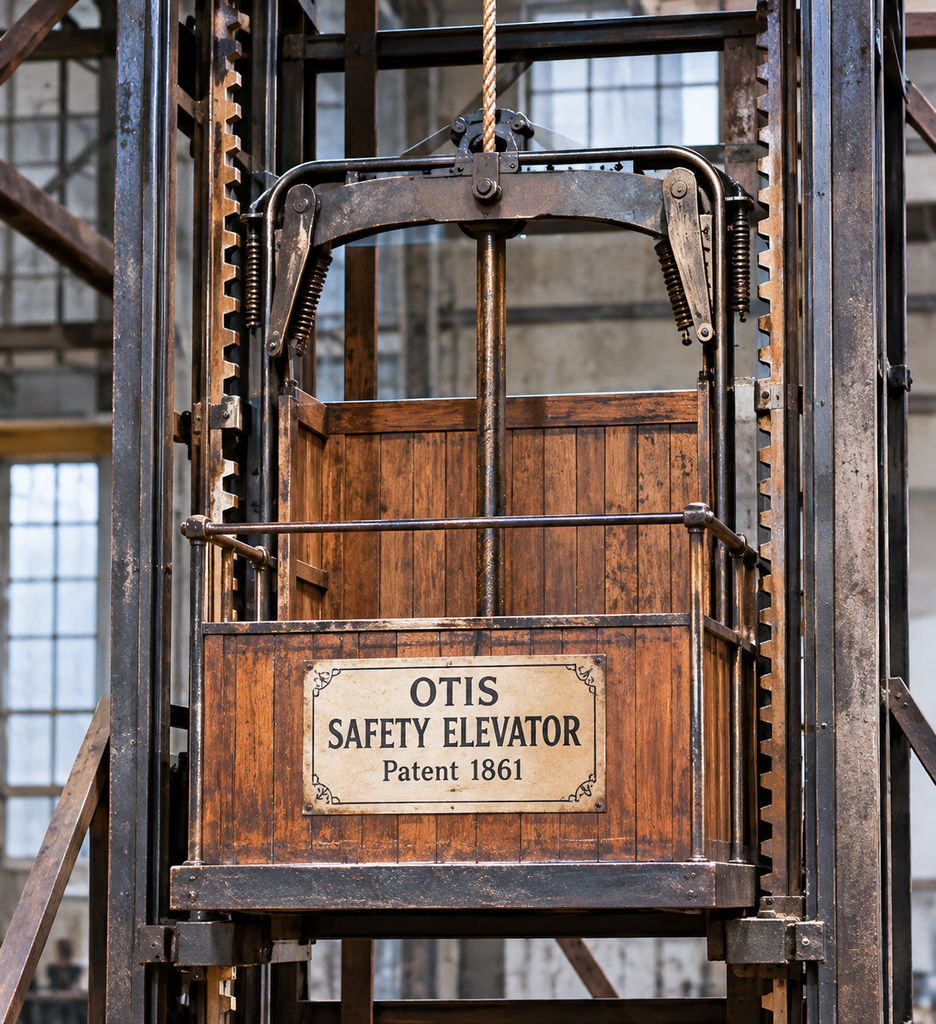
His invention used a spring-connected mechanism that worked with the elevator’s guide rails. When the supporting rope remained under tension, the safety mechanism stayed inactive. If the rope broke, the loss of tension activated the mechanism, causing gripping devices to engage with the guide rails.
This stopped the platform from falling freely.
The invention was an important improvement because it provided an additional layer of protection instead of depending entirely on the strength of the lifting rope.
Otis’s safety elevator helped change public attitudes toward elevator transportation.
It demonstrated that elevators could become practical and dependable machines for carrying passengers.
The Famous 1854 Crystal Palace Demonstration
Developing a new invention was only one part of Otis’s challenge. He also needed to convince people that his elevator safety mechanism actually worked.
In 1854, he demonstrated his invention at the Exhibition of the Industry of All Nations, held at the Crystal Palace in New York City.
The demonstration became one of the most memorable events in elevator history.
Otis stood on an elevated platform while an assistant cut the rope supporting it. The audience expected the platform to fall, but the safety mechanism immediately activated and stopped it.
Otis then reassured the audience with the famous words, “All safe, gentlemen, all safe!”
The demonstration attracted considerable attention and helped build confidence in his invention.
It was an effective way of showing the public that his safety elevator could overcome one of the biggest problems associated with early lifting machines.
Establishing the Otis Elevator Business
Otis recognized that his invention had commercial potential.
In 1853, he established his elevator business in Yonkers, New York. His early enterprise became known as the Union Elevator Works and General Machinery Depot.
He began manufacturing and selling elevators equipped with his safety mechanism.
Factories, warehouses, and commercial establishments gradually became interested in the new technology.
The business experienced growing demand as customers recognized the importance of safer lifting equipment.
Otis was not simply interested in creating an invention. He also wanted to make it commercially useful and accessible to businesses that needed reliable transportation systems.
The First Passenger Elevator in 1857
One of the most important milestones in Otis’s career occurred in 1857.
The E. V. Haughwout Building, a five-story department store in New York City, installed a passenger elevator equipped with the Otis safety system.
The elevator was powered by a steam engine and allowed customers to travel between the building’s floors.
This installation represented an important development in commercial transportation.
For the first time, customers could conveniently move between different floors of a department store without climbing stairs.
The installation demonstrated that elevators could become part of everyday commercial life.
It also helped establish the foundation for the modern passenger elevator industry.
Patent and Recognition
Otis continued improving his safety elevator technology.
On January 15, 1861, he received a United States patent for an improvement in hoisting apparatus.
His invention represented an important contribution to mechanical engineering and industrial safety.
Although he had already achieved recognition for his work, he did not live long enough to witness the worldwide expansion of the elevator industry.
His sons later continued developing the business he had established.
Personal Life and Death
Elisha Graves Otis married Susan A. Houghton, and they had two sons, Charles and Norton.
His life was filled with hard work, experimentation, and determination. He faced financial difficulties and professional challenges before achieving success as an inventor.
Unfortunately, his life was relatively short.
Elisha Otis died on April 8, 1861, in Yonkers, New York, at the age of 49. His death was caused by diphtheria.
Although he passed away at a relatively young age, his invention had already started transforming the future of buildings and transportation.
The Growth of Otis Elevator Company
After Elisha Otis’s death, his sons Charles and Norton continued developing the family business.
In 1867, they established Otis Brothers & Company, expanding the company’s manufacturing and commercial activities.
The business continued improving elevator technology and became an important name in the industry.
As cities expanded and taller buildings became increasingly common, the demand for elevators grew significantly.
Over time, the Otis name became internationally recognized in the elevator and escalator business.
The company’s development demonstrated how one inventor’s idea could grow into a major industrial enterprise.
How Elisha Otis Changed Modern Architecture
Elisha Otis did not invent the first elevator. Lifting devices had existed for centuries before his time.
His greatest contribution was developing a reliable safety mechanism that helped make passenger elevators practical.
This innovation influenced modern architecture in several important ways.
First, safer elevators made upper floors more accessible. This encouraged architects and builders to develop taller commercial and residential buildings.
Second, elevators helped cities use limited land more efficiently by allowing more people to work and live in multi-story buildings.
Third, businesses such as hotels, department stores, and office buildings benefited from convenient vertical transportation.
Finally, his invention encouraged further developments in engineering, mechanical safety, and transportation technology.
Without reliable elevators, the modern skylines of major cities would look very different.
Legacy of Elisha Graves Otis
Elisha Graves Otis remains one of the most influential American inventors in the history of mechanical engineering.
His safety elevator helped solve a major problem that had prevented people from trusting passenger lifting systems.
His work contributed to the development of modern cities and made tall buildings more practical for everyday use.
The company established around his invention continued to grow and became one of the best-known names in the elevator industry.
His story is an example of how practical innovation can transform society.
Elisha Otis did not simply improve a machine. He helped change how the world builds, works, shops, and lives.
His invention helped humanity move upward, one floor at a time.



Post Comment