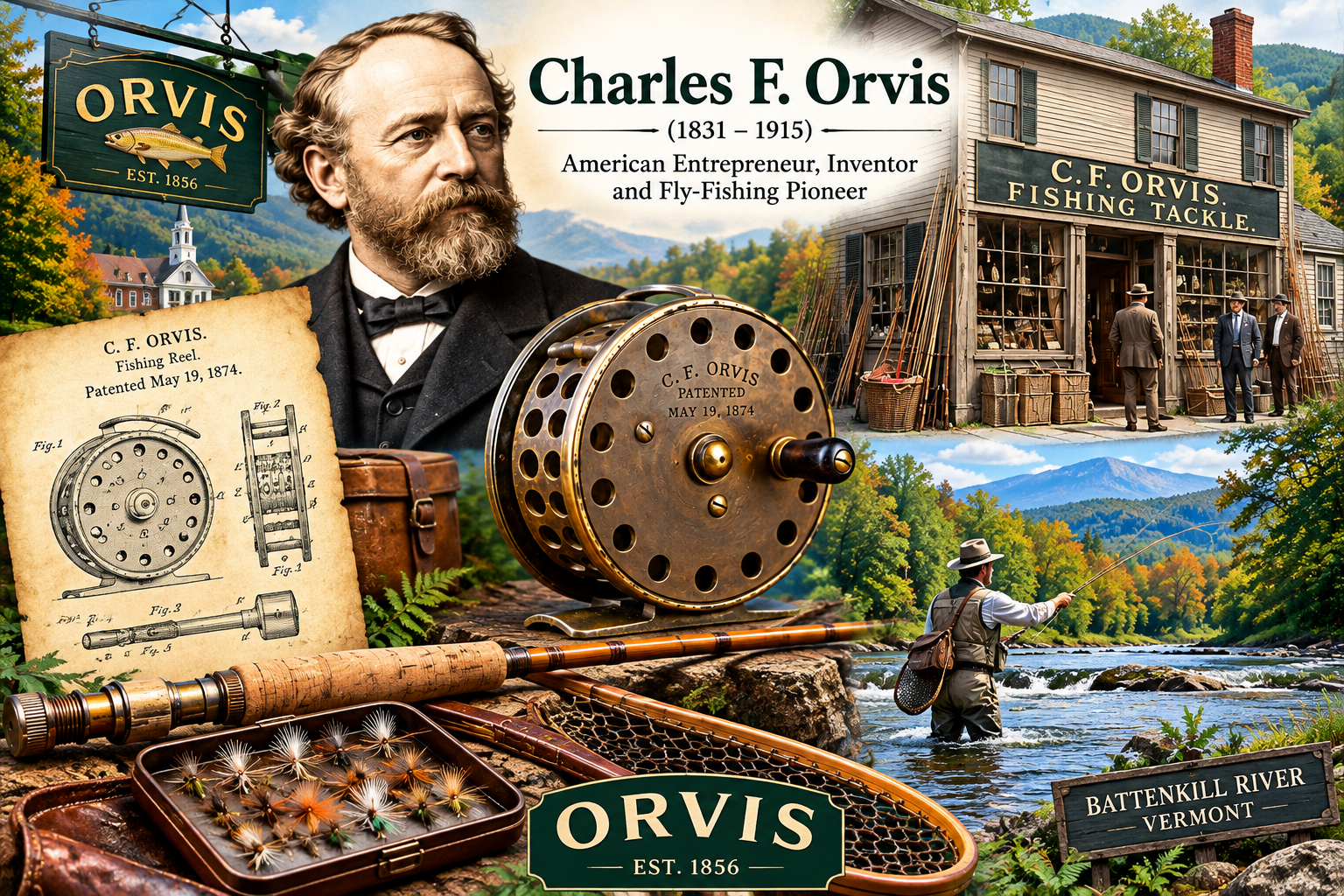
Charles F. Orvis: The Pioneer of Modern Fly Fishing
Introduction
Some people build businesses to earn a living. Others transform their personal passions into innovations that influence generations. Charles F. Orvis belonged to the second group.
Born in 1831 in Manchester, Vermont, Charles Frederick Orvis became one of the important pioneers of American fly fishing. His interest in fishing equipment, practical craftsmanship, and customer service helped him establish a company that would become a recognized name in the outdoor industry.
In 1856, Orvis founded the C.F. Orvis Company in Manchester, Vermont. Nearly two decades later, he patented a distinctive fly-fishing reel that became an important milestone in fishing equipment design.
His story is about more than fishing. It is about recognizing a problem, developing a practical solution, and building a business around quality and a genuine understanding of customers.
1. Early Life in Manchester, Vermont
Charles F. Orvis was born in 1831 in Manchester, a small town in southwestern Vermont. During the nineteenth century, the United States was experiencing significant changes in transportation, manufacturing, commerce, and everyday life.
Vermont’s rivers, streams, forests, and mountainous landscapes offered opportunities for fishing and other outdoor activities. For people who enjoyed spending time in nature, fishing was both a recreational activity and a way to appreciate the countryside.
Orvis developed an interest in practical craftsmanship at an early age. Historical accounts describe him as technically capable and interested in making and repairing objects.
His curiosity about how things worked would later become important to his career. Instead of simply accepting existing fishing equipment, he looked for ways to make it more useful.
Although detailed accounts of his childhood are limited, his later achievements demonstrate his ability to combine practical knowledge with business judgment.
2. Turning a Passion for Fishing Into a Business
In 1856, Charles F. Orvis established his fishing tackle business in Manchester, Vermont.
At the time, specialized fishing equipment was an important market for people who wanted reliable rods, reels, lines, and artificial flies. However, purchasing such equipment could be difficult for customers who lived far from specialist shops.
Orvis saw an opportunity to serve fishing enthusiasts by providing carefully made equipment and developing a reputation for quality.
His business focused on fishing tackle, including rods and reels. These products required an understanding of the practical challenges anglers faced on rivers and streams.
A fishing rod needed to be strong enough to handle a fish while remaining flexible enough for effective casting. A reel needed to manage the fishing line without creating unnecessary complications.
By concentrating on these practical requirements, Orvis established the foundations of a business that connected craftsmanship with outdoor recreation.
His company was not built on a single invention alone. It developed through a continuing commitment to equipment, customer needs, and improvements in product design.
3. The Revolutionary 1874 Fly-Fishing Reel
One of Charles F. Orvis’s most important achievements came in 1874, when he received a patent for an innovative fly-fishing reel.
During the nineteenth century, anglers faced several challenges when using fishing lines. The design of a reel influenced how easily a line could be managed, how quickly it could be wound, and how conveniently the equipment could be used.
Orvis’s design incorporated three important features: a narrow spool, ventilated side plates, and an upright mounting arrangement.
The narrow spool helped create a compact reel design. The perforated side plates reduced unnecessary material and allowed air to circulate around the fishing line.
Air circulation was particularly useful because damp fishing lines could deteriorate if they remained wet for extended periods.
The upright mounting arrangement also contributed to the reel’s distinctive configuration.
Together, these features represented a significant development in American fly-reel design. The American Museum of Fly Fishing identifies the 1874 Orvis patent reel as an important precursor to modern American fly reels.
The reel demonstrated how thoughtful engineering could improve a familiar piece of equipment without changing the basic purpose of fishing.
Rather than treating the reel as a simple accessory, Orvis approached its design as a problem that could be solved through careful observation and practical innovation.

4. Why His Invention Mattered
To understand the importance of Orvis’s reel, it helps to consider the relationship between equipment and the fishing experience.
Fly fishing requires anglers to cast a lightweight artificial fly using a fishing line. The rod, reel, line, and fly must work together to make the process effective.
A poorly designed reel can make handling the line more difficult. Equipment that is unnecessarily heavy or awkward can also interfere with casting and retrieving.
Orvis’s reel brought together a number of useful design characteristics in one product.
Its ventilated construction helped air reach the line, while its narrow spool and upright arrangement contributed to a practical and recognizable form.
The design became an important reference point in the history of American fly-fishing equipment.
It is important to recognize that Orvis did not invent fly fishing itself. The practice existed long before his lifetime, and other manufacturers also contributed to the development of fishing tackle.
His particular achievement was helping advance the design of the modern fly reel.
This distinction makes his contribution especially interesting: he improved an established activity by addressing the practical details that affected the people who enjoyed it.
5. Building a Business Beyond a Small Town
A successful invention can establish a reputation, but building a lasting business requires more than one good product.
Charles F. Orvis understood the importance of reaching customers beyond his immediate community.
During the nineteenth century, mail-order catalogues offered businesses a way to communicate with customers who could not easily visit their shops.
Orvis used catalogues to present fishing equipment to a wider audience. Customers could learn about products and order specialized tackle without traveling to Manchester.
This approach helped the company reach anglers outside Vermont.
It also reflected a broader transformation in American commerce. Improvements in postal services, transportation, and printing allowed businesses to connect with customers across greater distances.
For a specialist company, this was particularly valuable. Fishing enthusiasts in different regions could seek out equipment suited to their interests without depending entirely on local retailers.
Orvis’s business therefore combined product development with a practical understanding of distribution.
His approach helped establish the foundations of a recognizable outdoor brand.
6. The Importance of Quality and Customer Service
The Orvis business developed a reputation for emphasizing quality and customer satisfaction.
For fishing equipment, quality was not simply a matter of appearance. Customers needed products that could withstand repeated use and perform reliably outdoors.
A rod had to balance strength and flexibility. A reel had to manage the line effectively. Artificial flies needed to serve their intended purpose.
These requirements made specialized knowledge and careful manufacturing important parts of the business.
Orvis’s own interest in fishing helped him understand the needs of his customers. He was not merely selling equipment for an unfamiliar activity; he was serving a community whose interests he shared.
That connection between personal experience and commercial decision-making became part of the company’s identity.
The principle remains relevant to modern businesses: understanding how customers actually use a product can help a company develop more useful products and stronger relationships.
7. The Role of His Family in the Orvis Legacy
Charles F. Orvis’s family also contributed to the development of the business.
One particularly important figure was his daughter, Mary Orvis Marbury.
Mary became closely associated with the company’s artificial-fly department and played a significant role in documenting and organizing knowledge about fishing flies.
In 1892, she published Favorite Flies and Their Histories, a substantial work that explored artificial flies and their uses in fishing.
The book drew on information and experiences shared by anglers, helping preserve knowledge about fly patterns and fishing traditions.
Her work demonstrated that the company’s influence extended beyond manufacturing equipment. It also contributed to the documentation and communication of specialist fishing knowledge.
Mary’s achievements deserve recognition in their own right. They show how the wider Orvis family helped shape the company’s identity and its place in American fly-fishing history.
Together, Charles’s equipment innovations and Mary’s work with artificial flies illustrate the different ways practical knowledge can contribute to an industry.
8. Bamboo Rods and the Evolution of Fishing Equipment
The Orvis business was also associated with the development and sale of fishing rods.
During the nineteenth century, rod makers experimented with different materials and construction methods to improve strength, flexibility, weight, and casting performance.
Bamboo became an important material in the development of high-quality fly rods.
By the late 1870s, Orvis was using bamboo in its rod-making activities. The company became known for producing fishing equipment that appealed to serious anglers.
In 1880, outdoor writer Ned Buntline praised an Orvis bamboo rod as the best of its weight in the world, according to the company’s historical account.
Such recognition helped strengthen the company’s reputation in a competitive market.
The development of rods and reels also illustrates an important point about innovation: progress often results from many related improvements rather than a single dramatic invention.
Better rods, more practical reels, improved lines, and carefully selected artificial flies all contributed to the evolution of fly fishing.
Orvis helped bring several of these elements together through his business.
9. Connecting Fishing With Nature
Fly fishing depends on healthy rivers, streams, and aquatic environments.
Anglers who spend time outdoors often develop a close appreciation for the places where they fish. The condition of a river can influence not only the fishing experience but also the wider landscape and wildlife.
Manchester’s location near the Battenkill River helped connect the Orvis business with an area known for trout fishing.
The company’s historical materials describe Charles F. Orvis as a businessman who understood the relationship between fishing, the natural environment, and the appeal of outdoor recreation.
His legacy is therefore connected to more than equipment design. It also forms part of a broader American tradition of fishing, sporting culture, and appreciation of the outdoors.
Today, conservation is an important subject throughout the outdoor industry. Protecting rivers and streams helps preserve habitats and supports future generations of anglers.
The history of fly fishing offers a useful reminder that outdoor recreation and environmental stewardship are closely connected.
10. Charles F. Orvis and American Entrepreneurship
Charles F. Orvis provides an interesting example of nineteenth-century American entrepreneurship.
He began with a specialized interest and built a business around products that served a particular community.

His approach combined several elements:
– Technical innovation: Improving fishing equipment through practical design.
– Specialist knowledge: Understanding the requirements of anglers.
– Customer service: Building a business around the needs of its customers.
– Distribution: Using catalogues to reach customers beyond a local shop.
– Long-term thinking: Establishing a business that could continue beyond its founder.
These principles remain relevant to entrepreneurs today.
A modern business may sell software, clothing, tools, or outdoor equipment, but many of the underlying challenges remain similar. Companies must understand their customers, create useful products, communicate their value, and maintain trust.
Orvis’s story demonstrates how a relatively specialized business can develop a lasting identity when its products and services are closely connected to customers’ interests.
His career also shows that innovation does not always require inventing an entirely new activity. Sometimes, improving an existing product can make a meaningful difference.
11. His Final Years and Lasting Legacy
Charles F. Orvis died in 1915, but the company he founded continued after his death.
His sons, Albert and Robert, became involved in managing the business. Over time, the company experienced both challenges and opportunities as markets and manufacturing methods changed.
Like many established businesses, Orvis had to navigate changing customer expectations and difficult economic conditions.
The company faced serious financial problems during the Great Depression. In 1939, it was purchased by investors led by Dudley Corkran, who helped revive the business.
Later ownership and management changes supported further development and expansion.
The company’s subsequent history should not obscure Charles F. Orvis’s original contribution. His business established a foundation that later generations could adapt to changing circumstances.
The Orvis name continues to be associated with fly fishing and outdoor recreation.
Its history demonstrates how a business can outlive its founder when its products, knowledge, and identity remain relevant to successive generations.
12. What We Can Learn From Charles F. Orvis
Charles F. Orvis’s life offers several lessons for anyone interested in entrepreneurship, invention, or building a long-lasting business.
Solve Real Problems
His reel addressed practical concerns associated with fishing-line management and drying. This is a useful example of beginning with a real problem rather than developing a product without a clear purpose.
Turn Knowledge Into Value
His familiarity with fishing helped him understand the people who purchased his equipment. Specialized knowledge can become a commercial advantage when it is translated into useful products.
Think Beyond Your Immediate Market
Mail-order catalogues allowed the business to reach customers outside Manchester. Entrepreneurs can learn from this example by finding ways to connect with people beyond their immediate geographical area.
Build a Reputation Over Time
A business develops trust through the consistency of its products and services. A single invention may attract attention, but long-term success requires continued effort.
Leave Room for Future Generations
The Orvis company continued after Charles’s death and changed as new people managed it. A lasting business needs foundations that can support adaptation and growth.
These lessons make his story relevant even to readers who have never tried fly fishing.
Conclusion
Charles F. Orvis transformed his interest in fishing into a business that became an important part of American outdoor history.
Through the company he founded in 1856 and the innovative fly-fishing reel he patented in 1874, he helped advance fishing equipment and establish a lasting commercial legacy.
His achievements combined craftsmanship, technical understanding, customer service, and an appreciation of the outdoors.
The company that began in Manchester, Vermont, continued through changing generations and economic conditions, eventually becoming a widely recognized outdoor brand.
Charles F. Orvis’s story reminds us that meaningful innovation often begins with curiosity and a willingness to improve the things we use every day.
He did not invent the sport of fly fishing, but his contribution to reel design helped shape the equipment used by generations of anglers.
His legacy lives on in the history of American entrepreneurship and the continuing appeal of fishing as a way to connect with nature.



Post Comment