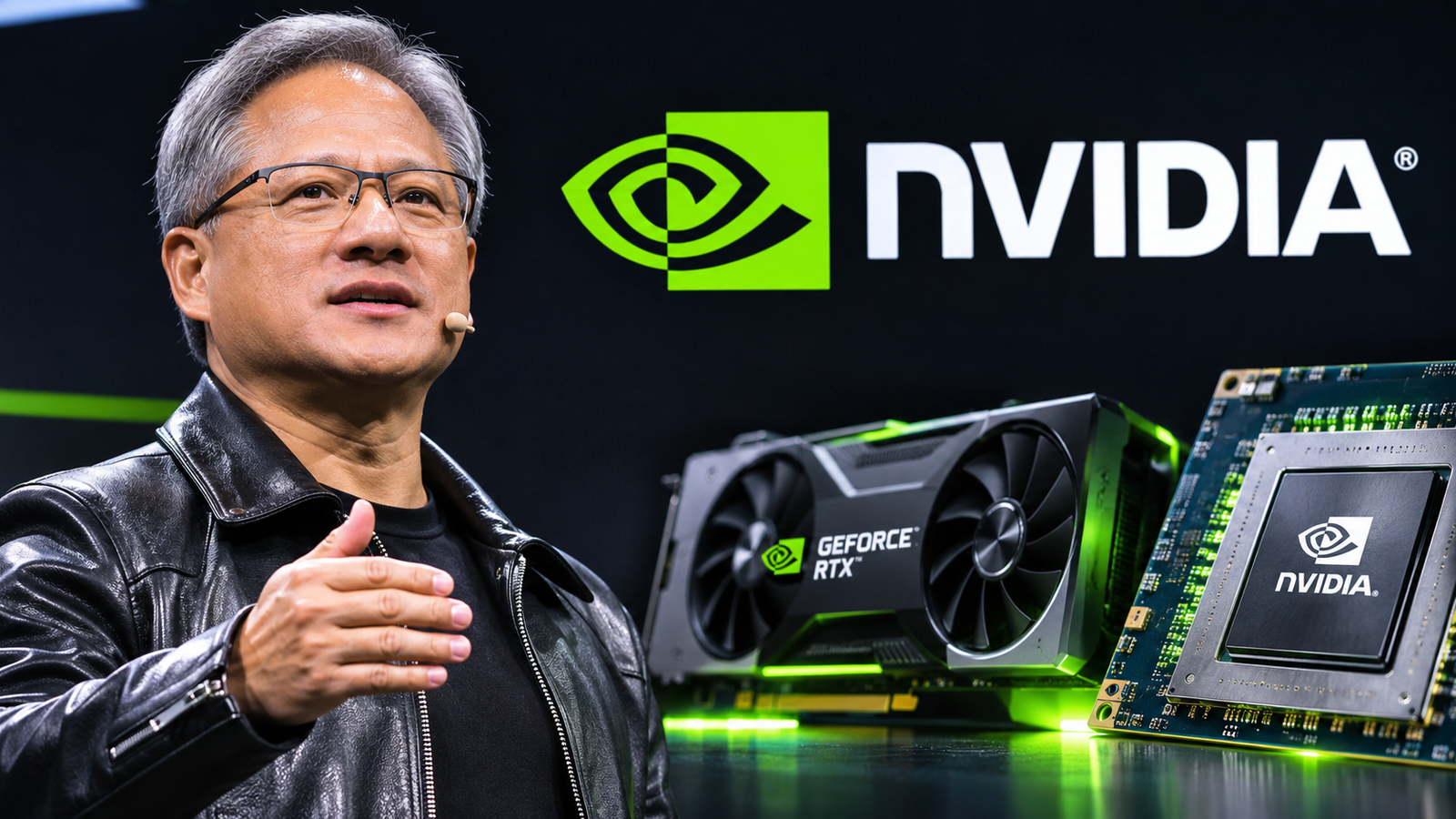
How NVIDIA Was Established: The Story of Its Founder
ntroduction
NVIDIA is one of the most influential technology companies in the modern world. Its name is famous for powerful computer chips, graphics cards, artificial intelligence, gaming technology, and advanced computing systems. Today, NVIDIA technology helps power everything from video games and scientific research to self-driving vehicles and artificial intelligence.
However, NVIDIA did not begin as a giant technology company. Its journey started in 1993 with three engineers who shared a vision of making computer graphics faster and more powerful.
Jensen Huang, Chris Malachowsky, and Curtis Priem founded NVIDIA with the belief that computers would become important platforms for gaming and multimedia entertainment. They wanted to develop specialized chips capable of handling complex graphics calculations.
Their idea eventually transformed the computer industry. What began as a small graphics technology business grew into a major force behind modern artificial intelligence.
1. The Beginning of NVIDIA
NVIDIA was officially established on April 5, 1993, in the United States.
During the early 1990s, personal computers were becoming increasingly popular. However, computer graphics were still limited. Creating realistic three-dimensional images required expensive equipment and powerful computing systems.
Traditional computer processors were responsible for handling many different operations, including graphics calculations. The founders recognized that specialized processors could perform graphics-related tasks more efficiently.
They believed that dedicated graphics technology would become increasingly important as computer games, multimedia applications, and digital entertainment developed.
This vision became the foundation of NVIDIA.
2. The Three Engineers Behind NVIDIA
NVIDIA was founded by three engineers with different experiences and technical backgrounds.
Jensen Huang
Jensen Huang was born in Taiwan in 1963 and later moved to the United States. He studied electrical engineering and developed professional experience in the semiconductor industry.
Before establishing NVIDIA, he worked at LSI Logic and Advanced Micro Devices (AMD).
Huang became NVIDIA’s president and chief executive officer. His leadership and long-term vision played a major role in the company’s development.
Chris Malachowsky
Chris Malachowsky was an experienced electrical engineer who worked at Sun Microsystems before co-founding NVIDIA.
His engineering knowledge and experience contributed to the development of the company’s early graphics technology.
Curtis Priem
Curtis Priem was a talented graphics-chip engineer with experience at IBM and Sun Microsystems.
He brought valuable technical expertise to NVIDIA and helped establish its early engineering direction.
Together, the three founders created a company focused on developing better computer graphics technology.
3. Why Did They Establish NVIDIA?
The founders recognized that the computer industry was changing.
Video games were becoming more sophisticated, and computer users wanted better graphics, faster performance, and more realistic visual experiences.
However, producing detailed three-dimensional graphics required enormous amounts of mathematical calculations.
The founders believed that graphics processors could handle these calculations more efficiently than relying entirely on traditional central processing units.
Their goal was to develop chips that could improve graphics performance and make advanced visual technology accessible to more computer users.
Gaming was their initial target market, but they also believed their technology could eventually serve other industries.

4. NVIDIA’s First Product and Early Challenges
In 1995, NVIDIA introduced its first product, the NV1.
It was an innovative graphics product designed to handle computer graphics, multimedia, and audio-related functions.
However, the NV1 did not achieve the commercial success the company expected.
One important problem was that its graphics approach did not align with the direction adopted by the wider computer software industry.
This created difficulties for game developers and computer manufacturers.
NVIDIA faced a serious business challenge. The company needed to reconsider its technology strategy and develop products that matched emerging industry standards.
Instead of abandoning its vision, the founders continued working on new graphics processors.
This experience became an important lesson in NVIDIA’s history: technological innovation must also meet the practical needs of customers and software developers.
5. The RIVA 128 Breakthrough
In 1997, NVIDIA introduced the RIVA 128 graphics processor.
Unlike the company’s earlier product, the RIVA 128 followed the graphics approach gaining acceptance in the computer industry.
It delivered strong performance and attracted attention from computer manufacturers.
The product became an important commercial success and helped NVIDIA recover from its early difficulties.
The company continued developing improved graphics processors, including the RIVA TNT series.
These products strengthened NVIDIA’s position in the growing computer graphics market.
6. The GeForce 256 Revolution
One of the biggest milestones in NVIDIA’s history came in 1999.
The company introduced the GeForce 256, which NVIDIA marketed as the world’s first Graphics Processing Unit, commonly known as a GPU.
A GPU is a specialized processor designed to perform graphics-related calculations efficiently.
The GeForce 256 represented an important step forward in computer graphics. It helped improve three-dimensional gaming, visual effects, and graphics performance.
The introduction of the GPU also helped establish a new identity for NVIDIA in the technology industry.
In January 1999, NVIDIA became a publicly traded company on the NASDAQ stock exchange.
These developments helped the company enter a new stage of growth.
7. Moving Beyond Gaming Technology
Initially, NVIDIA concentrated on graphics processors for computer games and multimedia applications.
However, the company gradually recognized that GPUs could perform many other types of calculations.
Scientists, researchers, engineers, and businesses needed powerful computing technology to solve complex problems.
NVIDIA began expanding its technology beyond gaming.
One of its most important developments came in 2006 with the introduction of CUDA.
CUDA allowed developers to use NVIDIA GPUs for general-purpose parallel computing.
This meant GPUs could help perform calculations used in scientific research, engineering, simulations, and other demanding applications.
CUDA became an important foundation for NVIDIA’s future development.
8. NVIDIA and the Artificial Intelligence Revolution
Artificial intelligence became one of the most important technological developments of the twenty-first century.
AI systems require enormous computing power to process information, recognize patterns, and learn from large datasets.
NVIDIA’s GPUs proved particularly useful for these tasks because they could perform many calculations simultaneously.
An important milestone came in 2012 when NVIDIA GPUs helped power AlexNet, an artificial intelligence system that achieved a major breakthrough in image recognition.
This development attracted attention from researchers and technology companies around the world.
As artificial intelligence continued advancing, demand for powerful GPUs increased.
NVIDIA expanded its work in AI computing and developed hardware and software platforms for researchers, developers, and businesses.
The company’s early investment in GPU computing helped prepare it for the modern AI revolution.
9. NVIDIA RTX and Advanced Graphics
NVIDIA continued improving computer graphics technology.
In 2018, the company introduced NVIDIA RTX technology, bringing real-time ray tracing to its graphics platforms.
Ray tracing is a technology that simulates how light interacts with objects and surfaces.
It can produce more realistic lighting, shadows, and reflections in computer-generated environments.
This technology became important in gaming, animation, architectural visualization, and professional graphics production.
NVIDIA demonstrated that its technology could improve not only computing performance but also the quality of digital experiences.
10. NVIDIA’s Expansion Into Different Industries
Over the years, NVIDIA expanded its products and platforms into several industries.
Artificial Intelligence: NVIDIA GPUs help power AI development, machine learning, and generative AI systems.
Healthcare: Researchers use GPU computing and AI tools to support medical imaging, scientific research, and drug discovery.
Automotive Technology: NVIDIA develops computing platforms and software for autonomous driving and intelligent vehicles.
Robotics: Its computing technologies help developers build and train advanced robotic systems.
Gaming: NVIDIA GeForce graphics processors continue to support modern computer gaming.
Scientific Research: Researchers use GPU computing to perform complex simulations and scientific calculations.

This expansion transformed NVIDIA from a graphics-chip manufacturer into a company serving a wide range of computing industries.
11. Jensen Huang’s Leadership and Business Vision
Jensen Huang has played an important role in NVIDIA’s development since its establishment.
As CEO, he guided the company through technological challenges, market competition, and major changes in the computer industry.
One of his most important decisions was supporting GPU computing beyond traditional graphics applications.
While NVIDIA had built its reputation through gaming technology, Huang recognized that GPUs could become essential tools for scientific research, artificial intelligence, and advanced computing.
His willingness to invest in long-term technological opportunities helped NVIDIA expand into new markets.
He is also widely recognized for his signature black leather jacket, which has become a familiar part of his public appearances.
His leadership demonstrates the importance of innovation, adaptability, and long-term thinking in building a successful technology business.
12. The Legacy of NVIDIA
NVIDIA’s journey demonstrates how a specialized technology idea can influence the development of an entire industry.
The company began with three engineers who wanted to improve computer graphics. Their work eventually helped establish GPU computing as an important part of modern technology.
Today, NVIDIA plays a major role in artificial intelligence, gaming, robotics, healthcare research, autonomous vehicles, and scientific computing.
Its technologies support researchers, developers, businesses, and creators around the world.
The company’s history also provides important lessons for entrepreneurs. Early business challenges do not necessarily determine the future of a company. Learning from mistakes, understanding market needs, and investing in innovation can create new opportunities.



Post Comment