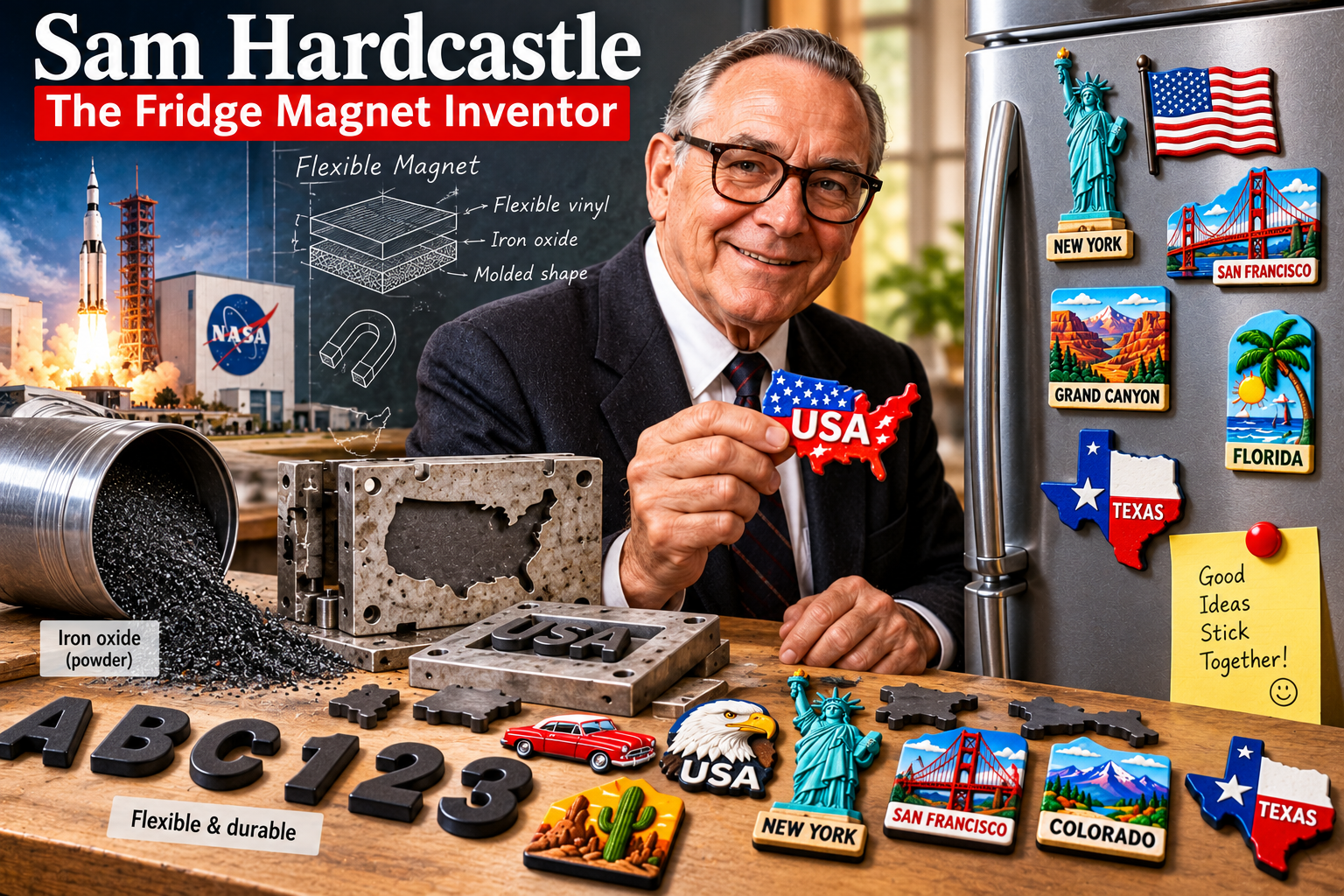
Sam Hardcastle: The Fridge Magnet Inventor
Introduction
Have you ever looked at the colorful magnets on your refrigerator and wondered who invented them? These small objects hold shopping lists, family photographs, children’s drawings, and memories of places we have visited.
One inventor who helped transform the refrigerator magnet industry was Sam Hardcastle, an American inventor and mold maker. In the late 1960s, he developed an innovative type of flexible, three-dimensional magnet that eventually became popular in American homes, souvenir shops, and businesses.
His story demonstrates how a practical industrial invention can find an unexpected place in everyday life.
Who Was Sam Hardcastle?
Sam Hardcastle was an American inventor and mold maker who worked with molded materials and manufacturing techniques.
During the late 1960s, he faced a technical challenge from customers in the space industry. They needed magnetic letters and numbers that could be used on large visual tracking charts.
The requirement was specific. The letters and numbers needed to be flexible, non-abrasive, and magnetic throughout their bodies. Ordinary plastic pieces with small magnets attached to their backs did not meet the requirements.
Hardcastle took on the challenge and developed a different approach to manufacturing magnets.
His innovation would eventually lead to a new market for molded refrigerator magnets.
The Invention of the Classic Magnet
Hardcastle’s breakthrough involved developing a molding compound containing magnetic material.
He experimented with combining iron oxide and a flexible material to create objects that were magnetic throughout, rather than relying on a separate magnet attached to the back.
The resulting product was flexible, three-dimensional, and suitable for molding into different shapes.
This became known as the Classic Magnet, a name later used by its manufacturer to distinguish the original molded magnets from other products.
The invention initially served an industrial purpose. However, Hardcastle soon recognized that the same technology could be useful in advertising, collectibles, and household products.
It was an important example of an industrial solution finding a much broader commercial application.
From Space Industry to the Kitchen
Hardcastle’s magnets were originally developed for use on large tracking charts. Their potential extended far beyond that initial application.
Because the material could be molded into different shapes, it offered manufacturers considerable creative freedom.

Hardcastle began exploring ways to produce magnets for everyday consumers. He also developed techniques for adding colors, words, logos, and detailed designs.
These improvements made the magnets more attractive as promotional products and souvenirs.
Businesses could use them to display their names and logos, while consumers could collect designs representing their interests and favorite places.
The refrigerator became a natural home for these products because its metal surface allowed magnets to hold papers and decorative objects in place.
Building a Magnet Business
After developing his magnetic products, Hardcastle established a promotional magnet business called Ad Specialties.
The company produced molded magnets for businesses looking for distinctive advertising products.
Unlike ordinary paper advertisements, these magnets could remain visible for months or even years. Customers could place them on refrigerators, filing cabinets, and other suitable metal surfaces.
This made them useful promotional items for companies wanting to keep their names in front of customers.
Hardcastle’s manufacturing methods also allowed detailed designs to be incorporated into the magnets. Words, symbols, and logos could be molded into the material, making the products more distinctive.
The combination of practical use and advertising value helped create a market for molded promotional magnets.
The Idea That Made Magnets Collectible
One of Hardcastle’s most successful ideas was to produce magnets shaped like the American states.
These magnets featured the outlines of individual states, along with state names, capitals, and recognizable symbols.
The designs appealed to travelers who wanted small souvenirs representing the places they had visited.
Instead of purchasing a souvenir that simply sat on a shelf, people could bring home something that was both decorative and useful.
State-shaped magnets became popular collectibles. Travelers could purchase a new magnet during each trip and gradually build a collection on their refrigerators.
The concept also helped establish a lasting connection between refrigerator magnets and travel memories.
Today, destination magnets remain familiar souvenirs in tourist destinations throughout the United States and around the world.
Why Refrigerator Magnets Became So Popular
Refrigerator magnets became popular because they combined several advantages in a small, inexpensive product.
1. Everyday usefulness
Magnets can hold shopping lists, reminders, photographs, calendars, and children’s artwork on suitable metal surfaces.
2. Personal expression
Colorful designs allow people to decorate refrigerators with their favorite characters, hobbies, places, and messages.
3. Travel memories
Souvenir magnets provide a simple way to remember holidays, road trips, and special occasions.
4. Affordable advertising
Businesses can distribute branded magnets as promotional gifts, helping customers remember their services.
5. Collectible designs

Magnets are available in countless shapes and styles, making them attractive to collectors.
Hardcastle’s work helped demonstrate how a practical magnetic product could serve these different purposes.
The Difference Between Hardcastle and Other Magnet Innovators
Although Sam Hardcastle played an important role in developing flexible, molded refrigerator magnets, he was not the only person who contributed to the history of these products.
William Zimmerman, for example, became associated with cartoon-style refrigerator magnets and received a patent for his design in the 1970s.
The history of refrigerator magnets therefore involves several innovations, manufacturers, and designers.
Hardcastle’s particular contribution was his development of flexible, three-dimensional magnets that were magnetic throughout their bodies. His work helped establish a distinctive product category for advertising and souvenirs.
Understanding this distinction gives a more accurate picture of how the modern refrigerator magnet evolved.
The Legacy of Sam Hardcastle
Sam Hardcastle’s story is a reminder that innovation does not always begin with a product intended for ordinary consumers.
His magnets were initially developed to solve a specialized problem involving industrial tracking charts. Their commercial potential became apparent only after the technology had been developed.
By exploring new uses for the material, Hardcastle helped transform a specialized manufacturing solution into a product that could be used in homes and businesses.
His state-shaped magnets also helped popularize the idea of collecting small souvenirs that could be displayed on refrigerators.
The original molded-magnet tradition has continued through manufacturers such as Ideaman, Incorporated, which produces Classic Magnets based on this style of product.
Although refrigerator magnets may seem like simple household objects, their development reflects creativity, experimentation, and the ability to recognize new opportunities.
Conclusion
Sam Hardcastle helped change the refrigerator magnet industry by developing flexible, three-dimensional magnets for practical and commercial applications.
His work began with a challenge from the space industry but eventually extended into advertising, household use, and travel souvenirs.
From holding a shopping list to preserving a memory of a favorite American destination, refrigerator magnets have become familiar objects in everyday life.
Hardcastle’s achievement illustrates an important lesson about invention: sometimes, a solution designed for a specialized purpose can become an enduring part of ordinary life.


Post Comment