Joseph Pulitzer: The Fundraiser Who Helped Complete the Statue of Liberty
When people look at the Statue of Liberty today, they often think of France, New York Harbor, immigration, freedom, and the American dream.
Few, however, immediately think of a newspaper publisher.
Yet in 1885, when the Statue of Liberty was waiting in New York Harbor, its future was uncertain. The enormous copper statue had crossed the Atlantic from France, but there was a serious problem: the pedestal on which it was supposed to stand was not finished.
The project needed money.
That was when Joseph Pulitzer stepped forward.
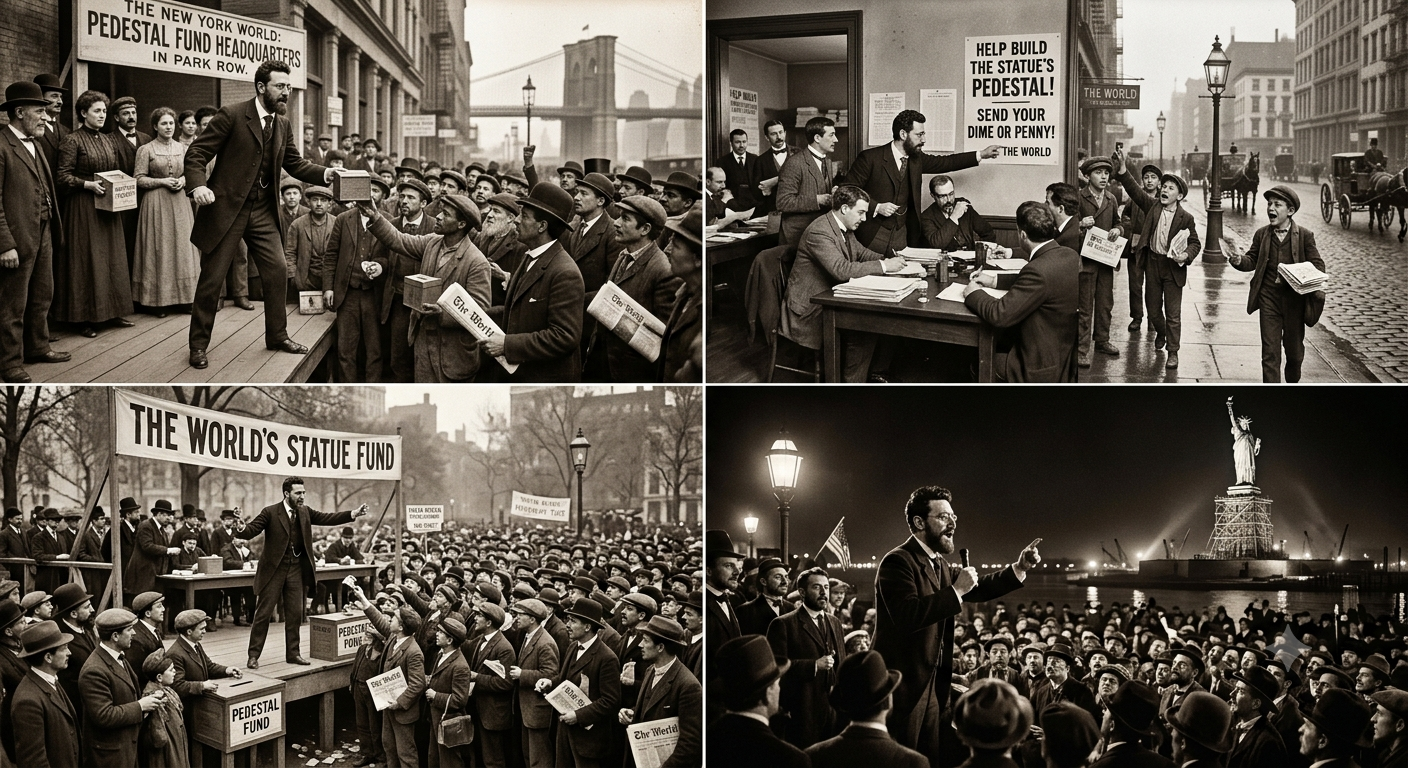
Through the pages of his newspaper, the New York World, Pulitzer launched an extraordinary public fundraising campaign. Instead of waiting for wealthy businessmen to pay the remaining bill, he appealed directly to ordinary Americans.
His campaign eventually raised more than $100,000 from more than 120,000 contributors, helping make it possible to complete the pedestal. The National Park Service describes Pulitzer’s six-month campaign as the effort that rescued the project financially.
But the story is larger than fundraising.
It is a story about an immigrant, a newspaper, a giant monument, and the power of thousands of ordinary people contributing small amounts toward something much larger than themselves.
A Monument Born in France
The Statue of Liberty was originally conceived as a gift from France to the United States.
French political thinker Édouard de Laboulaye supported the idea of a monument celebrating the relationship between France and the United States and the ideals associated with liberty and democracy.
The sculptor Frédéric-Auguste Bartholdi developed the monumental statue.
The project became a joint effort.
France would finance and construct the statue itself, while Americans were expected to raise money for the pedestal that would support it in New York Harbor.
The enormous statue was constructed in France between 1875 and 1884.
Alexandre-Gustave Eiffel and his engineering team developed the internal framework that supported Bartholdi’s copper exterior.
By 1884, the statue was essentially complete.
But the American side of the project had encountered a serious financial problem.
The pedestal remained unfinished.
America’s Financial Problem
The American Committee for the Statue of Liberty had been responsible for raising the money needed for the pedestal.
Fundraising had already produced substantial amounts, but it was not enough to complete the project.
The National Park Service records that the American committee raised about $125,000 between 1877 and 1884. By 1884, however, construction of the pedestal had stalled because the available funds had run out.
This created an extraordinary situation.
France had completed its gift.
The enormous statue was ready to travel across the Atlantic.
But America had not yet completed the structure that would hold it.
In 1885, the Statue of Liberty was dismantled in France and packed into 214 specially constructed wooden cases.
The French ship Isère carried the pieces across the Atlantic.
On June 17, 1885, the Statue arrived in New York Harbor.
New Yorkers celebrated the arrival.
But there was nowhere to permanently place the statue.
The unfinished pedestal remained the obstacle.
Enter Joseph Pulitzer
Joseph Pulitzer was not born into an American newspaper dynasty.
He was an immigrant who came to the United States at the age of 19.
Over the course of his life, he worked in several fields before becoming one of America’s most influential newspaper publishers.
By the time the Statue of Liberty arrived in New York, Pulitzer was the publisher of the New York World.
He had developed the newspaper as a publication aimed at a broad, mass audience.
And in 1885, he decided to use that audience to help save the Statue of Liberty project.
Pulitzer did something important.
He did not simply ask wealthy Americans to contribute.
He appealed to ordinary people.
His message was essentially that the Statue of Liberty should not become a monument paid for only by America’s richest citizens.
The French people had contributed to their part of the project.
Pulitzer argued that Americans should similarly contribute to their part.
The Power of a Newspaper
Pulitzer understood something that few fundraisers of his time could match.
He had a powerful communication network.
Every day, the New York World could reach thousands of readers.
Instead of treating the unfinished pedestal as somebody else’s problem, Pulitzer turned it into a public cause.
The newspaper encouraged readers to send whatever they could afford.
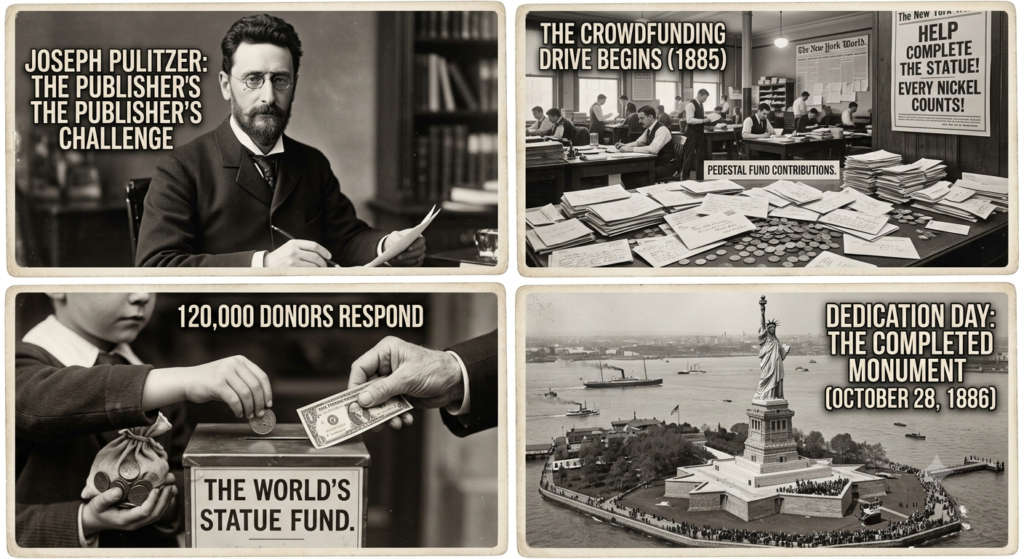
According to the National Park Service, most donations were around one dollar or less. In total, roughly 125,000 people contributed to the completion of the pedestal.
That detail is one of the most remarkable parts of the story.
The pedestal was not completed simply because one millionaire wrote a large check.
Thousands of people participated.
Children contributed.
Working people contributed.
Immigrants contributed.
Families contributed.
People who could give only a small amount still became part of the story.
Pulitzer’s newspaper even published the names of contributors, regardless of the size of their donations.
A small donation could therefore become a public statement:
I helped build it.
The Campaign That Changed Everything
Pulitzer’s fundraising campaign began in 1885, when the pedestal project was in serious trouble.
His newspaper repeatedly urged the public to contribute.
The campaign proved remarkably successful.
The National Park Service reports that Pulitzer’s six-month campaign raised more than $100,000.
By August 11, 1885, the World had collected more than $100,000, with most contributions being small.
This was an impressive demonstration of the power of mass participation.
Pulitzer had transformed the pedestal from an engineering and financial problem into a public movement.
The campaign also demonstrated the growing influence of American newspapers.
A newspaper was no longer simply a place where people read political news or advertisements.
It could organize public attention.
It could create awareness.
And in Pulitzer’s hands, it could mobilize thousands of people around a national project.
A Statue Without a Pedestal
There is something almost symbolic about the situation in 1885.
The Statue of Liberty had crossed an ocean.
Its enormous copper pieces were sitting in New York.
The American public had watched photographs and newspaper reports about the statue.
But the monument could not rise over New York Harbor until its foundation was ready.
The statue itself represented a gift from France.
The pedestal represented an American responsibility.
Pulitzer helped connect the two.
His fundraising campaign helped provide the money necessary to finish the pedestal, allowing the massive project to move forward.
More Than a Fundraiser
Calling Pulitzer simply “the man who raised money for the Statue of Liberty” would leave out an important part of the story.
He was a newspaper publisher with a particular vision of mass journalism.
He believed that ordinary people could play an important role in public life.
The Statue of Liberty campaign gave him an opportunity to put that philosophy into practice.
His appeal was not:
“Wait for someone wealthy to solve the problem.”
Instead, his campaign encouraged people to participate themselves.
The National Park Service notes that Pulitzer criticized the idea of relying on wealthy Americans while ordinary people were capable of contributing to the project.
That approach was particularly significant in a country experiencing enormous immigration and social change.
America was becoming increasingly diverse and urban.
Millions of people were building new lives, businesses, communities, and families.
A public monument financed partly through thousands of small donations reflected that broader society.
Emma Lazarus and the Pedestal Campaign
Pulitzer was not the only person connected with fundraising for the pedestal.
Poet Emma Lazarus also became part of the story.
In 1883, she wrote the sonnet The New Colossus as part of an exhibition organized to raise money for the Bartholdi pedestal fund.
The poem later became deeply associated with the Statue of Liberty.
Its famous words eventually helped shape how Americans and the wider world understood the monument.
But there is an important historical distinction.
Lazarus wrote her poem in 1883.
Pulitzer’s major newspaper fundraising campaign came later, in 1885, when the pedestal still lacked sufficient funding.
Together, these efforts became part of the larger story surrounding the completion of the monument.
The Statue Finally Rises
Once enough money had been raised, construction of the pedestal could continue.
The Statue itself had arrived in New York in June 1885.
After the pedestal was completed, workers began reconstructing the statue.
The process involved rebuilding Eiffel’s internal framework and attaching the copper sections of the statue. The National Park Service notes that the Statue was reassembled on the pedestal in 1886.
Finally, on October 28, 1886, the Statue of Liberty was officially dedicated.
President Grover Cleveland presided over the dedication ceremony.
The monument that had begun as a Franco-American project had finally become a reality in New York Harbor.
Pulitzer’s Lasting Connection to Liberty
Joseph Pulitzer did not design the Statue of Liberty.
He did not sculpt it.
He did not engineer its framework.
And he did not design its pedestal.
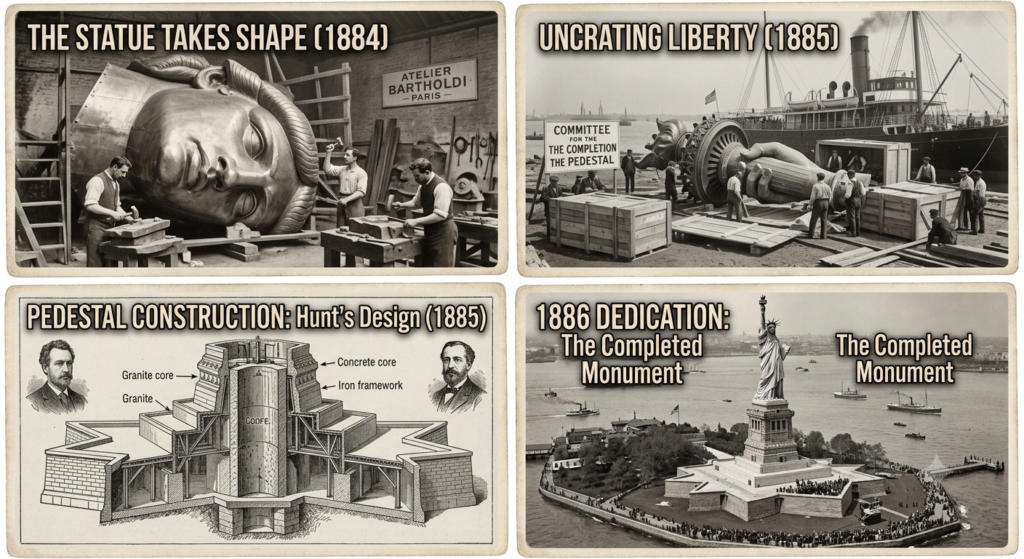
Those achievements belonged to other people, including Bartholdi, Eiffel, Richard Morris Hunt, and Charles P. Stone.
Pulitzer’s contribution was different.
He helped provide the financial bridge that allowed the American side of the project to be completed.
He used the reach of his newspaper to turn thousands of small contributions into a major fundraising effort.
That distinction matters.
The Statue of Liberty was the product of many people.
Artists.
Engineers.
Architects.
Workers.
Donors.
Poets.
Politicians.
And ordinary citizens.
Pulitzer became one of the most important figures in the final stage of that effort.
A Monument Built by Many Hands
Today, the Statue of Liberty is one of America’s most recognizable landmarks.
The monument stands on Liberty Island in New York Harbor.
The National Park Service identifies its official name as Liberty Enlightening the World. It was constructed in France, shipped to New York in 1885, reassembled, and officially dedicated in 1886.
Its meaning has also developed over time.
During the great era of immigration in the late nineteenth and early twentieth centuries, the Statue became an important symbol for people arriving in America.
For many immigrants entering New York Harbor, Lady Liberty became one of their first images of the United States.
That history gives Pulitzer’s fundraising campaign an additional dimension.
Many of the people who contributed to the pedestal were not part of America’s wealthiest class.
The National Park Service records that the overwhelming majority of contributions were small.
Yet those small contributions became part of a monument that would eventually welcome generations of newcomers.
The Fundraiser Behind the Monument
Joseph Pulitzer died in 1911, decades after the Statue of Liberty had been completed.
His name eventually became permanently connected with American journalism through the Pulitzer Prizes.
But another part of his legacy remains standing in New York Harbor.
When the Statue of Liberty arrived in America, it faced a simple but enormous problem:
The statue had arrived, but its foundation was not ready.
Pulitzer used the power of his newspaper to ask ordinary Americans to help.
More than 100,000 dollars was raised.
More than 120,000 people participated.
And the pedestal was completed.
The Statue could finally rise above New York Harbor.
Today, visitors see Lady Liberty as a single monumental figure.
But behind that figure is a complicated history involving French artists, American engineers, architects, construction workers, poets, newspaper readers, immigrants, philanthropists, and thousands of ordinary donors.
Joseph Pulitzer’s role was not to create the Statue of Liberty.
His role was to help make sure America had a place to put it.
And that is why Joseph Pulitzer deserves to be remembered not only as a newspaper publisher, but also as the fundraiser who helped complete one of America’s most enduring landmarks.


Post Comment