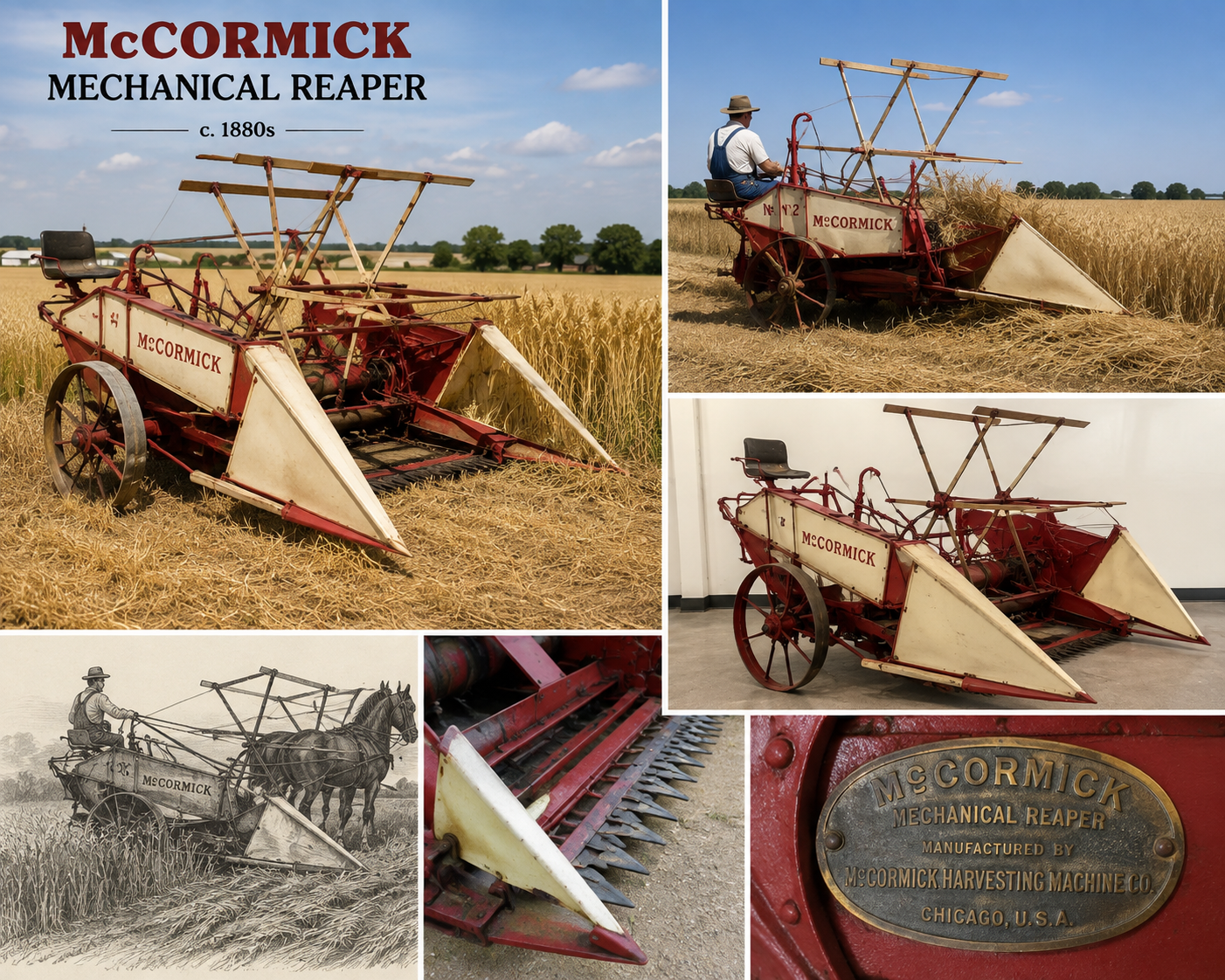
The McCormick Mechanical Reaper: The Machine That Transformed American Agriculture
Introduction
In the history of American agriculture, few inventions had an impact as profound as the McCormick Mechanical Reaper. Developed and commercialized by Cyrus Hall McCormick, the reaper helped transform grain harvesting from a slow, labor-intensive process into a faster and more efficient mechanical operation.
During the early 19th century, American farmers relied heavily on hand tools such as sickles and scythes to harvest wheat and other grains. Harvesting large fields required considerable labor, time, and physical effort. Farmers also faced a narrow window in which crops had to be harvested before storms, wind, or other unfavorable weather could damage them.
The mechanical reaper offered a practical solution. Pulled by horses, the machine used a moving cutting mechanism to harvest standing grain. Although it did not perform every stage of harvesting, it dramatically reduced the amount of manual labor required to cut crops.
The story of the McCormick Reaper is therefore more than the story of a machine. It is a story about invention, agricultural expansion, industrialization, entrepreneurship, and the changing relationship between humans and technology.
American Agriculture Before the Reaper
Before mechanical harvesting machines became widely available, grain harvesting was primarily a manual operation.
Farm workers used hand tools to cut crops stalk by stalk. After cutting, the grain had to be gathered, bundled, transported, and eventually threshed. On a small farm, this process was difficult enough. On a large farm, it could become an enormous challenge.
Timing was particularly important.
A mature grain crop could not simply be left standing indefinitely. Rain, wind, and other weather conditions could cause crops to fall or deteriorate. Farmers therefore needed to harvest as much grain as possible during a relatively short period.
This created a major demand for agricultural machinery capable of increasing harvesting speed.
Cyrus McCormick
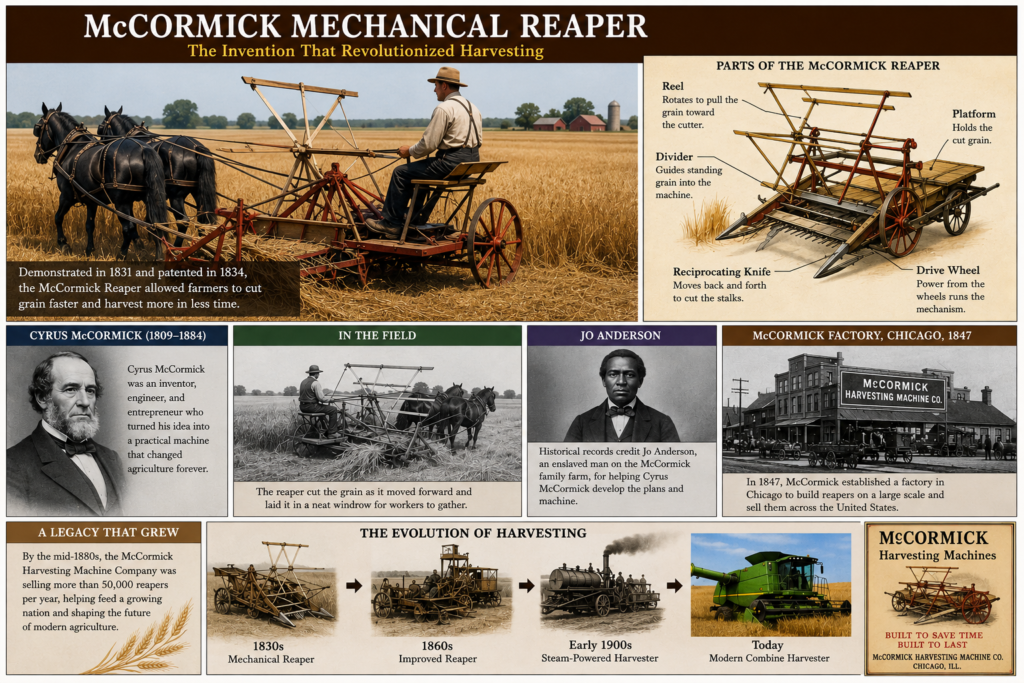
Cyrus Hall McCormick was born in 1809 in Rockbridge County, Virginia. He grew up in a family interested in agricultural machinery.
His father, Robert McCormick, had experimented with mechanical harvesting equipment. Cyrus continued working on the concept and focused on developing a machine that could perform effectively under real farming conditions.
Rather than treating the invention simply as a mechanical experiment, Cyrus McCormick pursued the larger challenge of making agricultural machinery practical and commercially useful.
That distinction became one of the most important aspects of his career.
The 1831 Demonstration
One of the important moments in the development of McCormick’s reaper came in 1831, when a working version of the machine was demonstrated.
The basic principle was straightforward: horses pulled the machine through a field while its mechanical cutting system severed standing grain.
For farmers accustomed to harvesting crops with hand tools, the sight of a machine cutting grain as it moved across a field represented a remarkable change.
The machine was not perfect, and agricultural machinery continued to evolve. However, the demonstration showed that mechanical harvesting could become a practical reality.
The 1834 Patent
McCormick received a U.S. patent for his reaper in 1834.
The patent was an important step, but obtaining a patent was only the beginning. A successful agricultural invention had to survive real-world conditions, be manufactured reliably, reach farmers, and provide enough value to justify its cost.
McCormick therefore continued improving the design and developing a business around the machine.
His later success would demonstrate that technological innovation and commercial organization could work together to transform an industry.
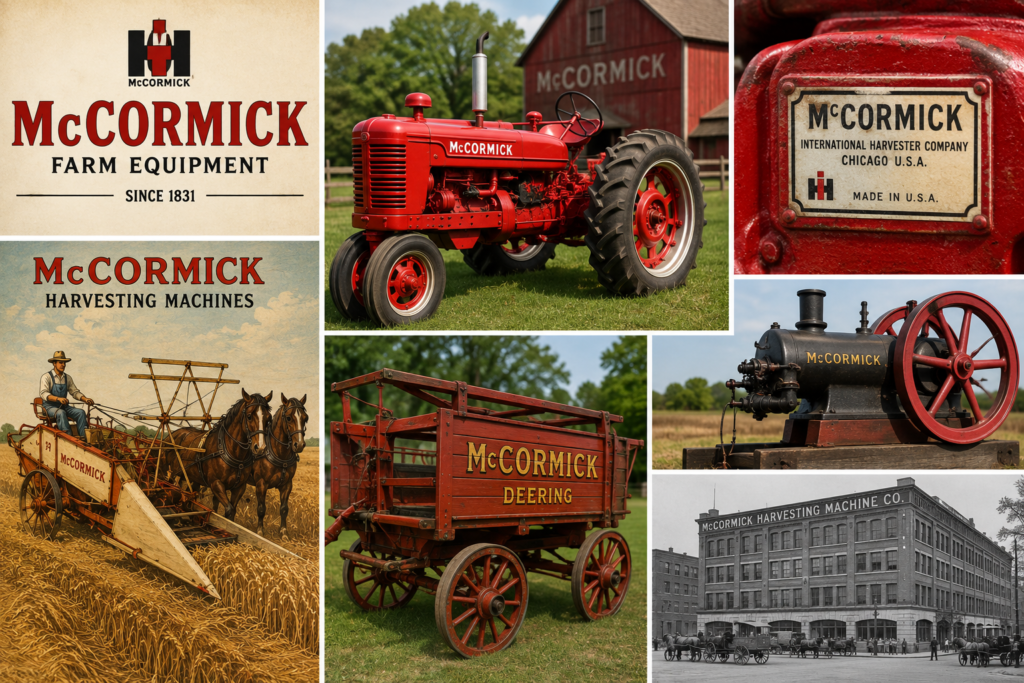
How the McCormick Reaper Worked
The McCormick Reaper was a horse-drawn harvesting machine built around several mechanical components.
A divider helped guide standing crops toward the cutting area. A reel helped position the grain for cutting, while a reciprocating knife moved back and forth to cut the stalks.
Once the grain was cut, it was deposited onto a platform.
The machine did not completely automate harvesting. Workers still had to collect and handle the cut grain. Nevertheless, the most repetitive part of the process—cutting standing grain—could now be performed mechanically.
This was the fundamental breakthrough.
The reaper converted a highly labor-intensive task into a mechanical operation powered primarily by horse traction.
Why the Reaper Was Revolutionary
The importance of the McCormick Reaper was not simply that it could cut grain.
Its greater significance came from its ability to increase harvesting capacity.
A farmer using hand tools could only harvest a limited area in a day. A mechanical reaper could cover much more ground in the same period.
This meant farmers could potentially cultivate larger areas without increasing their workforce at the same rate.
The invention therefore contributed to a broader transformation in American agriculture: land, labor, machinery, and production could be combined in new ways.
The Role of Labor
The introduction of agricultural machinery inevitably affected farm labor.
Before mechanical harvesting, large-scale grain farming required substantial numbers of workers during harvest season. A machine could reduce the amount of manual cutting required.
However, mechanization did not immediately eliminate agricultural labor.
Workers were still needed for many other tasks, including gathering crops, transporting grain, threshing, maintaining equipment, and managing farms.
Instead, machinery gradually changed the type and organization of agricultural labor.
This became a recurring pattern throughout the history of agricultural technology.
Jo Anderson and the Development Story
The history of the McCormick Reaper also includes the contribution of Jo Anderson, an enslaved man who lived and worked on the McCormick family farm.
Historical accounts indicate that Anderson assisted Cyrus McCormick during the development of the machine.
This is an important part of the story because inventions are often presented as the achievement of a single famous individual. In reality, technological development frequently depends on the practical knowledge, labor, experimentation, and assistance of many people.
Recognizing these contributions provides a more complete understanding of the history behind the machine.
From Invention to Business
Creating a working machine was only one part of McCormick’s achievement.
The larger challenge was building an organization capable of manufacturing and selling agricultural machinery on a large scale.
McCormick understood that farmers needed more than a demonstration. They needed reliable machines, replacement parts, service, information, and access to the product.
He therefore developed a business strategy around the reaper.
Demonstrations, sales networks, manufacturing improvements, and promotional efforts helped introduce the technology to farmers across the United States.
This combination of engineering and entrepreneurship became a defining feature of McCormick’s career.
The Move to Chicago
In 1847, McCormick established a factory in Chicago.
The location was strategically important.
Chicago was rapidly developing into a major transportation and commercial center, with growing connections to the agricultural regions of the American Midwest.
For an agricultural machinery manufacturer, this provided significant advantages. Machinery could be produced and distributed to farmers throughout expanding agricultural markets.
The Chicago operation helped McCormick move from producing machines on a relatively limited scale toward a much larger industrial enterprise.
The Growth of Agricultural Machinery
The success of the reaper encouraged continued innovation in agricultural machinery.
Manufacturers developed improved reapers, mowers, threshing machines, and eventually more sophisticated harvesting equipment.
Over time, separate harvesting operations began to be combined into increasingly complex machines.
The modern combine harvester, for example, can perform several operations that once required separate stages of labor.
The McCormick Reaper did not perform all of these functions, but it helped establish the principle that major agricultural tasks could be mechanized.
Agriculture and the Industrial Revolution
The McCormick Reaper was part of a much larger transformation known as the Industrial Revolution.
Industrialization was not limited to factories and urban manufacturing. Its influence extended into agriculture.
Machines increasingly replaced or supplemented repetitive physical labor. Standardized manufacturing made complex equipment more widely available. Transportation networks allowed agricultural machinery to reach distant farming communities.
The reaper therefore represented an important connection between industrial technology and farming.
It demonstrated that mechanical innovation could change not only manufacturing but also the way food was produced.
The Importance of Speed
One of the greatest advantages of mechanical harvesting was speed.
Harvesting is highly dependent on timing. A crop may be ready to harvest for only a limited period before weather or natural conditions threaten the yield.
A faster machine gave farmers greater flexibility.
Instead of relying entirely on large numbers of workers, farmers could use mechanical power to increase the amount of grain harvested within the available window.
This became increasingly important as farms grew larger and American grain production expanded.
The Expansion of American Grain Farming
During the 19th century, agricultural production expanded dramatically across the United States.
The development of the Midwest as a major grain-producing region created strong demand for efficient agricultural machinery.
Large areas of land could be cultivated, but producing grain profitably required efficient harvesting methods.
Mechanical reapers helped address this challenge.
By increasing harvesting capacity, they supported the economic development of large-scale grain farming and contributed to the broader mechanization of American agriculture.
McCormick’s Marketing Strategy
Cyrus McCormick was not only interested in engineering. He was also an innovative businessman.
He recognized that farmers needed to see a machine working before they would trust it with their crops.
Agricultural exhibitions and field demonstrations became important tools for introducing the technology.
McCormick’s organization also developed sales networks and promoted the practical benefits of the machine.
This approach helped turn an invention into a commercial product.
It also established an important principle in agricultural technology: innovation must solve a real problem and demonstrate clear economic value to users.
The Long-Term Legacy
The influence of the McCormick Reaper extended far beyond its original design.
The machine helped establish a new relationship between agriculture and mechanical technology.
Farmers increasingly came to depend on machines for planting, harvesting, threshing, and other operations.
Later inventions built upon this foundation.
Tractors eventually replaced many animal-powered systems. Combines integrated multiple harvesting processes. Modern machines now incorporate GPS guidance, sensors, automated controls, and advanced data systems.
Yet the fundamental objective remains similar to that of the early reaper: accomplishing agricultural work more efficiently.
From Horse-Powered Reaper to Modern Harvester
The technological distance between a 19th-century McCormick Reaper and a modern combine harvester is enormous.
The reaper relied on horses for traction and used a relatively simple mechanical cutting system.
Modern harvesters can contain powerful engines, computerized controls, hydraulic systems, sensors, GPS technology, automated steering, and sophisticated grain-handling mechanisms.
Despite these differences, the historical connection is clear.
The McCormick Reaper demonstrated that harvesting could be mechanized on a practical scale. Later engineers expanded that concept until harvesting became one of the most technologically advanced operations in modern agriculture.
Why the McCormick Reaper Still Matters
The McCormick Reaper remains historically important because it represents more than an agricultural machine.
It illustrates how one technological improvement can influence an entire economic system.
The reaper affected:
– Agricultural productivity
– Farm labor
– Large-scale grain production
– Manufacturing
– Transportation and distribution
– Agricultural business
– The development of later farm machinery
It also demonstrates the importance of combining invention with manufacturing and entrepreneurship.
Conclusion
The McCormick Mechanical Reaper was one of the important machines in the transformation of American agriculture during the 19th century.
Associated with Cyrus McCormick, the reaper provided farmers with a practical mechanical method for cutting standing grain. Its development in the early 1830s, the 1834 patent, and the establishment of large-scale manufacturing in Chicago helped turn mechanical harvesting from an experiment into a significant agricultural industry.
The reaper did not create modern agriculture by itself. It was part of a long sequence of inventions and economic changes. Nevertheless, it played an important role in demonstrating that machines could dramatically increase the speed and efficiency of agricultural work.
Today, modern combine harvesters can harvest enormous fields with technologies that would have seemed impossible in McCormick’s time. Yet the basic idea remains remarkably familiar: use mechanical power and engineering to help farmers harvest more efficiently.
The McCormick Reaper was therefore not simply a machine that cut grain. It was a symbol of a new agricultural era—one in which machinery became an essential partner in feeding a growing nation and, eventually, a growing world.


Post Comment