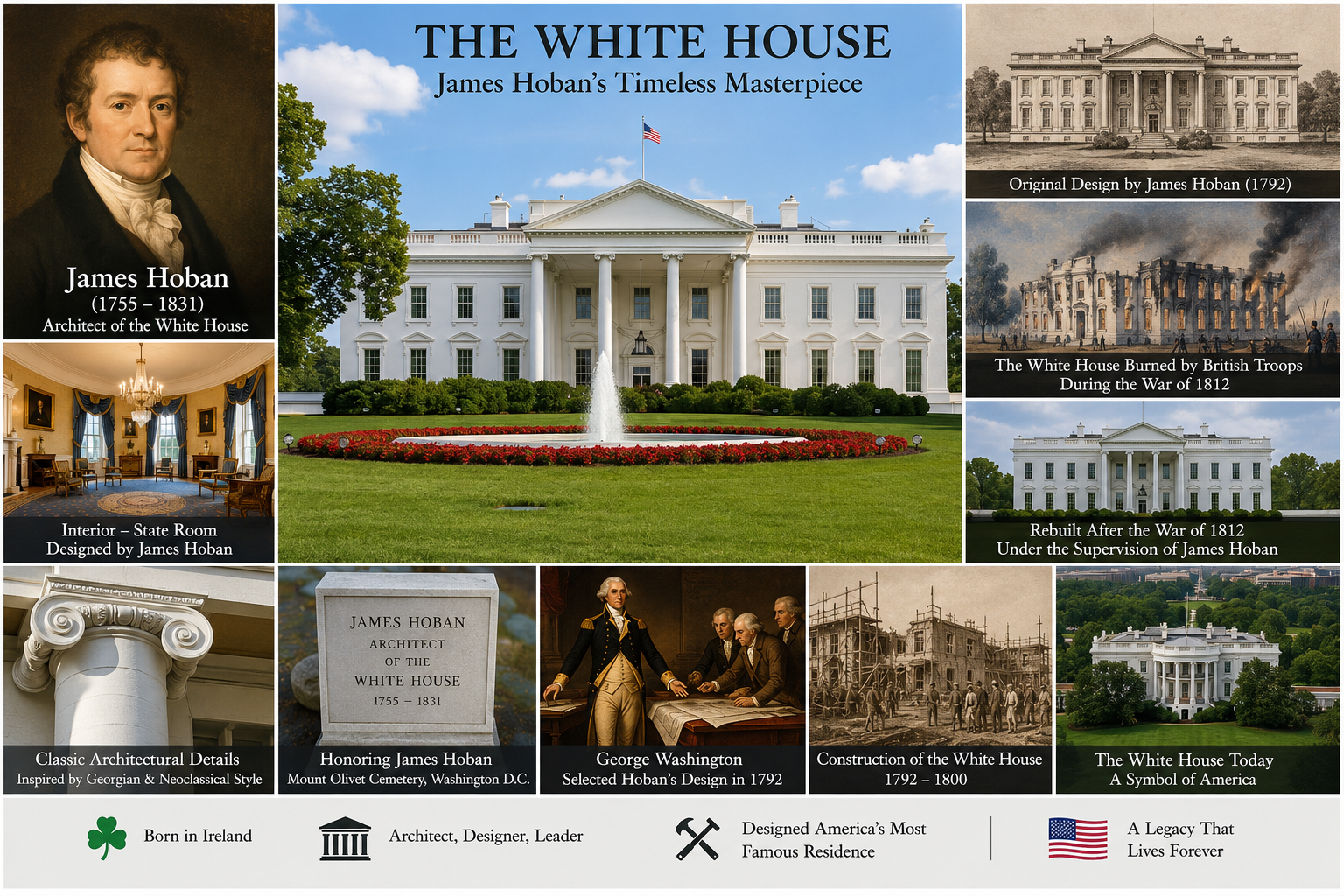
James Hoban: The Architect Who Designed the White House
Introduction
When people think of the White House, they often think of the presidents who have lived there. Yet behind this iconic building stands a remarkable architect whose name is often forgotten—James Hoban. Born in Ireland and later becoming one of America’s most respected architects, Hoban created the design for what would become one of the most recognizable buildings in the world.
His story is one of talent, perseverance, and opportunity. At a time when the United States was a young nation searching for its identity, James Hoban provided an architectural masterpiece that symbolized democracy, stability, and hope. More than two centuries later, the White House continues to serve as the official residence of the President of the United States, making Hoban’s work one of the most enduring architectural achievements in American history.
—
Early Life in Ireland
James Hoban was born around 1755 in County Kilkenny, Ireland. Little is known about his early childhood, but historians believe he came from a modest Catholic family during a period when opportunities in Ireland were limited.
Despite these challenges, Hoban displayed exceptional artistic and technical abilities. He studied architecture and drawing at the prestigious Dublin Society’s Drawing School, where students learned classical European architectural principles.
One of the buildings that greatly influenced him was Leinster House in Dublin. Its elegant Georgian style would later inspire many features of the White House.
—
Immigration to America
Following the American Revolutionary War, many skilled craftsmen sought new opportunities in the United States.
James Hoban immigrated to America around 1785, settling first in Philadelphia, then the nation’s capital. Soon afterward, he moved to Charleston, South Carolina, where his architectural talent quickly gained attention.
He designed several impressive public buildings and private homes, earning a reputation for combining beauty with practicality.
His success in Charleston eventually brought him to the attention of America’s leaders.
—
The Search for a Presidential Residence
In the early 1790s, President George Washington wanted the new federal capital to include a magnificent executive mansion worthy of the new republic.
A public competition was announced in 1792, inviting architects to submit designs for the President’s House.
Several respected architects entered the competition.
James Hoban submitted a design inspired by classical European architecture while adapting it to American needs.
His proposal impressed both the judging committee and George Washington himself.
Washington personally selected Hoban’s design as the winner.Winning the competition changed Hoban’s life forever.
—
Designing the White House
Construction of the White House began in 1792.
Hoban envisioned a building that projected strength without appearing like a royal palace.
His design reflected the democratic ideals of the United States.
Key architectural features included:
Symmetrical Georgian design
Classical columns
Elegant porticos
Large ceremonial rooms
Strong sandstone construction
Balanced proportions
These features created a building that looked dignified rather than extravagant.
Unlike European palaces designed to emphasize monarchy, Hoban’s design represented a government chosen by the people.
—
Challenges During Construction
Building the White House was an enormous undertaking.
Washington, D.C., was still largely undeveloped.
Construction materials had to be transported over difficult roads.
Workers included:
Skilled stone masons
Carpenters
Blacksmiths
Immigrant laborers
Enslaved African Americans, whose forced labor contributed significantly to the construction
Managing such a large project required exceptional organization and leadership.
James Hoban supervised construction personally, ensuring every important detail met his high standards.
—
The First Residents
Although George Washington selected the design, he never lived in the White House.
Construction took several years.
The first president to occupy the building was John Adams in 1800.
At the time, the White House was still unfinished.
Many interior rooms remained incomplete.
Nevertheless, Adams praised the building as a symbol of America’s future.
—
The War of 1812
One of the greatest challenges in Hoban’s career came during the War of 1812.
In 1814, British troops invaded Washington, D.C.
They set fire to several government buildings, including the White House.
The fire destroyed much of the interior.Only the exterior stone walls remained standing.
Many believed the President’s House would never be restored.
—
Rebuilding the White House
Rather than creating an entirely new design, the U.S. government once again turned to James Hoban.
He supervised the rebuilding process.
Using the original plans, Hoban carefully restored the White House while making several improvements.
The reconstruction preserved the building’s original appearance while strengthening its structure.
Thanks to Hoban’s dedication, the White House reopened only a few years later.
This restoration ensured architectural continuity that remains visible today.
—
Architectural Style
James Hoban’s work reflects the principles of Neoclassical and Georgian architecture.
Characteristics include:
Clean lines
Symmetry
Classical columns
Decorative restraint
Large windows
Balanced façades
These elements communicated stability, order, and permanence.
The design became a model for countless government buildings throughout the United States.
—
Other Architectural Projects
Although best known for the White House, Hoban also designed several other important buildings.
These included:
Government offices
Courthouses
Churches
Private residences
Public buildings in Washington and South Carolina
Many of these structures demonstrated the same attention to detail found in the White House.
—
Relationship with George Washington
George Washington respected James Hoban’s professionalism and craftsmanship.
The two worked closely during the planning and construction of the President’s House.
Washington occasionally suggested modifications to improve functionality.
Hoban successfully balanced the president’s ideas with sound architectural principles.
Their collaboration produced one of America’s greatest landmarks.
—
Influence on American Architecture
James Hoban helped establish a distinctly American style of civic architecture.
Future architects drew inspiration from his work when designing:
State capitols
Courthouses
Government offices
Universities
Museums
Historic residences
His influence can still be seen across the United States today.
—
Later CareerHoban continued serving as an architect and public official after completing the White House.
He remained active in Washington for many years.
His expertise was frequently sought for government construction projects.
Although he never achieved widespread celebrity during his lifetime, fellow architects admired his skill and dedication.
—
Death
James Hoban died on December 8, 1831, in Washington, D.C.
He was buried at Mount Olivet Cemetery.
Although his passing received modest attention at the time, history has recognized his extraordinary contribution to the United States.
—
The White House Today
More than 230 years after construction began, the White House remains one of the world’s most famous buildings.
It has served every U.S. president since John Adams.
Over the years, presidents have expanded and renovated the residence, but Hoban’s original vision remains at its core.
Millions of visitors admire the building annually.Its image appears on books, documentaries, films, television broadcasts, and historical publications worldwide.
—
James Hoban’s Lasting Legacy
James Hoban accomplished something few architects ever achieve.
He created a building that became the enduring symbol of an entire nation.
His design represents:
Democracy
Stability
Leadership
National unity
Architectural excellence
The White House has witnessed wars, peace treaties, presidential inaugurations, historic speeches, and countless moments that shaped world history.
Through all these events, Hoban’s masterpiece has remained standing.
—
Interesting Facts
James Hoban was born in Ireland before immigrating to America.
George Washington personally selected his White House design.
The White House construction began in 1792.
John Adams became the first president to live there in 1800.
The building was burned by British troops in 1814.
Hoban supervised its reconstruction after the fire.
The design was inspired partly by Dublin’s Leinster House.
The White House remains one of the most recognized buildings on Earth.
Post Comment