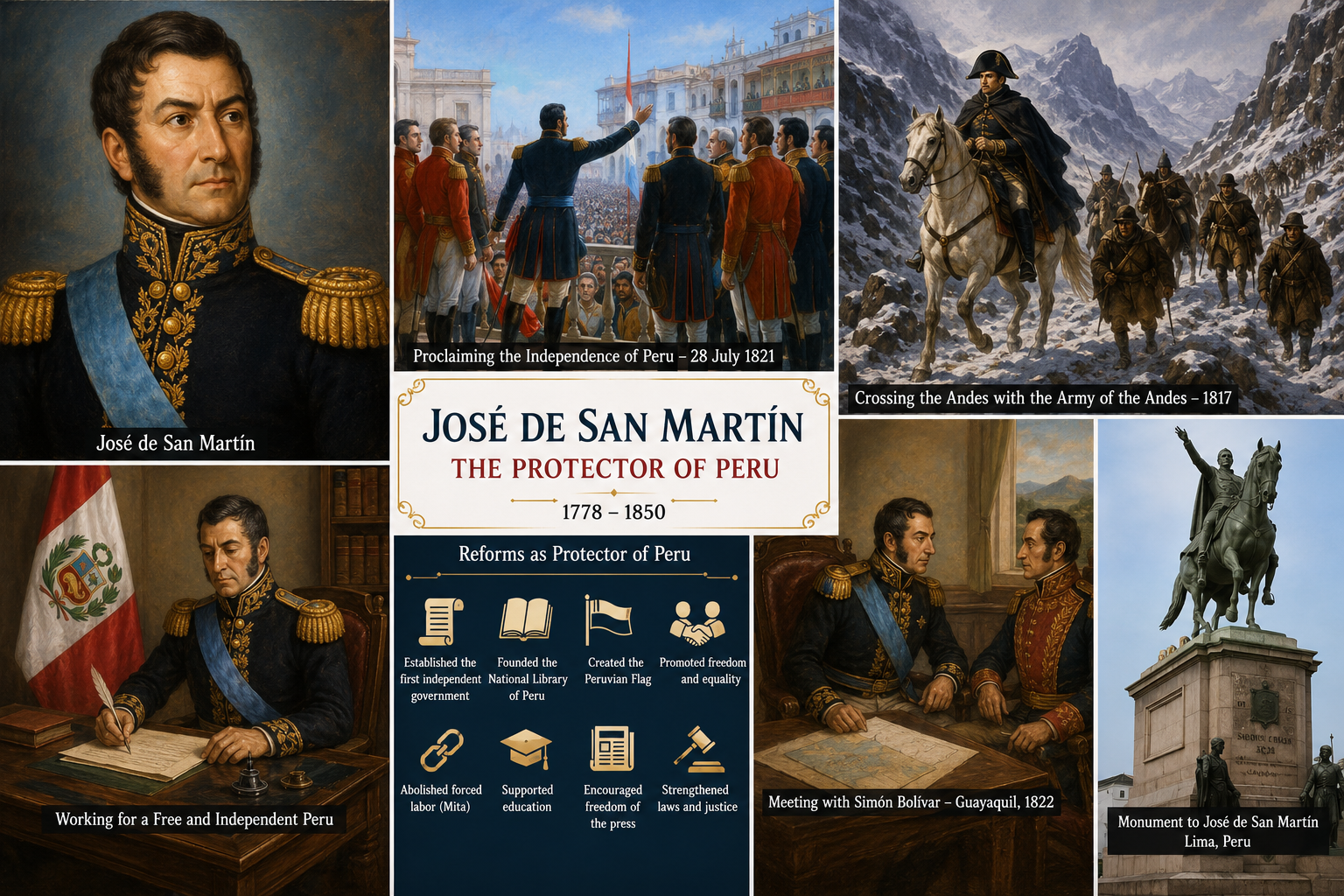
José de San Martín: The Protector of Peru Who Helped Liberate a Continent
Introduction
Few figures in Latin American history have earned as much respect as José de San Martín. Reverently known as the Protector of Peru, he was not merely a military commander but a visionary who dedicated his life to freeing South America from Spanish colonial rule. His leadership helped transform the political landscape of an entire continent, inspiring millions with his courage, discipline, and selflessness.
Unlike many military leaders who sought power for personal gain, San Martín believed that true victory meant securing freedom for others. After leading daring military campaigns across Argentina, Chile, and Peru, he voluntarily stepped away from politics rather than divide the independence movement.
Today, José de San Martín is remembered as one of the greatest liberators in world history and remains a national hero in Argentina, Chile, and Peru.
—
Early Life
José Francisco de San Martín y Matorras was born on 25 February 1778 in Yapeyú, in present-day Argentina. His father served as a Spanish colonial official, and when José was a child, the family moved to Spain.
Growing up in Europe, San Martín received an excellent military education. At just eleven years old, he entered the Spanish army, where he spent over two decades fighting in campaigns against France and other European powers.
His years in Europe shaped him into a disciplined officer, but they also exposed him to Enlightenment ideals of liberty and self-government. These ideas would eventually inspire him to return to South America.
—
Returning Home
In 1812, after more than twenty years in Spain, San Martín returned to Buenos Aires. The independence movement against Spanish rule had already begun, and experienced military leaders were desperately needed.
Rather than seeking comfort or wealth, San Martín immediately joined the revolutionary cause. He believed that South America’s future depended on complete independence from Spain.
His first success came at the Battle of San Lorenzo, where his cavalry defeated Spanish royalist forces. The victory established him as one of the revolution’s most capable commanders.
—
The Brilliant Andes Campaign
San Martín understood that defeating Spain in Argentina alone would not secure independence. Spanish forces remained strong in Chile and Peru.
Instead of launching a direct attack, he developed one of history’s boldest military plans.
He organized the Army of the Andes, spending years preparing soldiers, horses, weapons, and supplies.
In early 1817, approximately 5,000 troops crossed the snow-covered Andes Mountains—one of the highest mountain ranges on Earth.
The journey was incredibly dangerous:
Freezing temperatures
Thin mountain air
Steep cliffs
Shortages of food and water
Despite these hardships, the army successfully crossed the mountains and surprised Spanish forces.
The campaign is still considered one of the greatest military achievements ever accomplished.
—
Liberating Chile
After crossing the Andes, San Martín won the Battle of Chacabuco in 1817.
The victory secured much of Chile’s independence.
Working closely with Chilean patriot Bernardo O’Higgins, San Martín helped establish a new independent government.
One year later, the decisive Battle of Maipú ensured that Spanish control in Chile had effectively ended.
With Chile free, San Martín turned his attention to the greatest Spanish stronghold in South America—Peru.
—
The Importance of Peru
Peru was the center of Spanish political and military power in South America.
As long as Spain controlled Lima, independence elsewhere remained under constant threat.
San Martín believed that Peru had to be liberated before the continent could truly be free.
Instead of launching a reckless invasion, he carefully organized a naval expedition supported by the Chilean government.
—
Arrival in Peru
In 1820, San Martín landed on the Peruvian coast with his expeditionary force.
Rather than immediately attacking Lima, he used diplomacy, blockades, and negotiations to weaken Spanish authority.
Gradually, support for independence spread across Peru.
Many towns declared their loyalty to the revolutionary cause without major fighting.
—
Peru Declares Independence
On 28 July 1821, José de San Martín proclaimed Peru’s independence in Lima.
His famous declaration announced that Peru was free by the will of its people.
Soon afterward, he accepted the title:
Protector of Peru
This title recognized his temporary leadership during the country’s transition from colonial rule to independence.
—
Reforms as Protector
Although remembered primarily as a military hero, San Martín was also an effective reformer.
His government introduced significant changes:
Established Peru’s first independent administration
Created the national flag
Supported education
Founded the National Library of Peru
Promoted freedom of the press
Began ending forced labor practices
Encouraged equality before the law
These reforms laid the foundation for Peru’s future as an independent nation.
—
Meeting Simón Bolívar
In 1822, San Martín met fellow liberator Simón Bolívar in Guayaquil.
The meeting remains one of history’s great mysteries because no official record of their private conversation survives.
Afterward, San Martín made an extraordinary decision.
Rather than compete with Bolívar for leadership, he resigned and stepped aside.
He believed that unity was more important than personal ambition.
Bolívar would later complete Peru’s liberation by defeating the remaining Spanish armies.
—
Life After Politics
Following his resignation, San Martín left South America.
He spent most of his remaining years quietly in Europe.
Unlike many revolutionary leaders, he never attempted to reclaim power.
He lived modestly until his death in France on 17 August 1850 at the age of 72.
—
Legacy
Today, José de San Martín is honored throughout Latin America.
His name appears on:
Schools
Parks
Cities
Museums
Airports
Streets
Monuments
His achievements continue to inspire military leaders, historians, and defenders of freedom around the world.
Unlike conquerors who sought empires, San Martín fought to give nations their independence.
—
Why He Is Called the Protector of Peru
The title Protector of Peru reflected more than political authority.
It symbolized his commitment to protecting the country’s transition from colonial rule to independence.
His leadership combined military success with institution-building, making him one of the architects of modern Peru.
—
Leadership Lessons
Modern readers can learn valuable lessons from San Martín:
Great leaders prepare carefully before acting.
Courage often requires patience.
Real leadership means serving others.
Cooperation achieves more than personal rivalry.
Humility can be the greatest form of strength.
—
Conclusion
José de San Martín’s story is one of courage, discipline, and extraordinary vision. His daring crossing of the Andes, liberation of Chile, proclamation of Peruvian independence, and reforms as Protector transformed South America forever.
By voluntarily giving up power for the sake of unity, San Martín demonstrated a rare quality among revolutionary leaders: selflessness. More than two centuries later, he remains one of history’s finest examples of leadership in the service of freedom.
For Peru, Argentina, Chile, and all of Latin America, José de San Martín will always be remembered as the Protector of Peru and one of the continent’s greatest liberators.
Post Comment