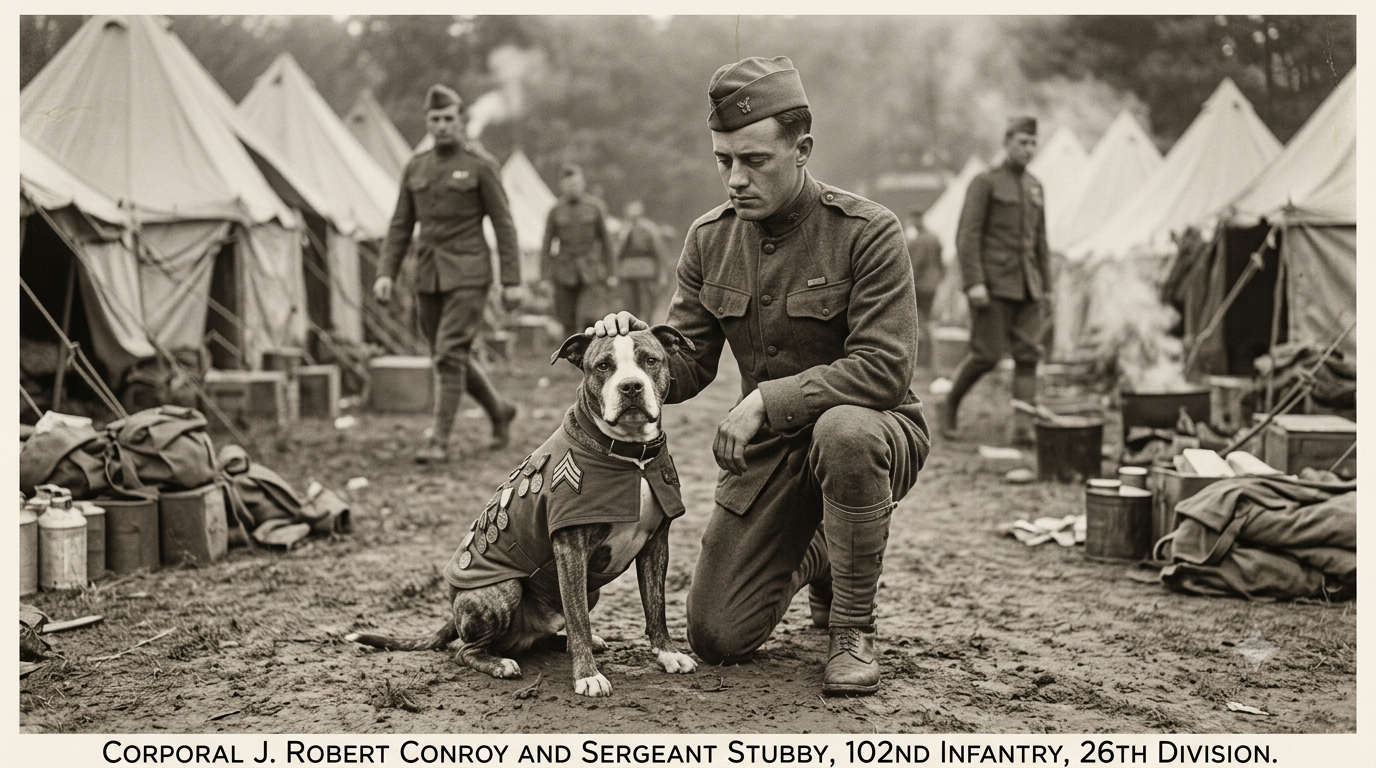
James Robert Conroy and Sergeant Stubby: The Soldier and the Dog Who Became a World War I Legend
During World War I, millions of young men crossed the Atlantic to fight in Europe. They endured trenches, artillery, gas attacks, mud, disease, and the constant uncertainty of battle.
Among those soldiers was an unlikely companion—a small stray dog named Stubby.
Stubby was not born into the military. He had no formal training, no military papers, and no official place in the American Army. Yet, through his intelligence, loyalty, and courage, he became one of the most famous animal figures associated with the First World War.
At the center of Stubby’s story was an American soldier named James Robert Conroy.
Conroy and Stubby met at a military training camp at Yale University in 1917. What began as a soldier befriending a stray dog eventually became a remarkable partnership that carried them from Connecticut to the battlefields of France.
A Stray Dog Meets an American Soldier
In 1917, American soldiers were training on the grounds of Yale University before being sent overseas.
A small brindle-colored stray dog began appearing around the camp. He was roughly two feet long and had a short tail. The soldiers eventually called him Stubby, partly because of his distinctive little tail.
One soldier took a particular interest in him: Private James Robert Conroy.
According to the Smithsonian, Stubby quickly became attached to Conroy. The two became inseparable during training. Stubby followed the soldiers as they marched, slept near them, and became familiar with the routines of military camp.
Conroy also began teaching Stubby military-style behaviors.
The dog learned to respond to commands and even learned a modified military salute. When the soldiers saluted, Stubby would raise his paw toward his face.
It was a simple trick, but it would later become one of the most famous parts of his story.
Stubby Wasn’t Supposed to Go to War
There was one major problem.
Stubby was a dog.
The military had no reason to send a stray dog across the Atlantic with an infantry unit. When Conroy’s unit prepared to leave for France, Stubby was not officially included in the plans.
Conroy, however, did not want to leave his companion behind.
So he found a way.
When the soldiers boarded the SS Minnesota, Conroy secretly brought Stubby aboard. According to Smithsonian records, Stubby was hidden in a coal bin until the ship was far enough from shore that turning back was no longer practical.
Eventually, Stubby was discovered.
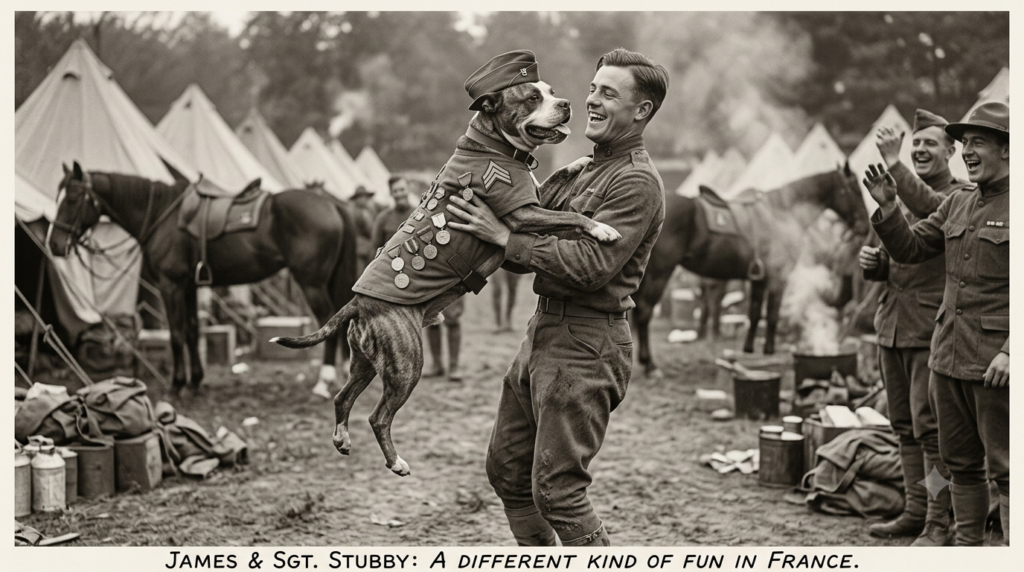
But instead of being sent home, the little dog won over the people around him.
When Conroy’s commanding officer confronted the pair, Stubby reportedly performed his famous salute.
The commanding officer allowed him to stay.
Stubby had officially become the unit’s mascot.
From Training Camp to the Trenches
The journey from an American training camp to the Western Front was a dramatic change.
Stubby eventually accompanied the 102nd Infantry Regiment of the 26th “Yankee” Division to France. The regiment reached the front lines in February 1918.
The reality of war was completely different from the training ground.
There were artillery explosions, machine-gun fire, trenches, mud, rats, and chemical warfare.
Yet Stubby adapted.
He lived alongside the soldiers and became part of their daily life. He provided companionship during an extremely difficult period and became a source of morale for the men around him.
But Stubby did more than simply stay beside the soldiers.
His remarkable sense of smell reportedly allowed him to detect chemical gas before some of the soldiers did.
When he sensed danger, he would bark and run through the trenches, alerting the men.
The soldiers could then put on their gas masks.
Conroy even had a small gas mask made for Stubby.
Stubby and the Soldiers
The trenches of World War I were dangerous places.
Soldiers could spend long periods underground while artillery shells exploded nearby. Rats and other problems were constant. Sleep was difficult, and the psychological pressure of combat was enormous.
In that environment, Stubby became more than a mascot.
He was a companion.
He reportedly caught rats around the trenches and stayed close to the soldiers. He also became useful in locating wounded men after fighting.
The Smithsonian’s National Museum of American History records that Stubby could locate wounded soldiers and alert others to their presence.
For the men who were living through the war, having a familiar animal nearby could provide a small reminder of ordinary life.
For Conroy, Stubby was especially important.
He was not simply the unit’s dog.
He was his friend.
Stubby Is Wounded
Stubby’s service eventually came with a serious cost.
During fighting near Seicheprey, France, in April 1918, a shell explosion sent shrapnel into Stubby’s chest and leg.
Conroy found his wounded companion and carried him for medical treatment. Stubby survived.
His recovery became another chapter in his wartime story.
At the hospital, he reportedly visited wounded soldiers and helped raise their spirits.
For a dog that had started life as a stray around a training camp, Stubby had become deeply connected to the soldiers who had adopted him.
The Capture of a German Soldier
One of the most famous stories associated with Stubby occurred during the fighting in France.
According to the Smithsonian, Stubby encountered a German soldier who was attempting to gather information about American positions.
Stubby attacked the man and held onto him until American soldiers arrived.
Afterward, Stubby became associated with the informal rank of sergeant.
The exact details of some stories surrounding Stubby have been repeated and embellished over the decades, so they should be treated as historical accounts rather than assuming every later retelling is independently verified.
What is well documented is that Stubby served with the 102nd Infantry and became an official mascot of the Yankee Division.
A Dog Who Became a Symbol
By the end of World War I, Stubby had become famous.
The Smithsonian records that he participated in 17 battles. He received multiple honors and was recognized for his wartime service, including an award presented by General John J. Pershing.
Stubby’s story attracted attention because he represented something unusual in the middle of an industrial war.
The First World War was dominated by artillery, machine guns, airplanes, tanks, chemical weapons, and enormous armies.
And yet one of the most memorable figures associated with the American war effort was a small dog.
For the soldiers, Stubby represented companionship and familiarity in an environment where almost everything was frightening and unfamiliar.
Coming Home
When the war ended, Stubby returned to the United States with Conroy.
The two remained together after the war.
Conroy eventually attended Georgetown University Law School, and Stubby became a mascot associated with the Georgetown Hoyas. He became something of a celebrity, appearing at events and attracting attention wherever he went.
Stubby even visited the White House and met U.S. presidents.
His journey was extraordinary: from an unknown stray dog to a military mascot, battlefield companion, decorated war animal, and national celebrity.
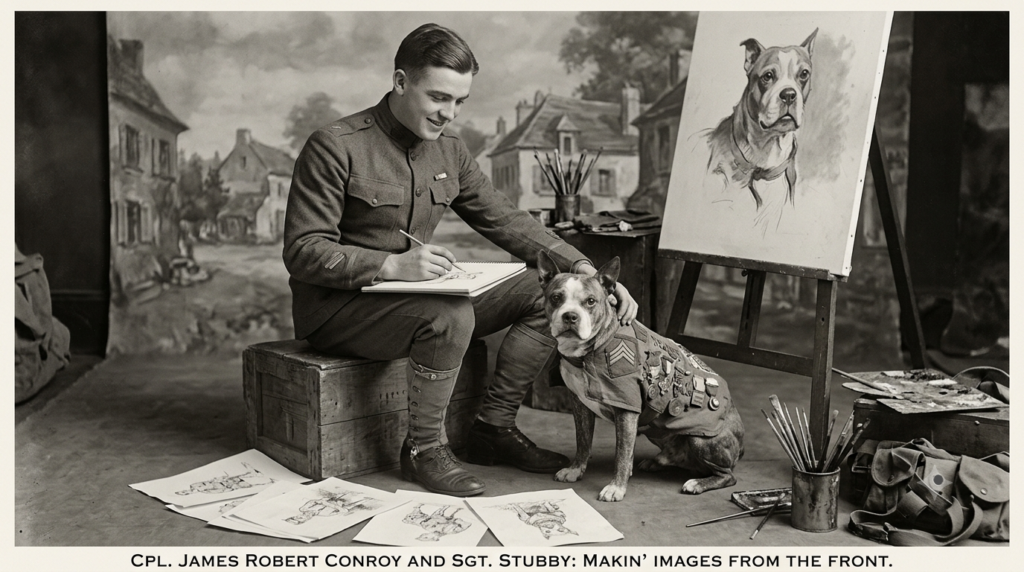
James Robert Conroy Never Forgot Stubby
The relationship between Conroy and Stubby lasted long after the war.
Conroy kept memorabilia connected to Stubby’s life and service. The Smithsonian collection includes Stubby’s harness and scrapbook, both connected to Conroy.
In 1956, decades after World War I, Conroy donated Stubby’s preserved body to the Smithsonian.
The donation ensured that the story of the little dog who followed American soldiers to France would not disappear.
The Smithsonian’s records identify the preserved Stubby as a taxidermic dog and credit the object to J. Robert Conroy.
Conroy himself died in 1987.
Stubby had died many decades earlier, on March 16, 1926, in Washington, D.C.
Why the Story of Conroy and Stubby Still Matters
The story of James Robert Conroy and Sergeant Stubby is not simply a story about a dog that went to war.
It is a story about companionship.
Conroy was a young American soldier entering one of the most dangerous conflicts in modern history. Stubby was a stray dog who happened to find his way into the life of a group of soldiers.
Neither could have known where their journey would lead.
Together, they crossed the Atlantic, lived through the trenches of France, experienced the dangers of combat, and returned home.
Stubby’s military service has become part of American World War I history, while Conroy’s role is equally important because he was the person who gave the stray dog a place among the soldiers and helped preserve his story for future generations.
Today, Stubby’s preserved remains are part of the collections of the Smithsonian’s National Museum of American History. The museum’s records, along with Conroy’s surviving scrapbook and Stubby’s military harness, provide tangible reminders of their unusual wartime partnership.
More than a century after Stubby first appeared at the Yale training grounds, his story continues to attract attention.
He began as a stray.
He became a soldier’s companion.
He survived the trenches.
And he eventually became one of the most recognizable animal figures of America’s World War I experience.
At the heart of that story was James Robert Conroy—a soldier who simply refused to leave his dog behind.
James Robert Conroy and Sergeant Stubby were, above all, two unlikely companions who went to war together and became part of American history.

Post Comment