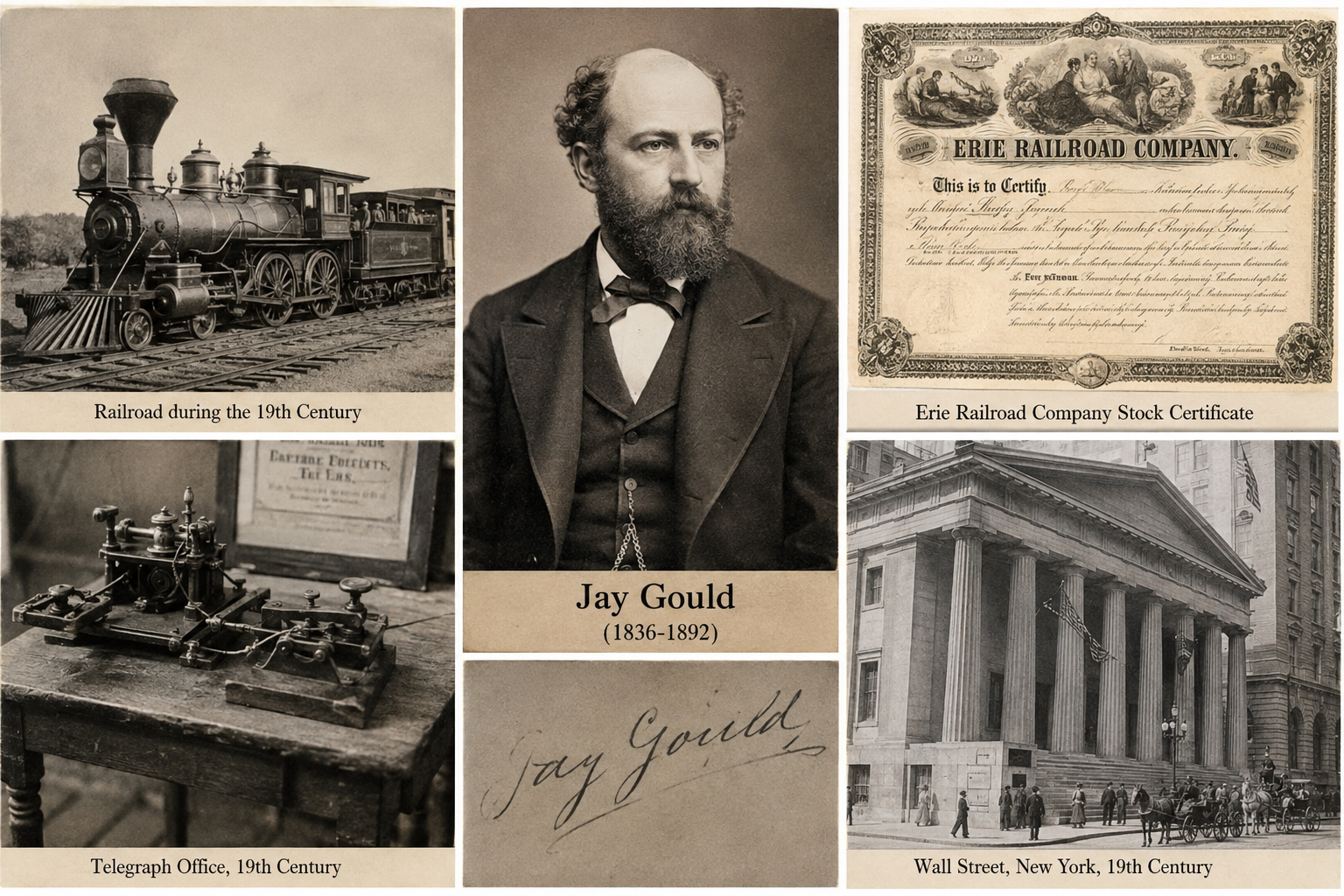
Jay Gould: The Controversial Railroad King Who Shaped America’s Financial History
Introduction
The history of American business is filled with extraordinary figures who transformed industries and accumulated immense fortunes. Among them, Jay Gould stands out as one of the most influential—and controversial—financiers of the 19th century. Admired by some for his financial brilliance and criticized by others for his aggressive business tactics, Gould played a significant role in shaping the American railroad and telegraph industries during the Gilded Age.
His remarkable journey from a poor farm boy in New York to one of the richest men in America is a story of intelligence, ambition, risk-taking, and controversy.
Early Life
Jay Gould was born on May 27, 1836, in Roxbury, New York. Raised in a modest farming family, he developed a strong work ethic at an early age. Unlike many wealthy businessmen of his era, Gould did not inherit a fortune. Instead, he relied on determination, self-education, and exceptional mathematical ability.
As a young man, he worked as a surveyor and mapmaker. His detailed maps earned him respect and provided the foundation for his future business ventures.
The Beginning of His Business Career
Gould first entered the lumber and tanning businesses, where he gained valuable experience in finance and management. His real passion, however, was investing.
He soon realized that railroads were becoming the backbone of America’s rapidly expanding economy. Seeing enormous opportunities, Gould began purchasing railroad stocks and acquiring interests in struggling railway companies.

Building a Railroad Empire
Throughout the 1860s and 1870s, Jay Gould became one of the most powerful railroad investors in the United States.
He gained influence over several major railroad companies, reorganized operations, reduced costs, and expanded railway networks. His ability to identify undervalued assets made him one of Wall Street’s most successful investors.
However, his methods often involved fierce competition, complex financial strategies, and corporate battles that earned him both admiration and criticism.
The Black Friday Gold Crisis of 1869
One of the most famous events associated with Jay Gould was the Black Friday Gold Panic of September 24, 1869.
Together with his business associate, James Fisk, Gould attempted to corner the U.S. gold market by buying large quantities of gold. Their strategy caused gold prices to soar dramatically.
When the U.S. government intervened by releasing gold into the market, prices collapsed within hours. Thousands of investors suffered devastating financial losses.
Although Gould managed to protect much of his fortune, the event permanently damaged his public reputation and made him one of the most controversial businessmen in American history.
Expansion into Telegraph Communications
Jay Gould understood that communication would become just as important as transportation.
He invested heavily in telegraph companies, eventually gaining significant control over the industry. His investments helped expand communication networks across the United States and strengthened his growing business empire.
Business Philosophy
Unlike many entrepreneurs who focused on manufacturing, Gould specialized in identifying opportunities in financial markets.
His strengths included:
– Long-term strategic thinking
– Exceptional financial analysis
– Calculated risk-taking
– Negotiation skills
– Rapid decision-making during market uncertainty
These qualities enabled him to build an enormous fortune despite frequent economic downturns.
Wealth and Influence
By the time of his death, Jay Gould was among the wealthiest individuals in America.
Adjusted for inflation, historians estimate that his fortune would be worth several billion dollars today. His investments influenced transportation, communications, and the broader development of the American economy during the late 19th century.
Criticism and Legacy
Jay Gould remains one of the most debated figures in American business history.
Supporters argue that he modernized railroads, expanded communication networks, and accelerated economic growth.
Critics accuse him of market manipulation, monopolistic practices, and placing personal profit above public interest. Because of these tactics, he is frequently associated with the term “Robber Baron,” a label applied to several powerful industrialists of the Gilded Age.
Regardless of opinion, his influence on American finance cannot be ignored.
Personal Life
Unlike many wealthy businessmen of his time, Gould maintained a relatively private lifestyle. He preferred working behind the scenes rather than seeking public attention.
He married Helen Day Miller, and together they had six children. Several of his descendants later became prominent figures in business, philanthropy, and public life.
Death
Jay Gould died on December 2, 1892, at the age of 56.
Although his life ended relatively early, his financial strategies, business decisions, and controversial legacy continue to be studied by economists, historians, and business leaders around the world.
Lessons from Jay Gould’s Life
Jay Gould’s story offers valuable lessons for entrepreneurs and investors:
– Knowledge is one of the greatest business advantages.
– Major opportunities often emerge during times of uncertainty.
– Long-term vision can create extraordinary wealth.
– Success should always be balanced with ethical responsibility.
– Reputation can be just as important as financial achievement.
Conclusion
Jay Gould was one of the most influential financiers of the Gilded Age. His remarkable rise from humble beginnings to extraordinary wealth demonstrates the power of intelligence, persistence, and strategic thinking. At the same time, his controversial methods remind us that business success is measured not only by profits but also by integrity and public trust.
More than a century after his death, Jay Gould remains a fascinating figure whose impact on American finance and industry continues to shape discussions about capitalism, investment, and corporate power.


Post Comment