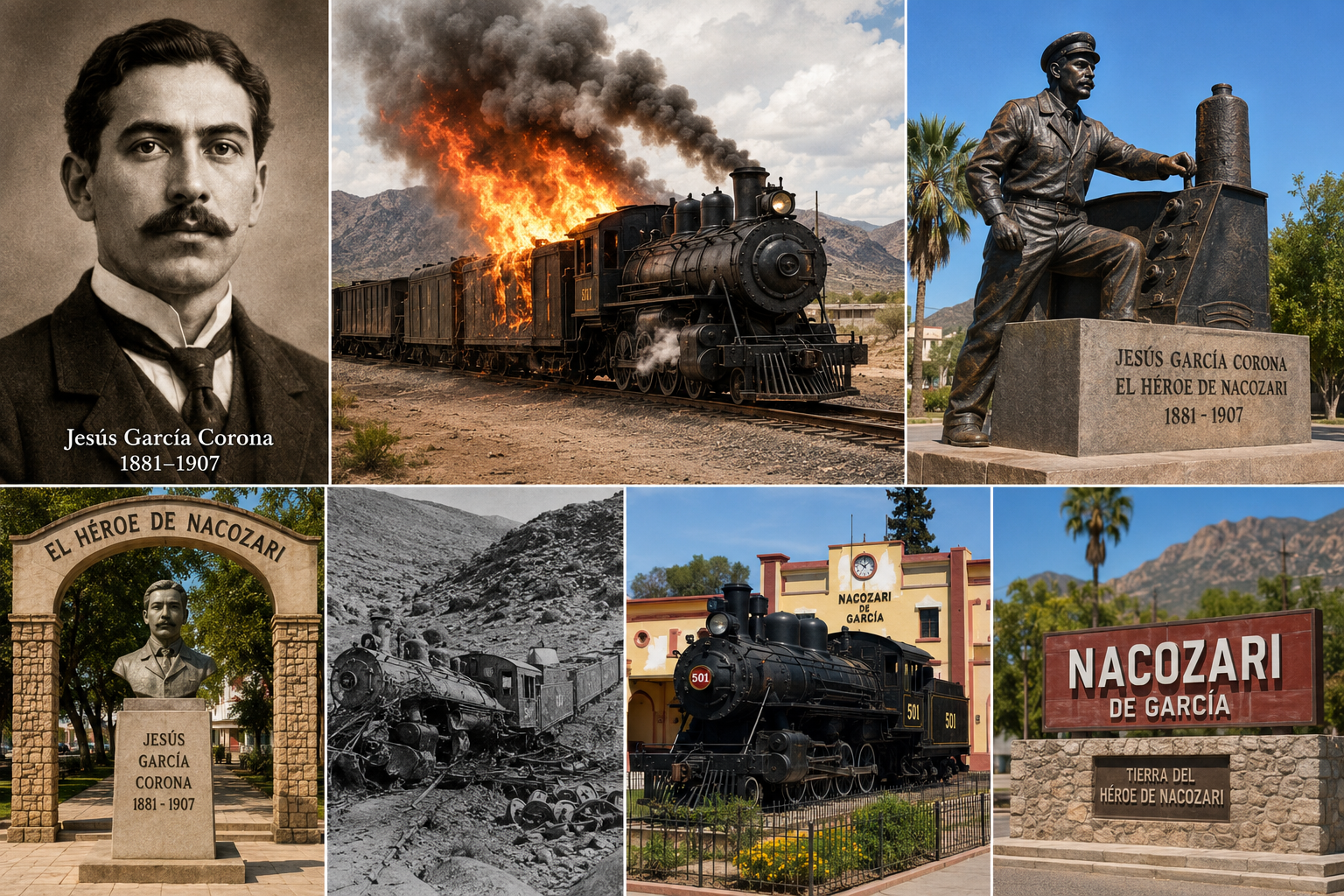
The Hero of Nacozari: How Jesús García Saved a Town with the Ultimate Sacrifice
Introduction
History is filled with extraordinary individuals who placed the lives of others above their own. Some became famous soldiers, explorers, or political leaders, while others were ordinary people who found themselves facing unimaginable circumstances. One such man was Jesús García Corona, forever remembered as “The Hero of Nacozari.” His remarkable act of courage on November 7, 1907, transformed him from a humble railroad engineer into one of Mexico’s greatest national heroes.
At only 26 years old, García made a split-second decision that saved an entire mining town from destruction. Driving a train loaded with dynamite, he realized that a fire had broken out among the explosive cargo. Instead of abandoning the train and saving himself, he chose to race the burning locomotive away from the town. Moments later, the explosives detonated, claiming his life but sparing hundreds—perhaps thousands—of innocent people.
More than a century later, his story continues to inspire generations. His name is honored in schools, monuments, museums, and annual commemorations throughout Mexico. His selfless sacrifice remains a timeless reminder that true heroism often comes from ordinary people making extraordinary choices.
—
Early Life
Jesús García Corona was born on September 13, 1881, in Hermosillo, Sonora, Mexico. Like many young men of his era, he grew up during a period of rapid industrial development. Railroads were transforming transportation, commerce, and mining throughout northern Mexico.
Seeking stable employment, García joined the railway industry as a young man. He began working in various positions before eventually becoming a locomotive engineer. His coworkers respected him for his dedication, discipline, and calm personality. Although he never imagined becoming famous, he took great pride in his work and understood the importance of safely transporting both passengers and freight.
Railroad workers in the early twentieth century faced dangerous conditions every day. Steam locomotives required constant attention, and accidents involving fire, mechanical failures, and hazardous cargo were always possible. Engineers needed courage, experience, and quick decision-making skills.
—
Nacozari: A Growing Mining Town
At the beginning of the twentieth century, Nacozari was one of northern Mexico’s most important mining communities. Copper mining attracted workers from across the region, while railroads connected the town with larger industrial centers.
The railway was the town’s lifeline. Trains transported miners, supplies, machinery, food, and valuable minerals. They also carried dangerous cargo, including large quantities of dynamite used for blasting rock inside the mines.
Because explosives regularly passed through populated areas, strict safety procedures were essential. Even a small accident could trigger a catastrophic explosion capable of destroying homes, businesses, and public buildings.
—
November 7, 1907: Disaster Begins
On the morning of November 7, 1907, Jesús García was assigned to operate a freight train carrying several cars loaded with dynamite.
As preparations continued, smoke suddenly appeared from one of the train cars. Witnesses quickly realized that the fire was spreading toward the explosives.
Panic swept through the station.
Railroad employees and townspeople understood the horrifying danger. If the dynamite exploded inside the station or near the center of Nacozari, the blast would devastate the entire community.
People began running for safety.
—
The Decision That Changed History
Jesús García had only seconds to decide.
He could jump from the locomotive and attempt to save himself.
Or he could remain aboard the burning train and try to move it away from the town.
Without hesitation, García chose the second option.
Opening the throttle, he accelerated the locomotive away from Nacozari as quickly as possible. Every additional meter increased the distance between the burning explosives and the people whose lives depended upon his actions.
He knew the risks.
He understood that the dynamite could explode at any moment.
Yet he continued driving forward.
—
The Final Moments
The train raced beyond the edge of town.
Only a short distance from the populated area, disaster finally struck.
The fire reached the dynamite.
A tremendous explosion ripped apart the locomotive and freight cars.
The blast instantly killed Jesús García and several others who had remained nearby.
Although he lost his life, the explosion occurred far enough from Nacozari to prevent the destruction of the town.
Hundreds of families survived because one railroad engineer refused to abandon his duty.
—
The Immediate Aftermath
The people of Nacozari quickly recognized the magnitude of García’s sacrifice.
Instead of mourning only a tragic accident, they honored an extraordinary act of courage.
His decision had prevented what could have become one of Mexico’s worst industrial disasters of the era.
Railroad workers across the country praised his bravery.
Newspapers reported the heroic story, and his reputation spread throughout Mexico.
—
Why His Actions Were Extraordinary
Heroism is often measured by the willingness to place others before oneself.
Jesús García demonstrated several remarkable qualities:
– Courage in the face of certain death.
– Calm thinking during a crisis.
– Professional responsibility.
– Selflessness.
– Dedication to protecting innocent lives.
Unlike fictional heroes, García possessed no special powers or military training. He was an ordinary working man who performed an extraordinary act during a single critical moment.
That is precisely why his story remains so inspiring.
—
National Recognition
Over time, Jesús García became one of Mexico’s most celebrated civilian heroes.
His achievements have been honored in many ways:
– The town officially became Nacozari de García.
– Monuments were erected in his honor.
– Streets and schools bear his name.
– Railway organizations continue to celebrate his courage.
– History books include his remarkable sacrifice.
Every year on November 7, ceremonies remember the engineer who gave everything to save his community.
—
Lessons for Modern Society
Although more than a century has passed, García’s story remains surprisingly relevant.
His sacrifice teaches valuable lessons:
Leadership
Real leaders accept responsibility even during dangerous situations.
Courage
Courage does not mean the absence of fear—it means acting despite fear.
Duty
Professional responsibility sometimes requires difficult decisions.
Community
Strong communities depend upon individuals willing to help others.
Integrity
Doing the right thing often requires personal sacrifice.
These values remain essential in modern workplaces, emergency services, transportation, healthcare, and everyday life.
—
Remembering the Hero
Visitors to Sonora can still discover memorials dedicated to Jesús García. Museums, statues, and historical markers preserve his memory for future generations.
His story is frequently taught in Mexican schools as an example of civic responsibility and patriotism.
Many railway workers proudly regard him as one of the greatest heroes in the history of rail transportation.
His legacy extends beyond Mexico because acts of self-sacrifice are universally admired across cultures and nations.
—
Historical Importance
The Hero of Nacozari represents more than a single event in railway history.
His story illustrates:
– The importance of industrial safety.
– The dangers faced by early railroad workers.
– The role of railways in national development.
– The power of individual courage.
– The lasting impact one person can have on an entire community.
Historians continue to reference the event as one of Mexico’s greatest examples of civilian heroism.
—
Conclusion
Jesús García Corona never sought fame or recognition. He was simply performing his daily responsibilities when disaster struck. Faced with an impossible choice, he chose to save others rather than himself.
His courageous decision transformed a potentially devastating tragedy into one of history’s greatest examples of selfless sacrifice.
More than one hundred years later, “The Hero of Nacozari” continues to symbolize bravery, duty, and compassion. His story reminds us that genuine heroes are not defined by wealth, power, or titles, but by the choices they make when others need them most.
As long as people remember acts of extraordinary courage, the legacy of Jesús García Corona will continue to inspire future generations. His sacrifice stands as a timeless testament to the incredible difference one individual can make in protecting the lives of many.



Post Comment