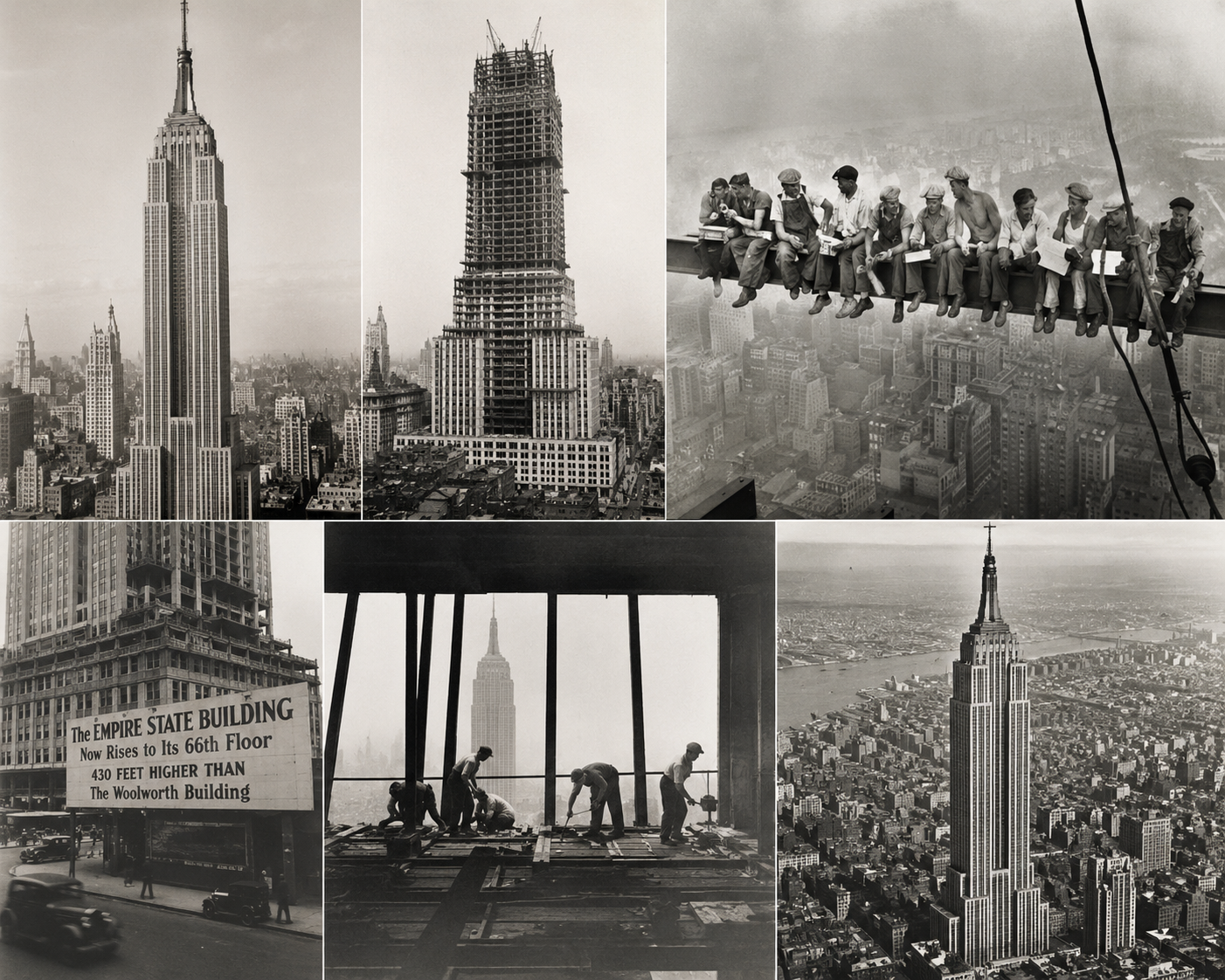
The Empire State Building: The dream was led by businessman John J. Raskob
Introduction
Few buildings in history have captured the world’s imagination like the Empire State Building. Rising high above the streets of Manhattan, New York City, it has become a universal symbol of ambition, engineering excellence, and the determination to achieve the impossible.
Today, millions of visitors travel from around the world to admire its breathtaking views and remarkable architecture. It has appeared in countless movies, documentaries, books, and photographs, making it one of the most recognizable landmarks on Earth.
Yet behind its elegant Art Deco design lies an extraordinary story of courage, innovation, and speed. The Empire State Building was not simply another skyscraper—it was a bold statement built during one of the darkest economic periods in American history.
Constructed during the Great Depression, when unemployment and financial hardship affected millions of Americans, the project offered hope and created thousands of jobs. Even more astonishing, the entire building was completed in just 410 days, an achievement that continues to amaze engineers nearly a century later.
This is the remarkable story of how the Empire State Building came to life.
New York’s Race to the Sky
The early twentieth century transformed New York City into the center of American business and finance. As companies expanded, competition extended beyond profits and markets—it reached the skyline.
Owning the tallest building in the world became a matter of prestige. Developers believed that a record-breaking skyscraper would symbolize economic strength, technological leadership, and national pride.
Several famous buildings competed for this title. The Singer Building and the Metropolitan Life Tower each briefly held the record before even taller structures appeared. Soon, the race intensified between the Bank of Manhattan Building at 40 Wall Street and the Chrysler Building.
When the Chrysler Building reached completion in 1930 with its striking stainless-steel spire, many believed the contest was over. However, another project was quietly preparing to surpass them all.
That project would become the Empire State Building.
The Vision Behind the Project
The dream was led by businessman John J. Raskob, a successful executive who believed New York deserved a skyscraper unlike anything the world had ever seen.
Working alongside former New York Governor Al Smith, Raskob imagined a building that would redefine modern architecture and stand as a lasting symbol of American ambition.
One famous story tells of Raskob placing a long pencil on a table and asking the architects, “How high can you make it so it won’t fall down?”
Whether the conversation happened exactly this way or not, it perfectly represents the spirit of the project. The goal was not simply to build another office tower—it was to build the tallest building on Earth.
Choosing the Perfect Location
The developers selected one of Manhattan’s most valuable properties—the site of the former Waldorf-Astoria Hotel on Fifth Avenue.
The famous luxury hotel relocated to a new address, making the land available for redevelopment.
The location offered several advantages:
– A prestigious Fifth Avenue address
– Excellent transportation connections
– Strong visibility from across New York City
– Enough space for an enormous skyscraper
Demolishing the old hotel was itself a major engineering project. Crews carefully dismantled the structure while preparing the foundations for what would soon become one of history’s greatest buildings.
Designing an Icon
The architectural firm Shreve, Lamb & Harmon received the responsibility of designing the skyscraper.
The architects embraced the fashionable Art Deco style, combining beauty with practicality. Their design featured clean vertical lines, elegant setbacks, and a graceful tower that emphasized height without sacrificing stability.
The building’s steel frame would support massive loads while allowing large office floors filled with natural light.
Modern elevators, advanced electrical systems, central heating, and improved ventilation would make the building one of the most technologically advanced office towers of its time.
The final design called for 102 stories—an extraordinary height in 1930.
Breaking Ground
Construction officially began on March 17, 1930.
The timing could hardly have been more challenging.
Only a few months earlier, the stock market crash of 1929 had triggered the Great Depression. Businesses failed, banks collapsed, and unemployment rose rapidly across the United States.
Despite the difficult economy, work on the Empire State Building continued at full speed.
Thousands of workers were hired, giving families a vital source of income during a period of widespread hardship.
The construction site quickly became one of the busiest places in New York City.
Every day, trucks delivered enormous quantities of steel, limestone, granite, cement, and construction equipment. Careful planning ensured that materials arrived exactly when needed, reducing delays and keeping the project moving at an extraordinary pace.
A Construction Site Like No Other
More than 3,400 workers eventually joined the project.
The workforce represented many different backgrounds and nationalities. Skilled ironworkers, stonemasons, electricians, carpenters, engineers, crane operators, and laborers worked side by side.
Among the most famous were Mohawk ironworkers from Canada, who earned a reputation for confidently walking across narrow steel beams hundreds of feet above the streets.
Photographs of these workers balancing high above Manhattan remain some of the most iconic images in construction history.
Although safety standards were far different from those of today, the workers demonstrated remarkable skill, courage, and teamwork every single day.
Engineering at Record Speed
One of the greatest achievements of the Empire State Building was not only its height but also the incredible speed of construction.
Instead of waiting for one stage to finish before beginning the next, different teams worked simultaneously.
While steel workers assembled the structural frame on the upper floors, crews below installed plumbing, electrical wiring, elevators, windows, and interior walls.
This carefully coordinated system allowed progress to continue almost nonstop.
At times, builders completed more than four floors in a single week—an astonishing pace that amazed the engineering world.
As the steel skeleton climbed higher into the Manhattan skyline, New Yorkers watched history being made.In the next part, I’ll cover the record-breaking construction process, engineering innovations, workers’ lives, safety challenges, and how the skyscraper became the tallest building in the world.
Building the Steel Giant
By the spring of 1930, the Empire State Building had become the busiest construction site in New York City. Every day, hundreds of trucks arrived carrying steel beams, limestone, granite, bricks, cement, and other building materials. Careful planning ensured that supplies reached the site exactly when needed, minimizing delays and keeping construction moving at an extraordinary pace.
The building’s structural steel frame formed its backbone. More than 57,000 tons of steel were used to create a strong yet flexible skeleton capable of supporting the enormous weight of the skyscraper while resisting powerful winds.
Massive cranes lifted steel beams high into the air, where teams of ironworkers guided them into place with remarkable precision. Riveters followed close behind, heating steel rivets until they glowed red before fastening the beams together with pneumatic hammers. The sound of hammering echoed throughout Manhattan from sunrise until sunset.
Life Hundreds of Feet Above the Streets
The men who worked on the upper floors faced some of the most dangerous conditions in the construction industry. Narrow steel beams, strong winds, changing weather, and tremendous heights made every working day a challenge.
Among the most respected workers were the Mohawk ironworkers, many of whom had gained a reputation for working comfortably at great heights. Their confidence, balance, and experience made them valuable members of the construction crews.
Historic photographs often show workers sitting on steel beams, eating lunch with the New York skyline below them. Although these images have become symbols of American courage, they also remind us of the risks faced by thousands of construction workers during that era.
Engineering Innovations
The Empire State Building represented one of the most advanced engineering projects of its time.
The architects and engineers designed the building to withstand heavy winds while providing millions of square feet of office space. Modern elevators allowed people to travel quickly between floors, making such a tall building practical for everyday business.
Special electrical systems powered thousands of lights, while advanced plumbing and heating systems ensured comfort throughout the building. Fireproof materials and improved structural engineering added extra safety compared with many earlier skyscrapers.
These innovations helped establish new standards for high-rise construction around the world.
Organizing One of History’s Fastest Construction Projects
One reason for the building’s incredible speed was exceptional organization.
Construction followed a carefully coordinated schedule. Every trade worked according to a precise timetable:
– Steel workers assembled the structural frame.
– Concrete crews poured floors.
– Bricklayers and stone masons completed the exterior walls.
– Electricians installed wiring.
– Plumbers installed water and drainage systems.
– Elevator specialists fitted elevator shafts and machinery.
– Interior workers completed offices almost immediately after each floor was enclosed.
Instead of waiting for one phase to finish before beginning another, many activities took place simultaneously. This approach saved months of construction time.
The project became an early example of modern large-scale project management.
Reaching New Heights
Week after week, the skyscraper climbed higher into the Manhattan skyline.
New Yorkers watched with amazement as another floor seemed to appear almost every day. Newspapers regularly reported on the building’s progress, and many people visited the site simply to witness history in the making.
When the steel framework finally reached its full height, the Empire State Building officially surpassed the Chrysler Building to become the tallest building in the world.
The victory marked the end of one of history’s greatest architectural competitions.
Completing the Exterior
After the steel frame was finished, workers installed thousands of limestone panels, granite blocks, aluminum details, and more than 6,500 windows.
The elegant Art Deco design emphasized strong vertical lines that made the building appear even taller than its already impressive height.
As sunlight reflected from its stone exterior, the Empire State Building quickly became one of New York City’s most beautiful landmarks.
The Human Side of the Project
Although the skyscraper is remembered for its engineering achievements, it also represents the dedication of thousands of ordinary workers.
Many laborers were supporting families during the Great Depression. For them, the project provided more than employment—it offered hope during one of America’s most difficult economic periods.
Construction demanded long hours, physical strength, teamwork, and unwavering concentration. Engineers, architects, supervisors, and laborers all contributed to the project’s success.
Their combined efforts transformed an empty construction site into the tallest building on Earth in just over a year.
A World Record
Perhaps the most astonishing achievement was the construction schedule itself.
Work began on March 17, 1930, and the building was substantially completed by April 11, 1931—only 410 days later.
Even with today’s advanced technology, constructing a skyscraper of similar size in such a short time would be considered an extraordinary accomplishment.
The Empire State Building demonstrated what careful planning, skilled labor, and determined leadership could achieve.
Preparing for Opening Day
As construction entered its final weeks, workers completed the interior offices, polished marble walls, tested elevators, installed lighting systems, and inspected every part of the building.
The observation decks were prepared to welcome visitors eager to experience breathtaking views of New York City from heights never before available to the public.
The world’s tallest skyscraper was finally ready.
Its official opening would become one of the most celebrated events in American architectural history, marking the completion of a project that inspired generations of engineers, architects, and dreamers.
The Grand Opening
On May 1, 1931, the Empire State Building officially opened its doors to the public. The ceremony attracted national attention because the skyscraper represented far more than a new office building—it symbolized American confidence and resilience during the Great Depression.
In a memorable moment, U.S. President Herbert Hoover used a telegraph signal from the White House in Washington, D.C., to switch on the building’s lights in New York City. Newspapers across the country celebrated the achievement, praising the architects, engineers, and thousands of workers who had completed the world’s tallest building in just 410 days.
For many Americans facing economic hardship, the Empire State Building became a powerful reminder that determination and innovation could overcome even the most difficult challenges.
The “Empty State Building”
Despite its spectacular opening, the building faced an unexpected problem. Because the Great Depression had severely affected businesses, many companies could not afford to rent office space.
As a result, large sections of the building remained vacant during its early years. Some New Yorkers jokingly called it the “Empty State Building.”
Although this nickname reflected the difficult economic conditions of the time, it did not last forever. As the U.S. economy recovered during the 1930s and 1940s, more businesses moved into the building. Gradually, it became one of the most desirable office addresses in New York City.
A Global Cultural Icon
The Empire State Building soon became much more than a business center. It evolved into one of the world’s most recognized landmarks.
Its appearance in the 1933 film King Kong, where the giant ape climbs the skyscraper before his dramatic final battle, introduced the building to audiences around the globe. The unforgettable scene helped cement the Empire State Building’s place in popular culture.
Since then, it has appeared in hundreds of movies, television shows, books, advertisements, and documentaries. Whether viewed in daylight or illuminated at night, the skyscraper instantly represents New York City.
Surviving History
Over the decades, the Empire State Building has witnessed many important events in American history.
It remained standing through World War II, economic recessions, technological revolutions, and dramatic changes in New York City’s skyline. One of the most remarkable incidents occurred on July 28, 1945, when a U.S. Army B-25 bomber accidentally crashed into the building during heavy fog. Despite the damage and tragic loss of life, the building’s strong steel structure remained intact, demonstrating the remarkable quality of its engineering.
The skyscraper continued operating only a short time after repairs, further proving its strength and durability.
Modern Renovations
Although the building is nearly a century old, it continues to evolve.
Major renovation projects have modernized elevators, improved energy efficiency, upgraded lighting systems, restored historic Art Deco features, and enhanced the visitor experience. Today, the Empire State Building is considered one of the world’s leading examples of sustainable skyscraper modernization.
Its observation decks on the 86th and 102nd floors attract millions of visitors every year, offering breathtaking panoramic views of New York City.
Interesting Facts
– Construction officially began on March 17, 1930.
– The building opened on May 1, 1931.
– It was completed in only 410 days, an extraordinary achievement.
– More than 3,400 workers participated in construction.
– Approximately 57,000 tons of structural steel were used.
– The building has 102 floors.
– Its total height, including the antenna, is 1,454 feet (443.2 meters).
– It contains 73 elevators serving offices and observation decks.
– For nearly 40 years, it was the tallest building in the world.
– Millions of tourists visit the Empire State Building every year.
Why the Empire State Building Still Inspires the World
Nearly one hundred years after its completion, the Empire State Building remains a masterpiece of architecture and engineering.
Modern skyscrapers may be taller, but very few have matched its influence on history and culture. Its construction demonstrated that extraordinary achievements are possible through careful planning, teamwork, skilled craftsmanship, and determination.
Students study its engineering. Architects admire its timeless design. Tourists dream of visiting its observation decks. Filmmakers continue to feature it as one of New York’s defining landmarks.
The Empire State Building is not simply a skyscraper—it is a symbol of ambition made real.
Conclusion
The story of the Empire State Building is ultimately a story of vision, courage, and perseverance. Built during one of America’s most difficult economic periods, it provided jobs, inspired hope, and transformed the skyline of New York City forever.
From the first excavation of the former Waldorf-Astoria Hotel site to the final steel beam placed hundreds of feet above Manhattan, every stage of construction reflected remarkable organization and engineering excellence.
Today, the Empire State Building continues to welcome visitors from every corner of the world. Its glowing lights, elegant Art Deco architecture, and unforgettable silhouette remind us that human imagination can create structures that endure for generations.
Nearly a century after its completion, the Empire State Building remains one of humanity’s greatest architectural achievements—a monument not only of steel and stone but also of determination, innovation, and the enduring spirit of those who dared to build higher than anyone had ever built before.

Post Comment