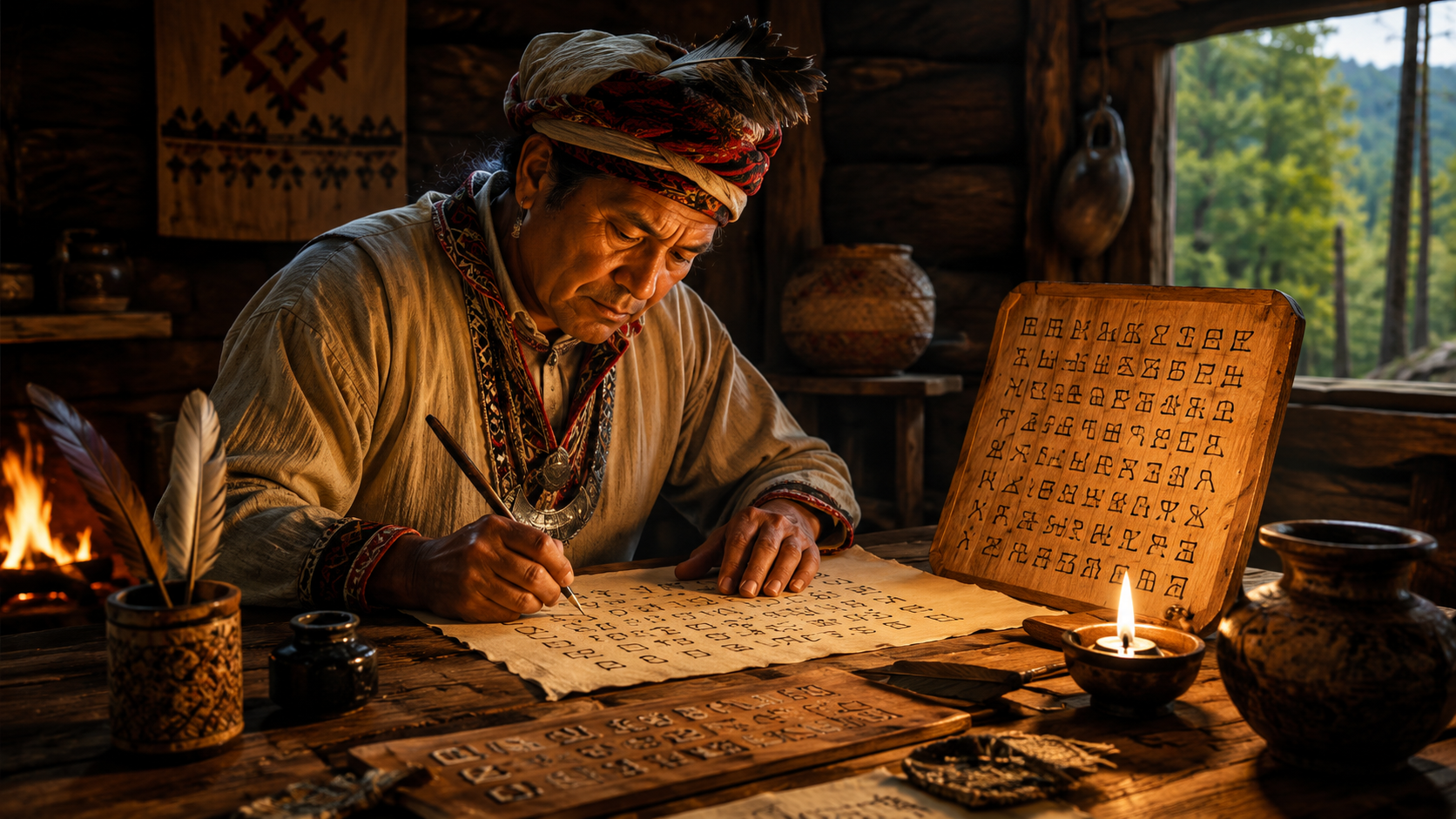
Sequoyah: The Cherokee Genius Who Gave His People the Gift of Writing
Introduction
Throughout history, a handful of individuals have transformed the future of their people through extraordinary innovation. Among them stands Sequoyah, the remarkable Cherokee scholar, inventor, and visionary who created the Cherokee syllabary—one of the few writing systems in history developed by a single person.
Unlike many famous inventors, Sequoyah never attended a formal school and could not read or write English. Yet his determination and brilliance enabled him to accomplish what many believed impossible: he gave the Cherokee Nation a practical writing system that dramatically increased literacy, preserved their language, strengthened their culture, and left a lasting legacy that continues to inspire the world today.
This is the incredible story of a man whose invention proved that knowledge, perseverance, and love for one’s culture can change history forever.
Early Life
Sequoyah was born around 1770 in the Cherokee town of Tuskegee, in present-day Tennessee. His Cherokee name is often recorded as Ssiquoya or Sikwayi. His mother, Wut-teh, was Cherokee, while historians continue to debate the identity of his father, who may have been of European ancestry.
Growing up in Cherokee society, Sequoyah learned traditional skills such as hunting, farming, blacksmithing, and craftsmanship. He became especially skilled in metalworking and silver jewelry, earning respect as a talented artisan.
At some point during his life, an injury left him with a permanent disability that limited his ability to hunt. Instead of allowing this setback to define him, Sequoyah devoted more time to observation, experimentation, and creative thinking.
The Mystery of “Talking Leaves”
During the late eighteenth century, European settlers used written documents to communicate across long distances. Cherokee people referred to these documents as “talking leaves,” because they seemed to allow paper to “speak.”
Sequoyah became fascinated by the power of writing. He noticed that government officials, traders, and military leaders relied on written language to preserve information, negotiate agreements, and share knowledge.
Many Cherokee leaders believed writing was far too difficult to create or that it belonged only to Europeans. Sequoyah disagreed. He believed the Cherokee language deserved its own writing system.
This belief became his life’s mission.
Years of Determination
Creating an entirely new writing system was an enormous challenge. For nearly twelve years, Sequoyah worked almost entirely alone.
Friends and neighbors often laughed at his strange experiments. Some believed he had become obsessed. Others feared his work involved magic.
Despite ridicule, Sequoyah continued refining his ideas.
Initially, he attempted to create a unique symbol for every word in the Cherokee language. He quickly realized that such a system would require thousands of symbols and would be impossible to learn.
He then discovered a much simpler solution.
Creating the Cherokee Syllabary
Instead of representing individual words or letters, Sequoyah designed symbols for syllables—the spoken units that make up words.
After years of testing and revision, he completed a system containing 85 symbols (later standardized to 86).
Each symbol represented one Cherokee syllable.
Because Cherokee words are naturally built from syllables, the system was remarkably efficient.
Although some characters resembled Roman, Greek, or Cyrillic letters, they represented completely different sounds.
The symbols were not copied from English; they formed an original writing system specifically designed for the Cherokee language.
Convincing the Cherokee Nation
Many Cherokee leaders remained skeptical.
To prove his invention worked, Sequoyah conducted a public demonstration.
He asked his young daughter, Ayokeh, to leave the room while he dictated words to observers.
After writing them down, he invited his daughter back and asked her to read the symbols aloud.
She repeated every word perfectly.
The demonstration amazed the audience.
Soon afterward, Cherokee leaders officially accepted the syllabary.
A Literacy Revolution
The impact was extraordinary.
Within only a few years, thousands of Cherokee people learned to read and write their language.
Missionaries, government officials, and visitors were astonished by how rapidly literacy spread.
Many historians consider it one of the fastest literacy movements ever recorded.
Children learned the syllabary quickly.
Adults embraced it eagerly.
Families exchanged written messages.
Community leaders kept records.
Knowledge could finally be preserved accurately in the Cherokee language.
The Cherokee Phoenix
One of the greatest achievements made possible by Sequoyah’s invention was the publication of the Cherokee Phoenix in 1828.
It became the first Native American newspaper printed in both Cherokee and English.
The newspaper shared government announcements, community news, educational materials, and cultural information.
It also strengthened Cherokee identity during a period of increasing pressure from the United States government.
The Cherokee Phoenix remains a milestone in American journalism and Indigenous history.
Preserving Culture
Language carries stories, traditions, ceremonies, songs, and history.
Without writing, much knowledge depends on oral tradition.
Sequoyah’s syllabary helped preserve countless aspects of Cherokee culture for future generations.
Folktales, historical accounts, legal documents, and religious writings could now be recorded in the Cherokee language.
His invention became one of the greatest achievements in Indigenous cultural preservation.
The Trail of Tears
Despite remarkable educational progress, tragedy struck the Cherokee Nation.
In the 1830s, the United States government forced thousands of Cherokee people from their ancestral homeland during the forced removal known as the Trail of Tears.
Thousands died from disease, starvation, exposure, and exhaustion.
Even during this heartbreaking period, Sequoyah’s writing system remained an important source of unity.
The syllabary helped preserve communication and cultural identity despite immense hardship.
Later Years
Sequoyah spent much of his later life traveling among Cherokee communities.
He hoped to unite different Cherokee groups through literacy and education.
He also searched for other Cherokee communities believed to live farther west.
Historical records suggest he died around 1843, possibly in what is now northern Mexico, although the exact location of his burial remains unknown.
Worldwide Recognition
Today, Sequoyah is recognized as one of history’s greatest language innovators.
His achievements have been honored in numerous ways.
The giant Sequoia tree is widely believed to have been named in his honor.
Schools, counties, roads, museums, and monuments across the United States bear his name.
Statues celebrate his contribution to Indigenous education.
The Cherokee syllabary is now part of the Unicode computer standard, allowing it to be used on modern computers, smartphones, and digital platforms around the world.
Why Sequoyah Matters Today
Sequoyah’s story carries lessons that remain deeply relevant.
He proved that education does not depend solely on formal schooling.
Innovation often begins with curiosity.
Cultural identity becomes stronger when language is preserved.
One determined individual can transform an entire society.
In an age when thousands of languages face extinction, Sequoyah reminds us that preserving language also preserves history, identity, and human diversity.
Interesting Facts
– Sequoyah created one of the few writing systems known to have been invented by a single individual.
– He spent approximately twelve years developing the Cherokee syllabary.
– The original syllabary contained 85 symbols, later standardized to 86.
– Cherokee literacy spread at an astonishing speed after its introduction.
– The Cherokee Phoenix became the first Native American bilingual newspaper.
– His writing system is still taught and used today.
– Unicode supports Cherokee characters for computers and smartphones.
– The giant Sequoia tree is commonly believed to honor his legacy.
Legacy
Few inventors have influenced the future of their people as profoundly as Sequoyah.
His work empowered an entire nation to read, write, preserve its traditions, educate future generations, and strengthen its cultural identity.
Although nearly two centuries have passed since his death, his invention continues to serve the Cherokee people and inspire linguists, historians, educators, and Indigenous communities worldwide.
Sequoyah’s greatest achievement was not simply creating symbols on paper—it was giving a nation a permanent written voice.
Conclusion
Sequoyah transformed history through patience, creativity, and unwavering belief in the value of his people’s language. Against overwhelming odds, he invented a writing system that sparked one of the fastest literacy movements ever recorded and helped preserve Cherokee culture for generations.
His legacy reminds us that true innovation is measured not by fame or wealth, but by the lasting positive impact it has on humanity. Today, every Cherokee word written in the syllabary stands as a tribute to the vision of one extraordinary man whose gift continues to echo through history.
Post Comment