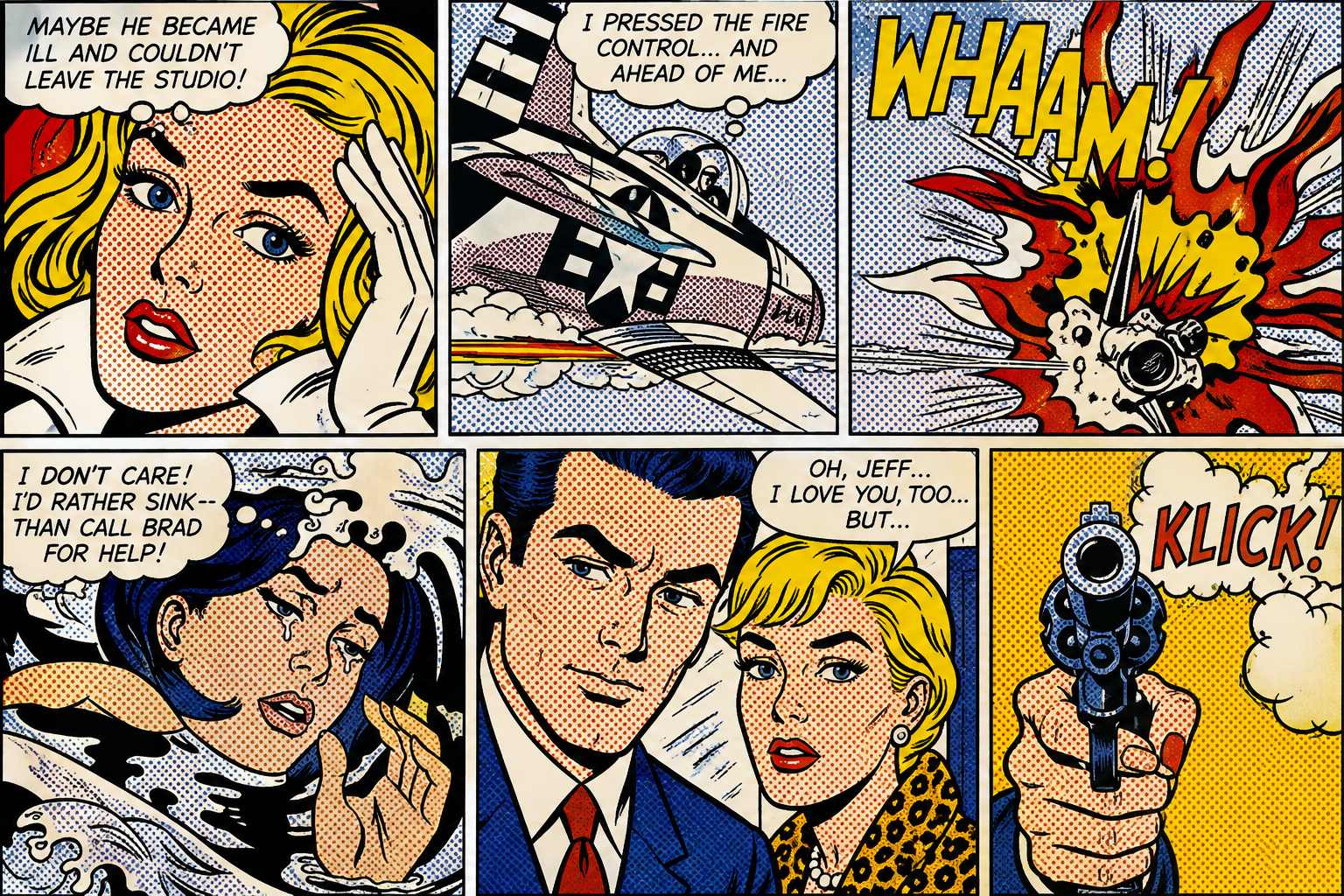
Roy Lichtenstein: The Pop Art Pioneer Who Turned Comic Books into Fine Art
Introduction
When people think of Pop Art, a few legendary names immediately come to mind. Among them, Roy Lichtenstein stands as one of the most influential artists of the 20th century. With bold colors, thick black outlines, dramatic comic-book scenes, and his signature Ben-Day dots, Lichtenstein transformed everyday commercial imagery into museum-worthy masterpieces.
His paintings challenged the traditional definition of art and forced critics and audiences alike to rethink the relationship between popular culture and fine art. At a time when abstract expressionism dominated the art world, Lichtenstein looked to comic books, advertisements, and mass-produced images for inspiration.
Today, his works hang in the world’s greatest museums, and his artistic style continues to influence painters, graphic designers, illustrators, advertisers, and digital artists across the globe.
This is the remarkable story of Roy Lichtenstein—an artist who forever changed modern art.
—
Early Life
Roy Fox Lichtenstein was born on October 27, 1923, in New York City. He grew up in an upper-middle-class family during a period when America was experiencing rapid cultural and economic change.
From an early age, Roy showed an interest in drawing and painting. Unlike many children, he was fascinated not only by fine art but also by cartoons, comic strips, magazines, and popular culture. These interests would later become the foundation of his revolutionary artistic career.
As a teenager, he attended art classes at the Art Students League of New York, where he developed his technical skills while learning traditional artistic techniques.
—
Education and World War II
Lichtenstein enrolled at Ohio State University, where he studied fine arts.
However, his education was interrupted by World War II.
In 1943, he joined the United States Army and served in Europe. During the war, he worked in various roles and witnessed the realities of military life.
After returning home, he resumed his studies and completed his degree. He later became an instructor at Ohio State University.
Teaching art helped him experiment with different artistic approaches while refining his own style.
—
Searching for His Artistic Voice
Throughout the 1950s, Lichtenstein explored many different styles.
His early paintings included:
Abstract art
Cubism
Expressionism
Historical themes
American folk imagery
Although these works demonstrated his technical talent, they failed to establish a unique identity.
Like many artists, he struggled to find a style that truly represented his creative vision.
Everything changed in the early 1960s.
—
The Birth of Pop Art
One day, according to popular accounts, Lichtenstein’s son challenged him to paint Mickey Mouse better than the comic books.
Inspired by this playful challenge, Roy created “Look Mickey” (1961).
The painting borrowed imagery from a children’s comic but enlarged it dramatically.
Instead of hiding the printed appearance of comics, Lichtenstein exaggerated it.
This painting marked the beginning of his signature style.
Soon, he became one of the leading artists in the newly emerging Pop Art movement.
—
What Is Pop Art?
Pop Art celebrated everyday consumer culture.
Instead of painting kings, landscapes, or religious scenes, Pop artists focused on:
Comic books
Advertisements
Product packaging
Newspapers
Hollywood celebrities
Consumer goods
The movement questioned the distinction between “high art” and “popular culture.”
Roy Lichtenstein became one of its greatest innovators.
—
The Famous Ben-Day Dots
One of Roy Lichtenstein’s most recognizable techniques was the use of Ben-Day dots.
Originally, Ben-Day dots were a commercial printing method used to create shading and color in newspapers and comic books.
Lichtenstein carefully hand-painted these dots on enormous canvases.
Although they looked machine-made, they required incredible patience and precision.
This illusion fascinated viewers.
His paintings appeared to be giant printed comic pages while actually being handmade works of art.
—
Comic Books Become Fine Art
Perhaps Lichtenstein’s greatest achievement was elevating comic-book imagery into fine art.
He borrowed dramatic scenes featuring:
Romance
War
Action
Emotional dialogue
Speech bubbles became an important visual element.
Instead of long stories, each painting captured one dramatic moment, allowing viewers to imagine the rest of the narrative.
This storytelling approach made his work immediately accessible to audiences.
—
Famous Masterpieces
Look Mickey (1961)
This painting is considered the beginning of Lichtenstein’s mature Pop Art style.
It introduced many features that would define his future work:
Thick outlines
Primary colors
Ben-Day dots
Comic-inspired composition
—
Whaam! (1963)
Inspired by a war comic, Whaam! depicts a fighter jet firing a missile that explodes dramatically.
The painting became one of the defining images of Pop Art and remains one of Lichtenstein’s most famous works.
—
Drowning Girl (1963)
Perhaps his most iconic painting, Drowning Girl shows a woman surrounded by waves, declaring:
> “I don’t care! I’d rather sink than call Brad for help!”
The exaggerated emotion reflects the melodramatic style of romance comics while inviting viewers to question how emotions are portrayed in popular media.
—
Oh, Jeff… I Love You, Too… But…
This romantic comic-inspired painting became another symbol of Pop Art.
Its expressive speech bubble and emotional tension perfectly demonstrate Lichtenstein’s fascination with comic storytelling.
—
Critics and Controversy
Not everyone admired Lichtenstein’s work.
Some critics argued that he merely copied comic-book artists without giving them enough recognition.
Others questioned whether comic-book images deserved to be displayed in prestigious museums.
However, supporters argued that Lichtenstein transformed ordinary images into something entirely new through:
Scale
Composition
Color
Context
Artistic interpretation
Today, his paintings are widely recognized as original works that changed the history of modern art.
—
Influence on Graphic Design
Lichtenstein’s visual language has influenced:
Graphic designers
Advertising agencies
Fashion designers
Digital illustrators
Comic artists
Video game designers
Even today, bold outlines, comic dots, and speech bubbles remain popular design elements inspired by his work.
—
Beyond Comic Books
Although famous for comic imagery, Lichtenstein explored many other subjects.
These included:
Landscapes
Mirrors
Interiors
Sculptures
Still-life paintings
Modern architecture
Throughout his career, he continually experimented while maintaining his instantly recognizable style.
—
International Recognition
As his reputation grew, museums around the world began exhibiting his work.
Major institutions including the Museum of Modern Art (MoMA), the Whitney Museum of American Art, and the Tate Modern have displayed his paintings.
Collectors also competed for his works.
Several of his paintings have sold for tens of millions of dollars at auction, making him one of the most valuable modern artists in history.
—
Personal Life
Despite his worldwide fame, Lichtenstein remained dedicated to his work.
He continued creating paintings, sculptures, and prints throughout his life.
Friends described him as thoughtful, disciplined, and intellectually curious.
Rather than chasing trends, he consistently explored new artistic ideas.
—
Death and Legacy
Roy Lichtenstein passed away on September 29, 1997, at the age of 73.
Although his life ended, his artistic influence continues to grow.
Today, art students study his techniques, museums celebrate his masterpieces, and designers continue to borrow elements of his visual style.
Few artists have had such a lasting impact on both fine art and popular culture.
—
Why Roy Lichtenstein Still Matters
In today’s digital age, images spread instantly through social media, advertising, and entertainment.
Lichtenstein recognized decades earlier that mass-produced images shape how people think and feel.
His paintings encourage viewers to ask important questions:
What makes something “art”?
Can commercial images become masterpieces?
How does popular media influence our emotions?
Where is the line between originality and inspiration?
These questions remain relevant today.
—
Lessons from Roy Lichtenstein’s Life
His journey teaches several valuable lessons:
Inspiration can come from everyday life.
Great artists often challenge established traditions.
Success requires persistence and experimentation.
Creativity sometimes means looking where others refuse to look.
Popular culture can have artistic value.
—
Conclusion
Roy Lichtenstein transformed ordinary comic-book illustrations into extraordinary works of art. By embracing popular culture rather than rejecting it, he helped redefine modern art and became one of the leading figures of the Pop Art movement.
His bold colors, Ben-Day dots, and dramatic storytelling continue to inspire artists across the world. More than simply copying comics, Lichtenstein changed how people viewed the relationship between art and everyday life.
Nearly three decades after his death, his paintings remain among the most recognizable images in modern art. His legacy reminds us that creativity often begins by seeing familiar things from a completely new perspective.
Whether admired for their humor, criticized for their appropriation, or celebrated for their innovation, Roy Lichtenstein’s works continue to spark conversation—proving that true art has the power to challenge, inspire, and endure.
Post Comment