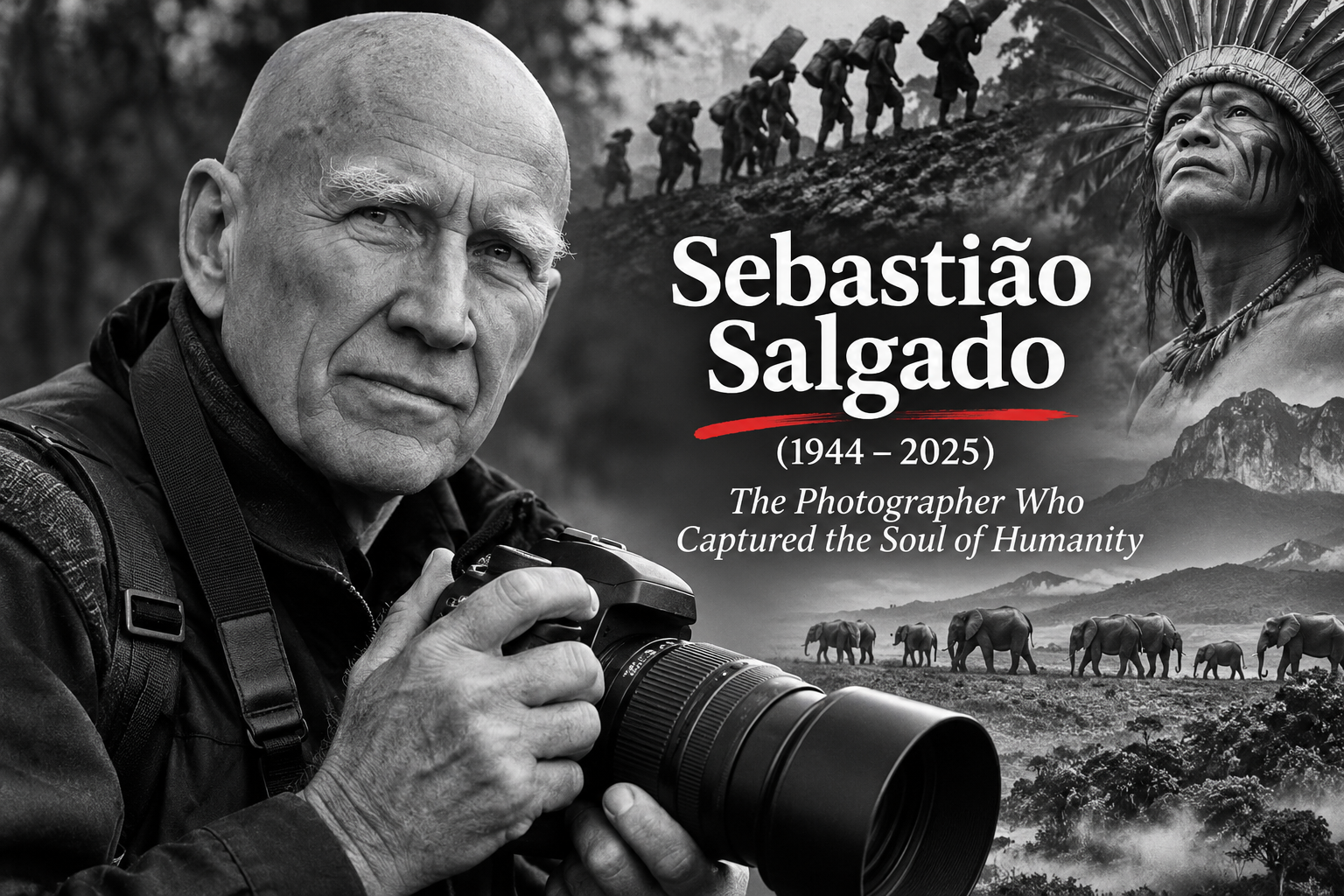
How Sebastiao Salgado Changed Photography Through Humanity and Nature
Introduction
A photograph can capture a moment, but a powerful photograph can tell the story of an entire life. Brazilian photographer Sebastião Salgado understood this better than most people. Through his extraordinary black-and-white photographs, he documented workers, refugees, Indigenous communities, wildlife, and some of the world’s most beautiful natural landscapes.
Salgado was not simply interested in taking beautiful pictures. He wanted people to understand the realities of life, including poverty, environmental destruction, human suffering, and the importance of protecting nature.
His photographs took viewers to places they might never visit and introduced them to people whose stories might otherwise remain unknown.
From the gold mines of Brazil to the remote regions of the Amazon rainforest, Salgado spent decades documenting the relationship between humanity and the natural world.
His journey from an economics student to one of the most respected documentary photographers in history is an inspiring story of creativity, courage, and purpose.
Early Life and Education
Sebastião Ribeiro Salgado Júnior was born on February 8, 1944, in Aimorés, a municipality in the Brazilian state of Minas Gerais.
He grew up in a rural environment surrounded by natural landscapes. His early experiences helped develop his appreciation for the countryside and the people who lived and worked there.
Unlike many photographers, Salgado did not initially plan to pursue photography as a career.
He studied economics at university and later continued his education in the field. His professional career initially took him away from photography.
However, his interest in the world around him gradually developed into something much bigger.
During the early 1970s, while travelling with his wife, Lélia Wanick Salgado, he began taking photographs. He discovered that photography offered a powerful way to communicate human experiences.
This discovery changed the direction of his life.
From Economist to Professional Photographer
In 1973, Salgado decided to leave his career in economics and become a professional photographer.
He moved into the world of photojournalism and began working with international photography agencies.
His early assignments introduced him to different countries, cultures, and communities.
He photographed people working in difficult conditions, families experiencing poverty, and communities facing political and economic challenges.
Instead of treating photography as entertainment, Salgado approached it as a way of documenting important human stories.
His photographs were often captured in black and white. This style gave his images a dramatic appearance and directed attention towards people’s faces, expressions, surroundings, and emotions.
Over time, his work became internationally recognised.
The Gold Mine Photographs That Made History
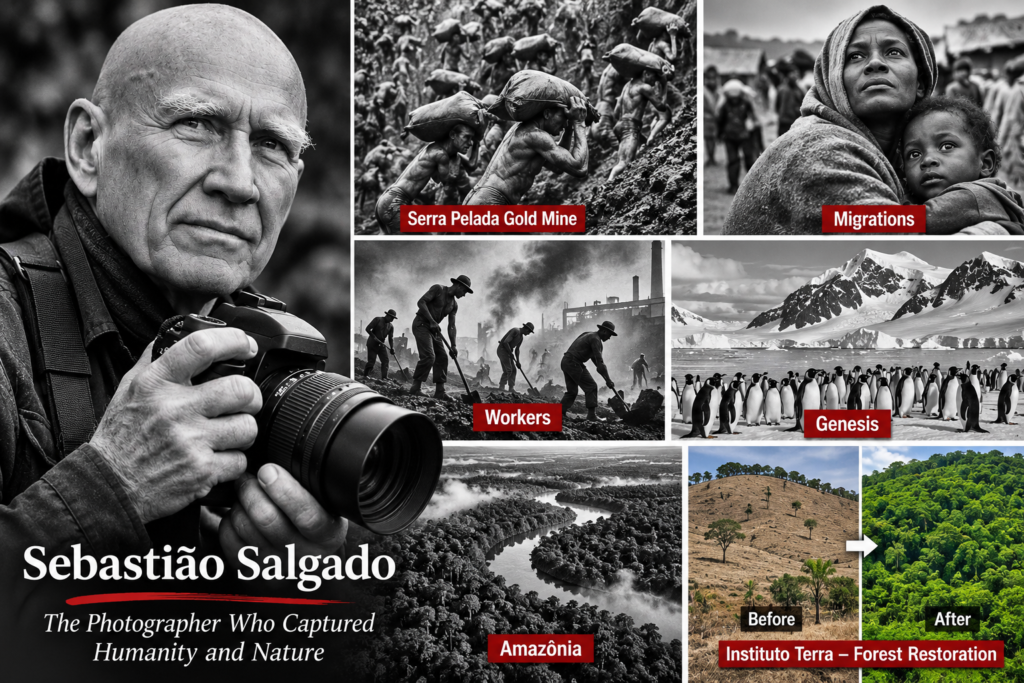
One of Salgado’s most famous photographic projects documented the Serra Pelada gold mine in Brazil.
During the 1980s, thousands of workers travelled to this enormous open-pit gold mine in search of wealth.
The working conditions were extremely difficult. Miners climbed steep muddy slopes while carrying heavy sacks of earth on their backs.
Salgado visited the mine and photographed the workers in extraordinary detail.
His pictures showed thousands of people moving across the enormous mining landscape. From a distance, the workers appeared almost like tiny figures covering the sides of a giant staircase.
But every figure represented a human being working under challenging conditions.
These photographs became some of the most recognised images of his career.
They demonstrated his ability to transform an ordinary working environment into a powerful visual story about labour, ambition, inequality, and human endurance.
Workers: A Tribute to Human Labour
In 1993, Salgado published his important photographic project titled Workers: An Archaeology of the Industrial Age.
The project documented people performing physically demanding jobs across different parts of the world.
He photographed miners, agricultural workers, fishermen, factory employees, and construction workers.
The photographs highlighted the importance of human labour in building modern society.
Many of the workers performed dangerous and exhausting tasks. Their daily lives involved physical strength, discipline, and determination.
Salgado wanted viewers to recognise the dignity of working people.
His photographs also documented traditional industries and occupations that were disappearing because of technological and economic changes.
The project became an important visual record of the industrial world and the people who helped build it.
Migrations: Photographing People Searching for a Better Life
Another major project was *Migrations: Humanity in Transition*, published in 2000.
This project focused on people forced to leave their homes because of war, poverty, political instability, and difficult economic conditions.
Salgado travelled to different countries to photograph refugees, displaced families, and migrants.
His images showed crowded settlements, families travelling together, children living in difficult circumstances, and communities trying to rebuild their lives.
The photographs communicated an important message: migration is not simply about moving from one country to another. It is often about survival, safety, and the hope of finding a better future.
The project encouraged people to think about the human consequences of conflict and inequality.
It remains one of his most significant contributions to documentary photography.
Genesis: Discovering the Beauty of the Natural World
After spending many years photographing human suffering and difficult living conditions, Salgado became increasingly interested in nature.
He began a major photographic project called *Genesis*.
The project took approximately eight years to complete and was published in 2013.
For this work, he travelled to remote regions of the planet to photograph landscapes, wildlife, and Indigenous communities.
His photographs included mountains, deserts, forests, oceans, animals, and places where traditional ways of life continued.
Unlike his earlier projects, which frequently documented industrial activity and social problems, *Genesis* focused on the natural beauty of the Earth.
The project presented a world that still contained extraordinary ecosystems and landscapes.
Through these photographs, Salgado encouraged people to appreciate nature and understand why it needed protection.
Instituto Terra: Bringing a Forest Back to Life
Salgado’s contribution to the world extended beyond photography.
After returning to his family’s land in Brazil, he and his wife, Lélia, became concerned about the destruction of the local Atlantic Forest.
The land had suffered significant environmental degradation.
Instead of accepting its condition, they decided to work towards restoring the ecosystem.
In 1998, they established Instituto Terra, an environmental organisation dedicated to forest restoration, conservation, and environmental education.
The project focused on planting native trees, restoring damaged land, and encouraging environmental awareness.
Over the years, the organisation helped restore large areas of Atlantic Forest and demonstrated the importance of long-term conservation.
This work showed another side of Salgado’s personality.
He was not satisfied with simply photographing environmental problems. He wanted to contribute to solutions.
His efforts became an inspiring example of how individuals and organisations can help restore damaged natural environments.
Amazônia: Celebrating the Amazon Rainforest
One of Salgado’s later major projects was *Amazônia*, published in 2021.
The project explored the Amazon rainforest, its landscapes, wildlife, rivers, and Indigenous communities.
He spent years photographing the region and documenting its extraordinary natural beauty.
His photographs showed enormous forests, flowing rivers, dramatic mountains, and communities whose lives were closely connected to the environment.
The project also highlighted the importance of protecting Indigenous cultures and the ecosystems of the Amazon.
The Amazon rainforest plays a crucial role in global biodiversity and contains countless species of plants and animals.
Through Amazônia, Salgado reminded the world that protecting nature is not only about saving beautiful landscapes. It is also about protecting the communities, wildlife, and ecological systems that depend on them.

His Unique Black-and-White Photography Style
One of the most recognisable features of Sebastião Salgado’s work was his use of black-and-white photography.
His photographs often contained dramatic lighting, strong contrasts, detailed textures, and carefully composed scenes.
He believed that photography should communicate more than the physical appearance of a subject.
His images frequently revealed emotion, dignity, struggle, and the relationship between people and their surroundings.
Black and white helped him concentrate attention on these elements without the distraction of colour.
His documentary approach required patience and extensive travel.
He often spent long periods with the communities he photographed, allowing him to understand their experiences before documenting their lives.
This combination of technical skill, patience, and human understanding helped establish his distinctive photographic identity.
Awards and International Recognition
Salgado received international recognition for his contribution to photography, art, and environmental awareness.
Some of his important honours included:
– Hasselblad Award (1989): Recognition of his exceptional contribution to photography.
– Prince of Asturias Award for the Arts (1998): Recognition of his artistic achievements.
– Praemium Imperiale (2021): One of the major international honours in the arts.
– French Académie des beaux-arts: He was elected as a member in 2016.
His work was exhibited in major galleries and museums around the world.
His photographic books also became influential publications for photographers, students, and readers interested in documentary storytelling.
Death and Lasting Legacy
Sebastião Salgado died on May 23, 2025, in Paris, France, at the age of 81.
His death marked the end of an extraordinary life, but his photographs continue to communicate powerful messages.
He left behind a remarkable collection of visual stories about workers, refugees, Indigenous communities, wildlife, and the natural environment.
His work reminds us that photography can be much more than an artistic profession.
It can become a record of history, a voice for people who are often overlooked, and a way to encourage positive change.
His environmental work through Instituto Terra also demonstrated that protecting nature requires action, commitment, and cooperation.



Post Comment