How Cheetos Became a Success
Introduction
Cheetos is one of the best-known cheese-flavored snack brands in the world. Its bright orange color, crunchy texture, distinctive taste, and memorable advertising have helped it stand out in a highly competitive snack industry.
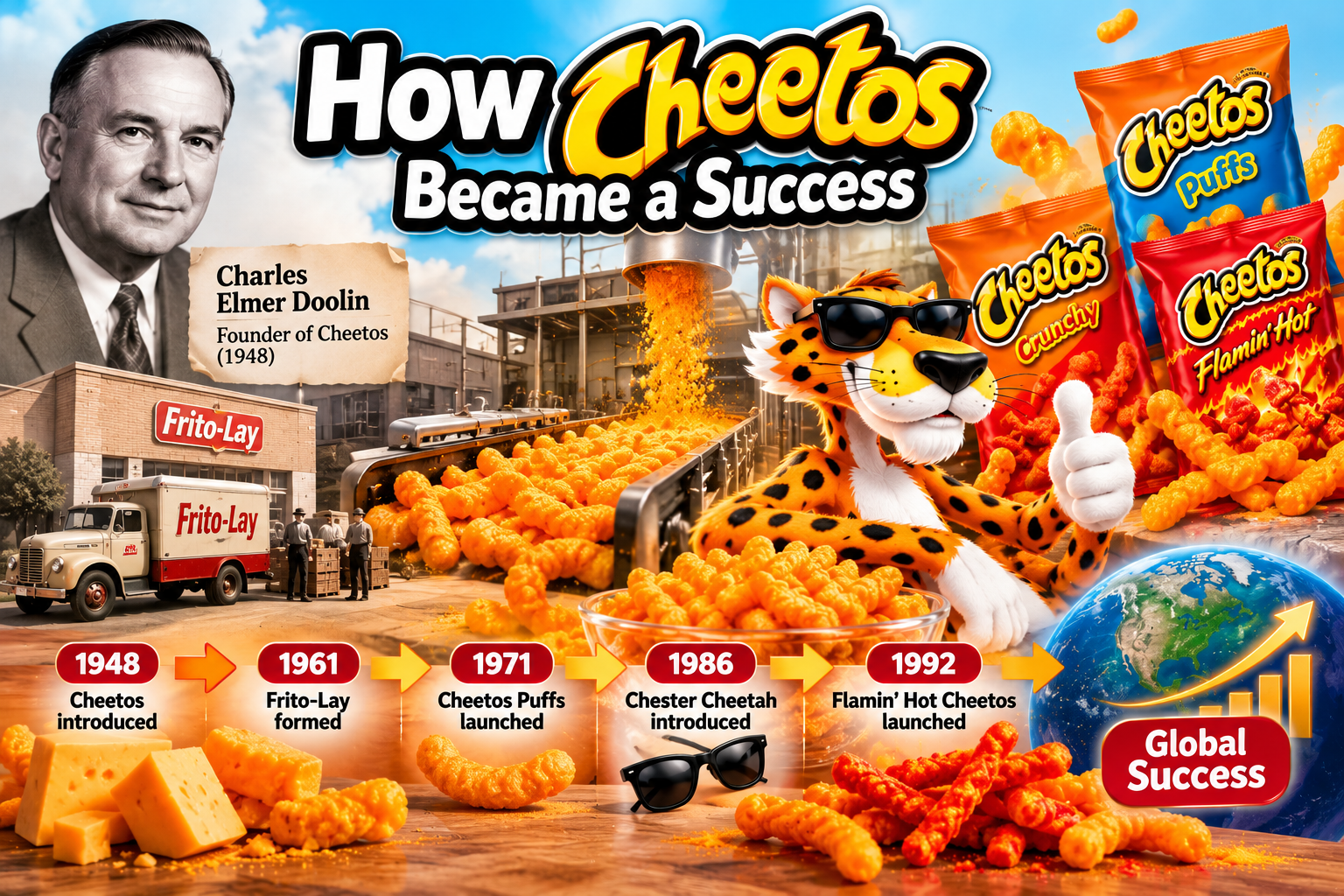
The story began in 1948, when Charles Elmer Doolin, the founder of the Frito Company, developed Cheetos in Dallas, Texas. What started as a simple corn-based snack eventually became an internationally recognized brand owned by Frito-Lay, a division of PepsiCo.
1. How Cheetos Started in 1948
Cheetos was introduced in 1948 by Charles Elmer Doolin, who had already established himself in the snack business through Fritos.
Doolin experimented with snack production and developed a cheese-flavored corn snack. The product offered something distinctive: a crunchy texture combined with a cheesy coating.
However, creating a good product was only the beginning. To become successful, the snack needed efficient manufacturing, attractive packaging, and a distribution network capable of reaching customers across the United States.
2. How Distribution Helped Cheetos Grow
A snack brand cannot become widely successful if customers cannot find it in stores.
Doolin’s business benefited from a partnership with Herman W. Lay, whose company had experience in potato chips and snack distribution.
In 1961, the Frito Company and H. W. Lay & Company merged to form Frito-Lay. This brought important manufacturing, marketing, and distribution capabilities together under one business.
The merger helped create a stronger platform for expanding snack brands, including Cheetos.
3. How PepsiCo Expanded the Brand
In 1965, Frito-Lay merged with the Pepsi-Cola Company to form PepsiCo.
The new corporate structure gave Frito-Lay access to greater resources and opportunities for expansion. Over time, Cheetos reached more markets and became part of a much larger international snack portfolio.
This illustrates an important business lesson: a successful product can grow faster when supported by a company with strong distribution, marketing, and operational capabilities.
4. How New Products Kept Customers Interested
Successful brands need to give customers reasons to return.
Cheetos initially became known for its crunchy cheese-flavored snack. In 1971, Cheetos Puffs introduced a different texture, offering customers a lighter, puffed alternative.
The brand subsequently expanded its range with different shapes, flavors, and product variations.
One especially recognizable extension was Flamin’ Hot Cheetos, which brought a spicy flavor to the brand’s portfolio. The product launched nationally in the United States in 1992.
Flamin’ Hot’s development has a disputed origin story. Although Richard Montañez has publicly claimed a role in its invention, reporting by the *Los Angeles Times* challenged his account, and Frito-Lay has attributed the product’s development to a team. It is more accurate to avoid crediting a single individual without qualification.

5. How Chester Cheetah Made the Brand Memorable
In 1986, Cheetos introduced Chester Cheetah, a playful cartoon mascot that became one of its most recognizable marketing assets.
Chester helped give the brand a personality beyond its flavor and packaging. His confident, mischievous character made advertisements easier to recognize and gave the company a consistent identity across campaigns.
The mascot helped Cheetos communicate fun, boldness, and a slightly rebellious attitude.
This strategy demonstrates the power of character-based branding: customers may remember a personality just as readily as they remember a product.
6. How Advertising Built Brand Recognition
Cheetos developed advertising campaigns that emphasized its distinctive taste, playful personality, and memorable orange cheese coating.
Rather than relying exclusively on product descriptions, the company used humor, visual storytelling, and its mascot to make advertisements recognizable.
Over time, the brand also expanded its presence through digital campaigns, social media, entertainment, and collaborations.
The lesson is that consistent advertising can make a product more memorable, particularly when its message and visual identity remain recognizable across different platforms.
7. How Cheetos Adapted to Changing Tastes
Consumer preferences change, and brands must adapt to remain relevant.
Cheetos expanded beyond its original crunchy product with different textures, spicy varieties, and other flavor options. These innovations gave existing customers more choices and helped the brand appeal to different preferences.
The company also experimented with marketing that connected the product with contemporary entertainment and popular culture.
Product innovation helped keep the brand relevant without abandoning its core identity.
8. What Made Cheetos Successful?
Several factors contributed to Cheetos’ long-term success:
A distinctive product: Its cheesy flavor, crunchy texture, and orange appearance made it recognizable.
Strong distribution: The resources of Frito-Lay and PepsiCo helped bring the product to a broad market.
Memorable branding: Chester Cheetah gave the brand a consistent and recognizable personality.
Product variety: New textures and flavors encouraged customers to explore the range.
Consistent marketing: Advertising helped reinforce the brand’s identity over many decades.
Cultural relevance: The brand continued to connect with audiences through entertainment, digital marketing, and popular culture.
No single factor explains the brand’s success. Its strength came from combining product development, distribution, brand identity, and marketing over many years.

9. Business Lessons from Cheetos
Cheetos offers useful lessons for entrepreneurs and small business owners.
First, develop a product with a clear identity. Customers should be able to understand what makes it different.
Second, invest in distribution. Even an excellent product needs to reach its intended customers.
Third, build a memorable brand. Consistent names, colors, packaging, and messaging can make a business easier to recognize.
Fourth, continue innovating. New products and variations can help a business respond to changing preferences.
Finally, think long term. Cheetos did not become an internationally recognized brand overnight. Its growth developed through decades of product development, corporate expansion, and marketing.
Conclusion
The success of Cheetos shows how a relatively simple snack can become a globally recognized brand through consistent innovation, effective distribution, and memorable advertising.
From Charles Elmer Doolin’s early product development in 1948 to the introduction of Chester Cheetah and the expansion into new flavors, Cheetos continually built on its original identity.
Its history demonstrates an enduring business principle: a distinctive product can create an opportunity, but sustained success depends on how well a company develops, markets, and delivers that product to customers.



Post Comment