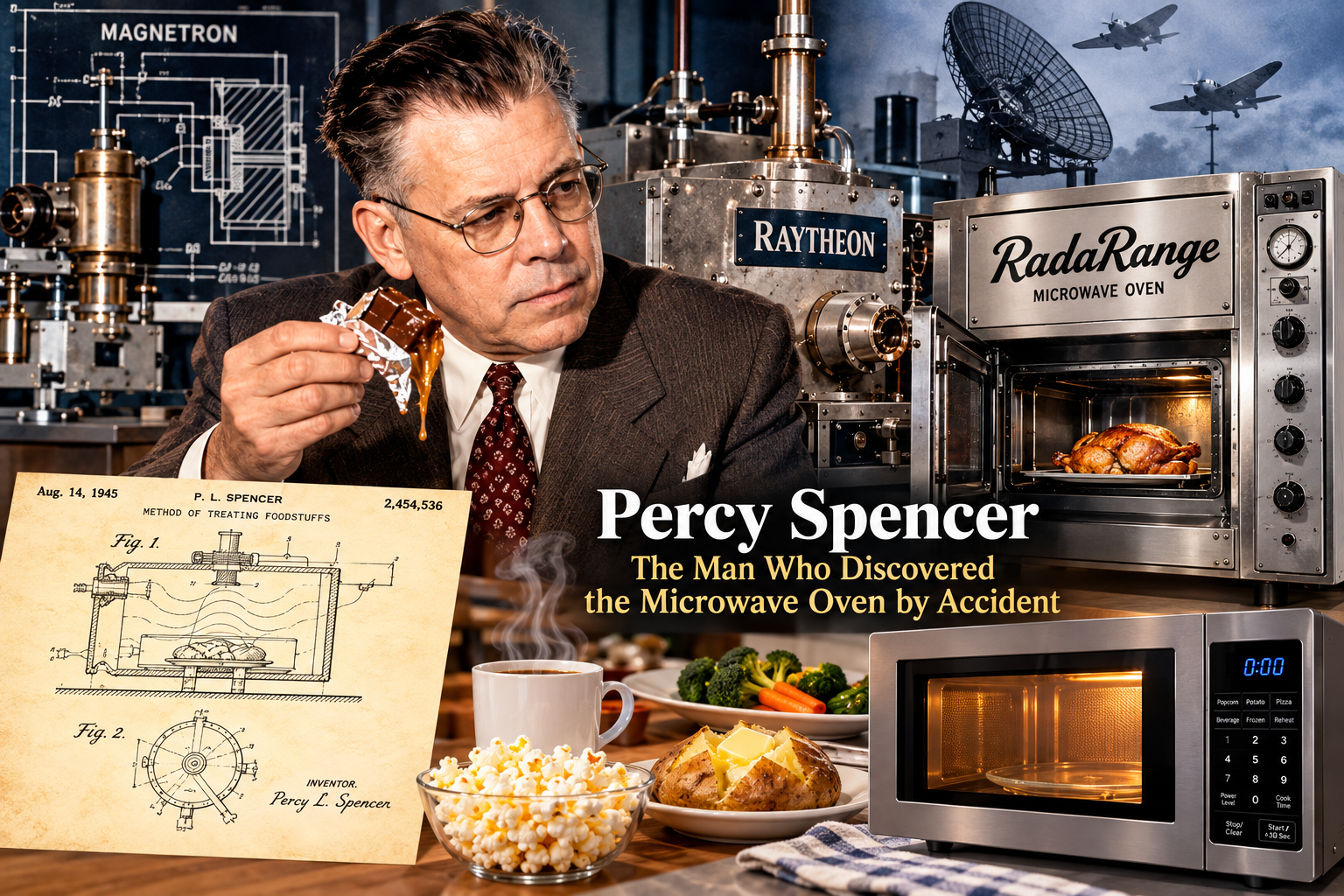
Percy Spencer: The Man Who Discovered the Microwave Oven by Accident
Imagine standing in a laboratory during the middle of the 1940s, surrounded by powerful radar equipment. You are working on technology designed for war when you suddenly notice something strange: a candy bar in your pocket has melted.
Most people might simply throw it away and continue working.
Percy Spencer did something different.
He became curious.
That small observation eventually led to experiments that helped create one of the most useful kitchen appliances of the modern age—the microwave oven.
Percy Spencer was an American engineer who worked for Raytheon and played an important role in improving the magnetron, a device that generated microwaves for radar. His work helped make magnetrons easier to manufacture during World War II. In 1945, while experimenting with magnetrons, Spencer discovered that microwave energy could heat food. His discovery eventually became the foundation for the commercial microwave oven.
His story is a fascinating example of how curiosity, engineering, and an unexpected accident can change everyday life.
Who Was Percy Spencer?
Percy LeBaron Spencer was born in Howland, Maine, in 1894. His early life was difficult. He lost his father when he was very young and later lost his uncle, who had helped care for him.
Spencer left school when he was around 12 years old and began working to support himself. Despite having very little formal education, he developed a strong interest in technology.
As a teenager, Spencer worked with electricity at a paper mill. At a time when electrical systems were still expanding into many parts of America, he gained practical experience that would become valuable throughout his career.
After the sinking of the Titanic in 1912, Spencer became fascinated by wireless communication and joined the U.S. Navy. While serving, he taught himself subjects such as mathematics, physics, and radio technology.
His ability to learn independently would become one of the defining characteristics of his career.
From Radio Technology to Raytheon
After leaving the Navy, Spencer worked in radio and electronics.
In 1925, he joined the American Appliance Company, which later became part of Raytheon. He would remain associated with the company for decades.
Spencer became particularly important in the development of magnetrons.
A magnetron is an electronic device capable of generating microwaves. During World War II, magnetrons became extremely important because they were used in radar systems to help detect aircraft and ships.
Radar technology was a major part of the Allied war effort, and the ability to manufacture magnetrons efficiently was extremely important.
In 1941, magnetrons were reportedly being produced at a rate of only about 17 per day. Spencer worked on ways to simplify their construction and make mass production possible. His improvements helped Raytheon dramatically increase production, eventually reaching thousands of magnetrons per day.
His work earned him recognition from the U.S. Navy.
But Spencer’s most famous invention was still ahead of him.
The Melted Candy Bar
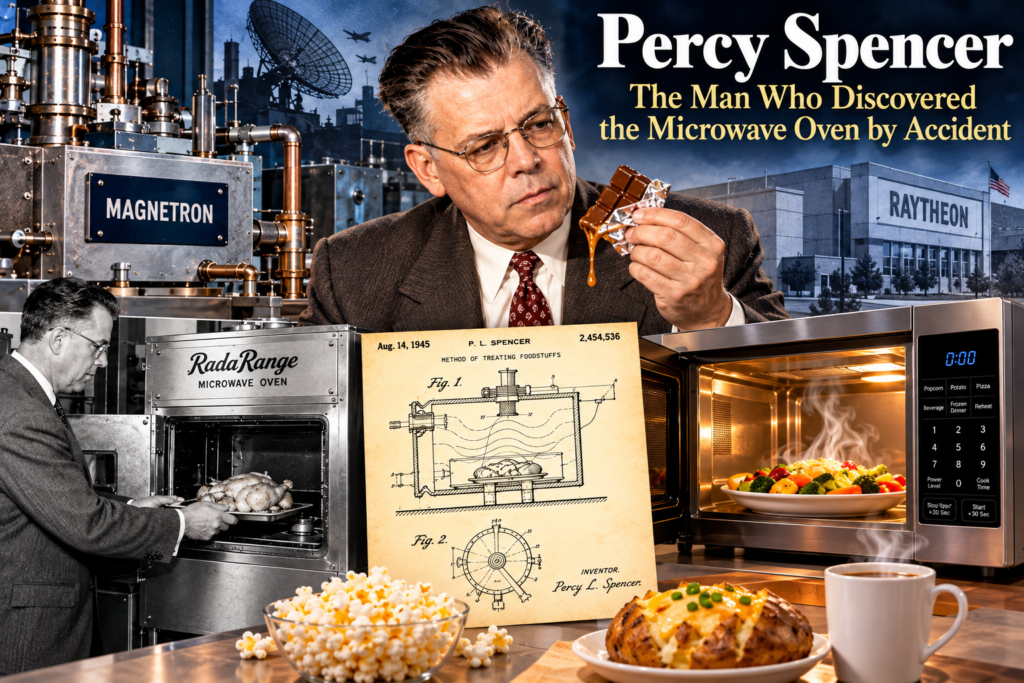
In 1945, Spencer was working around an operating magnetron at a Raytheon laboratory.
Then he noticed something unusual.
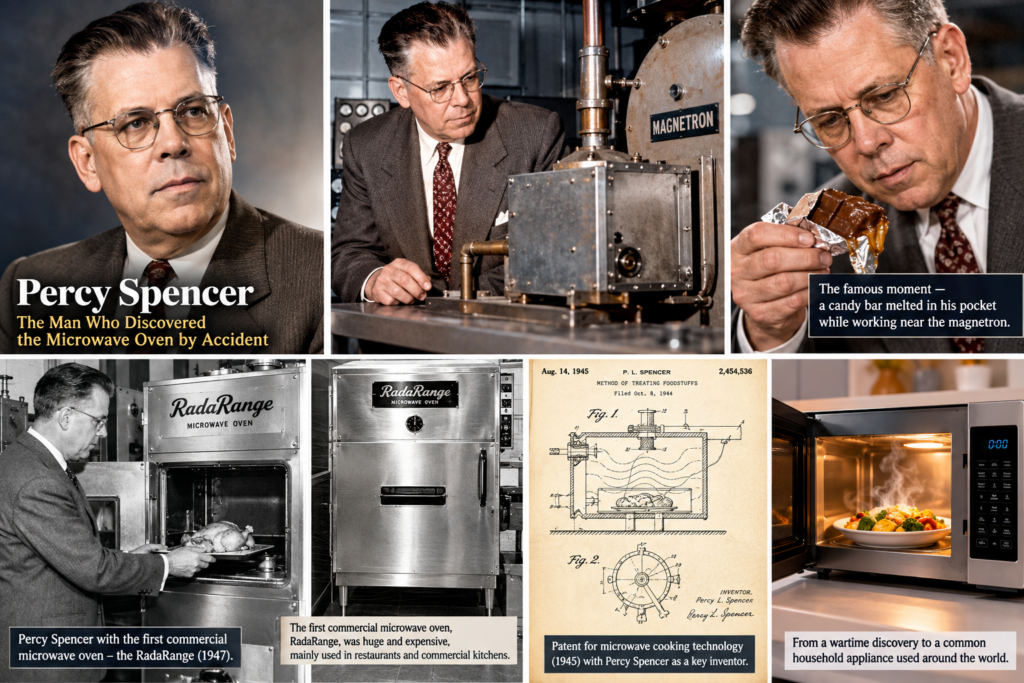
A candy bar that he had been carrying in his pocket had melted.
Spencer suspected that the magnetron’s microwave energy might have caused the heating.
Instead of treating the event as a coincidence, he decided to investigate.
This was the crucial moment.
He began experimenting with food near the magnetron. One of his early experiments involved popcorn kernels. When he exposed them to microwave energy, they began to pop.
That experiment provided evidence that microwaves could be used to heat food.
Spencer then continued experimenting with other foods. According to historical accounts, one experiment involving an egg produced a particularly messy result when the egg heated rapidly and burst.
These experiments helped Spencer and his colleagues understand the potential of microwave energy for cooking.
From Radar Technology to Cooking
The connection between radar and cooking may seem strange today.
Radar was designed to send and receive electromagnetic waves for detecting objects. But the same type of microwave energy generated by radar equipment could also transfer energy to food and heat it.
Spencer realized that this technology could potentially be adapted for cooking.
Raytheon began developing equipment specifically designed to heat food using microwaves.
In 1945, Spencer filed a patent for a method of treating food with microwave energy. U.S. Patent No. 2,495,429 was filed on October 8, 1945, and was granted in 1950.
This was an important step toward the microwave oven we know today.
However, the first machines were nothing like the small microwave sitting on a modern kitchen counter.
The First Microwave Oven
Raytheon’s first commercial microwave oven was called the Radarange.
It entered the market in 1947.
The early Radarange was enormous compared with modern appliances. It stood roughly six feet tall and weighed around 750 pounds. It was also extremely expensive, with early units costing thousands of dollars.
Clearly, this was not an appliance that most families could simply place beside their refrigerator.
Instead, early microwave ovens were mainly used in commercial environments such as restaurants.
One Radarange was purchased by a restaurant in Cleveland in 1947 for about $3,000.
The technology worked, but it needed to become smaller, cheaper, and easier to use before it could become a household appliance.
The Microwave Enters the Home
During the 1950s, manufacturers began developing microwave ovens for residential use.
One important example was the Tappan RL-1, developed with Raytheon technology. It was introduced in 1955 and is recognized by the Smithsonian as the first microwave oven designed for home use.
However, the early home microwave was still expensive. The RL-1 originally cost about $1,295, which made it difficult for ordinary families to afford. Only a small number were produced in its first year.
Over time, advances in magnetron technology helped make microwave ovens smaller and less expensive.
In 1967, Amana introduced a much more practical countertop microwave. It cost hundreds of dollars—still expensive for many families, but dramatically more accessible than the giant early machines.
Gradually, microwave ovens moved from restaurants and laboratories into ordinary American kitchens.
How Does a Microwave Oven Work?
The basic principle behind a microwave oven is surprisingly simple.
Inside the appliance is a magnetron, which generates microwave energy.
That energy enters the cooking chamber and interacts with molecules in the food. The electromagnetic energy causes molecules—particularly polar molecules such as water—to move and rotate. This movement produces heat.
Unlike a traditional oven, which generally heats the outside of food and allows heat to move inward, microwave cooking transfers energy directly through microwave interactions within the food.
That is why a microwave can heat many foods very quickly.
The same basic technology that once helped radar systems detect aircraft and ships eventually became a tool for heating leftovers, cooking vegetables, popping popcorn, and preparing meals.
Spencer’s Career Went Far Beyond the Microwave
Although Percy Spencer is best remembered for the microwave oven, his career was much larger than that single invention.
He became an important figure at Raytheon and eventually rose to become a senior vice president and member of the company’s board of directors.
He was also an extremely prolific inventor.
The National Inventors Hall of Fame credits Spencer with around 150 patents, while research by the Smithsonian’s Lemelson Center identified 108 U.S. patents issued to him between 1932 and 1963. The difference reflects variations in how his inventions and patent records have been counted.
His contributions to magnetron technology were particularly important during World War II because they helped support the large-scale production of radar equipment.
Spencer retired from Raytheon in 1964.
He died in 1970.
In 1999, he was inducted posthumously into the National Inventors Hall of Fame for his work on high-efficiency magnetron technology.
Was the Microwave Really Discovered by Accident?
The phrase “microwave oven discovered by accident” is popular because the melted candy-bar story is so memorable.
But the deeper story is more interesting.
Spencer did not accidentally invent a complete microwave oven in a single moment.
He was already an experienced engineer working with microwave-producing magnetrons. The unexpected melting of the candy bar gave him an observation that prompted further investigation.
His achievement was recognizing the significance of the observation, testing the idea, conducting experiments, and helping transform the discovery into practical technology.
In other words, the accident created the question—but engineering and experimentation produced the invention.
That distinction is important.
Many great inventions begin with an unexpected observation. What separates an interesting accident from a useful invention is what happens afterward.
From a Giant Machine to a Kitchen Essential
The transformation of the microwave oven is remarkable.
In the 1940s, the technology was connected to enormous radar systems and military research.
In 1947, the first commercial microwave ovens were huge, expensive machines.
By the 1950s, manufacturers were experimenting with residential models.
By the 1960s and 1970s, smaller and more affordable microwaves began entering homes in larger numbers.
By the end of the 20th century, the microwave had become a familiar part of American kitchen life. The Smithsonian notes that by 2000, microwaves were present in about 90% of U.S. households.
Today, people can heat a meal in minutes without giving much thought to the complex history behind the appliance.
The Legacy of Percy Spencer
Percy Spencer’s story is not simply the story of a microwave oven.
It is a story about curiosity.
He saw something unexpected and asked why it happened.
He experimented.
He tested his ideas.
He failed, learned, and continued.
And eventually, technology originally developed for radar helped create an entirely new way of cooking.
Every time someone presses a microwave’s start button, they are using technology that has roots in the laboratories of the World War II era.
The next time you watch popcorn pop inside a microwave, remember the engineer who noticed a melted candy bar and decided that the strange event deserved a closer look.
Percy Spencer didn’t plan to change the way the world cooked food.
But he was curious enough to investigate an unexpected accident—and that curiosity helped turn a wartime technology into one of the most recognizable appliances in the modern kitchen.
Final Thought
Great inventions don’t always begin with a perfect plan. Sometimes they begin with a surprising observation and a person willing to ask, “Why?”
Percy Spencer’s story is a powerful reminder that innovation can come from unexpected places—and that curiosity can turn an ordinary accident into extraordinary technology.

Post Comment