John Wesley Powell: The Explorer Who Unlocked the Secrets of the Colorado River
Introduction
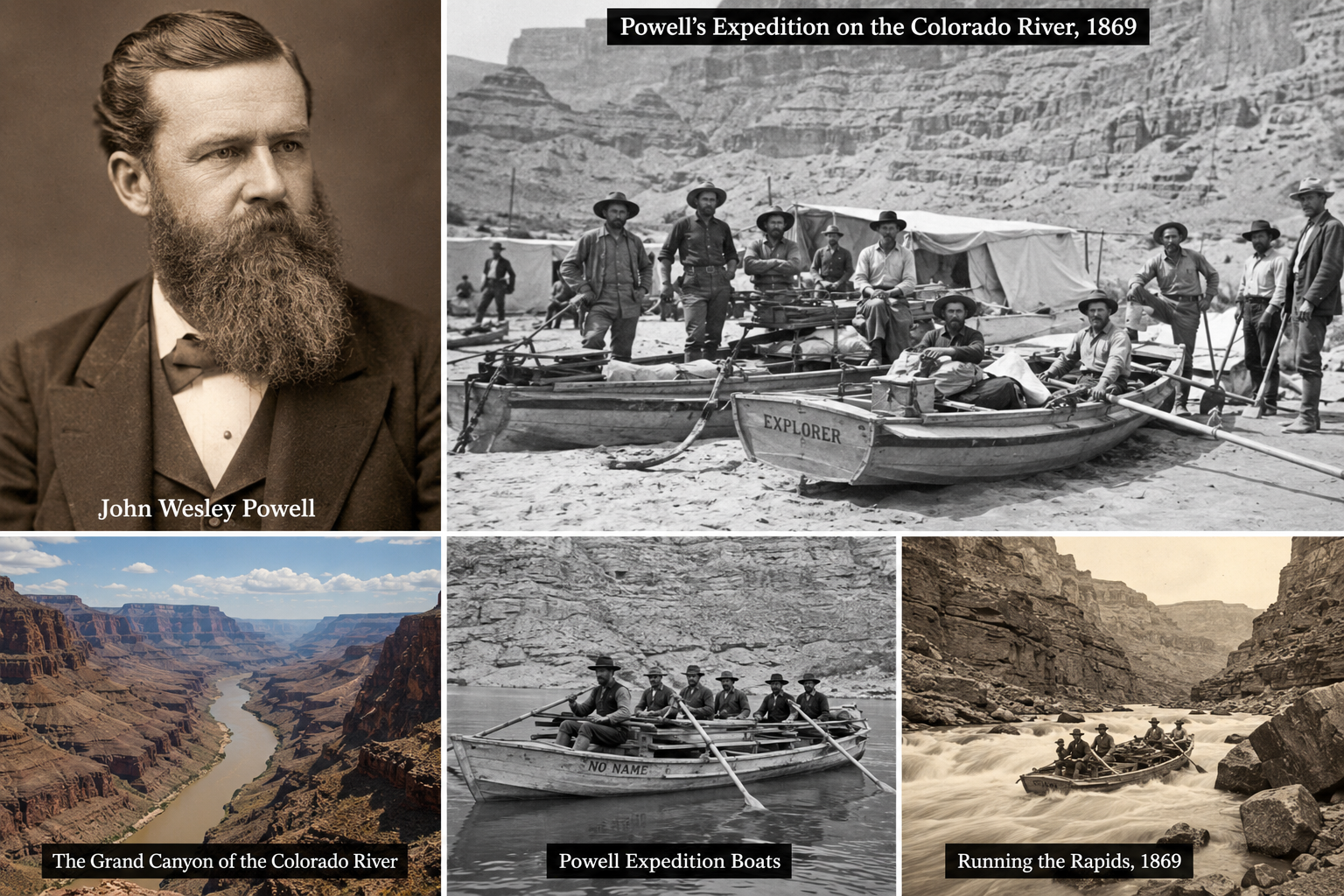
History remembers many great explorers, but few displayed the courage and determination of John Wesley Powell. Armed with scientific curiosity—and only one arm after losing the other during the American Civil War—Powell accomplished one of the greatest exploration feats in American history. In 1869, he led the first successful scientific expedition through the dangerous canyons of the Colorado River, including the Grand Canyon.
His expedition transformed maps, advanced geology, documented Native American cultures, and changed how people understood the American West. Powell’s legacy extends beyond exploration, influencing water management and conservation policies that continue to shape the western United States today.
Early Life
John Wesley Powell was born on March 24, 1834, in Mount Morris, New York. His family later settled in Ohio and Wisconsin, where his fascination with nature flourished. Although he never completed a formal university degree, Powell studied geology, botany, and zoology through independent learning and field exploration.
As a young man, he traveled extensively by canoe along major rivers, developing the navigation skills that would later prove invaluable.
A Soldier’s Sacrifice
When the American Civil War began, Powell enlisted in the Union Army. During the Battle of Shiloh in 1862, he suffered a severe gunshot wound that led to the amputation of his right arm.
Most people would have abandoned dreams of wilderness exploration after such an injury. Powell did the opposite. His determination became one of the defining qualities of his remarkable life.
The Great Expedition Begins
By the late 1860s, much of the Colorado River remained unexplored by scientists. Maps contained large blank areas, and the Grand Canyon was considered one of North America’s greatest mysteries.
On May 24, 1869, Powell and nine companions departed from Green River Station in Wyoming Territory with four wooden boats carrying food, scientific instruments, cameras, and journals.
Their mission was to map the river, study the geology, and record everything they observed.
Into the Unknown
The expedition faced violent rapids, towering canyon walls, freezing water, extreme heat, damaged boats, and dwindling food supplies.
Every day presented life-threatening challenges. Boats overturned, equipment was lost, and the explorers often carried heavy supplies around dangerous rapids.
Despite these hardships, Powell carefully documented rock layers, river features, plants, animals, and weather conditions.
Through the Grand Canyon
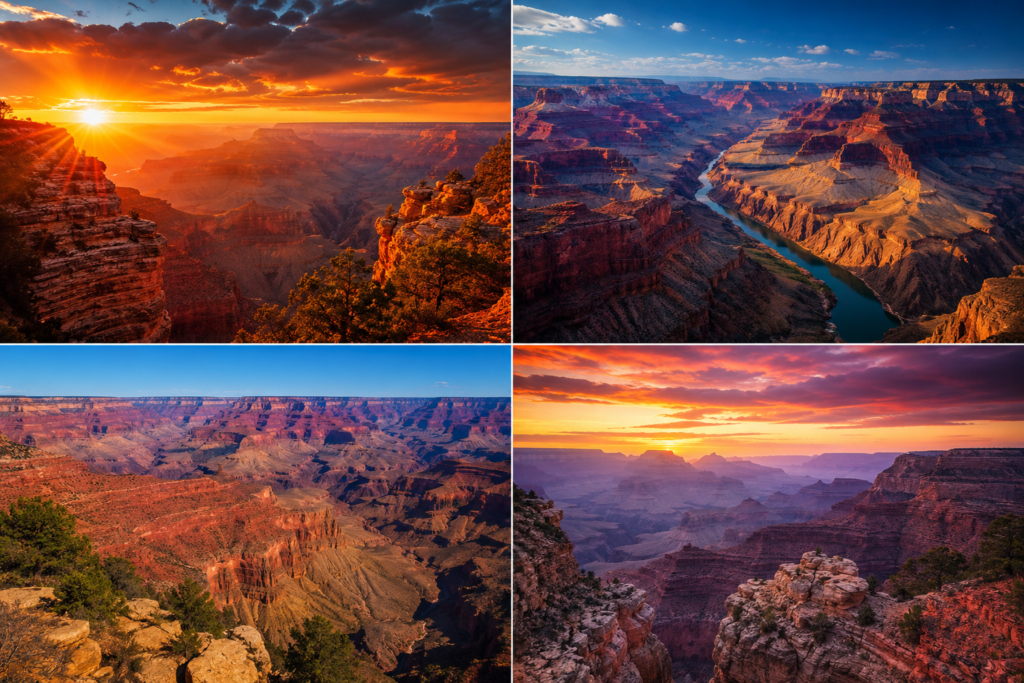
As the team entered the Grand Canyon, they encountered one of Earth’s most spectacular landscapes.
Massive cliffs rose thousands of feet above the river, exposing rock layers that revealed hundreds of millions of years of geological history.
Powell recognized that the canyon had been carved over immense periods by the Colorado River, helping scientists better understand Earth’s changing surface.
Tragedy Along the Way
Near the end of the journey, three members left the expedition, believing the river ahead was too dangerous.
They climbed out of the canyon and were later killed under circumstances that remain uncertain.
Powell and the remaining six members continued and successfully completed the expedition on August 30, 1869, after traveling roughly 1,000 miles.
Scientific Achievements
The expedition produced invaluable knowledge:
– Accurate maps of previously unknown river sections.
– Geological observations that influenced future research.
– Records of wildlife and vegetation.
– Important documentation of Native American communities.
– A deeper understanding of the geography of the American Southwest.
The Second Expedition
Recognizing the importance of additional research, Powell returned in 1871–1872 with better equipment and experienced scientists.
This expedition produced far more detailed maps, photographs, and scientific reports, establishing Powell as one of America’s leading explorers.
Leadership in Science
Powell later became Director of the United States Geological Survey.
He argued that settlement in the American West should be planned according to available water rather than arbitrary political boundaries. Although many ignored his advice at the time, modern water shortages have highlighted the wisdom of his ideas.
Leaving Green River
The expedition began at Green River Station in present-day Wyoming. Four sturdy wooden boats carried food, ammunition, scientific instruments, notebooks, and cameras.
The crew consisted of ten determined men with different backgrounds. Some had military experience, while others were skilled hunters, guides, or boatmen. Powell served as both expedition leader and chief scientist.
As the boats drifted into the current, the men knew there would be no easy way back.
The First Weeks
The early days seemed manageable. The river flowed through open country, allowing the men to establish a routine.
Each morning they packed supplies, checked the boats for damage, and recorded weather observations. Powell carefully documented rock formations, measured river currents, and collected geological samples.
Soon, however, the river became increasingly dangerous.
Fighting the Rapids
Towering cliffs closed around the expedition as they entered narrow canyons.
The Colorado River transformed into a series of violent rapids that smashed against hidden rocks. More than once, boats struck boulders and nearly capsized.
Whenever the rapids looked too dangerous, the men unloaded their equipment and carried it along the canyon walls before carefully guiding the empty boats through the rushing water.
This exhausting process often lasted for hours.
Hunger and Hardship
Weeks passed, and food supplies began to shrink.
Flour became damp, bacon spoiled in the summer heat, and coffee grew scarce. Hunting opportunities were limited because the canyon walls made travel difficult.
The explorers often survived on simple meals while working from sunrise until nightfall.
Despite these hardships, Powell insisted that scientific observations continue every day.
Exploring the Grand Canyon
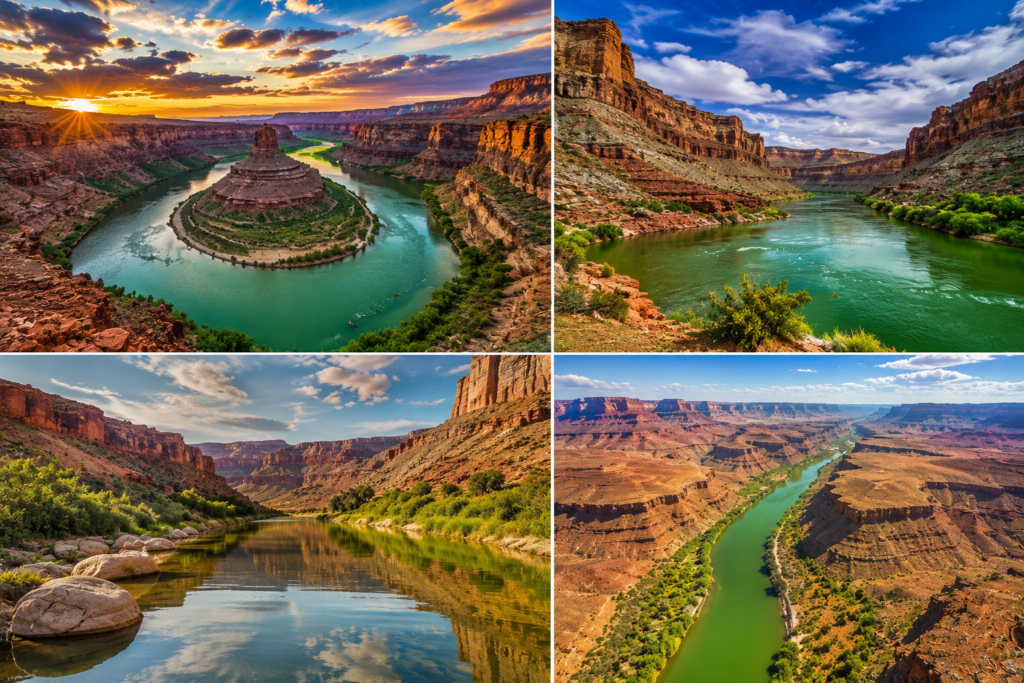
Eventually the expedition entered what is now recognized as the Grand Canyon.
The immense cliffs amazed the explorers. Layer upon layer of colorful rock stretched thousands of feet above the river, revealing Earth’s geological history.
Powell understood that these rock formations represented hundreds of millions of years of natural change.
His detailed notes later helped establish important geological theories.
Encounters with Native Peoples
Throughout the journey, Powell recorded valuable information about Native American communities living in the Southwest.
He respected the importance of learning about their languages, traditions, and knowledge of the land.
His later work helped preserve valuable ethnographic information that might otherwise have been lost.
The Expedition’s Darkest Moment
As the expedition neared its conclusion, fear spread among several members.
Three men believed the remaining rapids were impossible to survive. They decided to leave the river and attempt to cross the canyon on foot.
Sadly, they never returned and were later killed under circumstances that remain uncertain.
Their disappearance remains one of the greatest mysteries surrounding the expedition.
Reaching Safety
Powell and the remaining six members continued downstream.
After more than three months of extraordinary hardship, they finally emerged from the canyon on August 30, 1869.
Their successful journey proved that the Colorado River could be explored scientifically and safely with careful planning, determination, and teamwork.
Changing America’s Understanding
The expedition transformed scientific knowledge.
Powell’s journals described landscapes that few outsiders had ever seen.
His maps corrected major geographical errors, while his geological observations influenced future researchers for generations.
The expedition also inspired future explorers, photographers, and conservationists to study and protect the American West.
A National Hero Returns
When Powell completed the Colorado River expedition in 1869, newspapers across the country praised his courage. His detailed journals and maps fascinated scientists and the public alike. Americans finally had a clearer picture of the mysterious canyons and rivers of the Southwest.
Although many admired his bravery, Powell considered the scientific discoveries to be the expedition’s greatest achievement.
A Second Scientific Expedition
Powell knew that one journey was not enough. In 1871–1872, he organized a second expedition with improved boats, better equipment, skilled surveyors, photographers, and scientists.
This expedition produced:
– More accurate maps of the Colorado River.
– Thousands of geological observations.
– Detailed photographs of the Grand Canyon.
– Studies of plants, animals, and climate.
– Better records of Native American cultures.
The second expedition became one of the most important scientific surveys in American history.
Leading the U.S. Geological Survey
Powell’s reputation as a scientist continued to grow. In 1881, he became the director of the United States Geological Survey (USGS).
Under his leadership, the USGS expanded its work in:
– Geological mapping.
– Mineral research.
– Water resource studies.
– Land surveys.
– Scientific publications.
Powell believed that government decisions should be guided by reliable scientific evidence rather than politics or speculation.
A Visionary for Water Management
Perhaps Powell’s greatest legacy was his understanding of water in the American West.
After years of exploration, he realized that much of the western United States was too dry to support unlimited farming and settlement. He warned that rivers and rainfall were limited resources and that future communities would need careful planning.
He proposed that:
– Water should be shared fairly among communities.
– Farming should match local rainfall.
– Irrigation projects should be carefully managed.
– Land boundaries should reflect river basins rather than political lines.
Many leaders ignored these recommendations at the time, but modern droughts have shown how insightful Powell’s ideas were.
Champion of Native American Studies
Powell also believed that Native American cultures deserved careful study and respect.
As the first director of the Bureau of American Ethnology, he supported research into Indigenous languages, traditions, and history. His work helped preserve valuable cultural knowledge that might otherwise have been lost.
Although some of his views reflected the attitudes of the nineteenth century, his efforts to document Native cultures remain an important historical resource.
Author and Educator
Powell shared his discoveries through books, lectures, and scientific reports. His most famous work, “Exploration of the Colorado River of the West and Its Tributaries,” introduced readers to the dramatic landscapes, dangerous rapids, and scientific discoveries of his expeditions.
His writing combined adventure with careful observation, making science accessible to the general public.
Honors and Recognition
Throughout his career, Powell received widespread recognition for his achievements. Today, his name appears on schools, research centers, parks, mountains, lakes, and geographic landmarks across the United States.
Historians consider him one of the founders of modern American geology and environmental planning.
Lessons from John Wesley Powell
Powell’s life offers timeless lessons:
– Perseverance: Losing an arm did not end his dreams.
– Leadership: He inspired his team during extreme danger.
– Curiosity: Every challenge became an opportunity to learn.
– Science: Careful observation can change the world.
– Conservation: Natural resources should be managed wisely for future generations.
Why Powell Matters Today
Climate change, water shortages, and environmental conservation have made Powell’s ideas more relevant than ever. His belief that development must respect nature continues to guide scientists, engineers, and policymakers.
Millions of visitors explore the Grand Canyon each year, often unaware that Powell’s expeditions helped reveal its geological significance to the world.
Post Comment