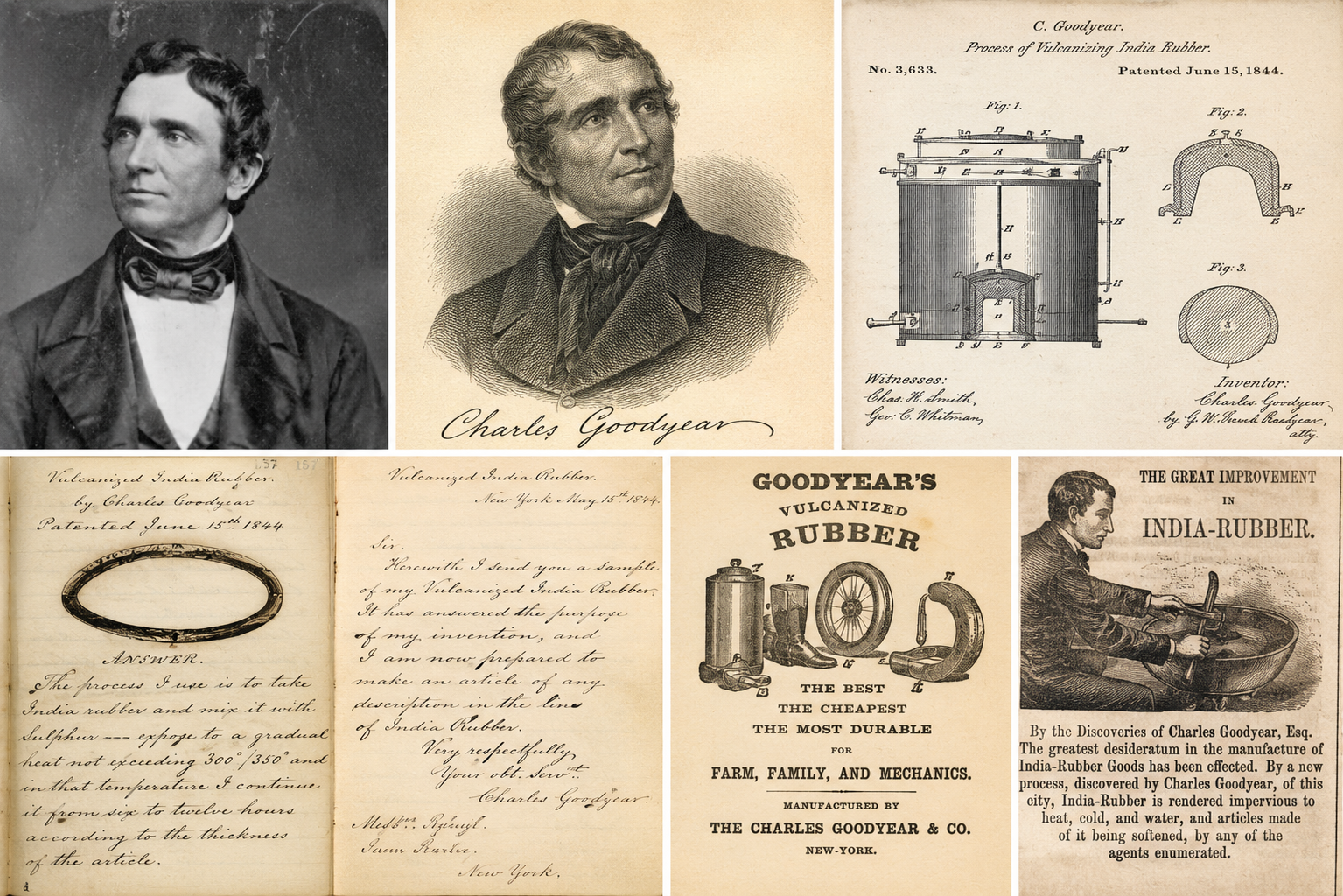
Charles Goodyear: The Accidental Innovation That Changed the World Forever
Introduction
History is filled with inventors whose determination transformed the world, but few stories are as inspiring as that of Charles Goodyear. Unlike many famous inventors who enjoyed wealth and recognition during their lifetimes, Goodyear spent years struggling with poverty, debt, and repeated failures. Yet his relentless pursuit of a solution to one of the nineteenth century’s greatest industrial problems led to an accidental discovery that revolutionized modern life.
Today, billions of people benefit from Goodyear’s invention every day, often without realizing it. Every car tire, airplane tire, rubber shoe sole, industrial belt, medical glove, garden hose, and countless other rubber products owe their durability to the process he discovered: vulcanization.
This is the remarkable story of a man whose persistence turned failure into one of history’s greatest accidental innovations.
Early Life
Charles Goodyear was born on December 29, 1800, in New Haven, Connecticut, United States. His father operated a hardware manufacturing business, giving young Charles early exposure to tools, machinery, and manufacturing techniques.
As a young man, Goodyear worked in the family business and eventually opened his own hardware company. He dreamed of becoming a successful businessman, but financial difficulties forced his company into bankruptcy. These hardships marked the beginning of a life filled with economic struggles.
Despite these setbacks, Goodyear remained optimistic. He believed that solving difficult problems required patience, experimentation, and unwavering determination.
The Rubber Problem
In the early 1800s, natural rubber fascinated manufacturers because it was waterproof, flexible, and elastic. However, it had one major flaw.
During hot summer weather, rubber became sticky, soft, and unpleasant to handle. In cold winter temperatures, it became hard, brittle, and cracked easily.
These problems made rubber nearly useless for reliable products. Factories lost money, customers were disappointed, and many believed rubber would never become an important industrial material.
Charles Goodyear refused to accept that conclusion.
He became obsessed with finding a way to make rubber stable in all weather conditions.
Years of Endless Experiments
Goodyear began experimenting in the 1830s. His laboratory was far from luxurious. Often he worked in small rented rooms, kitchens, or workshops using simple equipment.
He mixed rubber with dozens of different materials, including lime, acids, powders, and chemicals. Most experiments failed completely.
Friends considered him unrealistic. Investors lost confidence. His family struggled financially because nearly every dollar went into buying chemicals and rubber for experiments.
At times, Goodyear was imprisoned because he could not pay his debts. Yet even while in prison, he continued thinking about rubber and planning new experiments after his release.
His determination never disappeared.
The Accidental Discovery
The breakthrough came in 1839.
According to the most famous account, Goodyear was experimenting with a mixture of natural rubber and sulfur when a piece accidentally fell onto a hot stove.
Instead of melting into a sticky mass, something extraordinary happened.
The heated rubber became firm, elastic, and flexible without becoming sticky. Even after cooling, it retained its improved properties.
Goodyear realized he had discovered something entirely new.
The combination of sulfur and heat had permanently changed the molecular structure of the rubber.
This accidental event became one of history’s greatest technological discoveries.
Understanding Vulcanization
Goodyear named the process vulcanization, inspired by Vulcan, the Roman god of fire.
Vulcanization creates chemical bonds between rubber molecules.
This process gives rubber several remarkable qualities:
– Greater strength
– Improved flexibility
– Resistance to heat
– Resistance to cold
– Better durability
– Longer lifespan
– Improved elasticity
Instead of becoming sticky during summer or brittle during winter, vulcanized rubber remained reliable under a wide range of temperatures.
This breakthrough transformed rubber from a scientific curiosity into one of the world’s most valuable industrial materials.
Winning Recognition
Although the discovery was revolutionary, success did not come easily.
Goodyear spent years improving the manufacturing process and securing patents. Many competitors copied his work without permission, leading to expensive legal battles.
He traveled across the United States and Europe demonstrating his invention to manufacturers.
Slowly, industries realized the enormous value of vulcanized rubber.
Demand increased rapidly.
Factories began producing stronger rubber products that lasted much longer than anything previously available.
Changing the World
The impact of vulcanization cannot be overstated.
Without Charles Goodyear’s discovery, many modern industries would not exist in their current form.
His invention enabled the development of:
– Automobile tires
– Bicycle tires
– Airplane tires
– Conveyor belts
– Industrial machinery
– Waterproof boots
– Shoe soles
– Medical equipment
– Rubber seals and gaskets
– Electrical insulation
– Sporting goods
– Fire hoses
– Protective gloves
– Rubber bands
Every major transportation system today depends on vulcanized rubber.
Millions of vehicles safely travel roads because of the durability provided by Goodyear’s discovery.
Personal Sacrifice
Ironically, Charles Goodyear never became wealthy.
He spent nearly everything he earned funding new experiments and defending his patents.
Legal disputes drained his finances.
He borrowed money repeatedly.
His family endured years of hardship.
Even after industries adopted vulcanized rubber, Goodyear remained burdened by debt.
Despite changing the world, he lived a life of financial struggle.
His greatest reward was knowing that his work had solved a problem many believed impossible.
Death
Charles Goodyear died on July 1, 1860, at the age of 59.
Although he left behind significant debts, he also left one of the most influential inventions in industrial history.
His discovery continued improving lives long after his death.
Today, historians regard him as one of America’s greatest inventors.
The Goodyear Tire Company
Many people assume Charles Goodyear founded the Goodyear Tire & Rubber Company.
In reality, the company was established 38 years after his death, in 1898.
The founders named the company in his honor because his invention had made the modern rubber industry possible.
Today, Goodyear is recognized as one of the world’s leading tire manufacturers, carrying forward the name of the inventor who revolutionized rubber technology.
Scientific Importance
Vulcanization was more than an industrial improvement—it represented a major advance in materials science.
By understanding how heat and sulfur altered rubber’s internal structure, scientists gained valuable insights into polymers and chemical engineering.
Modern synthetic rubbers, high-performance tires, aerospace materials, and countless advanced products trace their origins back to Goodyear’s experiments.
His work laid the foundation for an entire branch of industrial chemistry.
Lessons from Charles Goodyear
Goodyear’s life teaches several timeless lessons:
Persistence beats talent. Years of failure did not stop him.
Accidents favor prepared minds. The famous accident became valuable because Goodyear understood what he was observing.
Innovation requires sacrifice. Great discoveries often demand years of effort before success arrives.
Failure is part of discovery. Every unsuccessful experiment taught him something useful.
Real success creates lasting impact. Although he never became rich, billions of people continue benefiting from his invention.
Legacy
Today, vulcanized rubber is found everywhere.
From children’s playgrounds to hospitals, factories, airports, sports stadiums, and space exploration equipment, Charles Goodyear’s discovery continues supporting modern civilization.
His story reminds us that history’s greatest inventions are not always created in expensive laboratories.
Sometimes they emerge from relentless determination, curiosity, and the courage to continue after countless failures.


Post Comment