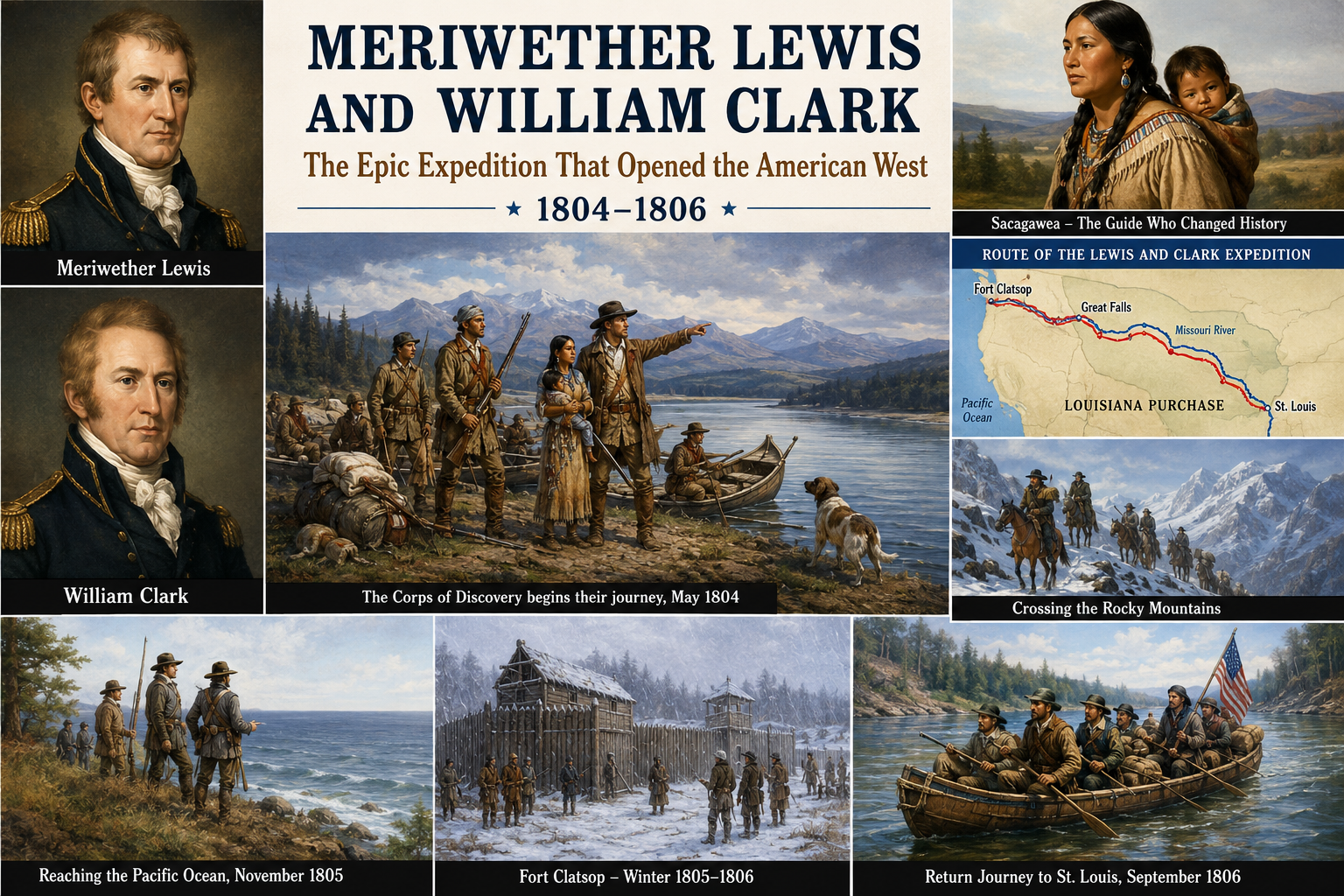
Meriwether Lewis and William Clark: The Epic Expedition That Opened the American West
Introduction
Few journeys in history changed a nation as profoundly as the expedition led by Meriwether Lewis and William Clark. Between 1804 and 1806, these two American explorers commanded one of the most ambitious expeditions ever undertaken in North America. Their mission was far more than a simple adventure—it was a scientific expedition, a diplomatic mission, and a quest to map the vast, mysterious lands acquired through the Louisiana Purchase.
The Lewis and Clark Expedition transformed the way Americans understood the continent. It revealed new rivers, mountains, forests, wildlife, and Native American cultures that were largely unknown to the United States government. The expedition also laid the groundwork for westward expansion, trade, scientific discovery, and future settlement.
Today, more than two centuries later, the story of Lewis and Clark remains one of courage, leadership, curiosity, and perseverance. Their expedition represents the spirit of exploration and continues to inspire historians, travelers, and adventurers worldwide.
—
America Before the Expedition
At the beginning of the 19th century, much of western North America remained unmapped by the United States. Although Indigenous peoples had lived across the continent for thousands of years, American officials possessed only limited geographical knowledge of the region beyond the Mississippi River.
In 1803, President Thomas Jefferson completed the historic Louisiana Purchase, acquiring approximately 828,000 square miles of land from France. The purchase nearly doubled the size of the young nation.
However, owning the land on paper was very different from understanding it.
Questions remained:
– What rivers crossed the territory?
– Could traders reach the Pacific Ocean by water?
– Which Native nations lived there?
– What plants and animals existed?
– What natural resources could support future settlements?
Jefferson needed trusted explorers to answer these questions.
—
Who Was Meriwether Lewis?
Born on August 18, 1774, in Virginia, Meriwether Lewis developed a fascination with nature during childhood. He spent countless hours exploring forests, identifying plants, and learning survival skills.
Lewis later served in the United States Army, where he demonstrated intelligence, discipline, and leadership.
President Thomas Jefferson recognized Lewis’s exceptional abilities and appointed him as his personal secretary. During this period, Lewis gained valuable experience in administration, geography, and scientific observation.
Jefferson believed Lewis possessed the ideal combination of courage, education, and curiosity to lead an expedition into the unknown West.
Before departing, Lewis studied:
– Botany
– Astronomy
– Medicine
– Cartography
– Navigation
– Zoology
His scientific preparation would become one of the expedition’s greatest strengths.
—
Who Was William Clark?
William Clark was born on August 1, 1770, also in Virginia.
Unlike Lewis, Clark had limited formal education, but he excelled in practical leadership, wilderness travel, and military command.
Clark served with distinction during military campaigns and became known for his remarkable map-making abilities.
Lewis had served alongside Clark in the army and trusted him completely.
When Jefferson selected Lewis to lead the expedition, Lewis insisted that Clark share command equally, even though official military paperwork ranked Clark slightly lower.
Their friendship became one of history’s greatest examples of teamwork.
Lewis focused primarily on scientific discovery.
Clark concentrated on navigation, mapping, logistics, and maintaining discipline.
Their complementary skills made the expedition remarkably successful.
—
The Corps of Discovery
The expedition officially became known as the Corps of Discovery.
Rather than traveling alone, Lewis and Clark recruited approximately 45 men, including:
– Soldiers
– Boatmen
– Hunters
– Blacksmiths
– Interpreters
– Carpenters
– Skilled frontiersmen
Each member possessed valuable survival skills.
They trained extensively before beginning the journey.
The team carried:
– Scientific instruments
– Medical supplies
– Weapons
– Trade goods for Native American tribes
– Journals
– Food
– Boats specially designed for river travel
Every item had to be carefully selected because replacements would be impossible once the expedition entered unexplored territory.
—
The Expedition Begins
The Corps of Discovery officially departed near St. Louis, Missouri, in May 1804.
Their route followed the powerful Missouri River, pushing upstream against strong currents.
The journey was physically exhausting.
Crew members spent long days rowing heavy boats.
Others walked along riverbanks pulling boats with ropes.
Mosquitoes, extreme heat, storms, and dangerous wildlife challenged the explorers almost every day.
Despite the hardships, Lewis and Clark carefully documented everything they encountered.
Their journals included detailed observations about:
– Rivers
– Mountains
– Climate
– Animals
– Plants
– Native American communities
These records became some of the most valuable scientific documents in American history.
—
Meeting Native American NationsOne of Jefferson’s important goals was establishing peaceful relationships with Indigenous peoples.
Throughout the expedition, Lewis and Clark met dozens of Native American nations.
They exchanged gifts, negotiated friendships, and explained the growing presence of the United States.
Many Native communities welcomed the explorers with generosity.Others remained cautious because European diseases, previous conflicts, and expanding settlements had created understandable concerns.
The expedition relied heavily on Indigenous knowledge.
Native guides explained:
– Safe travel routes
– River conditions
– Mountain passes
– Local wildlife
– Food sources
– Seasonal weather
Without this knowledge, completing the expedition would have been significantly more difficult.
The relationships formed during the journey became an essential part of its success.
Sacagawea: The Guide Who Changed History
One of the most remarkable figures of the Lewis and Clark Expedition was Sacagawea, a young Shoshone woman who became an invaluable member of the Corps of Discovery. Captured by another tribe as a child and later married to the French-Canadian fur trader Toussaint Charbonneau, she joined the expedition in the winter of 1804–1805.
Traveling with her infant son, Jean Baptiste, Sacagawea demonstrated extraordinary courage and resilience. Her presence signaled to many Native American nations that the expedition came in peace rather than as a war party.
Sacagawea served several crucial roles:
– Interpreting between different Native languages.
– Helping identify edible plants and medicinal herbs.
– Guiding the explorers through unfamiliar landscapes.
– Assisting in negotiations with Native American tribes.
– Recovering important journals and scientific instruments after a boat nearly capsized.
Her knowledge of the western wilderness proved indispensable. Today, Sacagawea is celebrated as one of the greatest guides in American history and remains a symbol of bravery and cooperation.
—
Crossing the Rocky Mountains
As the expedition continued westward, Lewis and Clark faced their greatest obstacle—the towering Rocky Mountains.
The explorers had hoped for an easy water route to the Pacific Ocean. Instead, they encountered steep peaks, narrow mountain passes, freezing temperatures, and early snowfall.
The crossing was far more difficult than expected.
Food supplies dwindled rapidly. Horses became exhausted, and many expedition members suffered from hunger, cold, and fatigue. At times, they survived on roots, dried meat, and whatever game they could hunt.
The Shoshone Nation played a vital role during this stage. They provided the expedition with horses and shared their knowledge of mountain trails, making it possible to continue west.
Without the assistance of the Shoshone people, the Corps of Discovery might never have crossed the Rockies.
—
Reaching the Pacific Ocean
In November 1805, after more than a year and a half of relentless travel, the explorers finally reached the Pacific Ocean.
For many members of the expedition, seeing the vast ocean was an emotional and unforgettable moment.
William Clark famously wrote in his journal that they had reached the “Great Pacific Ocean.
“The expedition established Fort Clatsop, near present-day Oregon, where they spent the harsh winter of 1805–1806.
Life at Fort Clatsop was challenging.
Constant rain soaked clothing and supplies. Food remained scarce, and many members suffered from illness. Despite these hardships, Lewis and Clark continued documenting wildlife, weather patterns, and local Native cultures.
Their observations added significantly to the scientific knowledge of the American West.
—
Scientific Discoveries
The Lewis and Clark Expedition was one of the greatest scientific missions in early American history.
Throughout their journey, the explorers carefully recorded information about the natural world.
They documented hundreds of plant and animal species, many of which were previously unknown to American scientists.
Among their observations were:
– Grizzly bears
– Prairie dogs
– Bighorn sheep
– Mountain goats
– Numerous bird species
– Unique trees, flowers, and medicinal plants
Lewis maintained detailed scientific notes describing the appearance, behavior, and habitats of these species.
William Clark produced remarkably accurate maps that greatly improved America’s understanding of western geography.
Their combined work became a priceless resource for future explorers, scientists, and settlers.
—
Returning Home
After spending the winter near the Pacific Coast, the Corps of Discovery began its return journey in March 1806.
The route home presented many of the same dangers they had faced earlier, including swollen rivers, difficult mountain crossings, and unpredictable weather.
During the return trip, Lewis and Clark divided the expedition into smaller groups to explore additional rivers and territories before reuniting later.
On September 23, 1806, after traveling nearly 8,000 miles (13,000 kilometers), the expedition returned safely to St. Louis.
Their arrival was celebrated across the young United States.
The mission had exceeded nearly every expectation set by President Thomas Jefferson.
—
The Lasting Legacy of Lewis and Clark
The achievements of Lewis and Clark extended far beyond their own lifetimes.
Their expedition:
– Produced the first detailed American maps of the West.
– Strengthened diplomatic relationships with many Native nations.
– Expanded scientific knowledge of North American wildlife and plants.
– Encouraged future exploration and settlement.
– Opened new opportunities for trade and commerce.
The expedition also highlighted the essential contributions of Indigenous peoples, whose guidance, knowledge, and assistance made the journey possible.
Today, the Lewis and Clark Expedition is remembered as a story of exploration, teamwork, endurance, and discovery.
National parks, museums, monuments, and the Lewis and Clark National Historic Trail preserve the history of their remarkable journey.
—
Conclusion
The expedition led by Meriwether Lewis and William Clark remains one of the defining achievements in the history of exploration. Their courage, leadership, and determination carried them across thousands of miles of unknown territory, expanding geographic and scientific knowledge while forging relationships with many Native American nations.
Although the expedition later became associated with the era of American westward expansion—which had profound and often harmful consequences for many Indigenous communities—it also stands as a landmark in exploration, cartography, and natural science.
More than two centuries later, the journals, maps, and discoveries of Lewis, Clark, Sacagawea, and the Corps of Discovery continue to educate and inspire people around the world. Their journey reminds us that curiosity, preparation, cooperation, and perseverance can overcome even the greatest challenges.
Post Comment