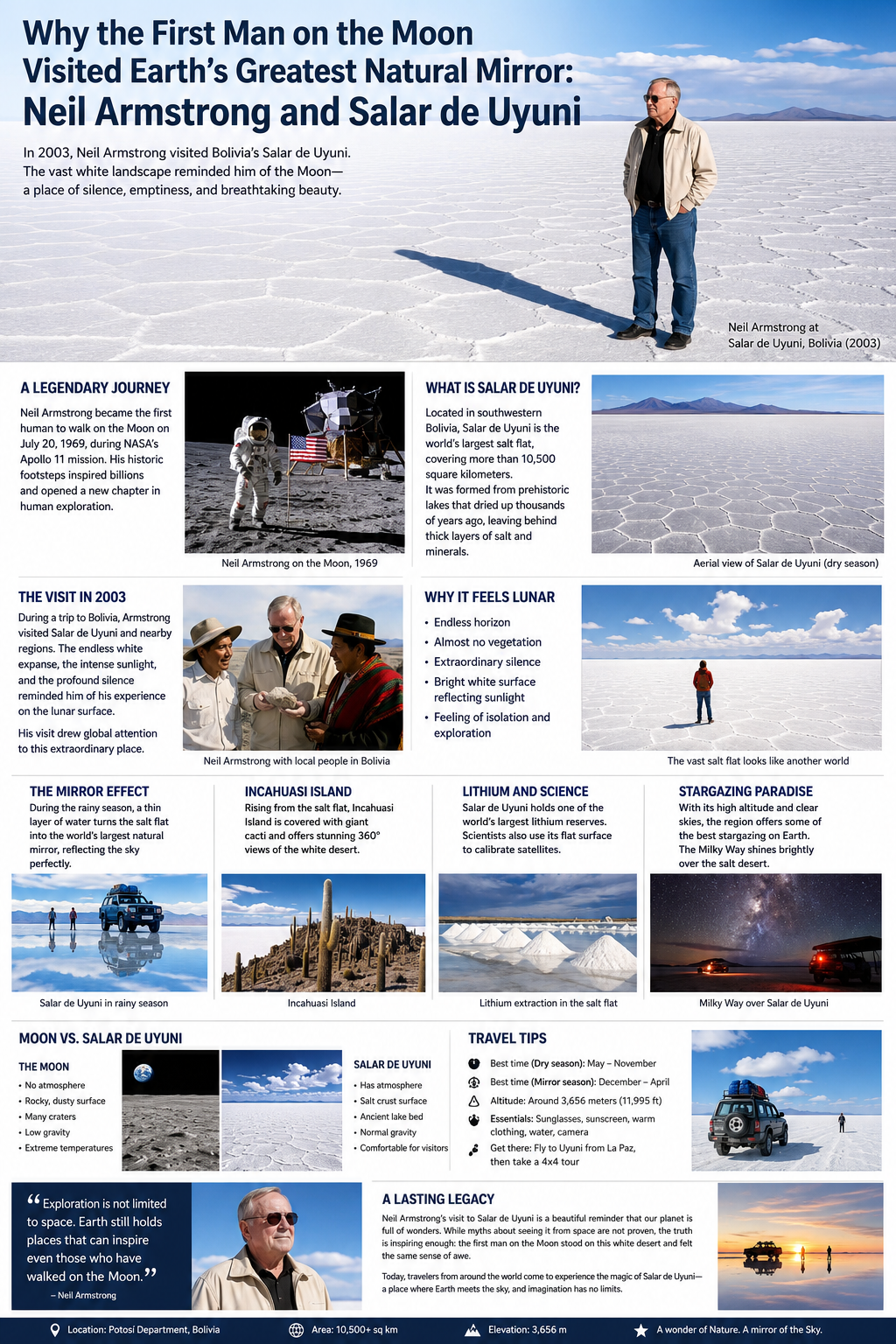
Why the First Man on the Moon Visited Earth’s Greatest Natural Mirror: Neil Armstrong and Salar de Uyuni
Introduction
When people hear the name Neil Armstrong, they immediately think of the Moon. On July 20, 1969, Armstrong became the first human being to walk on the lunar surface, making history with the famous words, “That’s one small step for man, one giant leap for mankind.”
More than three decades later, the legendary astronaut stood in another extraordinary landscape—not on the Moon, but on Earth. In 2003, Armstrong visited Salar de Uyuni in Bolivia, the world’s largest salt flat. Stretching farther than the eye can see, this dazzling white landscape has often been described as one of the most surreal places on the planet.
Although a popular internet story claims Armstrong first noticed Salar de Uyuni from space and later traveled there because of it, there is no reliable historical evidence supporting that claim. What is true is that Armstrong visited the salt flats during a trip to Bolivia, and reports from that visit say the landscape reminded him of the Moon. His visit also brought additional international attention to one of Earth’s most remarkable natural wonders.
This is the fascinating story of Neil Armstrong and the breathtaking Salar de Uyuni.
A Man Who Changed Human History
Neil Armstrong was born on August 5, 1930, in Ohio, USA. Fascinated by aviation from childhood, he became a naval aviator, test pilot, engineer, and eventually an astronaut.
In 1969, Armstrong commanded Apollo 11, the mission that achieved humanity’s dream of landing on the Moon. Millions of people watched as he descended the lunar module’s ladder and became the first person ever to walk on another world.
Few people in history have experienced the Moon firsthand. That unique perspective makes Armstrong’s later impressions of Earth’s extraordinary landscapes especially interesting.
Discovering Bolivia’s Greatest Natural Wonder
In 2003, Armstrong visited Bolivia as part of a cultural and scientific tour. During the trip, he explored Salar de Uyuni, located high in the Andes Mountains.
The immense salt flat impressed him with its endless horizon, brilliant white surface, and overwhelming sense of silence. According to accounts of the visit, Armstrong remarked that the place reminded him of the Moon.
His observation captured imaginations around the world because it came from someone who had actually walked on the lunar surface.
What Is Salar de Uyuni?
Salar de Uyuni covers more than 10,500 square kilometers (about 4,050 square miles), making it the largest salt flat on Earth.
Millions of years ago, the region was covered by enormous prehistoric lakes. As those lakes gradually evaporated, they left behind vast layers of salt and minerals. Today, the result is an almost perfectly flat white plain that seems to stretch forever.
During the rainy season, a thin layer of water transforms the salt flat into a giant natural mirror, perfectly reflecting the sky. This incredible phenomenon has made Salar de Uyuni one of the world’s most photographed landscapes.
Why It Feels Like Another Planet
Standing in the middle of Salar de Uyuni is unlike almost any experience on Earth.
The horizon appears endless.
There are almost no buildings.
There are very few trees.
The silence is remarkable.
The bright white surface reflects sunlight in every direction.
These qualities create a dreamlike atmosphere that many visitors describe as “walking on another planet.”
For Neil Armstrong, who had actually experienced the Moon’s barren landscape, the comparison was especially meaningful.
Similarities Between the Moon and Salar de Uyuni
Although they are scientifically very different, both places share certain visual characteristics.
The landscapes seem endless.
Both feel isolated from civilization.
The ground appears almost featureless over great distances.
The quiet environment creates a powerful emotional experience.
Strong sunlight produces dramatic contrasts and reflections.
These similarities explain why many people compare Salar de Uyuni to the Moon, even though the two environments are fundamentally different.
Important Differences
Despite the comparison, Salar de Uyuni is not a miniature Moon.
The Moon has no atmosphere.
There is no liquid water.
Its surface consists mainly of rock and dust created by meteor impacts.
Gravity is only one-sixth that of Earth.
Temperatures change dramatically between day and night.
Salar de Uyuni, on the other hand, has breathable air, changing weather, seasonal water, wildlife in surrounding areas, and a thick crust of salt formed by ancient lakes.
The resemblance is primarily visual and emotional rather than geological.
The World’s Largest Natural MirrorOne of Salar de Uyuni’s greatest attractions occurs during the rainy season.
A thin layer of rainwater covers the salt flat, creating one of the most perfect natural mirrors on Earth.
Clouds appear beneath your feet.
Mountains seem to float.
People look as though they are walking across the sky.
The line separating Earth and heaven almost disappears.
Photographers travel from every continent to capture this magical scene.
A Paradise for Creative Photography
The flat surface and endless horizon make perspective photography easy and fun.
Visitors create images showing people balancing on bottles, hiding inside shoes, holding giant objects, or interacting with miniature-looking friends.
These playful photographs have helped make Salar de Uyuni famous across social media and travel magazines.
Scientific Importance
Beyond its beauty, Salar de Uyuni is extremely important scientifically.
The salt flat contains one of the world’s largest known lithium resources.
Lithium is essential for rechargeable batteries used in smartphones, laptops, electric vehicles, and renewable energy storage.
Scientists also use the remarkably flat surface to calibrate satellites because it provides an excellent natural reference point.
This makes Salar de Uyuni valuable not only for tourism but also for science and technology.
Wildlife Around the Salt Flat
Although the central salt flat appears lifeless, the surrounding region supports fascinating wildlife.
Pink flamingos gather in nearby lagoons.
Vicuñas roam the high plains.
Foxes, llamas, and many bird species inhabit the Altiplano.
These animals thrive in one of South America’s most extreme environments.
Why Armstrong’s Visit Inspired People
Neil Armstrong rarely sought publicity after the Apollo missions.
He preferred a quiet life, making his travels particularly interesting to the public.
His visit to Bolivia reminded people that exploration is not limited to space.
Even after walking on the Moon, Armstrong continued discovering extraordinary places here on Earth.
That message continues to inspire travelers, scientists, photographers, and dreamers.
Separating Myth from Fact
Over the years, social media has circulated dramatic stories claiming Armstrong first spotted Salar de Uyuni from space because of its bright white appearance.
However, no reliable NASA documents, Apollo mission records, or verified interviews support this claim.
Similarly, there is no evidence that the world only learned about Salar de Uyuni after Armstrong visited.
In reality, geologists, scientists, explorers, and travelers had known about the salt flat long before 2003.
Nevertheless, Armstrong’s visit added another fascinating chapter to the history of this remarkable destination and introduced many new people to its beauty.
Visiting Salar de Uyuni Today
Thousands of tourists visit every year.
The dry season offers easy driving across the salt flats and excellent perspective photography.
The rainy season creates the famous mirror effect that has become one of the world’s most iconic natural sights.
Visitors should prepare for high altitude, intense sunlight, cold nights, and rapidly changing weather.
Proper sunglasses, sunscreen, warm clothing, and plenty of water are essential.
A Place That Inspires Wonder
Whether viewed through the eyes of an astronaut, scientist, photographer, or traveler, Salar de Uyuni is unforgettable.
Its endless white landscape reminds us that Earth still holds places capable of surprising even those who have explored outer space.
Neil Armstrong’s visit symbolizes humanity’s endless curiosity. From the dusty surface of the Moon to the shimmering salt plains of Bolivia, exploration continues to reveal the beauty of our universe.
Conclusion
Neil Armstrong’s footsteps on the Moon changed history forever. Decades later, his journey to Salar de Uyuni showed that some of the world’s most astonishing landscapes are found right here on Earth.
While popular myths exaggerate the connection between Armstrong and the salt flats, the true story is inspiring enough. A man who had walked on another world stood in Bolivia’s vast white wilderness and was reminded of the Moon.
Salar de Uyuni remains one of Earth’s greatest natural wonders—a place where science, history, photography, and imagination come together. Whether you dream of space exploration or simply love breathtaking destinations, this incredible landscape deserves a place on your travel bucket list.
Sometimes, the closest place to the Moon isn’t in space at all—it’s waiting quietly on the high plains of Bolivia, reflecting the sky like a giant natural mirror and reminding us that our own planet is full of extraordinary wonders.

Post Comment