Vincent Gaddis “Bermuda Triangle” Phrase Was Invented: The Real Story Behind the World’s Most Famous Maritime Mystery
Introduction
The Bermuda Triangle is one of the most famous mysteries in modern history. Millions of people have heard stories about ships disappearing without a trace, airplanes vanishing into thin air, and strange forces supposedly operating in a region of the Atlantic Ocean. Movies, documentaries, books, and television shows have transformed the Bermuda Triangle into a global legend.
But there is one fascinating question that many people never ask:
Who actually invented the phrase “Bermuda Triangle”?
Surprisingly, the term is much younger than most people think. Sailors had crossed these waters safely for centuries, and there was no ancient legend describing the area as a cursed triangle. The phrase itself was created in the 20th century by writers and journalists who connected unrelated disappearances into one dramatic story.
This article explores how the phrase “Bermuda Triangle” was invented, who popularized it, why the myth spread around the world, and what historians and scientists say about the mystery today.
—
Before the Name Existed
Long before anyone called it the Bermuda Triangle, ships regularly sailed through the western Atlantic Ocean.
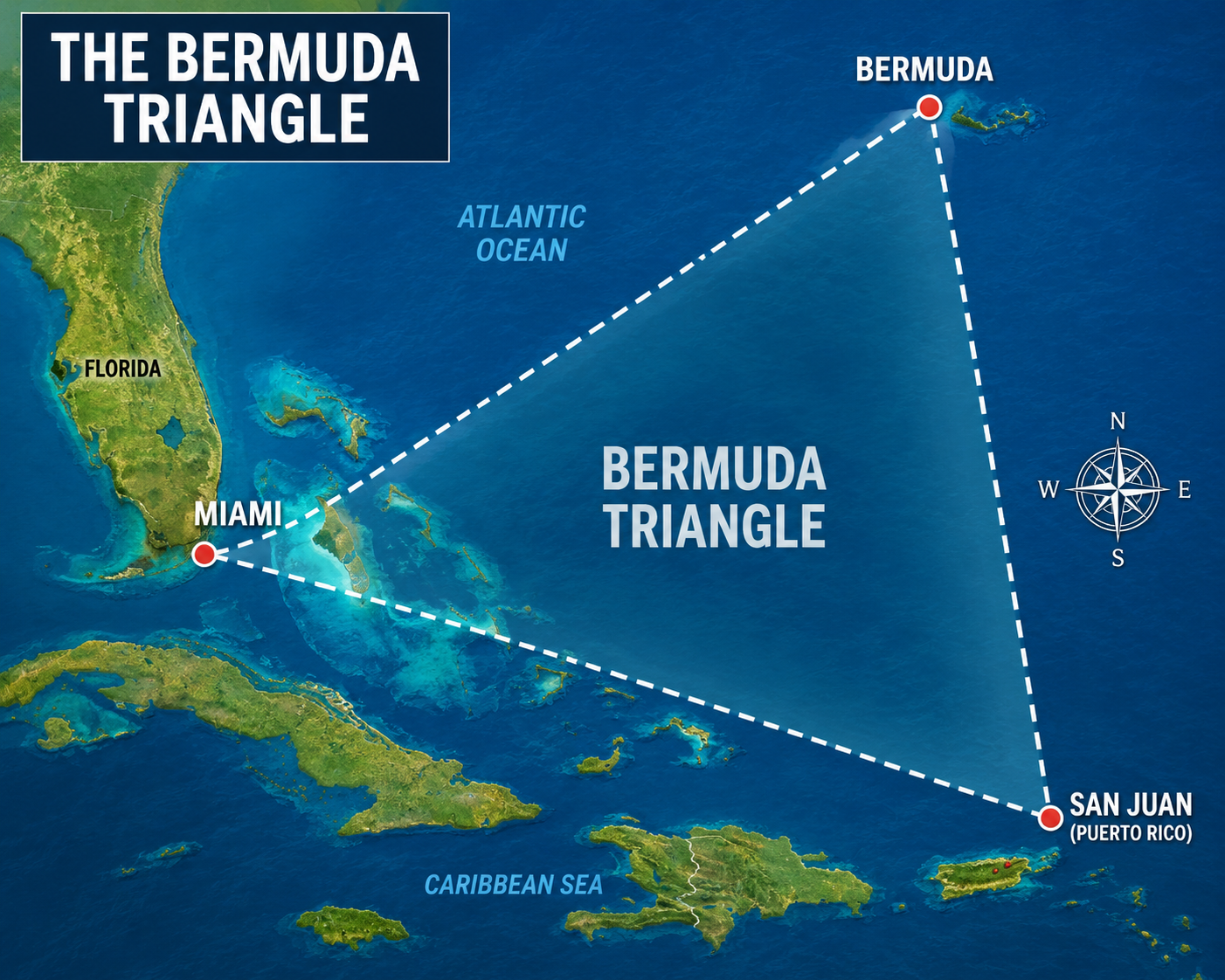
The region lies roughly between:
– Bermuda
– Miami, Florida
– San Juan, Puerto Rico
These waters were important shipping routes connecting North America, the Caribbean, and Europe.
Famous explorers, including Christopher Columbus, crossed this region during the Age of Exploration. Although Columbus described unusual compass readings and mysterious lights in his journals, he never suggested the area was cursed or unusually dangerous.
For hundreds of years, sailors regarded storms, hurricanes, reefs, and navigation errors as the primary dangers—not supernatural forces.
—
Early Maritime Disappearances
Throughout history, ships occasionally disappeared at sea.
This was not unusual.
Before modern navigation systems, captains faced:
– Powerful hurricanes
– Giant waves
– Hidden reefs
– Compass errors
– Mechanical failures
– Human mistakes
Because vast oceans leave little evidence after accidents, many disappearances remained unexplained.
However, these incidents were not connected into one mystery until much later.
—
The Flight 19 Incident
One event would eventually become the foundation of the Bermuda Triangle legend.
On December 5, 1945, five U.S. Navy TBM Avenger torpedo bombers departed from Florida for a routine training mission.
The flight, known as Flight 19, encountered navigation problems after its leader became disoriented.
Radio messages revealed growing confusion.
Eventually, communication stopped.
The aircraft were never found.
A rescue plane sent to search for Flight 19 also exploded shortly after takeoff, likely because of a fuel vapor explosion, adding another mysterious chapter to the story.
Although military investigations suggested navigational errors and poor weather were responsible, the disappearance captured public imagination.
—
The First Writer to Build the Mystery
The first major step toward creating the Bermuda Triangle myth came in 1950.
Journalist Edward Van Winkle Jones wrote an article for the Associated Press discussing several mysterious disappearances in the Atlantic Ocean.
Rather than claiming supernatural causes, Jones simply noted that multiple incidents had occurred in roughly the same region.
His article attracted attention because it grouped separate accidents into a single narrative.
This was the beginning of the legend.
—
George X. Sand Changes Everything
In 1952, writer George X. Sand published an article titled “Sea Mystery at Our Back Door” in Fate magazine.
This article became one of the most influential works in Bermuda Triangle history.
Sand discussed several disappearances, including Flight 19, and suggested the area contained an unusual mystery.
Although he never used the phrase “Bermuda Triangle,” he laid the foundation for later writers by linking multiple incidents together.
His dramatic storytelling captured readers’ imaginations.
—
Vincent Gaddis Coins the Phrase
The phrase “Bermuda Triangle” was officially introduced by writer Vincent Gaddis.
In February 1964, Gaddis published an article in Argosy magazine titled:
“The Deadly Bermuda Triangle.”
This article became historic because it was the first major publication to describe the mysterious region using the now-famous name.
Gaddis selected three locations:
– Miami
– Bermuda
– Puerto Rico
When connected on a map, they formed a rough triangle.
The name was simple, memorable, and dramatic.
Readers immediately remembered it.
Within a few years, newspapers and magazines around the world began repeating the phrase.
—
Why the Name Was Brilliant
The phrase “Bermuda Triangle” succeeded because it combined three powerful storytelling elements.
First, it identified a real geographic location.
Second, the word “Triangle” sounded mysterious and symbolic.
Throughout history, triangles have often appeared in myths, religion, and folklore.
Finally, the phrase was short and easy to remember.
People could instantly imagine a dangerous zone hidden in the Atlantic Ocean.
Good branding transformed scattered accidents into one unforgettable legend.
—
Charles Berlitz Makes It a Worldwide Phenomenon
Although Gaddis invented the phrase, it was author Charles Berlitz who made it famous worldwide.
In 1974, Berlitz published the bestselling book “The Bermuda Triangle.”
The book sold millions of copies and was translated into numerous languages.
Berlitz suggested many extraordinary explanations:
– Alien abductions
– Lost civilizations
– Atlantis
– Magnetic anomalies
– Time warps
– Unknown energy fields
The sensational claims fascinated readers.
Television programs soon adapted these ideas, turning the Bermuda Triangle into a global cultural phenomenon.
—
The Media Fuels the Myth
During the 1970s and 1980s, newspapers, magazines, television documentaries, and Hollywood films embraced the mystery.
Many reports emphasized unexplained disappearances while ignoring ordinary accidents or successful voyages.
As a result, people believed the Bermuda Triangle was far more dangerous than it actually was.
The legend spread faster than the facts.
—
Scientific Explanations
Scientists have carefully examined many Bermuda Triangle incidents.
Most cases can be explained by ordinary causes.
These include:
Hurricanes
The Atlantic experiences frequent hurricanes capable of sinking ships and crashing aircraft.
Gulf Stream
The powerful Gulf Stream can quickly carry away floating wreckage, making accidents difficult to investigate.
Human Error
Navigation mistakes remain one of the leading causes of maritime accidents.
Equipment Failure
Mechanical problems have caused numerous disappearances throughout aviation history.
Weather
Sudden storms can develop rapidly in tropical regions.
None of these explanations require supernatural forces.
—
Debunking the Legend
Research by historians and investigators has shown that many famous Bermuda Triangle stories were exaggerated.
Some incidents supposedly occurring inside the triangle actually happened hundreds of miles away.
Others involved storms that were omitted from popular retellings.
Some ships listed as “missing forever” were eventually found.
Writers often repeated earlier mistakes without checking original records.
This gradually created a legend that became larger than reality.
—
The U.S. Coast Guard’s Position
The United States Coast Guard does not recognize the Bermuda Triangle as an unusually dangerous region.
According to maritime authorities, accident rates in the area are comparable to other heavily traveled parts of the ocean.
There is no official evidence supporting claims of paranormal activity.
The Coast Guard attributes most incidents to natural hazards, weather, and human error.
—
Why People Love the Mystery
Despite scientific explanations, the Bermuda Triangle continues to fascinate millions.
Humans naturally enjoy mysteries.
Stories involving unknown forces, hidden civilizations, or unexplained disappearances stimulate curiosity.
The Bermuda Triangle combines adventure, fear, exploration, and imagination into one compelling narrative.
Even people who do not believe in paranormal explanations often enjoy discussing the mystery.
—
The Power of a Name
The history of the Bermuda Triangle demonstrates how powerful language can be.
Before 1964, these incidents were isolated maritime accidents.
After Vincent Gaddis introduced the phrase “Bermuda Triangle,” they became part of a single worldwide mystery.
A memorable name transformed history.
The legend shows how journalism, books, media, and popular culture can shape public perception for generations.
Post Comment