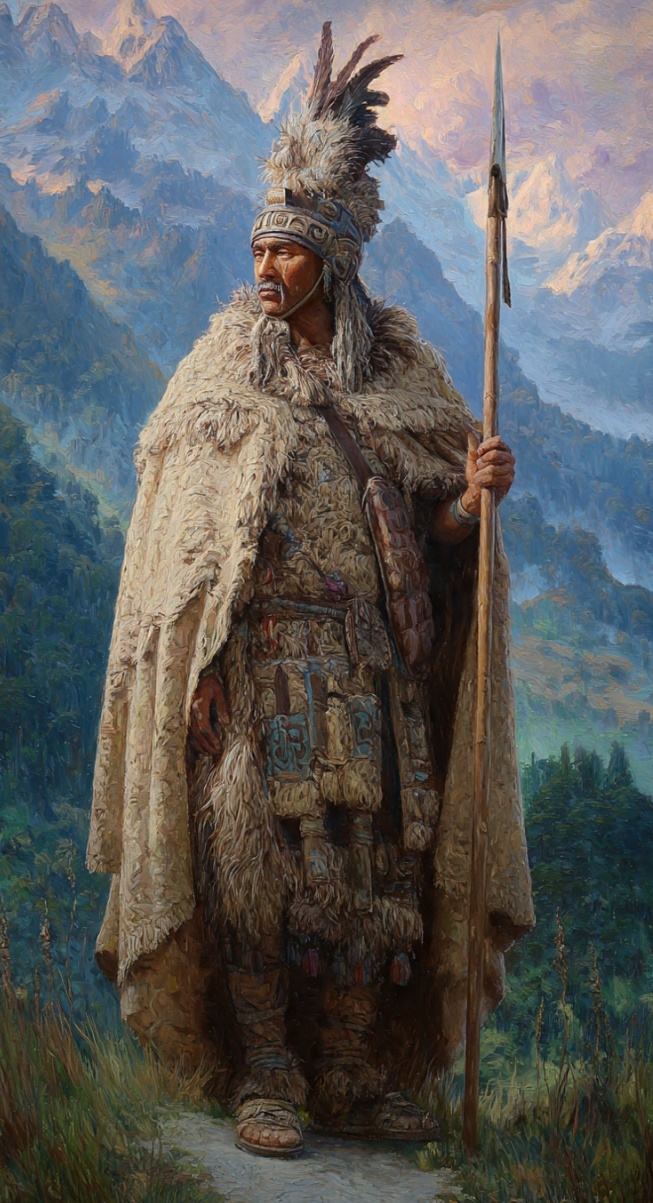
Caupolicán: The Legendary Mapuche Leader Who Defied the Spanish Empire
Introduction
Throughout history, countless leaders have fought to protect their people from invasion and oppression. Among the greatest Indigenous heroes of the Americas is Caupolicán, the fearless military leader of the Mapuche people in present-day Chile. During the sixteenth century, when the powerful Spanish Empire expanded across South America, many civilizations fell within a few years. The Mapuche, however, resisted with remarkable determination, and one of the most important reasons for their resilience was the leadership of Caupolicán.
His courage, determination, and willingness to sacrifice everything for his people transformed him into a legendary figure. Even today, more than 450 years after his death, Caupolicán is remembered as a symbol of freedom, resistance, and national pride.
This article explores his early life, the culture of the Mapuche people, and the events that shaped him into one of history’s most respected Indigenous leaders.
Who Were the Mapuche?
To understand Caupolicán, it is important to first understand the people he fought to protect.
The Mapuche are one of the oldest Indigenous peoples of southern Chile and parts of Argentina. Their name means “People of the Land,” reflecting their deep connection with nature, forests, rivers, and mountains. They lived in independent communities rather than a centralized empire.
Unlike the Inca Empire to the north, the Mapuche had no emperor. Each community was led by respected local chiefs. During times of war, these communities united under a temporary military leader called a toqui, chosen for bravery, intelligence, and leadership.
The Mapuche economy depended on farming, hunting, fishing, and trading. They cultivated maize, potatoes, beans, and squash while raising llamas and other animals. Their warriors were known for their speed, adaptability, and knowledge of the rugged landscape.
Spanish Arrival in Chile
In the early 1500s, Spanish explorers arrived in South America seeking gold, silver, and new territories for the Spanish Crown.
Following the conquest of the Inca Empire, conquistadors pushed farther south into present-day Chile. They expected another quick victory. Instead, they encountered the determined Mapuche.
Unlike many other Indigenous nations, the Mapuche refused to surrender. Every attempt by the Spanish to establish permanent control met fierce resistance.
This conflict became known as the Arauco War, one of the longest wars in the history of the Americas.
The Early Life of Caupolicán
Very little is known about Caupolicán’s childhood because the Mapuche passed down their history through oral tradition rather than written records.
Historians believe he was born in the early sixteenth century somewhere in southern Chile.
From a young age, he likely learned essential survival skills, including hunting, tracking, horseback riding, and combat with traditional weapons such as spears, clubs, bows, and stone axes.
Mapuche children were taught that protecting their families and their land was a sacred duty. These values shaped Caupolicán into a disciplined and courageous warrior.
As he matured, he earned the respect of other warriors because of his physical strength, wisdom, and leadership qualities.
Becoming a Respected Warrior
Long before becoming the Mapuche military leader, Caupolicán had already established himself as an exceptional fighter.
Spanish chroniclers frequently described Mapuche warriors as disciplined and fearless opponents.
Caupolicán participated in numerous battles during the early years of the Arauco War, gaining valuable experience in guerrilla tactics. The Mapuche often avoided direct confrontation with heavily armored Spanish soldiers. Instead, they relied on ambushes, surprise attacks, and their superior knowledge of forests, rivers, and mountain passes.
These methods helped them challenge one of the world’s most powerful military empires.
The Legendary Test of Strength
One of the most famous stories associated with Caupolicán tells of the contest used to select the next toqui.
According to tradition, candidates were required to hold a massive tree trunk on their shoulders for an extended period.
While historians debate whether this event happened exactly as described, the story has become one of the best-known legends in Chilean history.
It is said that Caupolicán carried the enormous log for two days and two nights without giving up, proving not only his extraordinary physical strength but also his endurance and determination.
The assembled chiefs then selected him as the new military leader of the Mapuche people.
Whether entirely historical or partly legendary, this story symbolizes the qualities the Mapuche admired most—strength, perseverance, and unwavering commitment to the community.
The Death of Lautaro
Before Caupolicán became the principal military leader, another remarkable Mapuche commander inspired resistance against Spain: Lautaro.
Lautaro had once served the Spanish and learned their military tactics before escaping to lead his own people. His victories shocked the conquistadors and proved they could be defeated.
However, in 1557, Lautaro was killed during battle.
His death was a devastating blow to the Mapuche resistance.
The responsibility for continuing the struggle soon fell upon Caupolicán.
At a time when many believed Spanish victory was inevitable, he accepted the enormous challenge of leading his people through one of the most dangerous periods in their history.
Preparing for Leadership
As the newly chosen toqui, Caupolicán faced an experienced enemy equipped with steel weapons, firearms, horses, and trained soldiers.
Yet he understood that the Mapuche possessed advantages of their own.
They knew the land better than any invader.
They could move quickly through forests and mountains.
Most importantly, they were united by their determination to remain free.
Caupolicán reorganized his warriors, strengthened alliances among different Mapuche communities, and prepared for the next phase of the Arauco War.
His leadership would soon be tested in some of the fiercest battles ever fought in colonial Chile.
Caupolicán Takes Command
After the death of Lautaro in 1557, the Mapuche people faced one of the most difficult moments in their history. Losing such a brilliant commander could have weakened the resistance, but the selection of Caupolicán as the new toqui gave the warriors renewed hope.
As military leader, Caupolicán inherited an enormous challenge. The Spanish Empire possessed steel swords, firearms, cannons, horses, and experienced soldiers. The Mapuche, on the other hand, relied on traditional weapons, intimate knowledge of the land, and an unbreakable determination to defend their freedom.
Rather than copying Spanish tactics, Caupolicán focused on the strengths of his own people. He encouraged cooperation among different Mapuche communities, improved communication between warriors, and relied on surprise attacks that made full use of forests, rivers, and mountains.
The Arauco War Intensifies
By the late 1550s, the Arauco War had become one of the fiercest colonial conflicts in the Americas.
Spanish settlements continued to expand into Mapuche territory, building forts to secure newly claimed land. These forts became frequent targets of Mapuche attacks. Caupolicán understood that destroying isolated strongholds could slow Spanish expansion and weaken their control over southern Chile.
Mapuche warriors often attacked at dawn or under the cover of darkness. They moved quickly, struck unexpectedly, and disappeared into difficult terrain before Spanish reinforcements could arrive.
These tactics frustrated the conquistadors, who found it difficult to defeat an enemy that refused to fight on their terms.
Battles Against García Hurtado de Mendoza
One of Caupolicán’s principal opponents was García Hurtado de Mendoza, the newly appointed Spanish governor of Chile. Mendoza arrived with fresh troops, better supplies, and a determination to crush the Mapuche resistance.
Several fierce battles followed. Although the Spanish possessed superior weapons, they frequently suffered heavy losses because the Mapuche fought with extraordinary courage and knew the landscape far better than their enemies.
Caupolicán’s leadership inspired his warriors to continue fighting despite repeated hardships. His ability to unite different communities was one of his greatest achievements, allowing the resistance to continue even after difficult defeats.
The Siege of Forts
Recognizing that Spanish forts threatened Mapuche independence, Caupolicán launched attacks against several defensive positions.
The Mapuche surrounded some forts, cutting off supplies and forcing Spanish soldiers into desperate situations. Although these sieges did not always end in victory, they demonstrated that Spanish control remained fragile.
The conflict became a war of endurance rather than a series of decisive battles. Neither side could easily eliminate the other, and the struggle continued year after year.
Leadership Beyond the Battlefield
Caupolicán was more than a warrior. He was also a leader who understood the importance of unity.
The Mapuche were organized into independent communities, each with its own local chief. Bringing these groups together required diplomacy, trust, and respect.
Caupolicán encouraged cooperation while allowing each community to preserve its traditions and independence. His leadership strengthened the overall resistance and made it far more difficult for the Spanish to divide the Mapuche.
His example demonstrated that courage alone was not enough—successful leadership also required patience, wisdom, and the ability to inspire others.
The Betrayal and Capture
Despite his military skill, Caupolicán eventually fell into Spanish hands.
Historical accounts differ regarding the exact circumstances of his capture. Many historians believe he was betrayed by individuals who revealed his location to the Spanish.
Spanish forces launched a surprise attack while he was staying with a small group of followers. Outnumbered and unable to escape, Caupolicán was captured after resisting fiercely.
For the Spanish, capturing the famous Mapuche leader represented an important psychological victory. They hoped that his imprisonment would discourage further resistance.
Instead, the opposite happened.
His courage during captivity strengthened his reputation among the Mapuche and inspired future generations to continue defending their homeland.
Refusing to Surrender
Spanish authorities expected Caupolicán to submit to colonial rule and encourage his people to surrender.
He refused.
Even as a prisoner, he remained loyal to the Mapuche cause. His unwavering commitment impressed both supporters and enemies alike.
Spanish chroniclers acknowledged his bravery, recognizing that he possessed exceptional determination despite facing certain death.
His refusal to abandon his principles transformed him from a military commander into a lasting symbol of resistance.
The Final Days
Following his capture, Spanish officials sentenced Caupolicán to death.
Historical records describe his final days with varying details, but they agree on one essential fact: he met his fate with remarkable courage.
According to traditional accounts, he faced execution without fear, maintaining the dignity expected of a Mapuche leader.
His death was intended to intimidate the Indigenous population. Instead, it elevated him to legendary status.
Stories of his bravery spread throughout Mapuche communities, ensuring that his sacrifice would never be forgotten.
A Legacy That Could Not Be Defeated
Although the Spanish executed Caupolicán, they failed to achieve their ultimate goal.
The Mapuche resistance continued for centuries.
Spanish settlements remained under constant pressure, and large portions of Mapuche territory stayed beyond effective colonial control for generations.
Caupolicán’s life demonstrated that true leadership is measured not only by victories in battle but also by the ability to inspire people to defend their identity, culture, and freedom.
His name became synonymous with resilience, courage, and the determination to resist overwhelming odds.
A Symbol of Indigenous Resistance
Although Caupolicán was executed in 1558, his story did not end with his death. Instead, his courage became an enduring symbol of Indigenous resistance in Chile. The Spanish hoped that executing the Mapuche leader would break the spirit of his people. Instead, it strengthened their determination to continue fighting for their homeland.
The Arauco War continued for centuries after Caupolicán’s death. Despite Spain’s military power, the Mapuche successfully defended much of their territory, making them one of the few Indigenous nations in the Americas to resist long-term European conquest.
Today, Caupolicán is remembered not only as a warrior but also as a symbol of freedom, dignity, and perseverance.
Post Comment