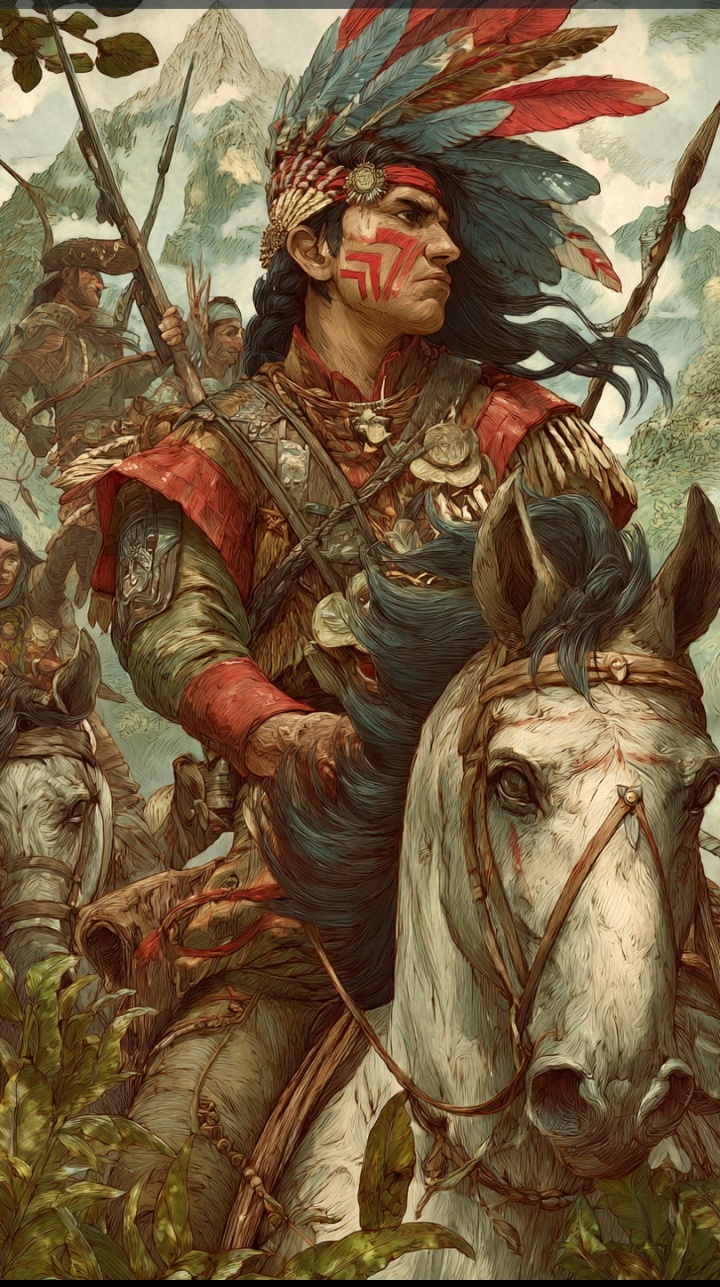
Lautaro: The Mapuche Warrior Who Defied the Spanish Empire
Introduction
Throughout history, many leaders have fought for the freedom of their people against powerful empires. Among South America’s greatest indigenous heroes is Lautaro, the legendary Mapuche warrior who led a determined resistance against Spanish conquistadors in 16th-century Chile. Although he lived for only about two decades, his courage, leadership, and military brilliance left a lasting mark on Chilean history.
Today, Lautaro is remembered as a symbol of independence, resilience, and the determination to protect one’s homeland. His story continues to inspire people around the world.
—
Early Life
Lautaro, whose Mapuche name was Leftraru (“swift hawk”), was born around 1534 in southern Chile. He belonged to the Mapuche people, an indigenous nation known for its strong traditions and fierce defense of their land.
As a young boy, Lautaro grew up learning traditional Mapuche customs, including horse riding, hunting, and survival skills. These experiences prepared him for the challenges that lay ahead.
—
Captured by the Spanish
When the Spanish conquistadors arrived in Chile under Pedro de Valdivia, they sought to conquer the region and force the indigenous people into submission.
During one of the Spanish campaigns, Lautaro was captured and made to serve Pedro de Valdivia. As a servant, he observed the Spanish army closely, learning their military tactics, cavalry formations, and weapons. Instead of losing hope, he quietly gathered knowledge that would later change history.
Eventually, Lautaro escaped and returned to his people.
—
Becoming a Military Leader
After returning home, Lautaro shared everything he had learned about Spanish warfare. His intelligence and leadership impressed the Mapuche chiefs, who chose him as a Toqui, or military commander.
Lautaro introduced new training methods, organized disciplined forces, and taught the Mapuche how to fight against Spanish cavalry using carefully planned tactics.
—
The Battle of Tucapel
In 1553, Lautaro led the Mapuche warriors at the Battle of Tucapel. His forces successfully defeated the Spanish army.
During the battle, Pedro de Valdivia was captured and died soon afterward. The victory shocked the Spanish Empire and proved that the Mapuche could successfully resist European conquest.
The Battle of Tucapel became one of the most important victories in the history of indigenous resistance in South America.
—
Continuing the Resistance
After Tucapel, Lautaro continued to lead campaigns against Spanish settlements. He inspired thousands of warriors and won several victories through careful planning, surprise attacks, and knowledge of the local landscape.
Although the Spanish possessed better weapons and armor, Lautaro demonstrated that courage, strategy, and unity could overcome many disadvantages.
—
Death of Lautaro
In 1557, while leading another campaign, Lautaro’s camp was surprised by Spanish forces at the Battle of Mataquito.
Despite fighting bravely, Lautaro was killed at only about 22 years of age. His death was a major loss for the Mapuche resistance, but his legacy lived on as the struggle against Spanish rule continued for centuries.
—
Leadership Qualities
Lautaro is remembered for several remarkable qualities:
– Exceptional military intelligence
– Courage in the face of overwhelming odds
– Strong leadership
– Strategic innovation
– Dedication to protecting his people
His ability to learn from his enemies and adapt those lessons made him one of history’s most respected indigenous military leaders.
—
Lautaro’s Legacy
Today, Lautaro is celebrated throughout Chile. His name appears on schools, streets, monuments, and public institutions. Historians recognize him as one of South America’s greatest indigenous heroes.
His life reminds us that freedom often requires determination, sacrifice, and unity.
—
Interesting Facts
– His original Mapuche name was Leftraru.
– He became a military commander while still very young.
– He learned Spanish military tactics while serving Pedro de Valdivia.
– He led the famous victory at the Battle of Tucapel in 1553.
– He remains a national symbol of courage in Chile.
—
Conclusion
Lautaro’s life is one of the most inspiring stories in Latin American history. Rising from captivity to become a brilliant military commander, he proved that knowledge, courage, and determination could challenge even the most powerful empire.
Although he died young, Lautaro’s achievements continue to inspire generations. His legacy stands as a powerful reminder that the fight for freedom and dignity can leave an impact that lasts for centuries.
Post Comment