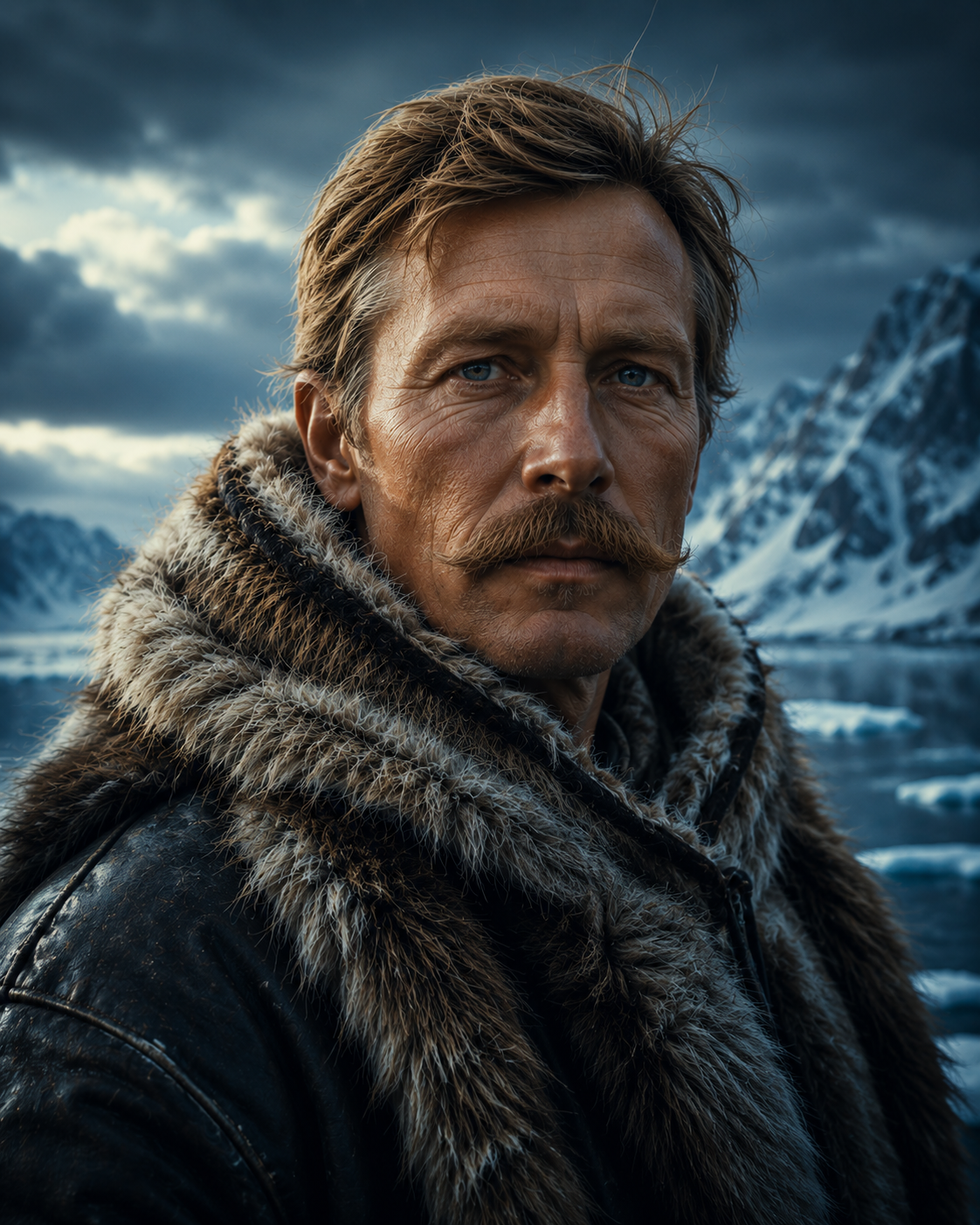
Knud Rasmussen: The Legendary Arctic Explorer Who Preserved Inuit Culture
Introduction
The history of Arctic exploration is filled with stories of courage, survival, and discovery. Among the greatest explorers of all time, Knud Rasmussen stands out for his extraordinary achievements and his deep respect for the Indigenous peoples of the Arctic. Unlike many explorers who focused only on mapping unknown lands, Rasmussen dedicated much of his life to understanding and preserving the traditions, languages, and stories of the Inuit.
Known as the “Father of Eskimology,” Knud Rasmussen made some of the most remarkable journeys ever undertaken across the frozen Arctic. Traveling thousands of kilometers by dog sled, he documented cultures that were changing rapidly due to outside influence. His work continues to inspire historians, anthropologists, explorers, and anyone fascinated by the polar regions.
Early Life
Knud Johan Victor Rasmussen was born on June 7, 1879, in Jakobshavn (now Ilulissat), Greenland. His father was Danish, while his mother had Inuit and Danish ancestry. Growing up in Greenland allowed Rasmussen to experience both European and Inuit cultures from an early age.
He learned the Greenlandic language alongside Danish and spent much of his childhood hunting, fishing, and traveling with Inuit communities. These experiences helped him develop exceptional survival skills and a lifelong respect for Arctic traditions.
Later, Rasmussen moved to Denmark for his education. Although he lived in Europe, Greenland remained close to his heart, and he dreamed of returning to explore its vast icy landscapes.
A Passion for Exploration
After completing his education, Rasmussen began organizing expeditions into northern Greenland. He believed that exploration should involve learning from the people who had lived in the Arctic for thousands of years.
Instead of treating the Inuit merely as guides, Rasmussen considered them teachers and partners. He admired their knowledge of navigation, hunting, weather, and survival in one of Earth’s harshest environments.
The Thule Trading Station
In 1910, Rasmussen and his friend Peter Freuchen established the Thule Trading Station in northwestern Greenland. The station became a center for trade, scientific research, and Arctic exploration.
From Thule, Rasmussen launched a series of famous journeys known as the Thule Expeditions. These expeditions transformed the world’s understanding of the Arctic and Inuit civilization.
The Famous Thule Expeditions
Between 1912 and 1933, Rasmussen led seven Thule Expeditions.
Each expedition had different scientific goals, including:
– Mapping unexplored Arctic regions.
– Studying Inuit languages.
– Recording myths and legends.
– Collecting archaeological evidence.
– Understanding migration across the Arctic.
These missions combined geography, anthropology, archaeology, and history, making them some of the most important scientific expeditions of the twentieth century.
The Fifth Thule Expedition
Rasmussen’s greatest achievement came during the Fifth Thule Expedition (1921–1924).His objective was to discover whether Inuit communities across Greenland, Canada, and Alaska shared common origins. Traveling mostly by dog sled, Rasmussen covered more than 18,000 kilometers (11,000 miles).
He became the first European to cross the Northwest Passage entirely by dog sled.
Along the way, he visited numerous Inuit settlements, carefully documenting their traditions, beliefs, songs, and stories. His records remain invaluable today because many of these oral traditions might otherwise have been lost.
Respect for Inuit Culture
One of Rasmussen’s greatest strengths was his respect for Indigenous knowledge.
Unlike many explorers of his time, he believed Inuit culture deserved careful study and preservation. He learned directly from elders, hunters, and storytellers, recording hundreds of legends and traditions.
His writings showed that the Arctic was not an empty wilderness but a homeland rich in history, culture, and human achievement.
Scientific Contributions
Rasmussen’s work made major contributions to several fields:
– Anthropology
– Ethnography
– Archaeology
– Geography
– Arctic history
His research helped scholars better understand the relationships among Inuit communities across the Arctic.
Many modern researchers continue to use the information Rasmussen collected more than a century ago.
Books and Publications
Knud Rasmussen wrote several books describing his expeditions and the cultures he encountered.
Among his best-known works are:
– Across Arctic America
– Intellectual Culture of the Iglulik Eskimos
– The People of the Polar North
These books introduced readers around the world to Arctic life through vivid storytelling and careful observation.
Challenges of Arctic Exploration
Traveling across the Arctic was never easy.
Rasmussen and his companions faced:
– Temperatures below –40°C
– Blizzards
– Sea ice
– Hunger
– Dangerous wildlife
– Months of darkness
Dog sleds were their primary transportation, and survival depended on teamwork, local knowledge, and careful planning.
Final Years
During his later years, Rasmussen continued writing and lecturing about the Arctic.
In 1933, after returning from another expedition, he became ill with pneumonia following complications from food poisoning. He died on December 21, 1933, at the age of 54.
Although his life was relatively short, his achievements left a lasting mark on exploration and science.
Legacy
Today, Knud Rasmussen is remembered as one of history’s greatest Arctic explorers.
His legacy includes:
– Preserving Inuit oral traditions.
– Expanding scientific knowledge of the Arctic.
– Promoting respect for Indigenous cultures.
– Inspiring future explorers and researchers.
– Demonstrating the importance of cultural understanding alongside exploration.
Museums, researchers, and historians continue to study his work, ensuring that his contributions remain relevant today.
Conclusion
Knud Rasmussen was far more than an explorer. He was a bridge between cultures, a passionate scientist, and a dedicated preserver of Inuit history. His expeditions revealed not only the geography of the Arctic but also the rich traditions of the people who called it home.
More than ninety years after his death, Rasmussen’s work continues to remind us that true exploration is not just about discovering new places—it is also about understanding and respecting the people who live there. His remarkable life remains an inspiring example of curiosity, courage, and cultural appreciation.
Post Comment