
Richard Byrd: The Antarctic Explorer
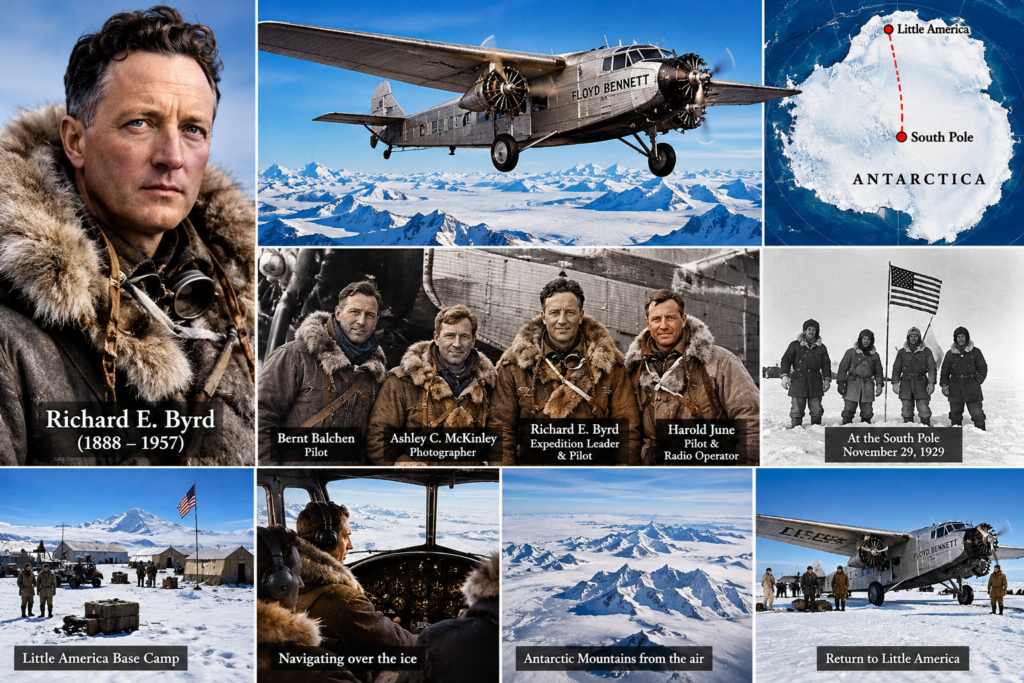
On November 29, 1929, American explorer Richard E. Byrd and his crew made history by flying over the South Pole. Their daring journey across Antarctica marked a major milestone in aviation and polar exploration. In an age when aircraft were still developing and Antarctica remained one of the most mysterious places on Earth, Byrd’s expedition demonstrated how courage, technology, and determination could push the boundaries of human discovery.
But reaching the South Pole was far more than an ordinary flight. It was a dangerous expedition across a frozen continent where extreme cold, unpredictable weather, and vast stretches of unexplored terrain threatened every mile of the journey.
Who Was Richard E. Byrd?
Richard Evelyn Byrd was born on October 25, 1888, in Winchester, Virginia. He grew up in a family with a strong connection to American public life and later pursued a career in the United States Navy.
Byrd became fascinated with aviation and exploration during a period when airplanes were transforming transportation and scientific research. Early aircraft had limited capabilities, and flying over remote regions required exceptional planning and courage.
He became known for his interest in exploring places that few people had ever visited. His ambitions extended from the Arctic to Antarctica, where he hoped aircraft could help scientists study the continent more efficiently.
Byrd believed aviation could transform polar exploration. Instead of relying entirely on long journeys by dogsled and foot, explorers could use airplanes to survey vast areas of ice and snow.
His ambitions eventually led him to organize an expedition to Antarctica.
The Antarctic Expedition of 1928–1930
In 1928, Byrd organized an ambitious American expedition to Antarctica.
The expedition aimed to establish a base, conduct scientific research, explore unfamiliar territory, and demonstrate the potential of aviation in polar regions.
The team transported equipment, food, fuel, aircraft, and other supplies to the Antarctic continent. Every item mattered because there were no nearby cities, airports, or supply stations.
The explorers established their main base, known as Little America, on the Ross Ice Shelf.
Life at the base was demanding. The crew faced freezing temperatures, powerful winds, darkness during the Antarctic winter, and the constant challenge of maintaining equipment in a harsh environment.
Despite these difficulties, the expedition prepared for one of its most ambitious objectives: flying over the South Pole.
Why Was Flying Over the South Pole So Difficult?
In 1929, aviation was still relatively young. Although airplanes had demonstrated their potential, long-distance flights over remote regions remained dangerous.
Antarctica presented an especially challenging environment.

The continent is covered by enormous ice sheets, with mountains, glaciers, and deep crevasses hidden beneath snow. Weather conditions can change rapidly, and strong winds can make flying difficult.
Pilots also had to consider the effects of cold temperatures on aircraft engines, fuel systems, and mechanical components.
Navigation presented another problem. The crew could not depend on familiar landmarks, roads, or established aviation routes.
A mechanical failure far from base could leave the expedition in a life-threatening situation.
Byrd and his team therefore needed careful preparation, reliable equipment, and precise coordination.
Their mission represented a major test of both human endurance and early aviation technology.
The Aircraft: Floyd Bennett
The aircraft used for the historic South Pole flight was a Ford Trimotor named Floyd Bennett.
The airplane was named after Floyd Bennett, a pilot associated with Byrd’s earlier Arctic exploration.
The Ford Trimotor was a three-engine aircraft with a metal fuselage and corrugated metal construction. Its design made it suitable for carrying passengers, equipment, and supplies.
For the Antarctic expedition, the aircraft needed to operate under demanding conditions and carry the crew across a vast, isolated landscape.
The airplane became an essential part of the expedition’s attempt to reach the South Pole from its Antarctic base.
Its engines, fuel supply, and overall performance were critical to the success of the mission.
November 29, 1929: The Historic Flight
On November 29, 1929, Byrd and his crew departed from their Antarctic base aboard the Floyd Bennett.
The mission was to fly over the South Pole, a point that had fascinated explorers for generations.
The crew included pilot Bernt Balchen, co-pilot Harold June, and radio operator Ashley C. McKinley.
Balchen played a particularly important role in piloting the aircraft through the challenging Antarctic environment.
As the airplane traveled across the continent, the crew faced a landscape unlike anything encountered on ordinary flights.
Below them stretched enormous expanses of ice and snow. Mountains and glaciers interrupted the seemingly endless white wilderness.
The crew relied on navigation instruments, observations, and careful flight planning to maintain their course.
Their journey required more than mechanical skill. It demanded calm decision-making under conditions where mistakes could have serious consequences.
Eventually, the aircraft reached the geographic South Pole.
Byrd and his crew successfully flew over the pole, accomplishing one of the most remarkable aviation achievements of the era.
The expedition demonstrated that airplanes could reach places that had previously required difficult overland journeys.
The Men Behind the Achievement
Although Richard E. Byrd became the best-known figure associated with the expedition, the flight was a team achievement.
Richard E. Byrd — Expedition Leader
Byrd organized the expedition and directed its broader exploration objectives. His ambition helped bring together the people, equipment, and resources needed for the historic mission.
Bernt Balchen — Pilot
Balchen was an experienced aviator whose flying skills were crucial to the journey. Navigating an aircraft over Antarctica required concentration, technical knowledge, and the ability to respond to difficult conditions.
Harold June — Co-Pilot
June helped operate the aircraft and supported the demanding work required during the long flight.
Ashley C. McKinley — Radio Operator
McKinley handled radio responsibilities, an important task during an expedition far from established communication networks.
Each crew member contributed to the mission’s success. Their combined efforts showed how teamwork was essential to early polar aviation.
The Return Journey
Reaching the South Pole was only part of the challenge.
The crew still had to return safely to its Antarctic base.
Fuel management, navigation, weather conditions, and aircraft performance remained serious concerns. A successful journey to the pole would mean little if the airplane could not complete the return flight.
The crew continued its journey and successfully returned to Little America.
The achievement was celebrated as a major milestone in American exploration.
For Byrd, the flight strengthened his reputation as one of the most prominent American polar explorers of the early twentieth century.
It also helped demonstrate the potential of aircraft as tools for scientific research and geographical exploration.
Why the 1929 Flight Changed Polar Exploration
The South Pole flight was important because it expanded the possibilities of exploration.
Before the development of aviation, explorers generally depended on ships, sledges, and lengthy journeys across difficult terrain.
Aircraft offered a different approach.
They could cover large distances more quickly, survey remote regions, and help researchers understand the geography of Antarctica.
The 1929 flight demonstrated that aviation could play a significant role in future expeditions.
It also showed the importance of combining technology with scientific observation.
Although aircraft did not eliminate the dangers of polar exploration, they became increasingly valuable in mapping and studying the continent.
Byrd’s expedition helped establish a foundation for later aerial surveys and scientific investigations in Antarctica.
The Scientific Importance of the Expedition
Antarctica remains one of the most scientifically important regions on Earth.
Its enormous ice sheets contain evidence about past climates, while its mountains and geological formations help researchers understand the history of the planet.
During Byrd’s expedition, scientific research was an important objective alongside geographical exploration.
The team gathered information about the continent and helped expand knowledge of its environment.
Aerial exploration offered researchers a broader perspective than ground travel alone could provide.
Scientists could begin to think about Antarctica as a vast geographical system rather than simply a collection of isolated coastal regions.
Modern Antarctic research now uses satellites, advanced aircraft, radar systems, and sophisticated scientific instruments. These technologies have transformed the study of the continent.
The historic flight of 1929 belongs to an earlier stage of that development, when even a single journey over the South Pole represented a remarkable achievement.
The Dangers of Antarctic Exploration
The success of the flight should not hide the dangers faced by the expedition.
Antarctica is an unforgiving environment. Temperatures can fall far below freezing, winds can become violent, and weather can reduce visibility dramatically.
Aircraft operating in such conditions face additional mechanical challenges.
Engines must function in extreme cold, and fuel and lubricants must remain suitable for operation. Pilots also have to manage the effects of altitude and the difficulty of identifying landmarks across an ice-covered landscape.
Rescue options are limited when an aircraft operates far from its base.
The crew therefore depended on preparation, experience, communication, and careful judgment.
Their success reflected not simply bravery but also the practical work required to make an ambitious expedition possible.
Richard Byrd’s Lasting Legacy
Richard E. Byrd continued to be associated with Antarctic exploration for decades after the 1929 flight.
He later led additional expeditions to Antarctica and became an influential figure in the development of American polar research.
His career reflected the changing relationship between exploration and technology during the twentieth century.
Explorers increasingly relied on aircraft, radios, motorized transport, and improved scientific equipment.
Byrd’s expeditions helped establish a stronger American presence in Antarctic exploration and contributed to the growth of organized scientific activity on the continent.
His legacy remains connected to the ambition of reaching remote places and expanding geographical knowledge.
At the same time, the history of polar exploration includes complex questions about national prestige, scientific priorities, and the treatment of Indigenous peoples in the Arctic. Antarctica itself has no Indigenous population, and its exploration history differs from that of the Arctic.
Understanding these distinctions helps place Byrd’s achievements in their proper historical context.
A Flight Into History
The historic South Pole flight of November 29, 1929, was a defining moment in the development of aviation and Antarctic exploration.
Richard E. Byrd and his crew crossed one of the most remote landscapes on Earth and successfully flew over the geographic South Pole.
Their achievement demonstrated the potential of aircraft to support exploration and scientific research in extreme environments.
The flight also illustrated the importance of teamwork, preparation, and technological innovation.
Nearly a century later, Antarctica continues to challenge scientists, explorers, and pilots. Modern technology has made the continent more accessible, but its immense distances and harsh conditions remain formidable.
The 1929 expedition stands as a reminder of an era when reaching the South Pole by airplane required extraordinary planning and courage.


Post Comment