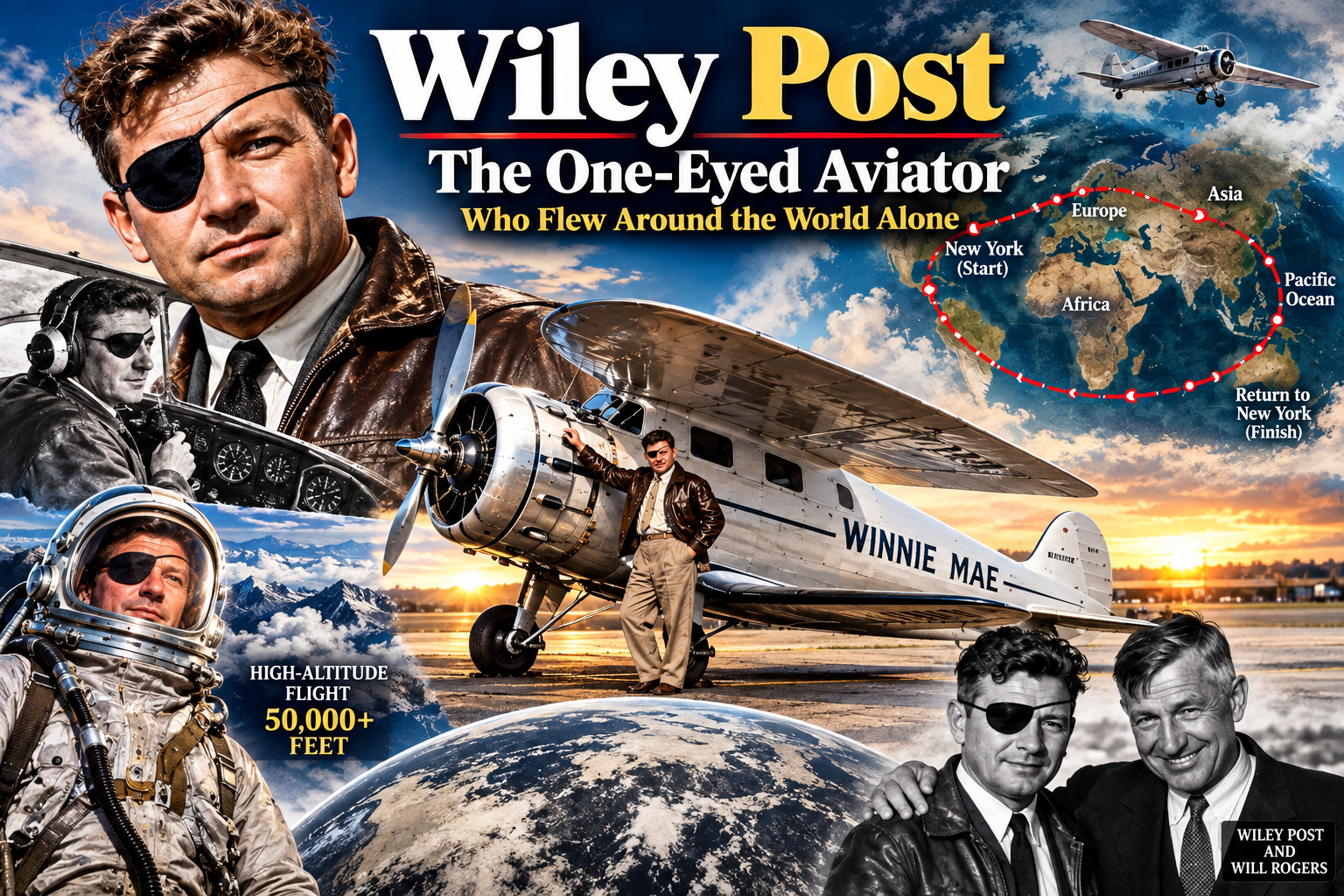
Wiley Post: The One-Eyed Aviator
Wiley Post was not an ordinary pilot.
He was a daring American aviator, aviation pioneer, record-breaker, and one of the most adventurous figures of the golden age of flight. Despite losing the sight in one eye, Post went on to become the first person to fly solo around the world.
His story is more than a story about airplanes and speed. It is a story about determination, technological innovation, risk, and the extraordinary possibilities of aviation during the early 20th century.
Who Was Wiley Post?
Wiley Hardeman Post was born on November 22, 1898, near Grand Saline, Texas. He grew up in a farming family and had little reason to expect that he would one day become one of America’s most famous aviators.
As a young man, Post became fascinated by machinery and eventually by airplanes. Aviation was still in its infancy, and flying was considered dangerous and experimental.
Post entered the aviation world through work as a mechanic and oil-field worker before becoming a pilot. His practical understanding of machines would later become one of his greatest advantages.
He was not simply someone who enjoyed flying. He wanted to understand how aircraft worked and how they could be pushed beyond their existing limits.
The Accident That Changed His Life
In 1926, Post suffered a serious accident while working in an oil field. A piece of metal struck his left eye.
The injury permanently damaged his vision.
For many people, such an injury might have ended an aviation career before it even began. But Post continued pursuing his passion for flying.
His determination eventually helped him become one of the most famous pilots of his generation.
His damaged eye also became part of the remarkable story surrounding his career. Wiley Post would later fly some of the most challenging routes of the era with vision in only one eye.
Wiley Post and the Winnie Mae
One of the most important chapters of Post’s career began when he became associated with a Lockheed Vega aircraft named Winnie Mae.
The aircraft became famous alongside its pilot.
Post and his team modified the airplane and equipped it with technology that helped transform long-distance aviation.
The Winnie Mae was not simply a transportation machine. It became Post’s laboratory for testing what was possible in long-distance flight.
The 1931 Around-the-World Flight
Wiley Post first became internationally famous in 1931.
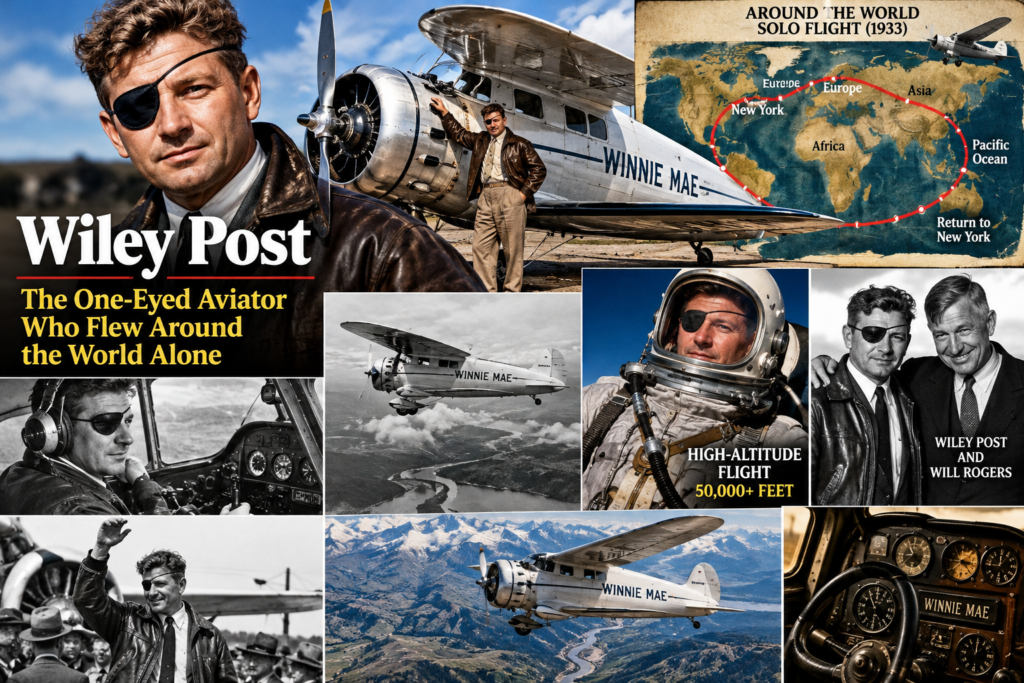
He and Australian navigator Harold Gatty attempted to fly around the world in the Winnie Mae.
Their journey began in New York.
They traveled across Europe and Asia, continuing through the Soviet Union before crossing the Pacific and returning to North America.
On July 1, 1931, Post and Gatty completed their journey.
Their official time was approximately 8 days, 15 hours, and 51 minutes, dramatically improving the previous record.
The achievement made Wiley Post a national hero.
But Post was not finished.
He wanted to prove that he could accomplish an even more difficult feat.
He wanted to fly around the world alone.
The First Solo Flight Around the World
Two years later, Wiley Post returned to the skies for another historic attempt.
This time, there would be no navigator sitting beside him.
Post took off from New York on July 15, 1933.
His goal was simple but extremely difficult:
Fly around the world alone and return to New York.
The flight required enormous concentration.
Navigation technology was still developing. Long-distance aviation was dangerous. Weather conditions could change rapidly, and mechanical problems could become life-threatening when an aircraft was thousands of miles from home.
Post continued across Europe, Asia, and North America.
On July 22, 1933, he returned to New York.
He had completed the first solo flight around the world.
His journey lasted approximately 7 days, 18 hours, and 49 minutes.
Post had not only flown around the world alone—he had also broken the record he and Harold Gatty had established two years earlier.
Technology Helped Make the Impossible Possible
Wiley Post’s achievements were not based on courage alone.
Technology played an important role.
His Lockheed Vega was equipped with advanced equipment for the time, including a Sperry autopilot and radio navigation equipment.
The autopilot was especially important.
Flying continuously for days was physically exhausting. An autopilot could help maintain the aircraft’s course while Post rested or performed other necessary tasks.
This combination of human skill and emerging technology represented the future of aviation.
Post demonstrated that aircraft could become faster, more capable, and increasingly reliable for long-distance travel.
Flying Higher Than Ever Before
Post’s ambitions went beyond long-distance travel.
He became fascinated with high-altitude flight.
At high altitudes, aircraft could potentially encounter less turbulence and stronger winds. However, flying that high created another major problem:
the human body could not safely function in extremely thin air without protection.
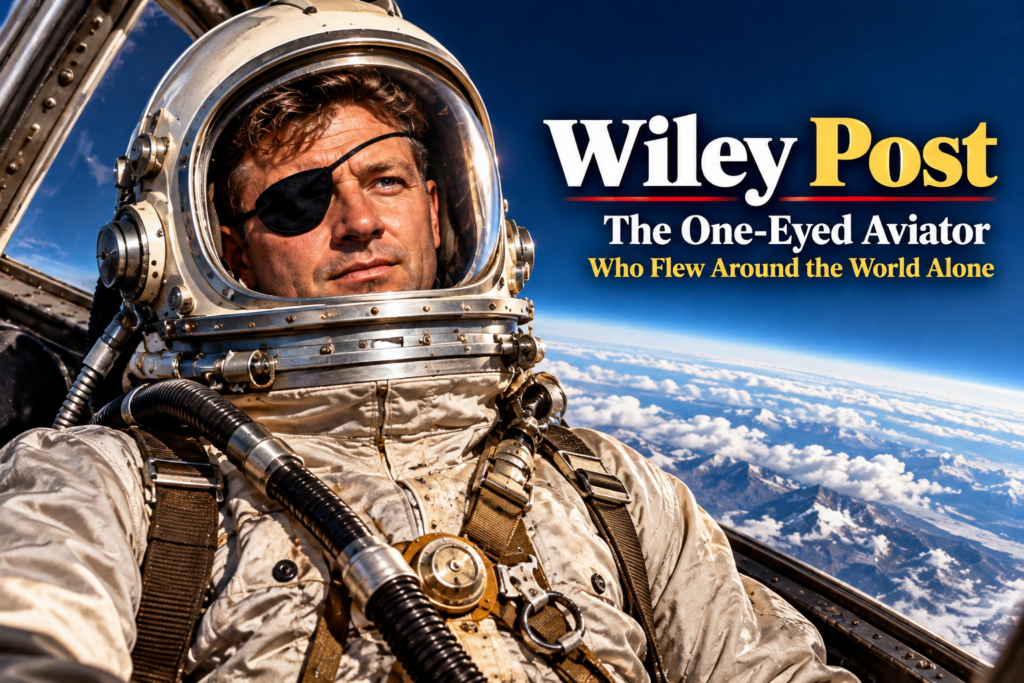
Post worked with engineers and developed a pressure suit.
The result was one of the earliest practical pressure suits used for high-altitude aviation.
In 1934, Post reached an altitude of more than 50,000 feet during a series of high-altitude flights.
At the time, this was an extraordinary achievement.
His experiments contributed to the development of technology that would later become important for high-altitude military aviation and eventually human spaceflight.
The Pressure Suit
Post’s pressure suit looked unusual compared with modern aviation equipment.
It was bulky, sealed, and designed to maintain pressure around his body.
Inside the aircraft, the air pressure at extreme altitude could become dangerously low.
The suit helped Post survive conditions that would otherwise have been impossible for an unprotected pilot.
His experiments demonstrated an important principle:
Humans could travel into environments where the natural conditions were not suitable for the human body—if technology could provide the necessary protection.
This idea would become fundamental to later high-altitude aviation and space exploration.
Wiley Post and Will Rogers
Another famous chapter of Post’s life involved American humorist and entertainer Will Rogers.
The two men became friends.
In 1935, Post and Rogers began exploring the possibility of an aerial journey through Alaska.
Post was flying a hybrid aircraft that combined components from different aircraft designs.
On August 15, 1935, Post and Rogers departed from Fairbanks.
They were flying near Point Barrow, Alaska, when the aircraft crashed shortly after takeoff following a stop.
Both men were killed.
Wiley Post was only 36 years old.
His death shocked America.
One of the country’s most famous aviators had died while continuing to explore new possibilities in aviation.
The Legacy of Wiley Post
Wiley Post’s legacy extends far beyond his records.
He represented an era when aviation was changing rapidly.
Only a few decades earlier, powered flight had been almost unimaginable.
By the 1930s, adventurous pilots were crossing oceans, setting speed records, flying at extreme altitudes, and attempting journeys around the world.
Post was one of the people who pushed those boundaries.
His accomplishments helped demonstrate the potential of long-distance aviation and advanced flight technology.
His work with autopilot systems, navigation equipment, and pressure suits also showed how engineering could expand the limits of human performance.
A Man Who Refused to Be Defined by Limitations
Perhaps the most inspiring part of Wiley Post’s story is the way he responded to adversity.
After losing sight in one eye, he did not abandon aviation.
Instead, he continued learning, experimenting, and flying.
He became a pilot when aviation was still dangerous.
He flew around the world with a navigator.
Then he returned and did it alone.
He climbed to extraordinary altitudes using technology that he helped develop.
Post’s life demonstrates an important lesson:
A limitation does not always determine what a person can accomplish.
Sometimes, determination and innovation can create a new path forward.
Why Wiley Post Still Matters
Modern aviation can make the achievements of early pilots seem almost unbelievable.
Today, commercial aircraft routinely cross oceans. Pilots have sophisticated navigation systems, weather information, communication technology, and highly reliable aircraft.
Wiley Post operated in a completely different world.
Every long-distance flight involved uncertainty.
Mechanical failures could be catastrophic. Navigation was difficult. Weather information was limited. Emergency services were almost nonexistent compared with today’s standards.
Yet Post repeatedly challenged those limitations.
His flights helped capture the imagination of the public and showed that the world was becoming increasingly connected through aviation.
Final Thoughts
Wiley Post was more than a record-setting pilot.
He was an experimenter, an innovator, and a symbol of America’s early aviation age.
He lost the sight in one eye but continued flying.
He crossed the world with a navigator and then returned to do it alone.
He experimented with high-altitude flight and developed technology to protect the human body from extreme conditions.
His life ended tragically in Alaska in 1935, but his achievements continued to influence the story of aviation.
Wiley Post’s greatest legacy may not be a single record.
It may be the idea that the limits of human flight were not fixed.
Someone had to test them.
Wiley Post was one of the men who dared to try.
Wiley Post: The One-Eyed Aviator Who Flew Around the World Alone.
His story remains one of courage, innovation, and the relentless pursuit of the unknown.


Post Comment