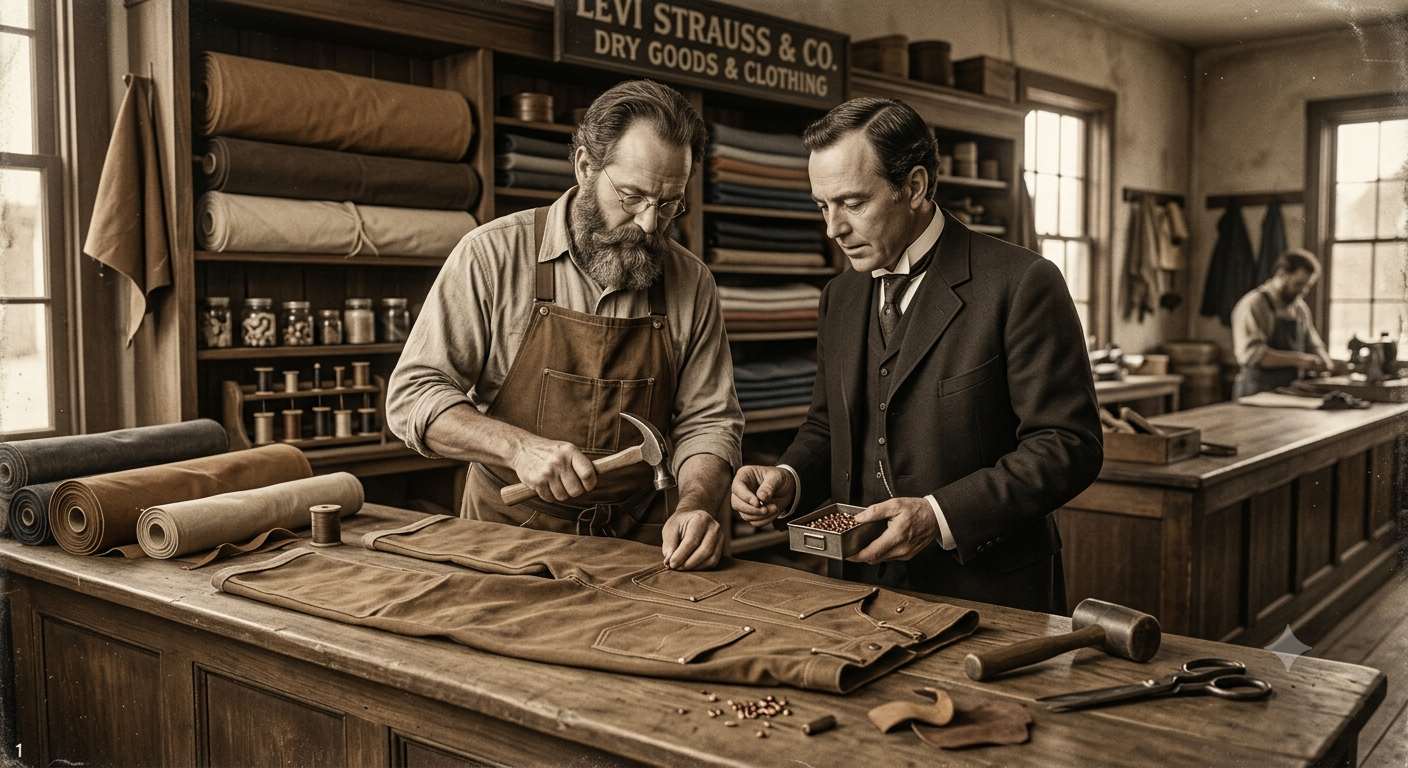
Jacob W. Davis and Levi Strauss: The Men Who Created the Modern Blue Jean
Few pieces of clothing have become as recognizable around the world as the blue jean. From American workers and cowboys to Hollywood stars, musicians, entrepreneurs, and everyday people, jeans have traveled far beyond their original purpose. Today, they are worn in almost every country and have become a symbol of American culture, practicality, independence, and personal style.
But the modern blue jean did not emerge from a single person’s imagination. Its story began with two men from very different backgrounds: Jacob W. Davis, a skilled tailor and inventor, and Levi Strauss, a German-born businessman who built a successful dry-goods company in San Francisco.
Their partnership transformed a simple pair of work trousers into one of the most influential garments in modern history.
Jacob W. Davis: The Tailor Who Solved a Practical Problem
Jacob William Davis was born in the Russian Empire in 1831. As a young man, he learned the tailoring trade and eventually immigrated to the United States.
Davis eventually settled in the American West, where he worked as a tailor. His profession placed him directly in contact with working people who needed clothing capable of surviving difficult conditions.
During the nineteenth century, workers such as miners, railroad laborers, farmers, and construction workers regularly subjected their clothing to intense wear. Ordinary trousers could tear at points where the greatest pressure was placed on the fabric.
Davis began thinking about how he could make work trousers stronger.
His breakthrough came from an unusual idea: using metal rivets to reinforce the weakest points of the trousers.
Instead of allowing the fabric to carry all the strain, Davis placed small copper rivets at important stress points, particularly around the pockets and other areas that could easily rip.
It was a simple idea, but it solved a major practical problem.
The Customer Who Inspired the Riveted Pants
According to the historical account associated with Davis’s invention, a customer asked him to make a particularly durable pair of trousers. Davis experimented with copper rivets to strengthen the garment.
The result proved successful.
Other customers became interested in the reinforced trousers, and Davis realized that he had created something with commercial potential.
However, there was a problem.
Davis needed money and materials to develop the idea on a larger scale. He also needed a business partner capable of supplying the fabric and supporting production.
That is where Levi Strauss entered the story.
Levi Strauss: The Businessman Behind the Partnership
Levi Strauss was born Löb Strauss in Bavaria in 1829. He immigrated to the United States as a young man and eventually moved to San Francisco during the California Gold Rush era.
The Gold Rush had transformed San Francisco into a rapidly growing commercial center.
Strauss recognized that the thousands of people moving west needed supplies. Rather than becoming a miner himself, he built a business supplying goods to people who were working and living in the developing American West.
In 1853, he founded what became Levi Strauss & Co.
The company originally dealt in dry goods, supplying merchants and customers with products needed in everyday life.
Strauss’s business experience eventually connected him with Jacob Davis.
The Letter That Changed Clothing History
Davis was using fabric supplied through Levi Strauss & Co. for his work.
After discovering the effectiveness of his riveted trousers, Davis wanted to protect his invention. He wrote to Levi Strauss and proposed that they apply for a patent together.
Davis explained his idea and suggested that Strauss help finance the patent process.
The partnership was established.
On May 20, 1873, the United States government granted Jacob W. Davis and Levi Strauss a patent for an improvement in fastening pocket openings.
The patent, U.S. Patent No. 139,121, described the use of rivets to reinforce points where the garment was particularly vulnerable to tearing.
That patent is widely regarded as a foundational moment in the history of the modern blue jean.
What Did They Actually Invent?
It is important to understand exactly what Davis and Strauss created.
They did not invent trousers.
They did not invent denim.
They did not invent blue fabric.
And they did not invent every feature associated with modern jeans.
Their major contribution was the riveted work-pant design that made trousers significantly more durable.
Davis was the tailor and inventor who developed the practical rivet-reinforcement technique.
Strauss was the businessman whose company supplied materials and helped turn the invention into a commercial product.
Their partnership brought together two different skills: invention and business.
That combination became extremely important.
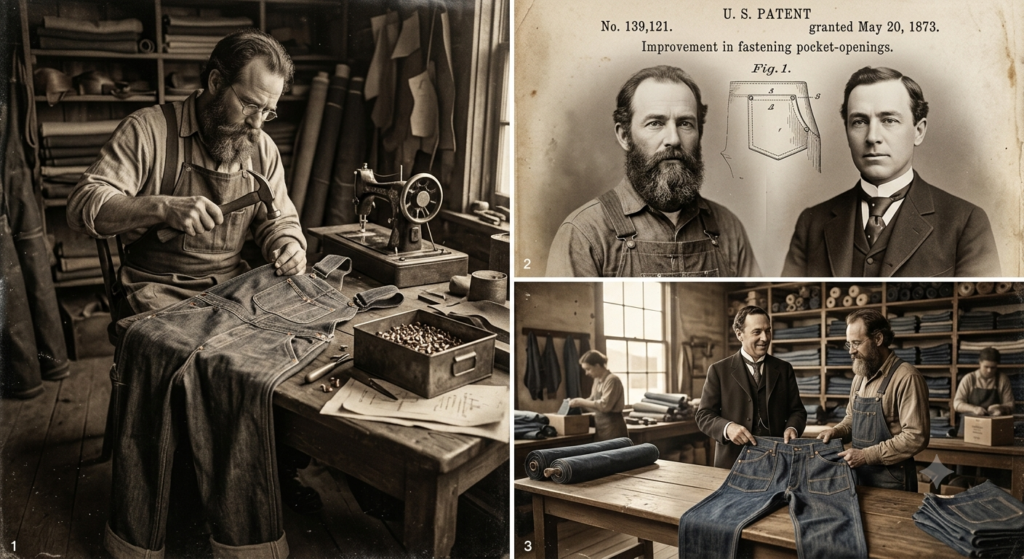
Why Copper Rivets Mattered
The basic idea behind the riveted trousers was engineering through simplicity.
Work trousers experience considerable stress around pockets and seams. When workers carry tools or other heavy objects, the fabric around pockets can experience repeated pulling forces.
A small metal rivet could distribute some of that force and reduce the likelihood of the fabric separating.
For workers in the nineteenth-century American West, this was not merely a fashion detail.
It was useful technology.
The trousers were designed to survive real work.
That practical origin would eventually become one of the most important characteristics of jeans.
From Workwear to an American Icon
After receiving the patent, Davis joined Levi Strauss & Co. in San Francisco and became involved in manufacturing the riveted trousers.
The company began producing the reinforced garments on a larger scale.
The pants were originally intended primarily for working people.
Miners, mechanics, laborers, farmers, and other workers needed durable clothing, and the riveted trousers offered an attractive solution.
The garments were not initially sold as luxury fashion.
They were workwear.
That distinction is important because the global cultural meaning of jeans developed much later.
The Importance of Denim
The trousers eventually became strongly associated with denim fabric.
Denim was a durable cotton textile that had already been used for work clothing.
Its strength made it particularly suitable for trousers designed for demanding physical labor.
The combination of durable denim and copper rivets created a garment that could withstand considerable abuse.
The familiar blue color also became an important part of the garment’s identity.
Over time, the words “blue jeans” became almost universally associated with this type of clothing.
Jacob Davis’s Role
Jacob W. Davis is sometimes overshadowed by the Levi Strauss name.
That is understandable because Levi Strauss & Co. eventually became a major international company.
However, Davis’s contribution is fundamental.
He was the working tailor who encountered a practical problem and developed an inventive solution.
His knowledge of garment construction allowed him to understand where clothing was most likely to fail.
His solution was straightforward: reinforce vulnerable points with metal rivets.
Davis’s story is an example of how innovation can emerge from everyday work.
He did not begin with a plan to create a global fashion icon.
He was trying to make a stronger pair of trousers.
Levi Strauss’s Role
Levi Strauss played a different but equally important role.
He understood business, supply chains, manufacturing, and the needs of the growing American market.
By partnering with Davis, Strauss helped transform a tailor’s invention into a commercially manufactured product.
The company provided the organizational structure necessary to produce and distribute the trousers.
Without manufacturing and distribution, an invention can remain a local curiosity.
The Strauss-Davis partnership helped prevent that from happening.
The Patent and the Birth of an Industry
The 1873 patent gave the partners legal protection for their riveted garment design.
The patent also marked the beginning of a long commercial history.
The product continued to evolve.
Over the following decades, the company developed recognizable design elements and branding associated with its work trousers.
The garment gradually became part of the mythology of the American West.
Cowboys, miners, ranchers, railroad workers, and other working Americans helped establish the image of rugged denim clothing.
Jeans and the American West
The American West became an important part of the cultural identity of denim.
The rugged landscapes of California, Nevada, Arizona, and other western regions created a natural environment for durable work clothing.
Jeans became associated with people who worked outdoors and performed physically demanding jobs.
The garment represented practicality.
It was not designed to impress.
It was designed to last.
That reputation would remain an important part of jeans culture even after jeans entered mainstream fashion.
From Workwear to Popular Culture
During the twentieth century, jeans began moving beyond the workplace.
Hollywood played an important role in this transformation.
Western films frequently featured actors wearing denim, reinforcing the connection between jeans and the American frontier.
Later, musicians and cultural movements adopted denim as a symbol of individuality and rebellion.
Young people increasingly wore jeans outside traditional work environments.
The garment’s meaning changed.
What had started as practical workwear became casual everyday clothing.
Eventually, designers and fashion houses began incorporating jeans into high-fashion collections.
The transformation was remarkable.
A garment designed for laborers became one of the world’s most recognizable fashion products.
Why Their Partnership Was So Important
The story of Davis and Strauss illustrates an important principle in American innovation.
Major inventions often emerge through collaboration.
Davis possessed technical knowledge.
Strauss possessed commercial resources and business experience.
Neither man’s contribution should erase the other.
The modern blue jean developed from the combination of Davis’s invention and Strauss’s business partnership.
That distinction makes the story more interesting, not less.
It demonstrates how an idea can move from a workshop to a global market.
A Legacy That Outlived Its Inventors
Jacob W. Davis died in 1908.
Levi Strauss died in 1902.
Neither man lived to see jeans become the worldwide cultural phenomenon they eventually became.
They could not have imagined jeans being worn by people in countries around the world, appearing on movie screens, fashion runways, music stages, and city streets.
Their original product was designed for workers.
Its eventual audience became almost everyone.
Today, billions of pairs of jeans are produced and sold around the world.
The basic concept of durable work trousers remains recognizable more than 150 years after Davis and Strauss established their partnership.
More Than Just a Pair of Pants
The history of jeans is ultimately a story about American industrial development, immigration, entrepreneurship, craftsmanship, and innovation.
Jacob W. Davis was an immigrant tailor who noticed a problem and developed a practical solution.
Levi Strauss was an immigrant businessman who understood the opportunities created by a rapidly expanding American economy.
Together, they created a durable garment that answered a real need.
Their invention did not become famous overnight.
It grew through decades of work, manufacturing, changing lifestyles, popular culture, and fashion.
But the foundation was established in 1873, when the two men received their patent for riveted work trousers.
The Men Behind the Blue Jeans
When people put on a pair of blue jeans today, they are wearing a garment with a history that reaches back to the nineteenth-century American West.
The story begins not with a fashion designer, but with a tailor trying to solve a problem.
Jacob W. Davis brought the inventive idea: reinforce vulnerable parts of work trousers with copper rivets.
Levi Strauss brought business experience, resources, and a company capable of helping manufacture and distribute the product.
Their partnership turned a simple improvement into a lasting commercial success.
The blue jean eventually became much more than workwear.
It became a symbol of American life and one of the most widely recognized garments in the world.
Yet beneath the fashion, branding, and cultural history is a remarkably simple idea: make clothing stronger so it can survive the work of ordinary people.
That idea, developed by Jacob W. Davis and brought to market with Levi Strauss, helped create one of the most enduring garments in modern history.
Post Comment