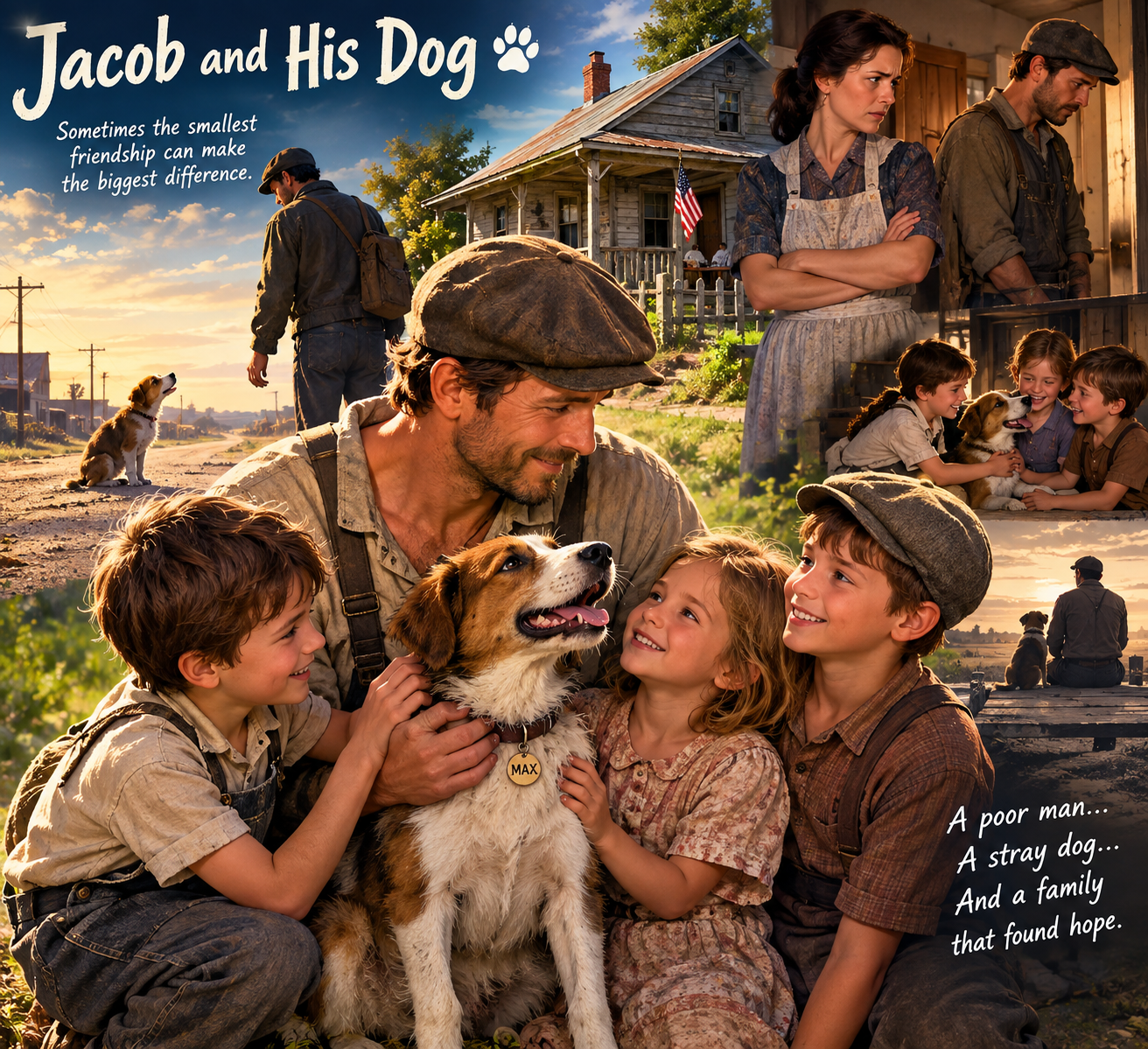
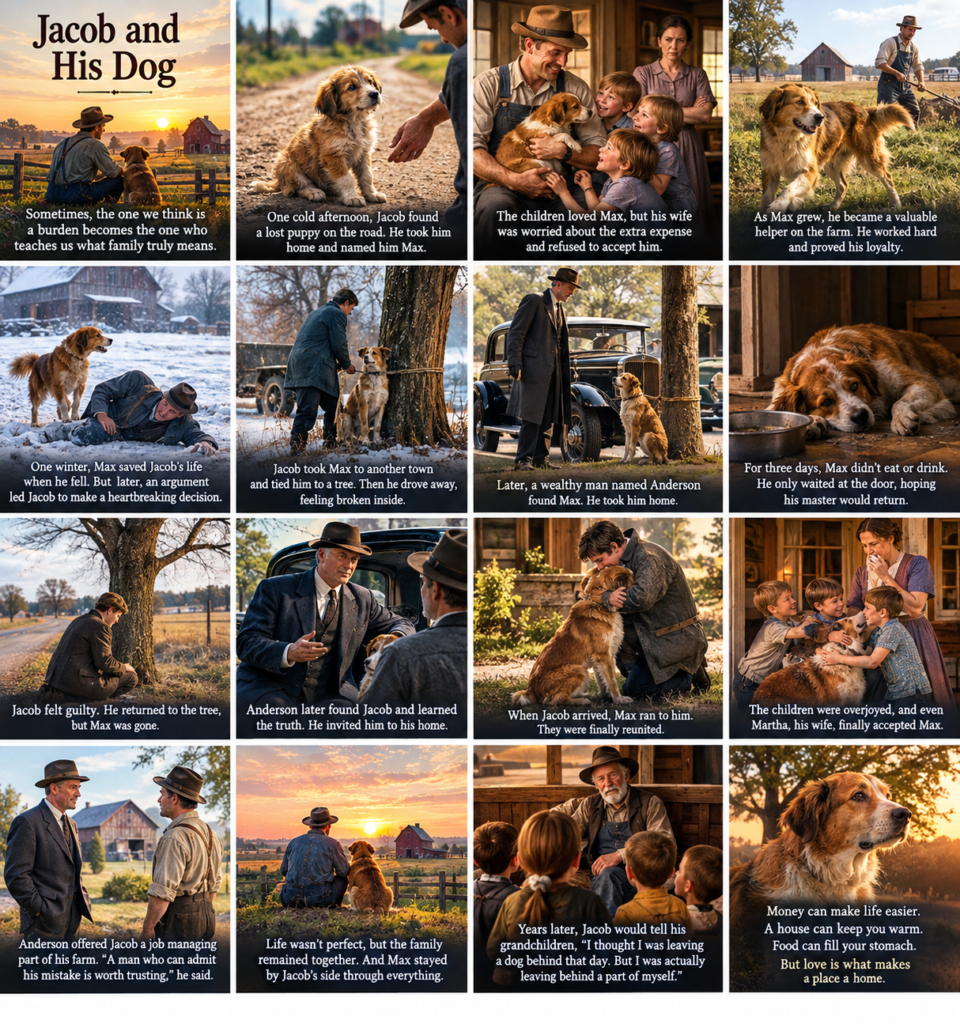
Jacob and His Dog
In a small farming town somewhere in the American countryside, where wooden houses stood beside long dirt roads and horse-drawn wagons still carried much of the day’s work, there lived a poor farmer named Jacob Miller.
Jacob was not a wealthy man.
He owned a small piece of land, an old farmhouse, a weather-beaten barn, and a few animals. His hands were rough from years of hard work, and his boots were usually covered in mud by the end of the day.
But Jacob had something more valuable than money.
He had a family.
His wife, Martha, was a practical woman who understood how difficult their life had become. They had three young children—Thomas, Lily, and little Samuel.
The children loved their father dearly, but life was not easy.
Every dollar had to be carefully spent. Every loaf of bread mattered. When winter arrived, Jacob had to think about coal for the stove, food for the family, and repairs to the old farmhouse.
Martha worried constantly.
She wanted to protect her children from poverty.
And then, one cold afternoon, Jacob found a puppy.
It happened on his way home from town.
The little animal was sitting beside the dirt road, shivering beneath a wooden fence. Its fur was dirty, its paws were muddy, and it looked exhausted.
Jacob stopped his wagon.
He climbed down and walked toward the puppy.
“Where did you come from, little fellow?”
The puppy looked up at him.
Its tail moved slightly.
Jacob knelt down.
The dog slowly walked toward him and rested its head against Jacob’s hand.
Jacob smiled.
“You’re alone, aren’t you?”
The puppy gave a tiny whimper.
Jacob looked down the empty road.
There was no house nearby and no one searching for the animal.
After a moment, Jacob picked up the puppy and placed him inside his coat.
“Come on,” he said softly. “Let’s get you somewhere warm.”
When Jacob arrived home, his three children immediately ran toward him.
“Papa!”
But then Thomas noticed something moving inside his father’s coat.
“What is that?”
Jacob opened his coat.
The puppy looked out.
The children’s eyes became wide with excitement.
“A dog!”
“A puppy!”
“Can we keep him, Papa?”
The three children surrounded Jacob.
Martha came out of the kitchen.
The moment she saw the puppy, her expression changed.
“Jacob…”
“I found him on the road,” Jacob explained.
Martha folded her arms.
“We cannot keep him.”
The children became silent.
“But Mama—” Lily began.
“No,” Martha said firmly. “We can barely feed ourselves.”
Jacob looked at the puppy.
“He was alone.”
“And now he is another mouth to feed,” Martha replied.
Jacob understood her fear.
He knew she wasn’t being cruel.
She was worried.
Still, he couldn’t bring himself to put the puppy back on the road.
“We’ll manage,” Jacob said.
Martha sighed.
“That is what you always say.”
Jacob smiled sadly.
“We’ll call him Max.”
The children cheered.
From that day forward, Max became part of the Miller household.
At first, Martha kept her distance.
She did not hate the dog.
But she refused to love him.
Whenever Max followed her into the kitchen, she would say, “Out.”
Whenever he sat beside the children’s beds, she would tell him to move.
And whenever Jacob gave Max food, Martha reminded him that the children needed every bit of food they could get.
But Max never complained.
He simply stayed near the family.
He slept in the barn.
He followed Jacob into the fields.
And every afternoon, he waited at the end of the dirt road for the children to return home.
As the months passed, Max grew.
The small puppy became a strong, intelligent dog.
Jacob soon discovered that Max was more than a pet.
He was a worker.
When Jacob went into the fields, Max followed him.
When a young calf escaped from the barn, Max helped bring it back.
When chickens wandered toward the road, Max chased them safely toward the farmhouse.
One winter morning, Jacob slipped on the frozen ground while carrying a heavy sack of grain.
The sack fell from his hands.
Jacob tried to stand but couldn’t.
Max immediately ran to him.
The dog barked loudly and ran toward the farmhouse.
Martha heard the barking.
She stepped outside.
Max ran back toward Jacob and then toward the house again.
Martha understood.
Something had happened.
She followed the dog.
They found Jacob lying on the frozen ground.
He was badly shaken but alive.
That evening, Martha quietly placed a bowl of food near Max.
Max looked at her.
Martha said nothing.
It was the first time she had ever fed him.
But even then, she did not completely accept him.
Years passed.
The family remained poor.
Jacob worked harder than ever, but the farm never produced enough money.
One spring, a terrible storm destroyed part of their crop.
The roof of the barn needed repairs.
The children needed shoes.
The family needed food.
Martha became increasingly anxious.
One evening, she and Jacob argued.
“We cannot keep living like this,” she said.
“I know.”
“We need to cut every unnecessary expense.”
Jacob looked at Max lying near the fireplace.
Martha followed his eyes.
“Even him.”
Jacob’s face became serious.
“He isn’t an expense.”
“He eats food.”
“He works.”
“He is still another responsibility.”
The argument grew louder.
The children listened from the other room.
Finally, Martha said something Jacob could not forget.
“Choose, Jacob. We cannot carry everyone.”
Jacob said nothing.
That night, he could not sleep.
Before sunrise, he made a terrible decision.
He would take Max to another town.
Perhaps someone there would give him a better home.
Perhaps it would be better for everyone.
Jacob saddled his wagon.
Max happily followed him.
The dog thought they were going somewhere together.
He did not know what Jacob had planned.
They traveled several miles away from town.
Finally, Jacob stopped near a large oak tree beside a quiet country road.
He climbed down.
Max jumped from the wagon.
Jacob took a rope.
His hands trembled.
He tied Max to the tree.
The dog looked at him with complete trust.
Jacob could barely look into his eyes.
“I’m sorry, boy.”
Max wagged his tail.
Jacob turned away.
Max began to whine.
Jacob walked back toward the wagon.
The whining became louder.
Then came the barking.
Jacob stopped.
He closed his eyes.
For a moment, he almost turned around.
But he forced himself to keep walking.
“Forgive me, Max,” he whispered.
Then Jacob drove away.
Max barked until Jacob disappeared from sight.
He remained beside the tree, waiting.
Perhaps his master would come back.
Perhaps he was only being left there for a little while.
But Jacob did not return.
Several hours later, an expensive automobile appeared on the road.
It belonged to a wealthy businessman named Edward Anderson.
Anderson was traveling home from another town when he noticed the dog.
He ordered his driver to stop.
“What is that dog doing there?”
They got out.
Max was exhausted.
Anderson looked around.
There was no house nearby.
“Who would leave a dog tied to a tree?”
Max looked toward the road.
Anderson noticed something in his eyes.
The dog was waiting.
“Untie him,” Anderson said.
His driver freed Max.
But Max would not move.
Anderson crouched beside him.
“Come on, boy.”
Max finally stood.
Anderson took him home.
He gave Max food.
Fresh water.
A warm place to sleep.
But Max would not eat.
He would not drink.
For three days, he barely moved.
He sat near the front door and stared outside.
Anderson became concerned.
“What are you waiting for, boy?”
Max remained silent.
On the fourth morning, Anderson’s housekeeper found Max standing at the door.
He was looking toward the road again.
Anderson understood.
The dog wasn’t sick.
He was heartbroken.
Meanwhile, Jacob was suffering from his own decision.
The farmhouse felt different without Max.
The children stopped laughing as much.
Thomas asked every evening, “When is Max coming back?”
Jacob never had an answer.
Little Samuel kept a small piece of cloth that belonged to Max.
Lily cried when she thought nobody was watching.
Martha saw what her decision had done to the family.
One evening, she found Jacob sitting alone in the barn.
“You miss him,” she said.
Jacob didn’t answer.
Finally, he whispered:
“I left him there.”
Martha sat beside him.
“Jacob…”
“I tied him to that tree and drove away.”
His voice broke.
“I kept thinking I was doing the right thing.”
Martha lowered her eyes.
“Maybe we were wrong.”
The next morning, Jacob took his wagon.
He went back to the place where he had left Max.
But the dog was gone.
Jacob searched the road.
He searched the nearby fields.
Nothing.
He sat beneath the oak tree.
For the first time in many years, Jacob cried.
“I came back, boy.”
But Max wasn’t there.
What Jacob did not know was that his life was about to change.
A few days later, Anderson was driving along the same road.
He stopped near the oak tree.
And there, standing beside the road, was Jacob.
Anderson recognized him.
He remembered the man who had once owned the dog.
He stepped out of the automobile.
“Are you looking for a dog?”
Jacob looked up.
“Yes.”
“What was his name?”
Jacob’s eyes filled with tears.
“Max.”
Anderson stared at him.
Then he understood everything.
“You left him here.”
Jacob nodded.
“I did.”
“Why?”
Jacob told him the truth.
He explained about the farm, the children, the money, and the arguments.
Anderson listened quietly.
Then he said:
“Come with me.”
Jacob looked confused.
“Where?”
Anderson opened the automobile door.
“To see someone who has been waiting for you.”
They arrived at Anderson’s house.
The moment Anderson opened the door, Max ran outside.
He stopped.
He saw Jacob.
For a second, everything became still.
Then Max ran.
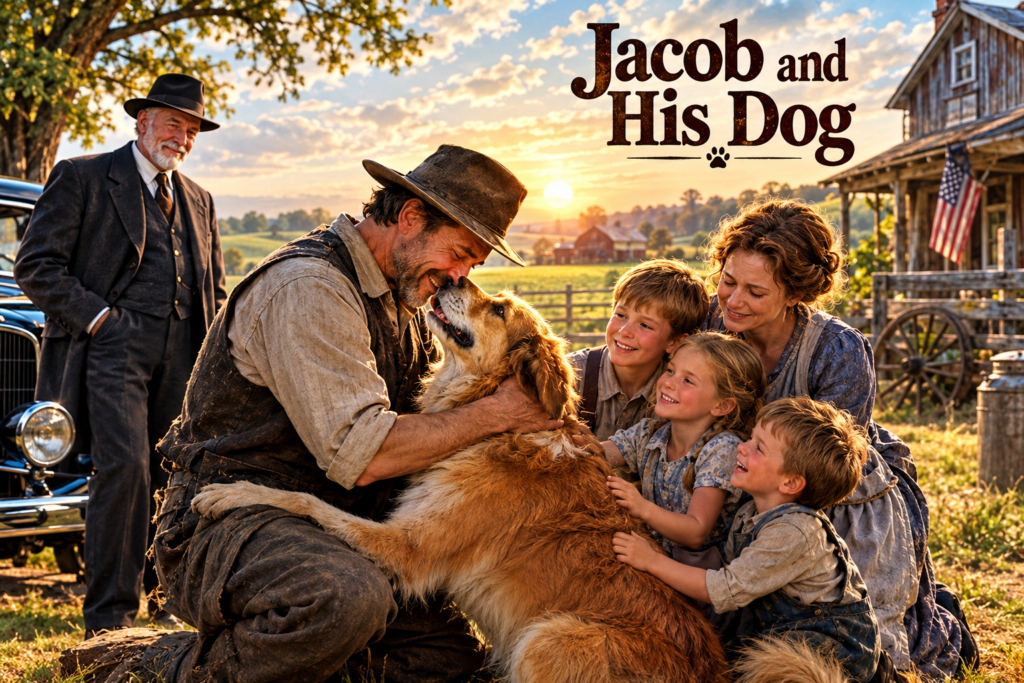
Jacob dropped to his knees.
“Max!”
The dog jumped into his arms.
Jacob held him tightly.
“I am sorry, boy. I’m so sorry.”
Max licked his face and wagged his tail.
There was no anger in the dog’s eyes.
Only happiness.
Anderson stood nearby.
“He wouldn’t eat,” he said.
“He barely drank.”
“He only wanted to go home.”
Jacob wiped his tears.
“I thought I was giving him a better life.”
Anderson looked at him.
“No. He already had the life he wanted.”
Jacob looked down at Max.
Anderson continued:
“You.”
The journey home was quiet.
Max sat beside Jacob all the way.
When they reached the farmhouse, the children came running.
“MAX!”
They surrounded him.
Thomas hugged his neck.
Lily cried.
Little Samuel laughed.
Even Martha stood at the doorway with tears in her eyes.
Max slowly walked toward her.
Martha looked down at him.
For a moment, neither moved.
Then she knelt.
She placed her hand on his head.
“I was wrong,” she whispered.
Max rested his head against her shoulder.
Martha began to cry.
From that day forward, Max was no longer simply Jacob’s dog.
He was part of the family.
Anderson did not forget Jacob either.
Before leaving, he offered Jacob a position managing part of his farm.
“You know the land,” Anderson said.
“And I know you are a hardworking man.”
Jacob looked surprised.
“Why would you help me?”
Anderson smiled.
“Because a man who can admit his mistake is worth trusting.”
Jacob accepted the offer.
Life did not suddenly become perfect.
There were still hard winters.
There were still bad harvests.
There were still bills to pay.
But the family stayed together.
And Max remained beside Jacob through all of it.
Years later, when Jacob was an old man, he would sometimes sit beneath the same oak tree where he had once abandoned his dog.
Max was long gone by then.
But Jacob never forgot him.
He would tell his grandchildren:
“I thought I was leaving a dog behind that day.”
He would pause.
“But I was actually leaving behind a part of myself.”
Then he would smile.
“Fortunately, Max loved me enough to wait for me.”
And whenever Jacob finished the story, he would always say the same thing:
“Money can make life easier.
A house can keep you warm.
Food can fill your stomach.
But love is what makes a place a home.”
And somewhere in the quiet countryside, the old oak tree continued to stand beside the road—a silent reminder of a poor farmer, a faithful dog, and one second chance that changed an entire family.


Post Comment