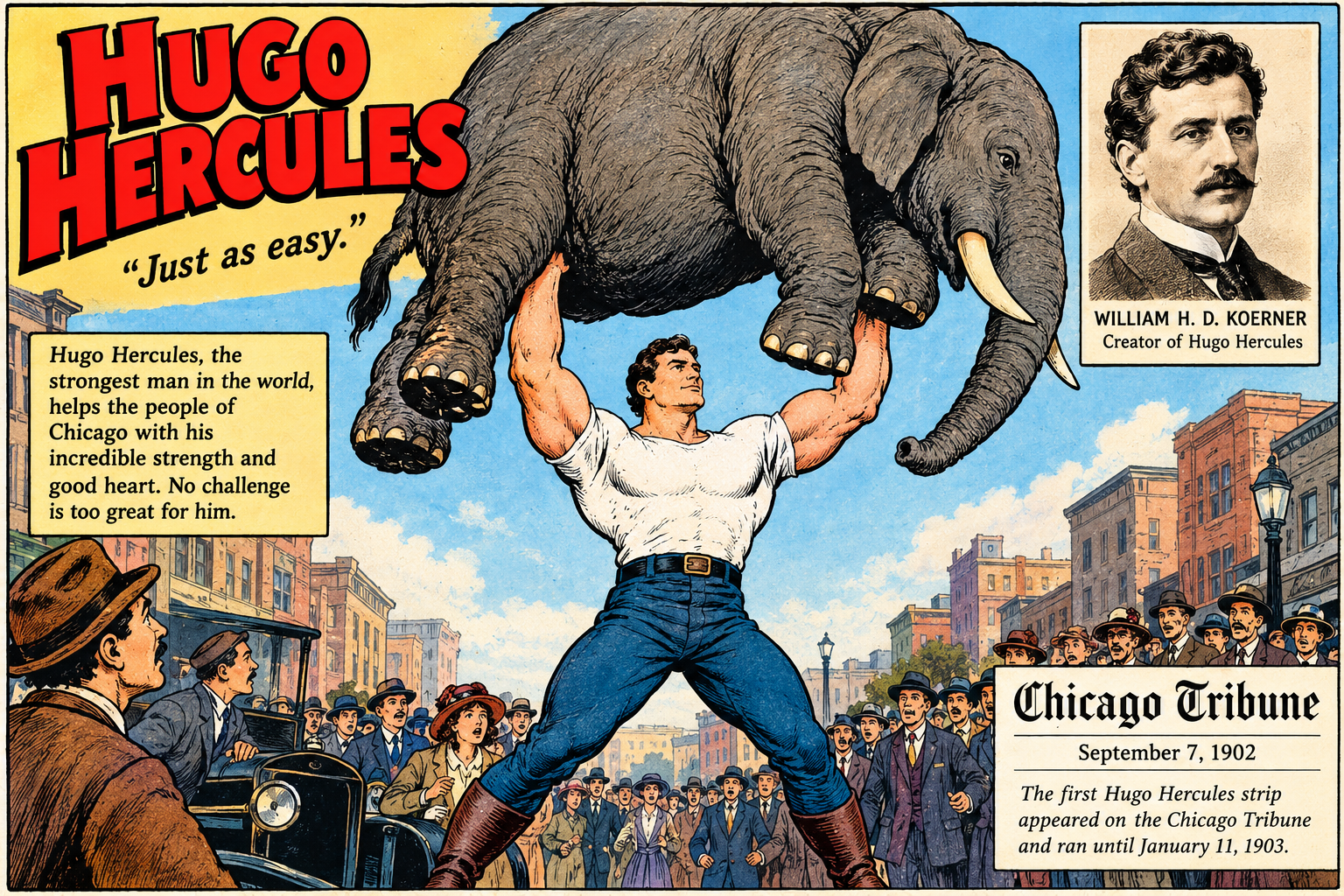
William H. D. Koerner and the Birth of the Superhero
Long before Superman flew through the skies, Batman appeared in Gotham City, or Captain America carried his shield, an extraordinarily strong man was already walking through the pages of an American newspaper.
His name was Hugo Hercules.
He had no cape. He did not wear a colorful costume. He did not have a secret identity or a famous supervillain. He simply walked through the streets, encountered ordinary problems, and solved them with astonishing physical strength.
Behind this remarkable character was an American artist named William H. D. Koerner, also known as Wilhelm Heinrich Detlev Körner.
In September 1902, Koerner introduced Hugo Hercules to readers of the Chicago Tribune. The character’s adventures lasted only a few months, but his place in comic history became much larger than his brief newspaper career suggested.
Today, Hugo Hercules is frequently described as one of the earliest superhero comics—and by some historians as the earliest superhero fiction comic.
America Before Superman
When people think about the birth of the superhero, they usually think of Superman. The Man of Steel made his famous debut in Action Comics #1 in 1938, establishing many characteristics that would define the modern superhero. But the idea of a hero with extraordinary physical abilities existed decades earlier.
At the beginning of the twentieth century, American newspapers were becoming an important home for illustrated humor and comic strips. Artists experimented with exaggerated characters, impossible situations, fantastic adventures and larger-than-life personalities.
It was during this period that Koerner created Hugo Hercules.
His character appeared at a fascinating moment in American popular culture—a time when technology, industrialization, newspapers and mass entertainment were transforming everyday life.
And Hugo was different.
He wasn’t simply a funny-looking newspaper character.
He possessed superhuman strength.
The Arrival of Hugo Hercules
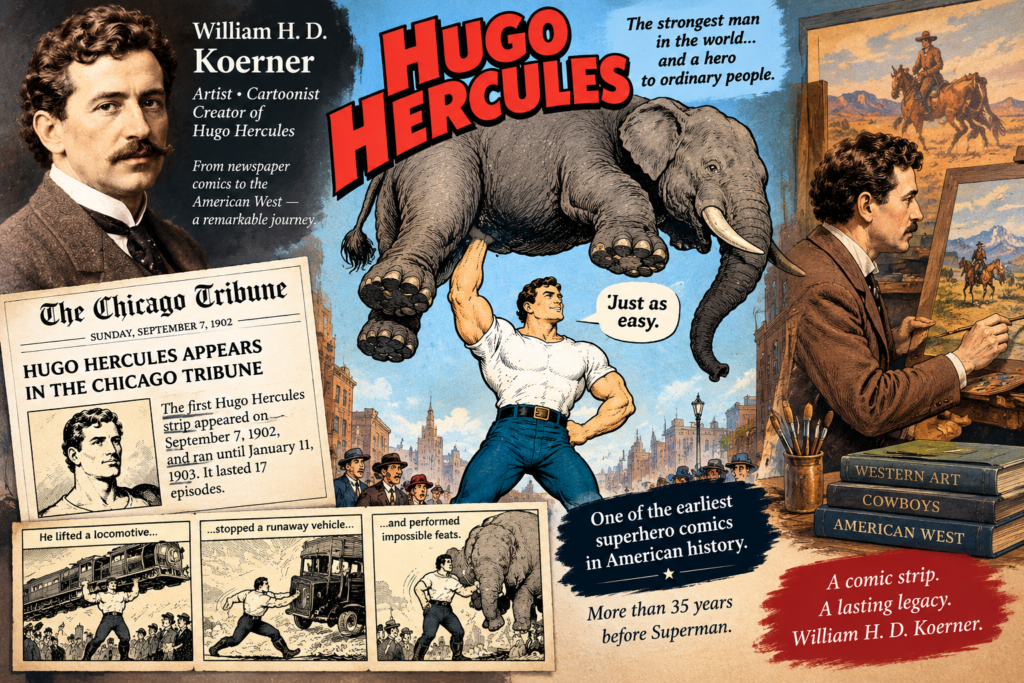
The first Hugo Hercules strip appeared in the Chicago Tribune on September 7, 1902.
The series continued until January 11, 1903, lasting roughly five months and producing seventeen strips.
Koerner both wrote and illustrated the strip.
Hugo was portrayed as a good-natured, extraordinarily powerful man who wandered around town helping people. His incredible physical abilities frequently shocked the people around him.
The opening adventure was titled “Hugo Hercules Obliges Beauty in Distress.” From the very beginning, the character was presented as someone who could intervene when ordinary people faced problems.
That basic idea would eventually become one of the defining principles of the superhero:
A person possesses extraordinary abilities—and uses them to help others.
A Man of Impossible Strength
Hugo’s strength was deliberately exaggerated.
He could perform feats that no ordinary human could accomplish.
In different adventures, he lifted enormous objects, performed astonishing physical feats and demonstrated strength on a spectacular scale.
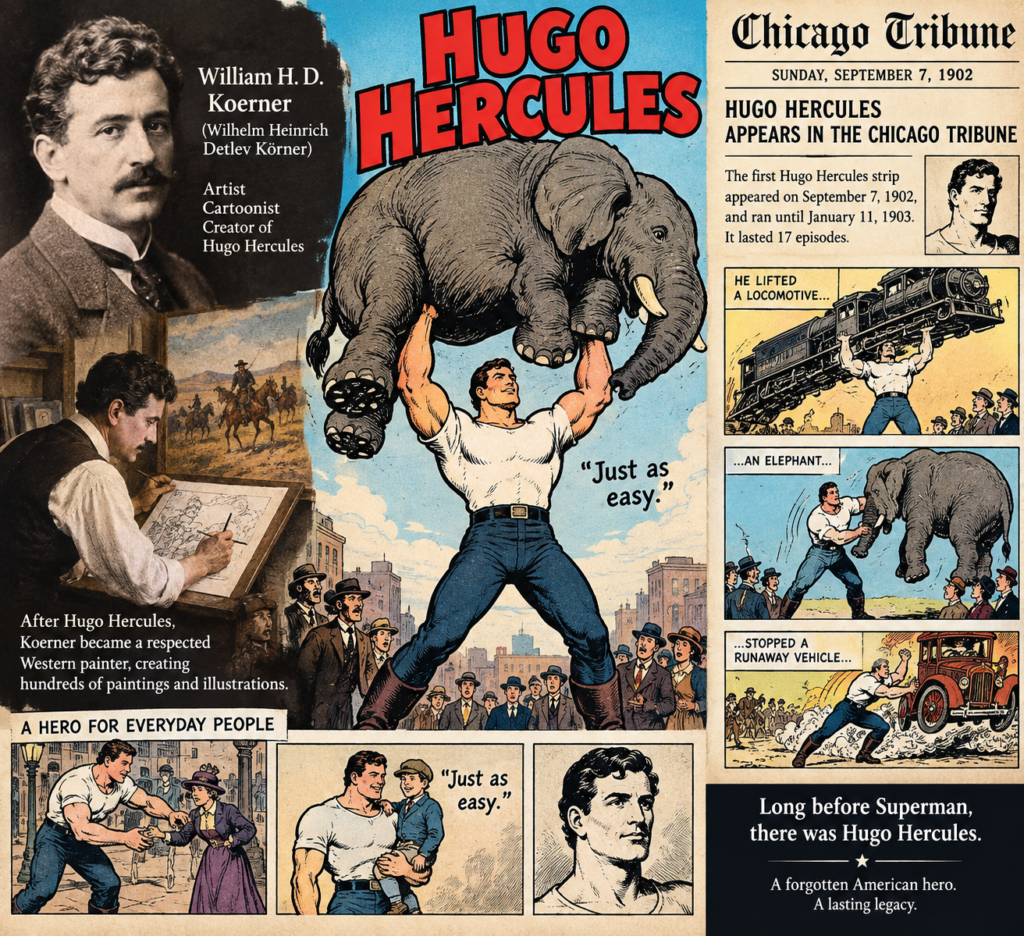
One famous episode presented Hugo lifting an elephant.
In another, he demonstrated extraordinary strength involving a locomotive.
He could even perform feats that transformed everyday objects into toys.
These weren’t meant to be realistic demonstrations of human athleticism.
They were visual jokes built around an impossible idea:
What if an ordinary-looking man possessed incredible strength?
That question would eventually become central to superhero storytelling.
“Just as Easy”
One of Hugo Hercules’s most memorable characteristics was his casual attitude toward his incredible abilities.
After performing an impossible feat, Hugo could essentially shrug it off as though nothing unusual had happened.
His recurring expression was:
“Just as easy.”
That attitude made Hugo different from the dramatic heroes that would appear decades later.
He wasn’t constantly explaining his powers.
He wasn’t terrified of them.
He simply possessed extraordinary strength and treated it as part of everyday life.
The contrast between Hugo’s enormous physical power and his relaxed personality created much of the humor in the strip.
Was Hugo Hercules Really the First Superhero?
This is where the story becomes especially interesting.
It would be tempting to say:
William H. D. Koerner invented the superhero in 1902.
But historians and comics scholars are more cautious.
The definition of “superhero” is complicated. There were fictional heroes and characters with extraordinary abilities long before 1902. Mythological figures such as Hercules had possessed superhuman abilities for thousands of years.
There were also characters in literature and popular entertainment who displayed unusual strength, courage or fantastic abilities.
So Hugo Hercules was not the first superhuman character in human storytelling.
But Hugo Hercules is extremely important because it brought several elements together in an early American comic-strip format.
Related Article
Charles R. Knight: The Man Who Brought Dinosaurs to Life
Hugo had:
– extraordinary physical power
– a recognizable recurring identity
– adventures built around his abilities
– a heroic relationship with ordinary people
– a continuing newspaper-strip presence
Because of this combination, scholars and historians frequently describe Hugo Hercules as an early superhero or superhero precursor. The Grand Comics Database, for example, describes it as being considered by some the earliest superhero comic.
A scholarly discussion in The Superhero Reader goes even further, describing Hugo Hercules as the first positive presentation of a heroic superman in comics.
So rather than saying that Koerner unquestionably invented the superhero, it is more accurate to say:
William H. D. Koerner helped establish one of the earliest recognizable superhero archetypes in American comics.
The Hero Without a Cape
One of the most fascinating things about Hugo is what he didn’t have.
There was no cape.
There was no mask.
There was no futuristic costume.
There was no secret headquarters.
There was no elaborate origin story explaining how Hugo obtained his powers.
And there was no supervillain waiting for him every week.
Instead, Hugo simply appeared as an extraordinarily powerful man living in the ordinary world.
This makes him look surprisingly modern in one sense and completely different from modern superheroes in another.
The modern superhero became strongly associated with costumes, secret identities, crime fighting and recurring villains.
Hugo existed before those conventions had fully developed.
He was essentially a super-powered newspaper hero before the superhero formula had been invented.
More Than Just Strength
Hugo’s adventures weren’t only about showing off. His strength could be used to solve problems. That distinction matters. A character who is simply powerful is not necessarily a superhero. The superhero concept usually involves extraordinary abilities combined with heroic or helpful behavior. Hugo repeatedly used his strength to assist people and overcome difficult situations.That is one reason his character remains important to comics historians.
His stories demonstrated an early version of a formula that would later become enormously successful:
ordinary world + extraordinary man + impossible problem + heroic solution.
Decades later, this formula would become the foundation of an entire entertainment industry.
Why Hugo Hercules Disappeared
Despite its historical importance, Hugo Hercules did not become a lasting success. The strip ended on January 11, 1903, after only seventeen installments. There was no long-running Hugo Hercules franchise. There were no decades of newspaper adventures. There was no Hugo Hercules movie empire.
The character essentially disappeared.
And that makes the story even more remarkable.
One of the earliest superhero-like characters in American comics arrived, disappeared and was largely forgotten while the genre that he anticipated was still waiting to be born.
More than three decades later, Superman would arrive and transform the idea of the superhero forever.
William H. D. Koerner
The man behind Hugo Hercules deserves attention in his own right. William H. D. Koerner was not destined to remain only a newspaper cartoonist. After the short run of Hugo Hercules, Koerner moved toward illustration and eventually became known especially for his Western art. His later career was very different from his work on Hugo Hercules. He produced illustrations and paintings depicting the American West, cowboys, Native American subjects, landscapes and frontier life. His artistic career eventually became much more significant than the brief newspaper strip that brought Hugo Hercules into existence.
In other words, Koerner’s story is not simply the story of a forgotten comic-book creator. It is the story of an artist who experimented with an entirely new type of popular character before moving into another field of American visual culture.
From Hugo Hercules to Superman
The distance between Hugo Hercules and Superman is more than thirty-five years.
Yet the connection is fascinating.
Hugo appeared in 1902.
Superman appeared in 1938.
Between them, popular culture continued experimenting with strongmen, adventurers, detectives, masked heroes, science-fiction characters and pulp protagonists.
Gradually, the superhero formula developed.
The hero became more visually distinctive.
Costumes became important.
Secret identities became important.
Villains became recurring characters.
Origin stories became more elaborate.
Powers became more diverse.
And eventually, the superhero became one of America’s most recognizable cultural creations.
Hugo Hercules was not Superman.
But he belonged to the early history of the idea.He was an important step along a road that eventually led to the modern superhero.
A Forgotten American Pioneer
History often remembers the people who create successful industries but forgets the people who experimented before the industry existed. William H. D. Koerner belongs in that second category. His Hugo Hercules strip lasted only a few months. Yet the character contained an idea that would become enormously powerful. A man with abilities far beyond those of ordinary humans could enter the everyday world and use his extraordinary strength to help people. That sounds familiar because modern popular culture has repeated the idea thousands of times. But in 1902, the concept was still young. Koerner was experimenting with it in an American newspaper.
Why Hugo Hercules Matters Today
Looking back from the age of Marvel and DC, it is easy to underestimate how revolutionary these early experiments were. Today’s audiences are accustomed to superheroes. Superheroes appear in movies, television programs, video games, comic books, toys and merchandise around the world.
But none of that existed in 1902.
There was no established superhero industry.
There was no standard superhero costume.
There was no shared superhero universe.
There was simply an artist with an unusual idea.
William H. D. Koerner created a man whose strength was almost limitless and placed him in ordinary American life.
The result was Hugo Hercules.
The strip was short-lived.
Its creator eventually moved on.
But the idea survived.
The Forgotten Man Before the Superheroes
Perhaps the most remarkable part of Koerner’s story is that he did not receive the kind of fame later superhero creators would receive. The names of Superman’s creators, Jerry Siegel and Joe Shuster, became permanently connected with superhero history. Stan Lee and Jack Kirby became legendary figures of the Marvel era. Bob Kane and Bill Finger became associated with Batman. But decades before many of those names became famous, William H. D. Koerner had already placed a super-powered hero into an American newspaper. His creation didn’t conquer the world. It didn’t create a massive franchise. But it helped demonstrate what comics could do.
The Birth of an Idea
The birth of the superhero was not a single moment.
It was a long evolution.
Mythology supplied the superhuman.
Literature supplied the hero.
Pulp fiction supplied adventure.
Newspapers supplied the comic strip.
Artists experimented with extraordinary characters.
And eventually, all of those influences came together to create the modern superhero.
Hugo Hercules stands near the beginning of that journey.
He was strong enough to lift impossible objects.
He could solve problems ordinary people could not.
And he treated his incredible abilities as though they were completely normal.
Most importantly, he appeared in an American comic strip in 1902, decades before the superhero became a dominant form of popular entertainment.
William H. D. Koerner may not have known that he was helping to establish a new genre.
He was simply creating a comic.
But sometimes history works that way.
An artist creates something for the readers of his own time—and decades later, people discover that his idea was pointing toward the future.
Before Superman. Before Batman. Before Marvel’s heroes. There was Hugo Hercules.
And behind Hugo stood William H. D. Koerner, an almost forgotten American artist who helped give the superhero one of its earliest forms.

Post Comment